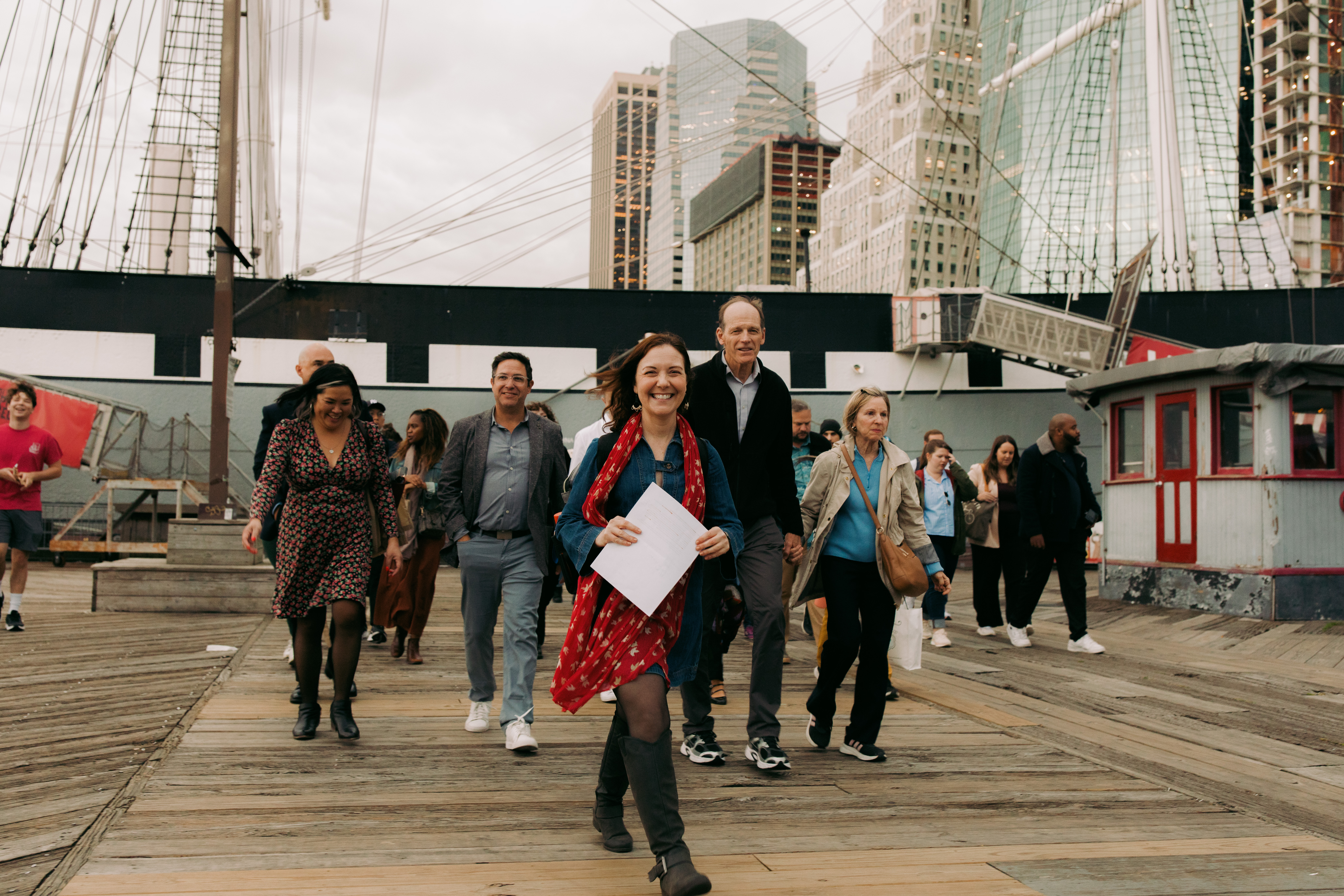
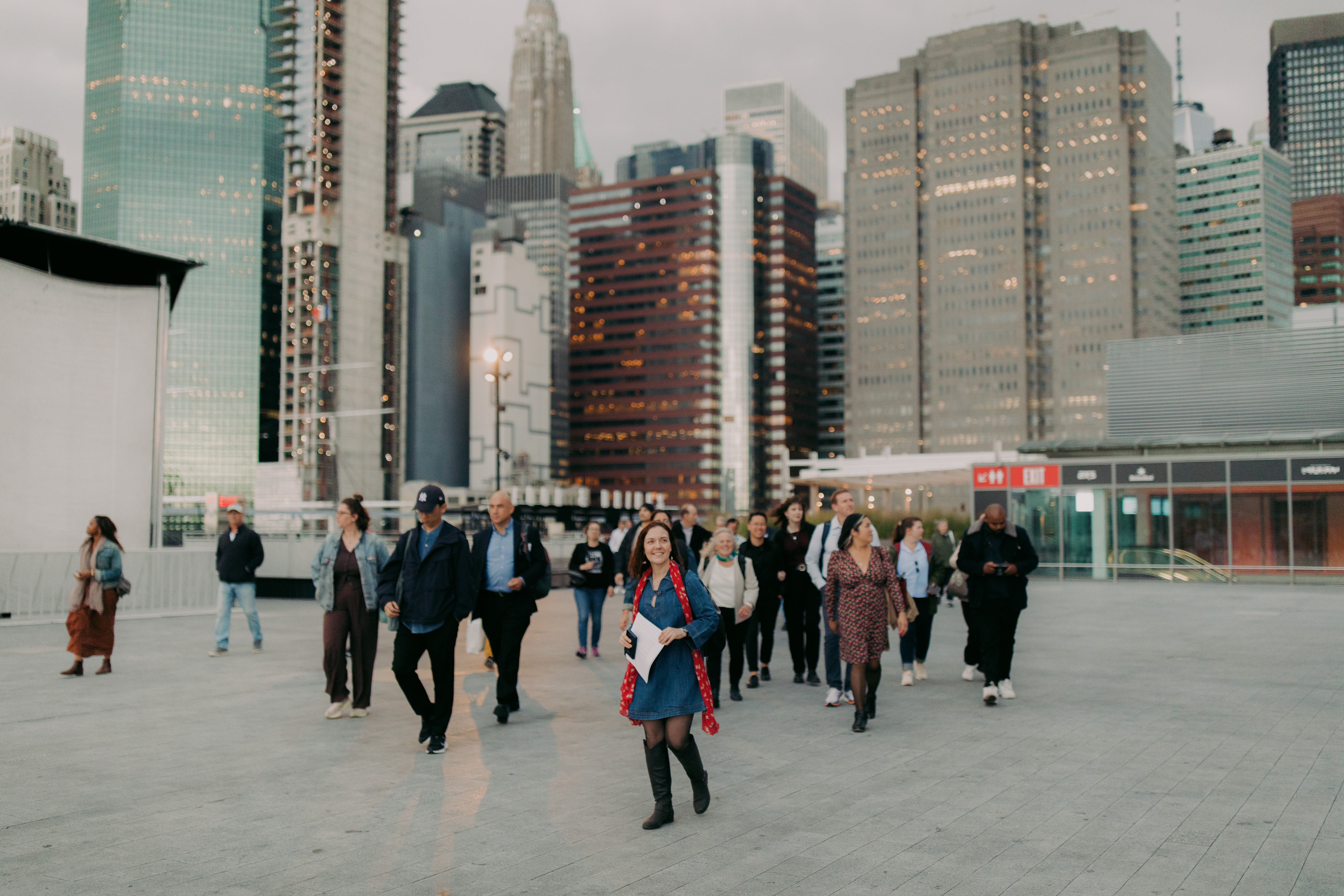
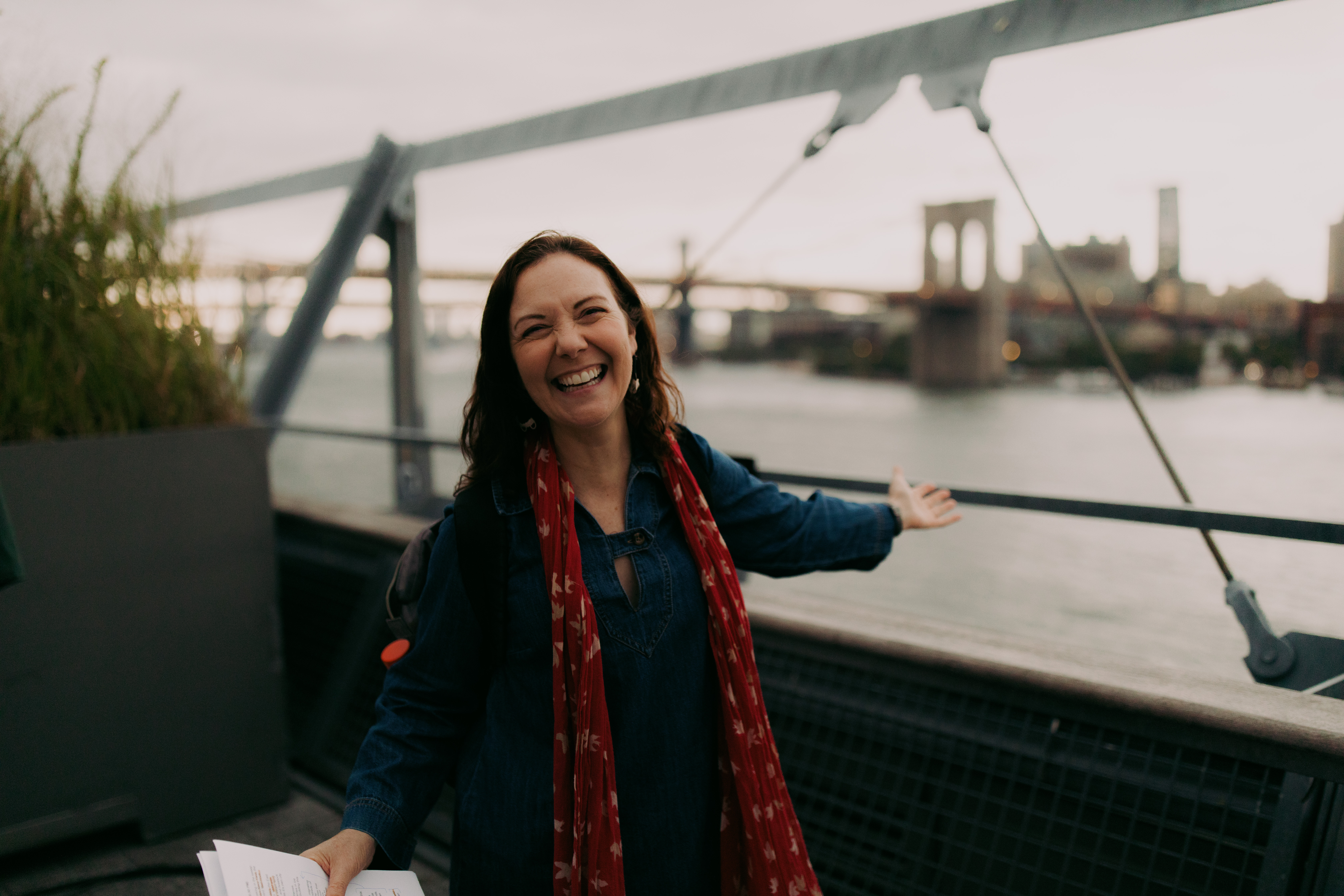
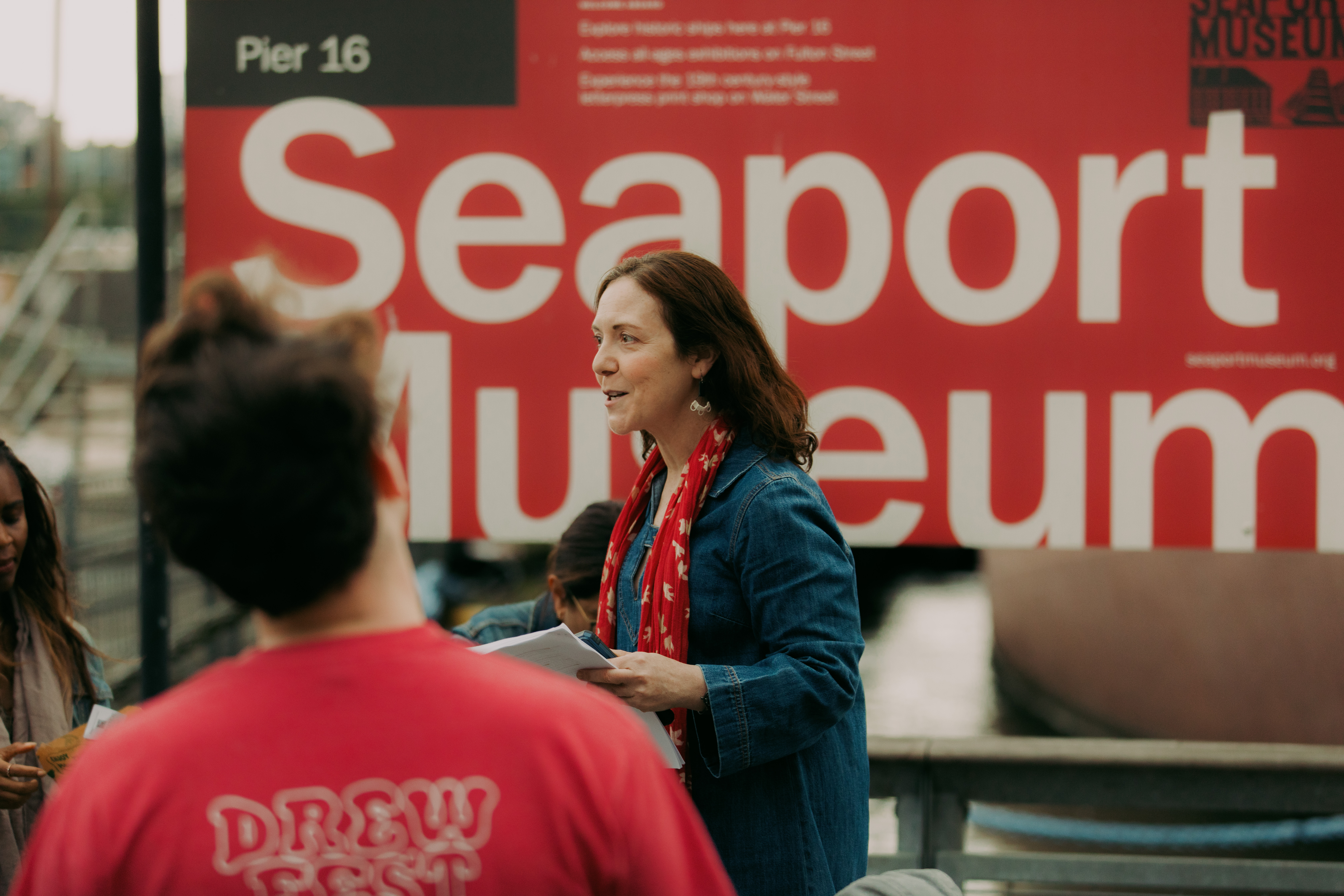
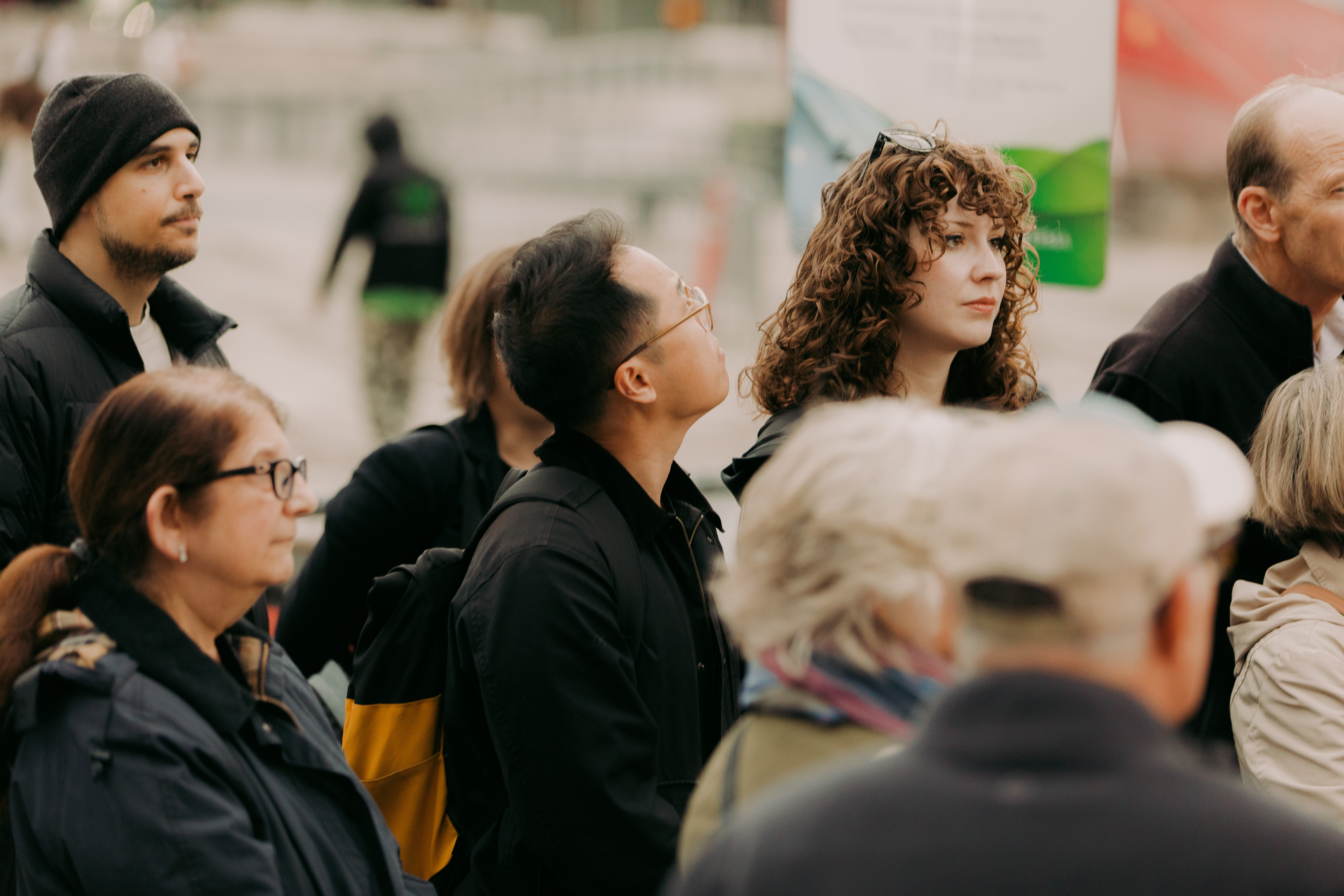
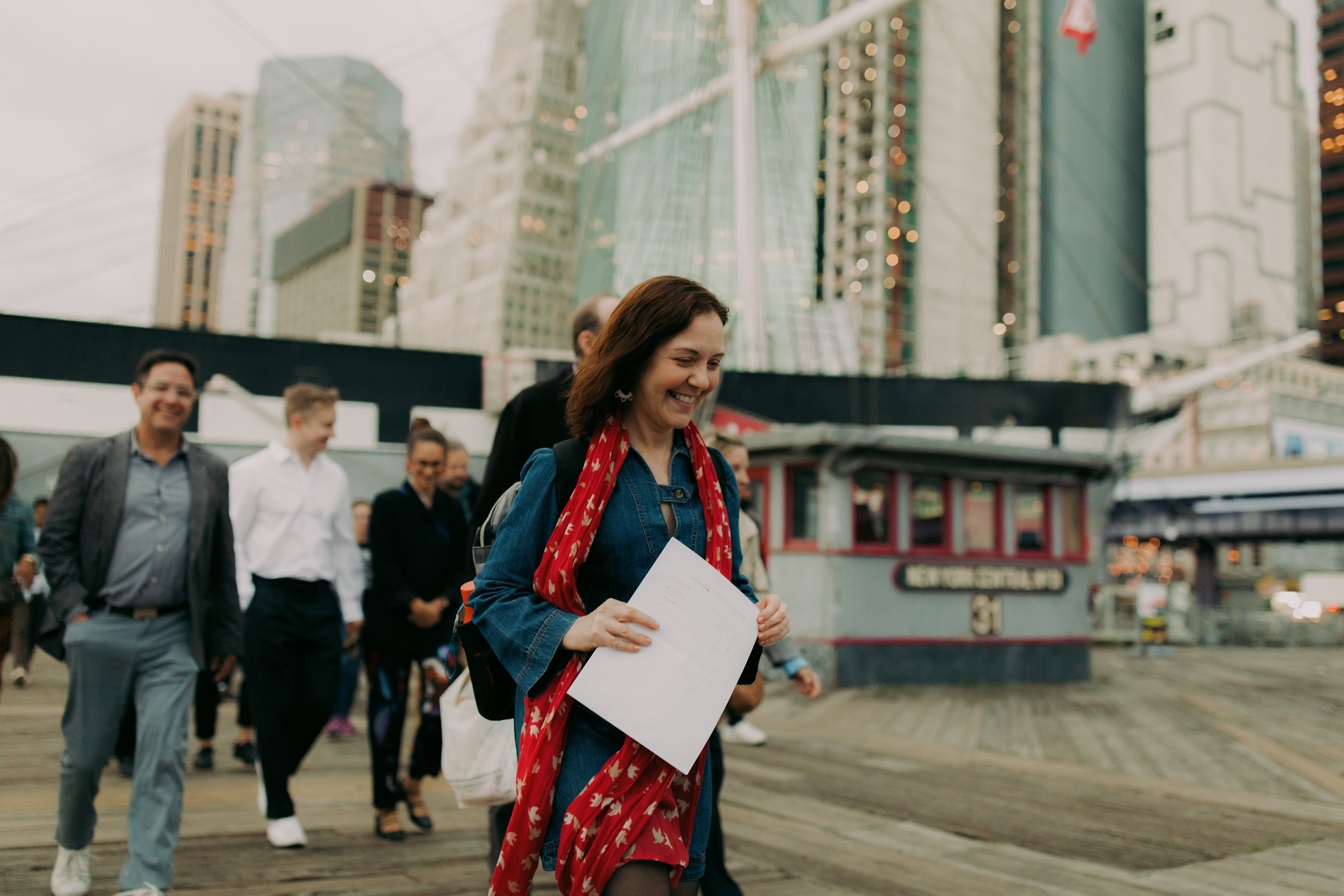
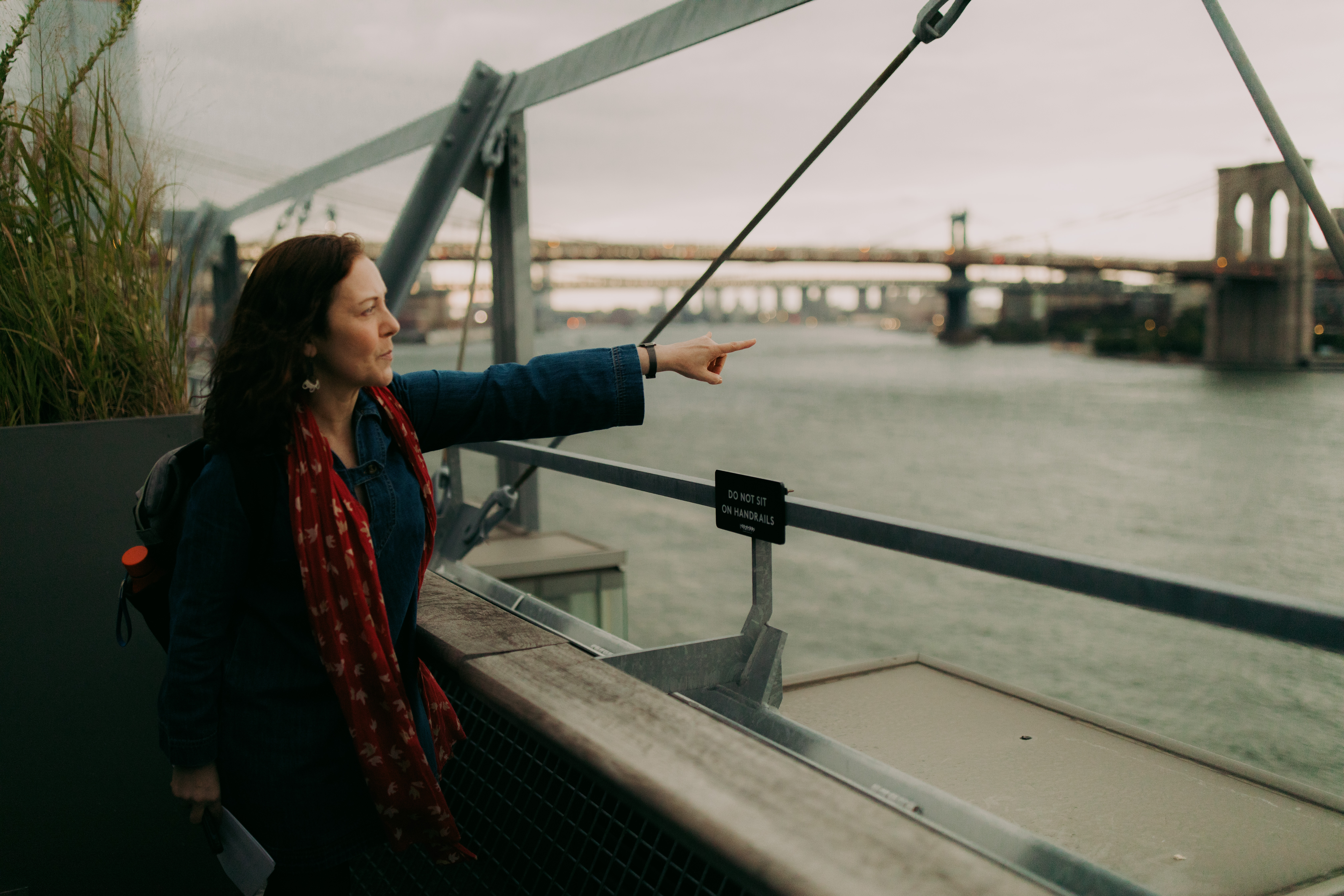
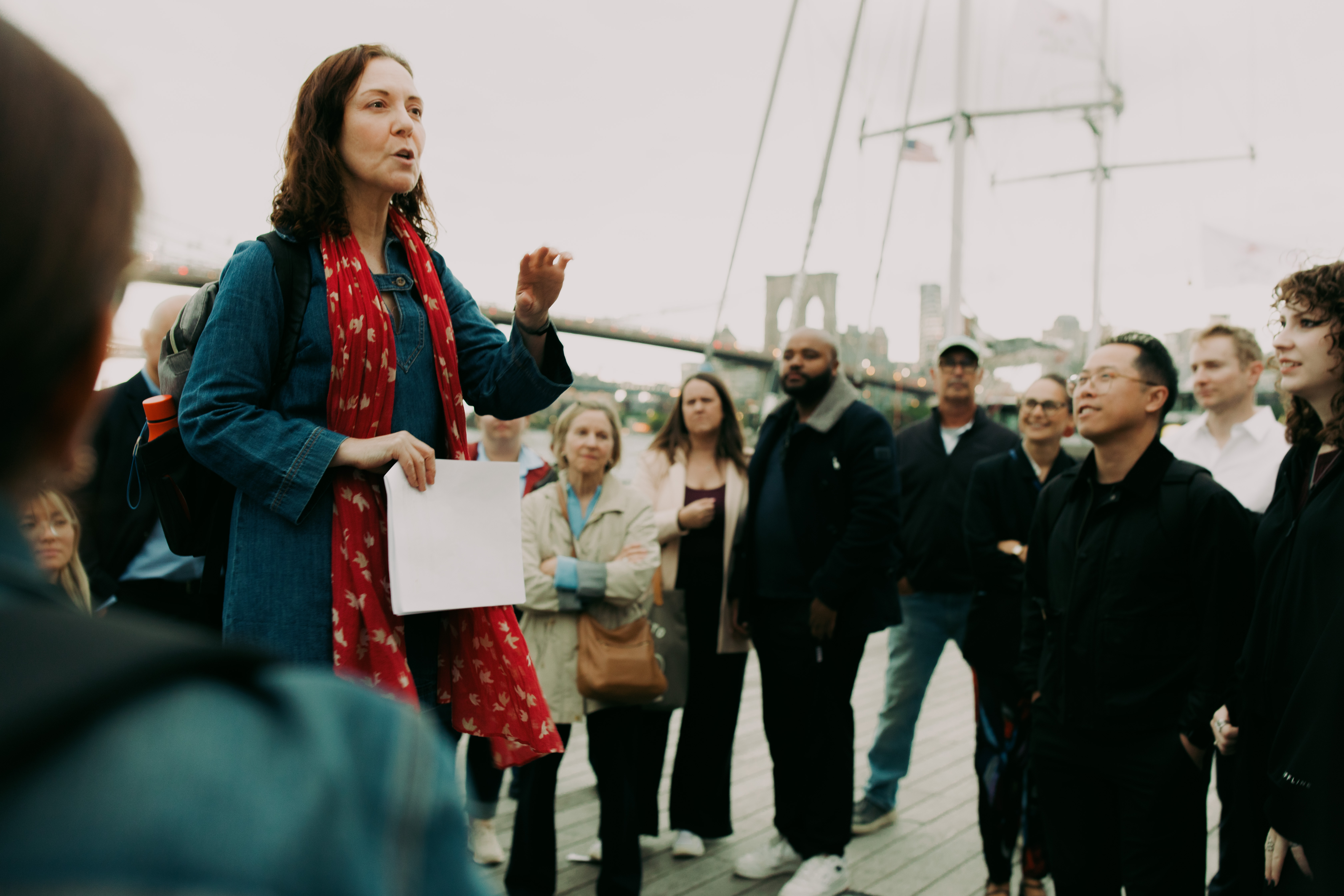
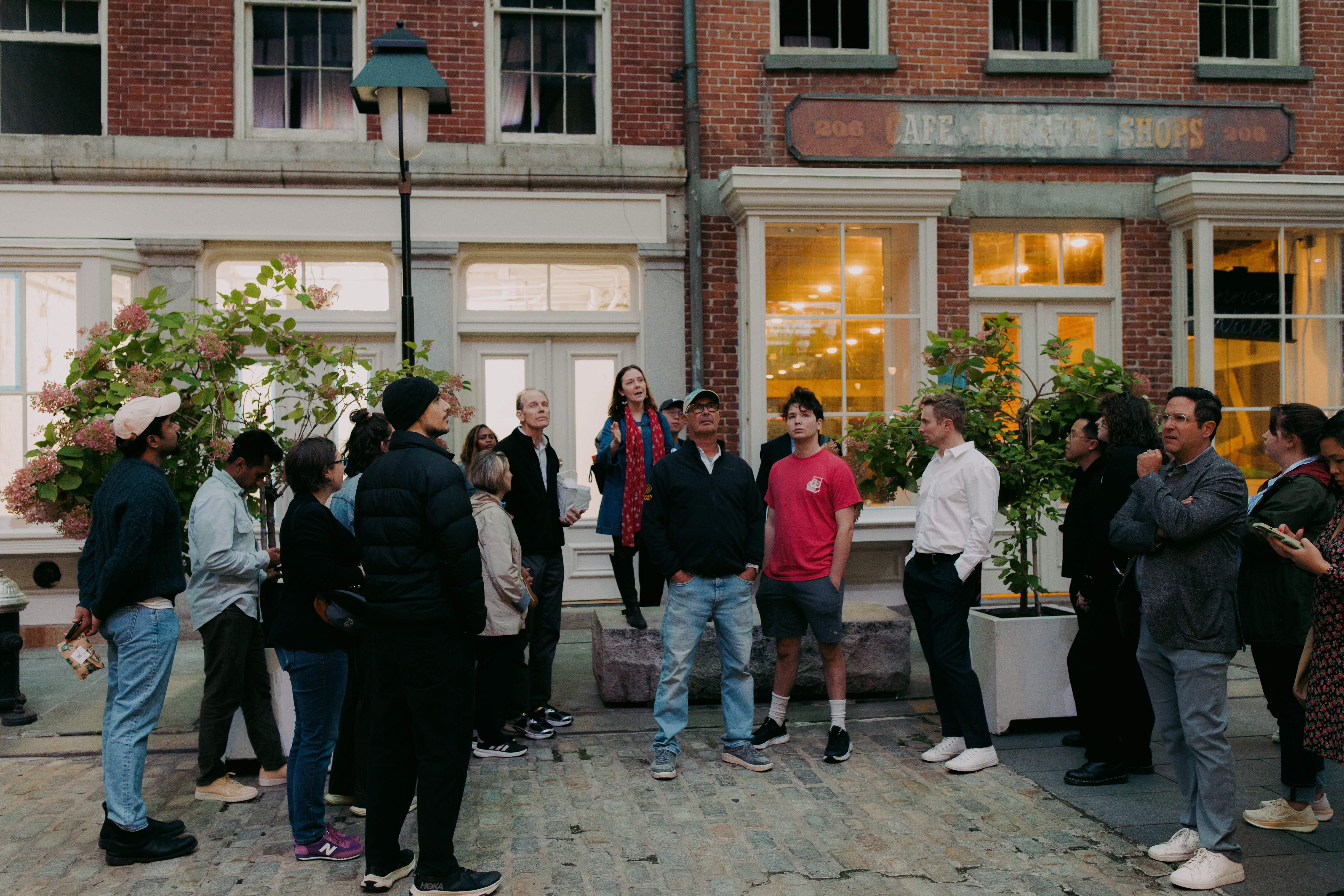
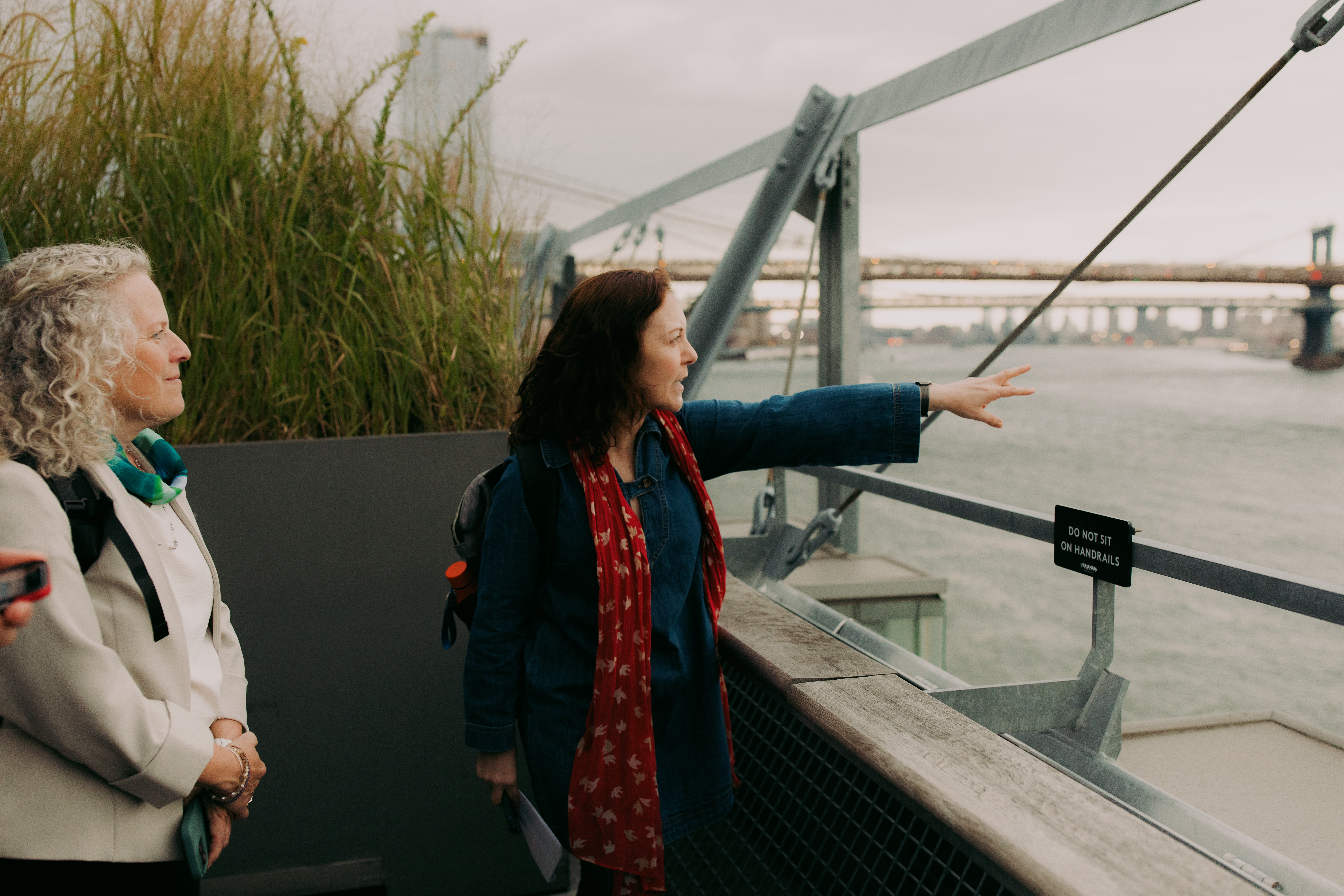
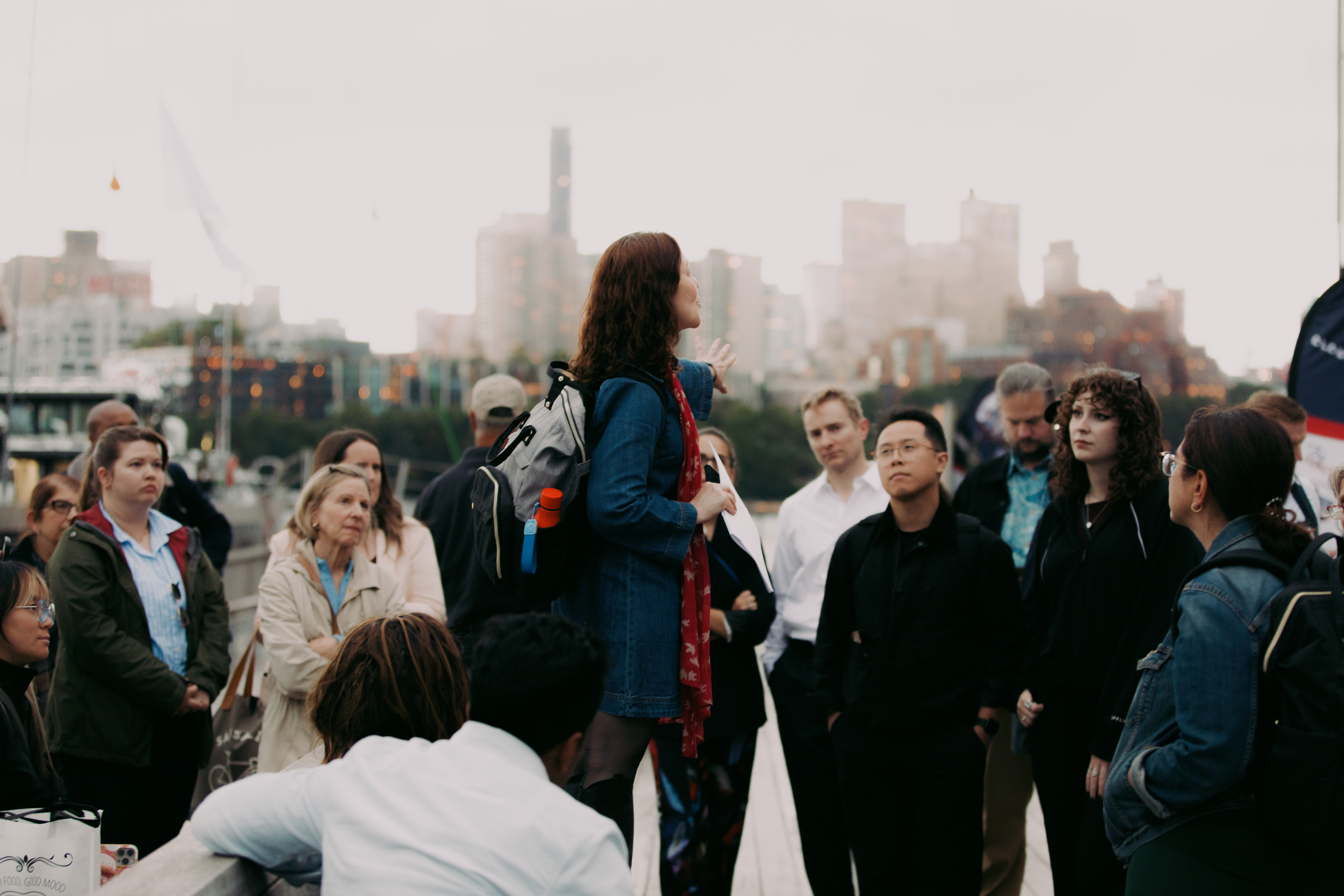
Me leading our tour group. Photo by Shannon Carroll.
This is me in my happy place: sharing stories about New York City’s secret past, weaving together narratives about food, nature, and people. My second official Climate Week NYC event was a huge success!
On Tuesday evening, we gathered at South Street Seaport for the NYC’s Secrets & Lies walking tour, Sunken Suppers & Coastal Secrets, as part of Climate Week NYC. Together, we walked through centuries of changing coastlines—from ancient oyster reefs that once buffered this harbor against storm surges to colonial wharves, historic street markets, and the nature-based solutions along the water that are reimagining and rebuilding coastal resilience today.
A huge thank you to the 44 people who bought tickets. You are all stars with insightful questions, boundless curiosity, and great energy for the entire evening.
Tremendous gratitude to photographer Shannon Carroll for capturing the spirit of our group so brilliantly throughout the evening, and to Climate Group for sending Shannon to photograph our event, all the support you gave to us, and an incredible week. 🙏
Where should we take our secret history stories next? 🌊🦪
All photos by Shannon Carroll for Climate Week NYC
Fraunces Tavern in NYC. Photo by Christa Avampato.
When global leaders, researchers, climate advocates, scientists, and business managers gather across New York City for Climate Week NYC 2026 next week, the conversations will often hover at 30,000 feet. We will hear about carbon offsets, macroeconomic shifts, and international energy policy, as well as companies talking (often in broad strokes) about their actions and programs.
Those high-level summits matter. Yet climate resilience does not start in a boardroom—it lives under our feet, in the streets we navigate daily, and along the shorelines that shape our city.
Long before seawalls and modern bulkheads defined Lower Manhattan, this shoreline functioned as a dynamic, edible ecosystem. Oysters the size of dinner plates stabilized storm surges, tidal wetlands cushioned the coast, and maritime markets fed a growing metropolis straight from local waters and busy sidewalks. The street names we walk every day—Water Street, Pearl Street, Front Street—trace the literal history of how New Yorkers continually pushed soil into the harbor, reshaping the edges of New York’s islands while distancing ourselves from the natural systems that sustained us to make us the city we are today.
Looking at climate adaptation through the lens of history changes how we view resilience:
Rediscovering Living Infrastructure: Oysters and salt marshes were never just food sources; they were natural breakwaters. Rebuilding living shorelines today is not a new invention—it is a return to an ecological equilibrium that protected these New York islands for centuries.
Understanding What Lies Beneath: When we walk Lower Manhattan, we are standing on layers of ballast stones, discarded oyster shells, historic timber, and sunken treasure. Knowing how past generations transformed the coast helps us understand why these same neighborhoods flood today during severe storms.
Reconnecting Food to Place: A resilient city requires a resilient food web. Examining how New York historically fed itself from surrounding estuaries reveals the urgent need to protect regional waterways, support local fisheries and food-based businesses, and eliminate pollution in our waters, as well as our air and soil.
Join the Walk
We already have a great crowd who’s bought tickets, but a handful of spots remain for those who want to step out of the conference rooms and experience Climate Week NYC from the street level with me.
We will walk the historic paths of Lower Manhattan around the South Street Seaport, examine how colonial maritime trade shaped our physical geography, and discuss how community-driven ecological repair can protect our coastal neighborhoods like this one from rising tides and storms.
Whether you join in person or follow along from afar, reconnecting with the historical geography of your own neighborhood is one of the most powerful ways to ground climate action in reality.
The Togetherhood Takeaway
You don’t need to attend an international summit to build a climate mindset. You can start by observing how your own neighborhood interacts with the living world.
Find What Existed Before Modern Infrastructure: Look up historical topographic maps of your neighborhood (such as the Welikia Project for NYC) or check out exhibits at your local museums. Notice where streams, marshes, and natural shorelines once flowed beneath modern pavement. That historical geography often predicts where water pools during heavy downpours today and opens up our imaginations to what we may be able to restore so that all living beings thrive.
Support Nature Restoration: Back grassroots organizations working directly in your neighborhood. In NYC, we have quite a few including the Billion Oyster Project, local riverkeeper groups, and Natural Areas Conservancy. Restoring native habitats builds long-term natural buffers against storm damage and climate resiliency.
Walk with Curiosity: Take an hour this week to walk your neighborhood with fresh eyes. Notice where rainwater drains, how trees and vegetation exist alongside human-made infrastructure, and your wildlife neighbors.
Next week, I will be sharing a full recap from my walking tour, along with dispatches, field notes, and ideas gathered from events across Climate Week NYC that I’ve attended.
When we think about building sustainable cities, our focus often turns to what we should eliminate such as single-use plastics and gas-fueled appliances. What if the future of urban resilience isn’t only about reducing what we consume, but actively reimagining what we discard?
Right now, food waste represents one of the largest systemic challenges in our urban ecosystems. When organic scraps end up in landfills, they decompose anaerobically and release methane, a greenhouse gas significantly more potent than carbon dioxide. Then there’s also the matter of all the resources such as land, water, and labor that were used to create the wasted food. At the same time, our construction sector relies heavily on carbon-intensive, extractive materials like traditional concrete.
A team of designers and researchers from my undergrad alma mater, the University of Pennsylvania, decided to connect food waste with the needs of construction industry into a single, elegant solution. Their project asks a radical question: What if yesterday’s citrus peels and coffee grounds could become building materials?
The Science of Circular Construction
The project, emerging from Penn’s Weitzman School of Design, transforms discarded organic waste into durable, biodegradable building pavers.
Here is how this circular process works:
Harnessing Natural Binders: Instead of relying on energy-intensive synthetic polymers or Portland cement, the team extracts natural binders from citrus rinds and other fruit scraps. Pectin and cellulose fibers create structural bonds naturally when processed correctly.
Low-Carbon Fabrication: The mixture of shredded organic waste and natural binders cures with minimal heat and pressure compared to standard concrete manufacturing, dramatically slashing embedded carbon emissions.
Load-Bearing Utility: The resulting pavers are strong enough for outdoor walking paths, patio spaces, and urban gardens, providing a functional alternative to conventional masonry.
Return to the Soil: Unlike concrete—which remains rubble forever—these biomaterial pavers can eventually degrade naturally at the end of their lifecycle, returning nutrients back to the earth without shedding toxic microplastics or chemicals.
Rethinking Waste as a Resource Stream
What makes this project so compelling for community agency is its local potential. We don’t need exotic, imported materials to create sustainable infrastructure. Every neighborhood already produces tons of organic matter every single day through local coffee shops, juice bars, grocery stores, and home kitchens.
By viewing our urban waste streams as raw material pipelines, we can decentralize manufacturing, reduce municipal hauling costs, and create localized economies that turn kitchen trash into civic assets.
The Togetherhood Takeaway
Resilience means closing the loops in our daily lives and recognizing the hidden structural value in the things we throw away.
Audit Your Household Waste Stream: Look at your kitchen trash this week. How much of what you throw away is organic matter that could be composted or repurposed? Supporting municipal compost programs keeps organic material out of landfills where it causes the most damage.
Champion Circular Procurement: In your workplace or local community projects, advocate for bio-based and circular materials. Whether choosing reclaimed wood, mushroom packaging, or bio-composite tiles, prioritize products designed with their end-of-life in mind.
Support Student & University Innovation: Breakthroughs in urban sustainability often start in university design labs. Follow and amplify the work of interdisciplinary research hubs working on biomaterials, circular textiles, and regenerative architecture.
The materials to build a greener world are already in our hands—and in our compost bins. When we learn to design with nature rather than against it, our cities become cleaner and healthier.
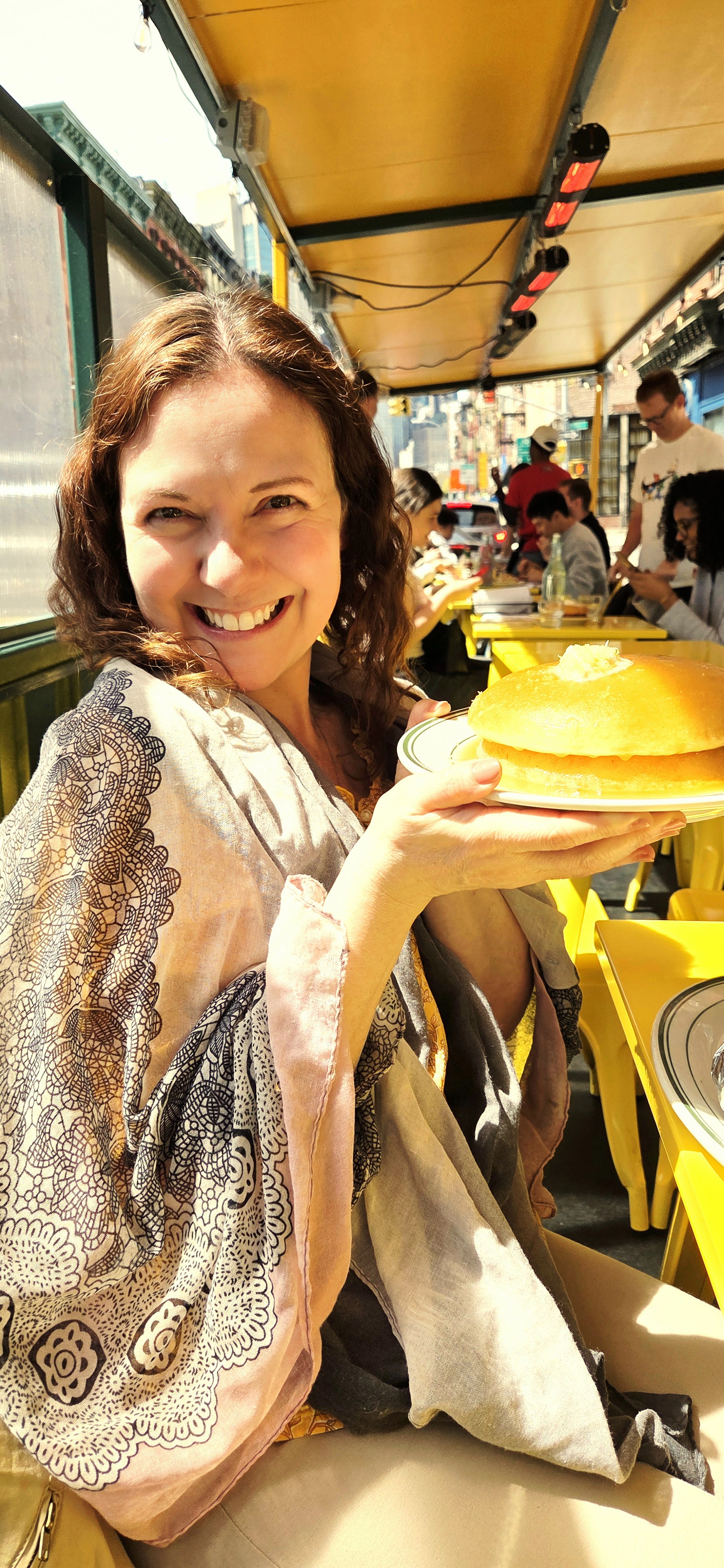
Me smiling with a plate of Golden Diner’s famous pancakes
I see myself as an amateur cook and baker, and a professional eater. I’m always hungry for something delicious. I also love that other than a recipe I may have on my phone (though I love cookbooks – I read them like novels!), cooking and baking are completely analog, tactile activities. No screens. No chatter. Lots of experimenting. No matter how well I know a recipe, making it never unfolds exactly the same way twice (at least not for me!)
I don’t like shopping. At all. Except for grocery shopping. Picking out and trying on clothes. Ugh. Not at all interested. Picking out produce, spice blends, cheeses. Sign me up for all of that. I get giddy as I head home with my grocery bags knowing they are full of potential to bring me joy.
There’s something magical and poetic about taking a bunch of separate ingredients and combining them to make something greater than the sum of its parts. I love the science, art, and sprinkle of luck that’s involved in cooking and baking.
Because I’m an adventurous eater, I’m also an adventurous cook and baker. I love to try making a cuisine that’s not in my wheelhouse. I love cracking into a recipe that I’ve never made before. I like to stretch my techniques, trying to make something that feels just beyond my skill set. Like all adventures, there will be some mishaps. Sometimes, I’ll mess up, make a mess, or burn something.
The other day I made something that was *truly* awful. I tossed it right into the compost, which crushed my heart a bit because it felt like a waste of time and I hate food waste. It makes me hangry to make something terrible, but that’s part of the process of an analog activity.
Sometimes I’ll completely surprise myself with how good something is. I’ll master a technique that I’ve worked hard to fully understand and execute. That makes me feel like a wizard, confident in my abilities and happy with a full belly.
When perfecting a recipe, I have to try and try again to get it just right and to get a result I’m consistently happy with. And there’s something to be said for that. Yes, the reward of something perfectly cooked or baked is a thing of beauty. But there’s also so much reward in the process itself from the planning and research, to shopping, to being in my kitchen and then at my dining table. I even like the washing up afterwards.
On my bucket list is a cooking vacation where the entire point of the trip is to take cooking classes, go to food markets, and visit farms, restaurants, and food businesses. Food is so full of everything I love – culture, history, and stories. Always stories. And to me, that sounds like an ideal way to spend my time.
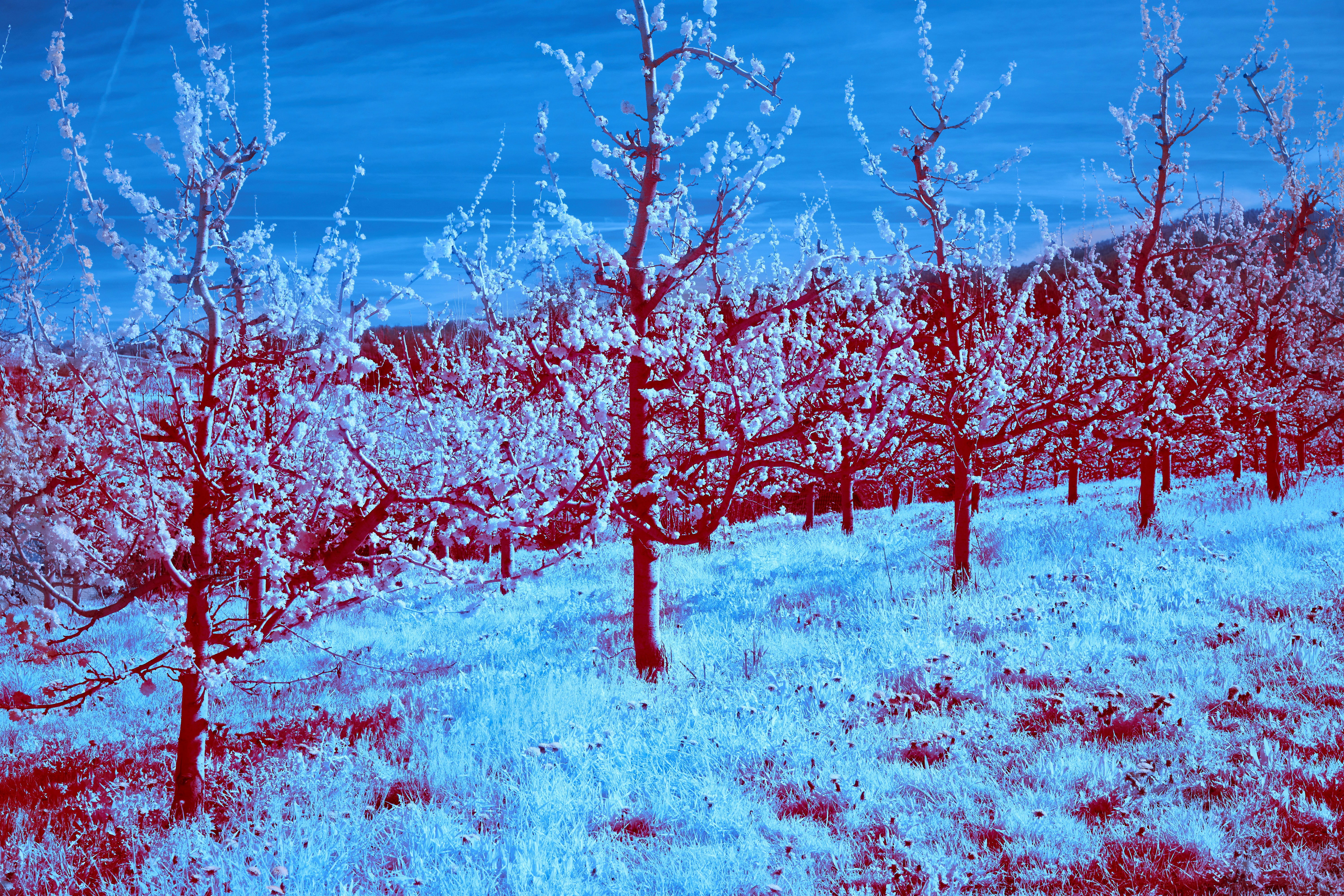
We feel guilty for being tired in January. But for apple trees, squirrels, and bears doing nothing is the most productive thing they do all year.
I grew up on an apple farm in New York State’s Hudson Valley.
Because of that, my relationship with winter is a little different than most. To the casual observer, an apple orchard in January looks unproductive. The branches are bare, the ground is frozen, and it appears that nothing is happening.
But if you ask a farmer, they’ll tell you January is one of the most critical months of the year. It’s the month that decides the harvest.
We have a tendency in our culture to treat rest as a sign of weakness—or at best, a reward you get only after you’ve burned out. But nature has a different rulebook. She doesn’t ask herself to earn her rest. In the wild, winter isn’t a pause button; it’s an active biological process of repair.
If you’re feeling slow, foggy, or tired this week, I have good news: there’s nothing wrong with you. In fact, you’re doing everything right according to nature. You are just wintering.
Here are three examples of how nature uses the cold to build the future—and how we can adopt a few pages of her playbook.
1. The Apple Tree: Counting the Cold
On the farm, nature and farmers alike live by a concept called “Chill Hours.”
We tend to think trees just “shut off” when the temperature drops. In reality, they’re actively counting. Apple trees have a strict biological requirement to endure a specific number of hours (usually 800 to 1,000) between 32° and 45°F (0° and 7°C.)
If they don’t get those hours—if the winter is too warm or too short—the hormone that suppresses blooming won’t break down. They literally cannot produce fruit in the spring unless they have rested enough in the winter.
The lesson? The productivity of the harvest is biologically impossible without the stillness of the winter. You aren’t losing time by resting; you’re banking your Chill Hours for when the light and warmth of spring return.
2. The Arctic Ground Squirrel: Renovating the Brain
If you’ve felt a bit of “brain fog” lately, you’re in good company.
When the Arctic Ground Squirrel hibernates, their body temperature drops below freezing, and they essentially disconnects their neural pathways. Their brain synapses wither and retract—like pruning a tree—to save energy.
This sounds destructive, but it’s actually a renovation. Research shows that when they wake up, their brains undergo a massive “regrowth” phase. They regenerate those connections stronger and more efficient than before, similar to how muscle fibers when broken down by exercise knit themselves back together when we rest to become stronger.
The brain fog isn’t a failure; it’s a remodel. Sometimes the brain needs to disconnect to clear the clutter and build new pathways for the year ahead.
3. The Black Bear: The Miracle Healers
Finally, there’s the bear. We know they enter a deep sleep in the winter, but what happens while they sleep is the real miracle.
Research from the University of Minnesota found a stunning capability in hibernating black bears: they are super-healers. If a bear goes into hibernation with a wound, the bear will heal faster and with less scarring during their dormant state than they would during the active summer months.
Even with a metabolism running at a fraction of normal speed, their immune system shifts into a specialized repair mode.
It’s a powerful reminder: We heal best when we rest.
A Permission Slip for January
If nature—in all her wisdom and efficiency—requires a season of dormancy to prepare for fruit, rewire the brain, and heal wounds, why do we think we are exempt? Why do we insist on pushing through when what we really need is the sleep and rest that will help us be better versions of ourselves in the long-run? Sleep and rest are powerful tools. Use them. Appreciate them. Luxuriate in them. Your future self will thank you.
So, if you’re struggling to get into high gear this winter, stop. Take a nap. Read a book. Laugh with friends. Eat nourishing food. Breathe. Let the ground freeze knowing you’re giving yourself your necessary Chill Hours. Spring will be here soon enough. Don’t rush it. Rest.
Sugar kelp can grow in the waters around NYC, and thrives during the cold winter months
I recently read a fascinating piece in Smithsonian Magazine about the “underwater forests” returning to life off the coast of California. It details the restoration of Giant Kelp—towering, 100-foot strands that form cathedrals of biodiversity, sequester carbon, and shelter marine life.
It’s an inspiring success story of ecological recovery. But as I read about the Chumash people and marine biologists working together in the Pacific, I couldn’t help but ask a question closer to home: Could we apply this to the waters of New York City?
The answer is a resounding yes—but it looks a little different here. And it’s already beginning.
Different Coast, Different Kelp
In California, the focus is on restoration: bringing back wild Giant Kelp forests that have been decimated by urchins and climate change.
In New York and the broader Northeast, our opportunity lies in regenerative ocean farming. We don’t have the deep-water Giant Kelp; we have Sugar Kelp (Saccharina latissima). This golden-brown algae is shorter, but it is a powerhouse. It thrives in our cold winter waters—growing rapidly when most marine life is dormant—and acts as a “scrubbing brush” for our harbors.
Sugar Kelp absorbs carbon dioxide (fighting ocean acidification) and, crucially for NYC, it soaks up excess nitrogen from urban runoff, which is the main driver of harmful algae blooms.
We aren’t just “restoring” nature here; we are building a blue economy. Here are the local pioneers turning this idea into reality right now.
1. The Indigenous Lead: Shinnecock Kelp Farmers
Just as the Chumash people are leading efforts in California, the Shinnecock Indian Nation is leading the way on Long Island. The Shinnecock Kelp Farmers are a multi-generational collective of Indigenous women leveraging thousands of years of traditional ecological knowledge to heal the water.
They have established the first Indigenous-owned kelp farm on the East Coast in Shinnecock Bay. Their work proves that kelp isn’t just a crop; it’s a tool for sovereignty and survival, actively filtering the waters that sustain their community.
2. The Science: It Works in the East River
You might think kelp needs pristine, open ocean to survive. Think again.
Researchers Dr. Christopher Gobler and Mike Doall from Stony Brook University have been running pilot studies to see if kelp could survive the urban waters of the East River. The results were surprising: the kelp didn’t just survive; in some cases, it grew better in the nutrient-rich waters of the harbor than in cleaner, deeper waters. This suggests that NYC’s “working waterfront” could double as a biological filtration system.
3. The Pioneers: Breaking the Regulatory Barrier
The technology exists, but the permits have been the hard part. The industry is so new that New York State didn’t have a regulatory framework for it until very recently.
In 2023, Violet Cove Oyster Co., led by former WNBA star Susan Wicks, secured the first-ever commercial permit to grow kelp in New York state waters (Moriches Bay). It took years of advocacy to get there. Her success paves the way for oyster farmers across the region to become “multitrophic” farmers—growing shellfish and seaweed together to maximize the environmental benefit.
The Vision for a “Blue” NYC
Organizations like GreenWave are already training the next generation of ocean farmers, with a goal of creating thousands of jobs. Imagine a future where the New York harbor isn’t just a transit lane for ferries and cargo, but a grid of regenerative farms.
These farms would provide local food, sustainable fertilizer, and bioplastics, all while cleaning the water and capturing carbon.
California’s underwater forests are a reminder of nature’s resilience. NYC’s underwater farms could be a testament to our innovation. The seeds (or rather, the spores) have been planted. Now, we just need to support the regulations and organizations that will let them grow.
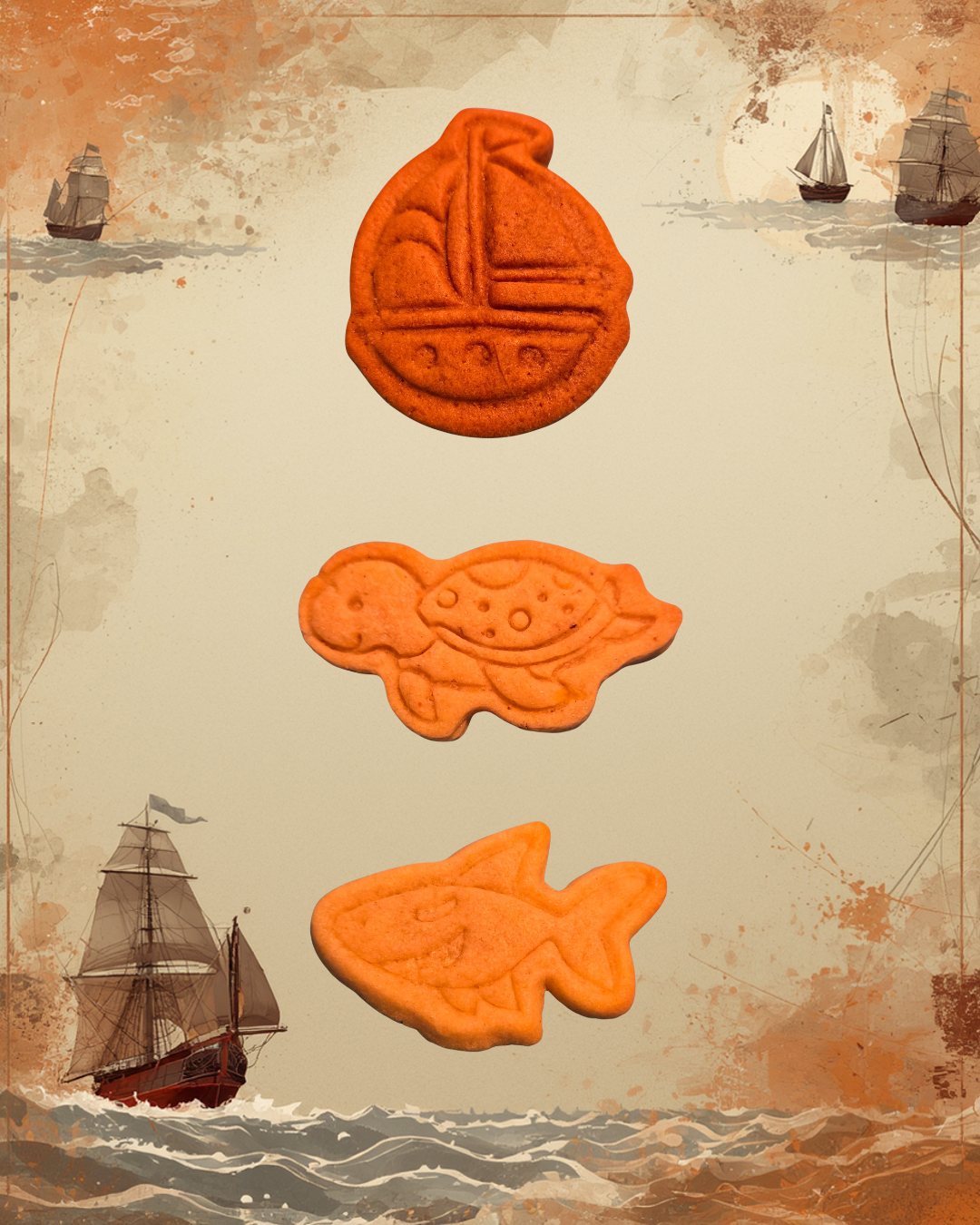
For the December NYC’s Secrets & Lies storytelling show at the South Street Seaport Museum, I baked 300+ cookies for our guests. All the recipes had a historical backstory and a maritime connection to match the theme of our show and the beautiful venue.
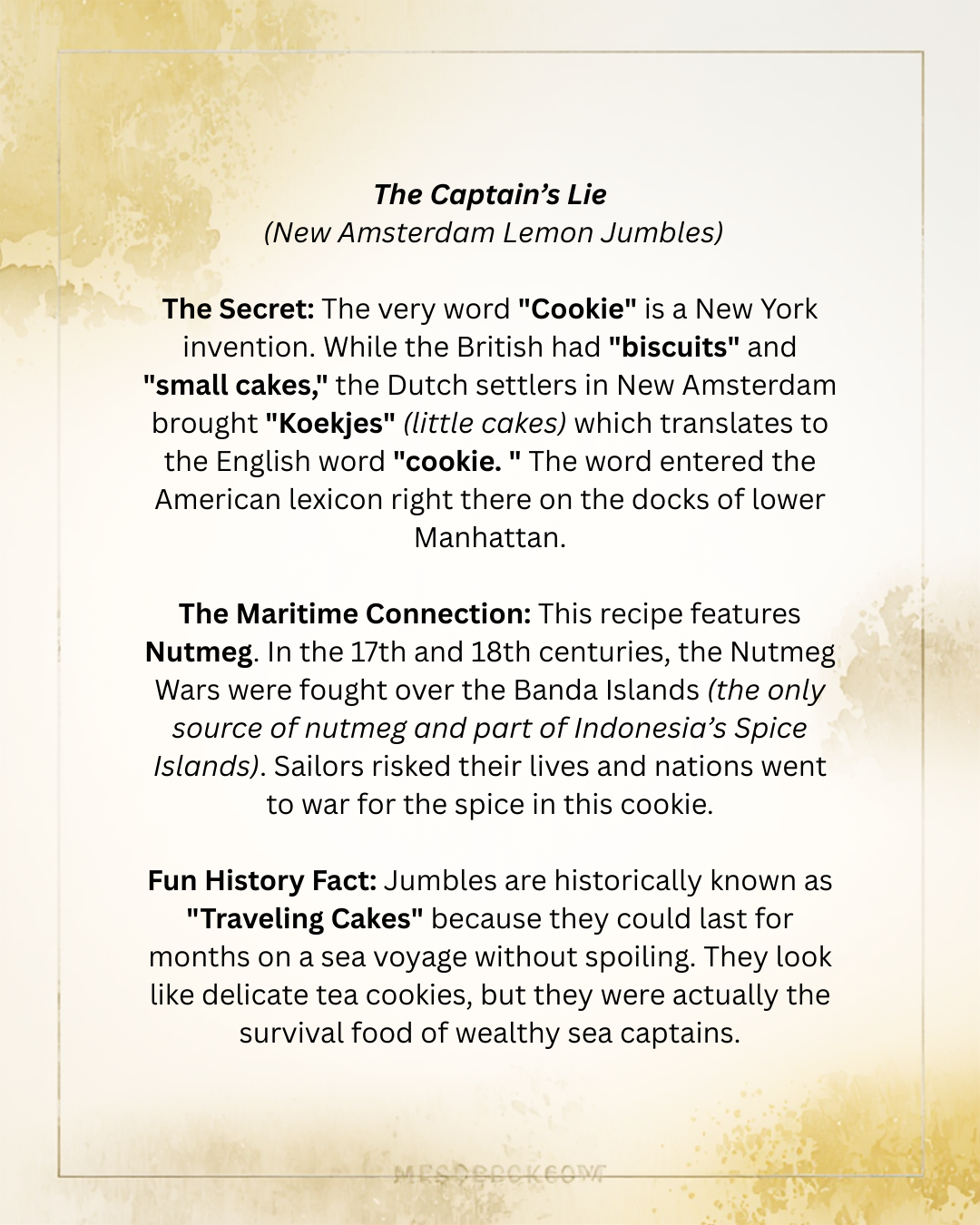
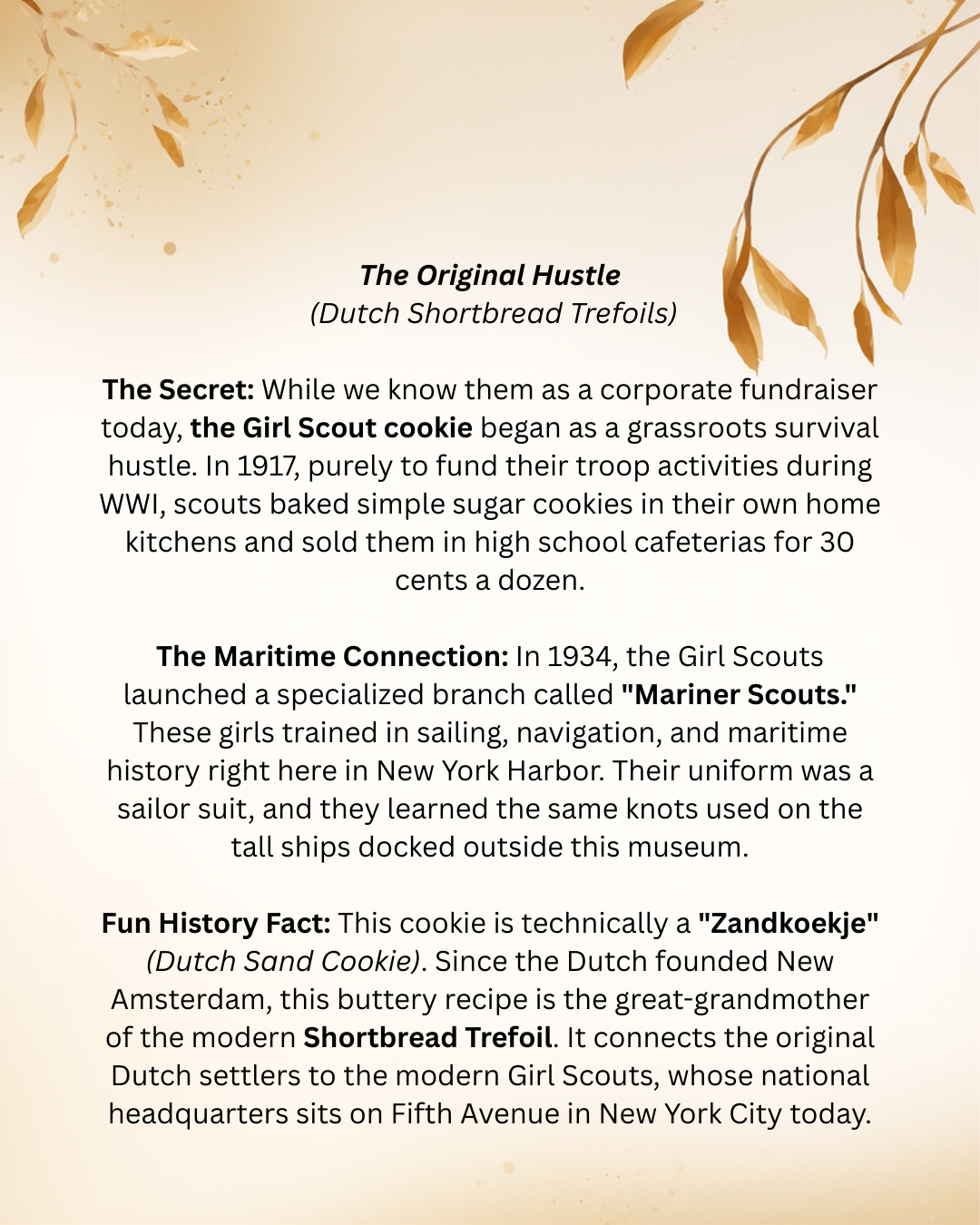
I’ve gotten messages asking for the recipes and the stories behind them, so here they are! Swipe through the photos to find the recipe cards and the history behind each cookie.
I hope you enjoy baking up a bit of NYC history with:
– The Captain’s Lie (New Amsterdam Lemon Jumbles)
– Sweet Corruption (Spiced Molasses Gingerbread)
– The Original Hustle (Dutch Shortbread Trefoils a la the Girl Scouts)
Since it’s cookie season, I’d love to see your baking pics! Happy baking!
Do you want to pay $15 or $125 for the same dinner in NYC? There’s a restaurant that lets you choose, no questions asked. And it showcases how nature and human communities work in sync to improve all lives.
It’s called Community Kitchen, located on the Lower East Side inside The Lower Eastside Girls Club. Most of us talk about “fixing the food system” in the abstract. But Community Kitchen is actually doing it. Founded by Mark Bittman, it’s running a radical experiment: A sliding-scale restaurant where you pay pay what you wish for the same meal.
And it just keeps getting better:
– It heals the planet: The dinner menu served Wednesday – Saturday, created by James Beard award-winning chef Mavis-Jay Sanders, is plant-forward and prioritizes ingredients from farmers using agroecological (sustainable farming) practices. This minimizes chemicals running into our waterways and soil, and supports biodiversity, treating the farm as an ecosystem rather than a factory.
– It heals the community: They utilize a “sliding scale” payment model. You pay what you can—$15, $45 (the cost of the meal), or $125 (to help others who can’t afford the meal.) If you have the means to pay the higher tier, you are directly helping a neighbor enjoy a nutritious, dignifying meal.
– It respects the worker: Unlike the industry standard, they pay a living wage with full benefits to their team members, correcting the inequities often found in restaurant labor.
– It’s delicious: They prepare top-quality food from scratch that appeals to all members of our communities, using primarily local and seasonal ingredients. Each meal has multiple courses.
It is a rare example of a “closed loop” of kindness—where caring for the soil and caring for the neighbor are part of the same meal.
If you are looking for a way to give back this season (or just want an incredible dinner), Community Kitchen is a wonderful place to dine with purpose. It’s a powerful reminder that “nature” isn’t just “out there”—it’s on our forks, and in how we care for one another.
Location: Lower Eastside Girls Club (East Village).
Chef: Mavis-Jay Sanders
Pricing: Sliding scale for the same meal – you choose the price you pay ($15/$45/$125)
Sustainability: Menu prioritizes plant-forward dishes and agroecological (sustainable farming) practices
Note: If you can’t find the reservation you’re looking for on the site, please check back! They release seats at all price levels gradually. Walk-ins are also welcome.
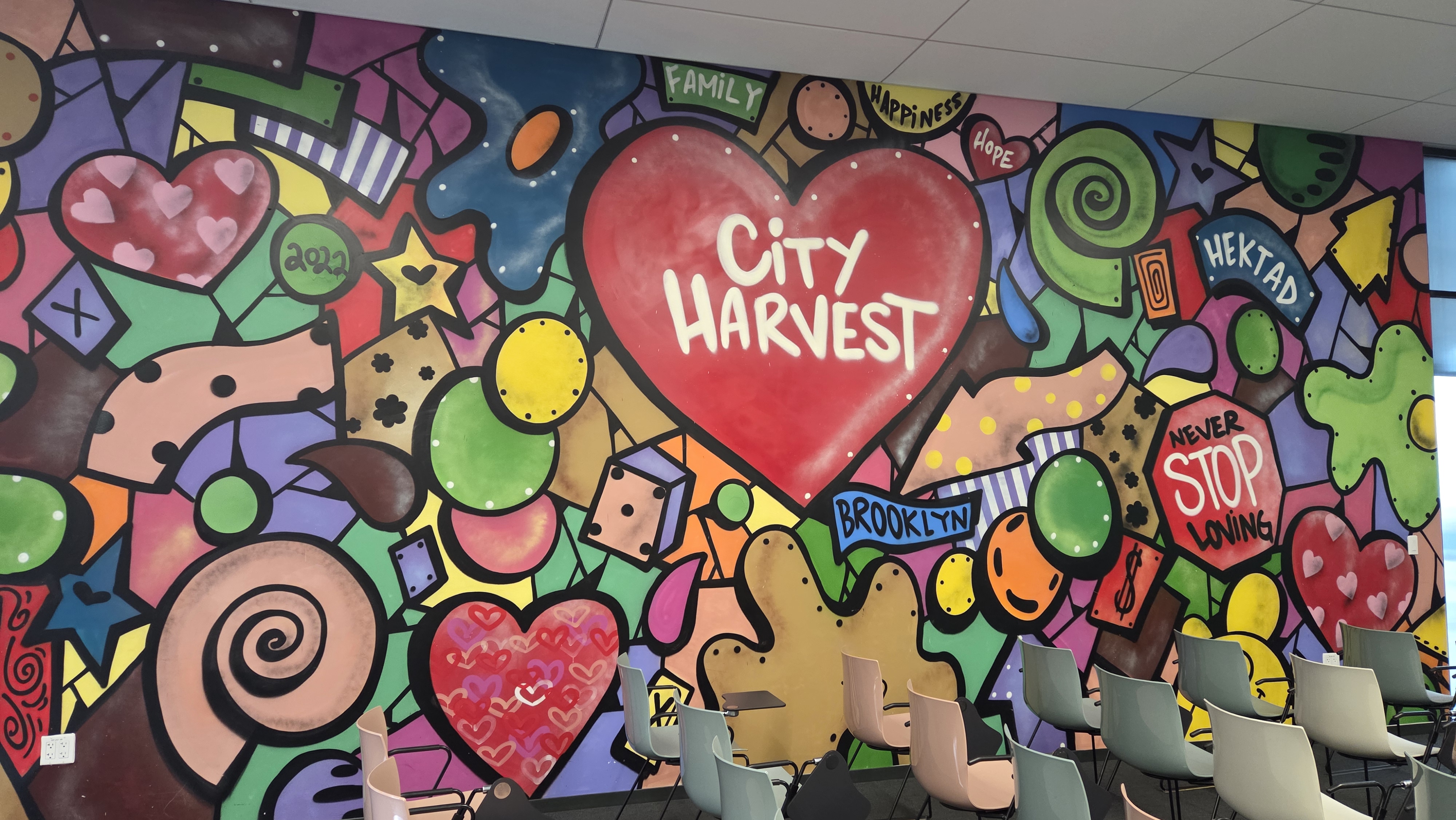
Our team of volunteers at last week’s City Harvest repack event
The Repack: What Happens When a Community Shows Up
Last week, I was deeply moved by the incredible generosity and hard work of the volunteers at City Harvest. We were there because of the enormous, urgent need created by current economic pressures and the fallout of the government shutdown, which is impacting vital food assistance programs for New Yorkers.
Together, we accomplished something phenomenal:
We helped repack 40,000 pounds of bulk fresh produce into 7,710 household-sized bags—the second-highest number of bags ever packed at the City Harvest Food Rescue Center since 2022!
This food is critical right now as City Harvest ramps up to serve neighborhoods with the highest populations of SNAP recipients. They expect to distribute over 1 million more pounds of food this November than they did last November.
We showed up and showed out, and it was a joy to be part of this community effort, even though I wish it wasn’t necessary.
The NYC Food Insecurity Crisis is Real
The need for this emergency support is stark, especially as the government shutdown has delayed or complicated critical aid. Our fellow workers, friends, and neighbors are struggling to put food on the table.
In New York City, approximately 1.73 million residents receive SNAP benefits. That’s 1 in 5 New Yorkers.
In Brooklyn alone (where I live and where City Harvest has its headquarters), that number is over 700,000. That’s 1 in 4 Brooklyn residents.
This work with City Harvest is personal to me because I grew up food insecure and my family received government-backed public assistance including WIC funding and at my school I was part of the free lunch program. As an adult who climbed out of that situation though education, hard work, and the generosity of these supportive government programs, giving back means a lot to me.
Why City Harvest is a Game-Changer (A Two-Part Solution)
City Harvest doesn’t just feed people; it’s a massive champion for the environment, tackling the staggering problem of food waste head-on.
From City Harvest
How You Can Be Part of the Solution
The work we did last week is ongoing. Join the City Harvest family!
This work isn’t just about charity; it’s about Togetherhood. Let’s continue to show up for our community and ensure that healthy, quality food goes to tables, not landfills.
The urgent global challenge is feeding a rapidly growing population while fighting the uncertainty of climate change. As a storyteller and a biomimicry scientist, I often ask: How does nature solve a massive, existential crisis? The answer, it turns out, lies not in some distant super-technology, but in the subtle genius of a single plant cell.
New research from the Cold Spring Harbor Laboratory has illuminated a fundamental biological “master switch” in the DNA of food crops like corn, giving us an actual blueprint for creating a resilient, thriving future. This isn’t just botany; it’s a profound lesson in survival written right into the plant kingdom.
The Inner Wisdom of the Plant
Plant growth, from the deepest root to the ripest ear of corn, is governed by its stem cells—unspecialized cells that hold the potential to become any part of the plant. The challenge facing plant scientists has always been figuring out how to balance these cells: when should they grow and when should they specialize into, say, a fruit or a thick stalk?
In a breakthrough study, scientists mapped the gene expression in these cells, revealing the network of regulators that act as the plant’s precise internal control panel. This network balances growth and stress response, allowing the plant to strategically allocate its resources for survival.
This knowledge is a gift to us all because it shows how nature manages risk. A plant facing drought doesn’t just despair; it shifts resources to deepen its roots. A plant under pest attack doesn’t just succumb; it redirects energy to fortify its cell walls. It’s a marvelous, elegant system of risk mitigation through metabolic flexibility.
A Blueprint for Humanity’s Resilience
As my work focuses on biomimicry—integrating nature’s genius into the human world—I see in this discovery a direct path to solving our human challenge of food security. We are not meant to struggle endlessly against the elements; we are meant to learn from the masters of endurance.
This plant study provides us with three clear takeaways for building a better world:
Precision over Force: Instead of overwhelming fields with more fertilizer and water, we can use this genetic knowledge to engineer plants to be more efficient—to use nitrogen more effectively and direct energy precisely where it’s needed most for resilience.
Unlocking Latent Potential: We are now able to see and manipulate the plant’s own evolutionary solutions. We can develop crops with deep-seated, natural defenses against drought and disease, built on the plant’s own wisdom, not on chemical dependency.
The Power of the Foundational System: The corn stalk teaches us that true resilience comes from perfecting the foundation. By understanding and replicating the simplest, deepest biological controls, we can build human systems that are robust and adaptable, just like an ecosystem.
A Brighter Future Ahead
This breakthrough is more than just a scientific finding; it is a fundamental shift in our relationship with nature. By finally decoding the genetic “master switch” that plants use to govern their own destiny, we are handed a powerful blueprint for survival. The challenge of global food security has never been greater, but this research proves that the solution is not an endless technological sprint, but a deeper engagement with the patient, profound wisdom of the living world. The era of resilient agriculture is not just on the horizon—it has already begun, written in the complex, hopeful language of a plant’s own DNA.