The storytellers of NYC’s Secrets & Lies and I have spent the last month celebrating the secrets hidden beneath New York City—from the quiet wilderness of Central Park to the forgotten history in the street streets. As October deepens, we’re switching our focus from nature’s secrets to something far more chilling: NYC’s infamous ghosts and the secrets they left behind.
The audience feedback from our last event, NYC’s Secrets & Lies – Nature, was absolutely overwhelming. Before we dive into the chilling tales planned for October 28th, we want to prove that this is more than just a show—it’s a truly unforgettable New York experience. If you’ve been on the fence, let our past audience convince you to secure your spot for a night of fright, tricks, and treats!
Why the Show Works
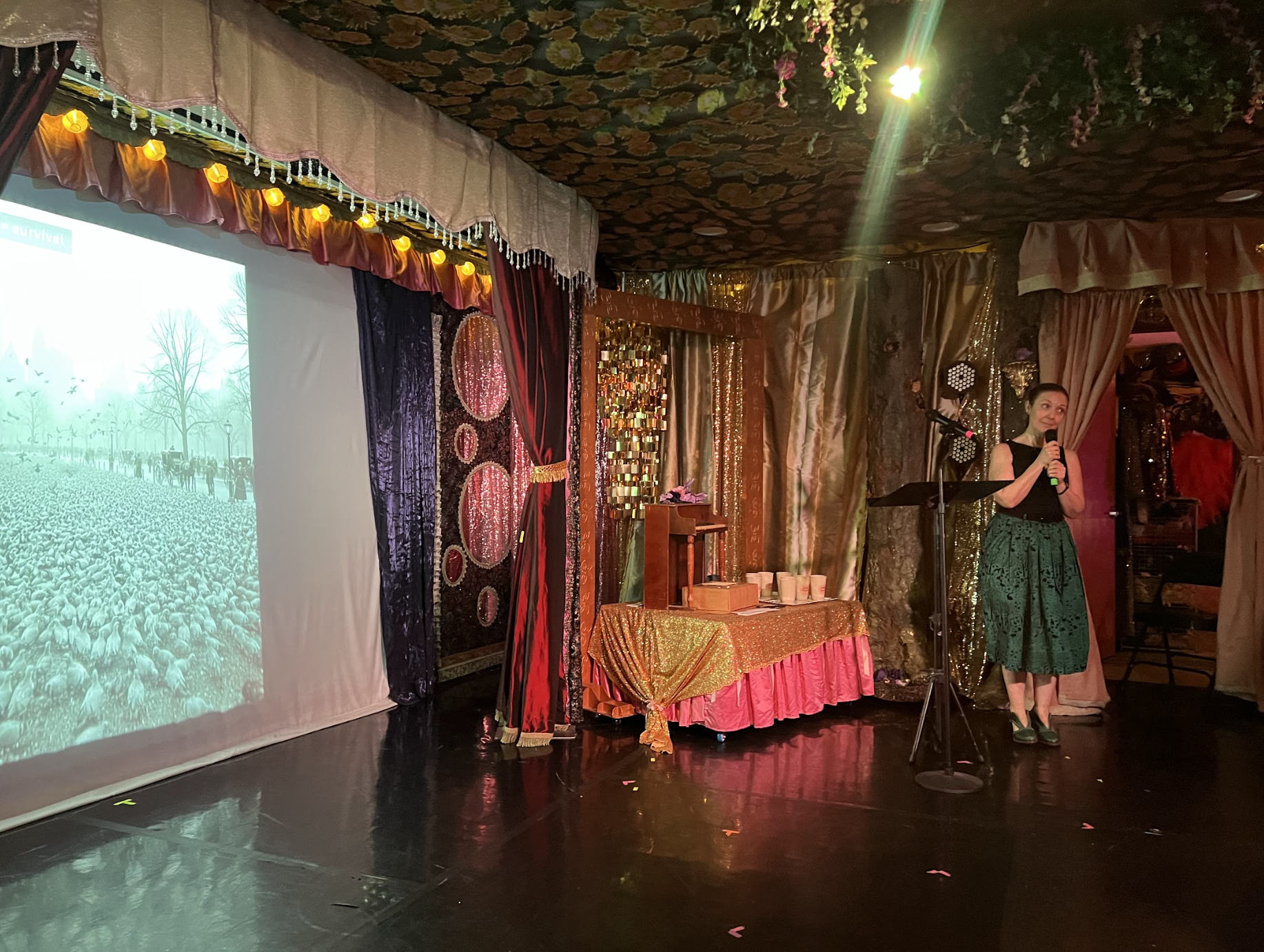
We set out to create compelling, high-caliber storytelling, and the response confirmed it. This show isn’t just reciting history; it’s about crafting a narrative that sticks with you long after you leave The Hidden Jewel Box Theater, a secret theater hidden inside Port Authority Bus Terminal.
Here is a glimpse of what audience members said about the last installment:
🗣️ Testimonial 1: “From the moment I stepped in through the secret door to the moment I left through ANOTHER secret door, this was the best storytelling I’ve ever seen in NYC!”
🗣️ Testimonial 2: “I haven’t been this entertained and educated at the same time in a long time. The perfect New York night out—NYC’s Secrets & Lies is a true hidden gem of the city’s indie arts scene.”
🗣️ Testimonial 3: “A masterclass in stage presence. The performers brought every secret to life and I had no idea which stories were true and which was the lie! I bought tickets for the next show before I left the theater.”
From Nature to Ghosts
Image created by Christa Avampato
The same dedication to research, quality performance, and compelling narrative that wowed the audience last month is now being turned towards the city’s darker corners.
For NYC’s Secrets & Lies – Ghost Stories on Tuesday, October 28th at 8pm, we’re diving deep into the true hauntings and the unsettling history that makes New York one of the spookiest places on earth. Expect to hear real, unsettling stories about:
The notorious ghosts of Greenwich Village’s oldest theaters.
The dark family secrets buried beneath modern skyscrapers.
The lingering spirits tied to a famous Manhattan landmark.
And one big lie! This is an intimate, spine-tingling historical journey just three days before Halloween. Our show is your perfect way to connect with the ghosts of New York’s past. Come early when the doors open at 7:30pm to enjoy some treats, meet the storytellers, and explore The Hidden Jewel Box Theater before it closes and disappears forever!
Space at The Hidden Jewel Box Theater is extremely limited for this one-night-only event. With the clock ticking down to October 28th, tickets are selling fast thanks to the buzz from our last show. Don’t wait to secure your spot!
PS – Keep following our social channels for behind-the-scenes looks at the chilling research for the Ghost Stories show! You can follow me on Instagram and Threads at @christarosenyc and you can follow the show on Instagram at @nycsecretsandlies.
I just attended Dr. Katharine Hayhoe’s Climate Week NYC talk at the American Museum of Natural History, and it was the most empowering climate message I’ve ever heard. It reframes the entire discussion around three simple ideas: Head, Heart, and Hands.
A research-backed truth: Dr. Hayhoe shared that most people in this country and in the world (~60% on both counts) are worried about climate change. We, the worried, don’t need more doom and damning data to get us concerned because we’re already there.
The challenge: Even though we’re worried, we aren’t taking enough action to alleviate our worry because we don’t know what to do about it.
The solution: Sync up our head, heart, and hands – what I’m calling the great triumvirate of change – and sync with others.
Well, that’s all well and good, but how do we do that? Dr. Hayhoe’s advice: Get clear about what we care about, how climate change will impact what we care about, find others who care about what we care about, and start talking!
Here’s our action plan:
Head: Define Your Why. Clearly identify exactly why you’re worried. Finish this sentence: “I care about climate because I care about…” How is your personal well-being, favorite place, or dearest value already being affected by climate change? Keep it simple, personal, and jargon-free.
Heart: Connect to Community. Now that you know what you care about, find communities, groups, and individuals who share that passion and are also affected by climate change.
Hands: Turn Conversation into Action. Get in touch with those communities and start talking about your shared worries and values. That act of conversation and connection will lead to meaningful, collaborative action or project to protect what you care about.
Climate change will affect everything everywhere all at once. It is a global issue, and no one will escape it so no matter what you care about, it will be impacted and there are communities of people who care about it, too. Let’s dive into an example from my personal life to see this action plan come to life.
An example:
Head: I’m worried about climate change because I love New York City. Since most of our city is at or near sea level, we will be subject to serious impacts from sea level rise, and we have a lot of issues now with rain flooding the streets and subways – our main modes of transportation. We also have a lot of people living in a small amount of space so there is a lot of pollution that impacts our health and well-being, and often crowds out green space, which is causing more heat, dirtier air, and health issues.
Heart: I love this city, and I do believe we can make it greener, cleaner, and healthier for all beings who live here – people, pets, wildlife, and plants. I want to find other people who also care about nature in NYC.
Hands: I run a live storytelling game show called NYC’s Secrets & Lies all about the secret history of NYC. This month, I decided to make the show all about stories related in nature in NYC and applied to have it become an official Climate Week NYC event. They accepted it (hooray!). I found a terrific venue – a hidden theater inside Port Authority Bus Terminal (a great tie into the transportation issues impacted by climate change here in NYC!) We had a wonderful cast of storytellers who were enthusiastic about the topic and told a wide range of stories. I also invited Josh Otero from the Natural Areas Conservancy to be our special guest to talk about all of the amazing work they do to make NYC greener and healthier. We had a sold-out show with a waitlist of 33 people, and all of the stories talked about interesting aspects of the history of nature in NYC. We had so much fun, and it was a great way to get the message out there! This show gave me a place to put my worries about climate change and turn them into action with others. I’m planning to do more of these shows – stay tuned!
Our climate anxiety is reaching new heights and as Dr. Hayhoe explained, the way to use that anxiety for good is through stories. Storytelling is about conversations. Every great idea, every meaningful action, every ounce of change – it all begins with a conversation. Get out there, start talking, and see what change you can create with others.
I’m really happy to have joined a new collective created by Climate Film Festival that’s bringing together sustainability professionals with filmmakers to raise the bar on and expand opportunities for climate storytelling. As someone who has one foot in each of these worlds, I’m so excited to be part of this new professional group and to help craft and fund these stories that drive action.
Yesterday I went to the Essex Market coffee hour for our first in-person event and attended an excellent panel about climate documentary making. As someone who studied how to use storytelling to drive more climate investment from family offices, I felt like I was in just the right place at just the right time because financing was a key part of the conversation. I heard a number of filmmakers talk about the challenge of finding financing for their climate films, especially with the current situation in D.C.
What filmmakers need to consider is that private funders don’t want to just fund a movie. They want to fund systemic change, especially when it comes to protecting and restoring the health of the planet. Filmmakers need to show how their films, and the platforms and supports they are building around their films, will get viewers to engage in creating meaningful change. That change needs to be measured and reported on.
Is that asking more from filmmakers? Yes. Is it asking them to be skilled business people, entrepreneurs, and community leaders on top of their filmmaking expertise and beyond the creation of the film? Yes. Isn’t making a movie already a Herculean task? Yes. Is that a challenge? Yes. It’s also today’s funding reality.
You aren’t just making a movie, not anymore. You’re building a movement, and that movement is what’s fundable with a movie being one cornerstone of many.
I was saddened to hear about the passing of Robert Redford this morning. When I was an undergrad at the University of Pennsylvania, he came to campus to explore a film and storytelling partnership between the university, the West Philadelphia community, and his Sundance Institute. I remember seeing him from a distance and immediately noticing that there was a light about him, a kind of magical aura that emanated from his smile and ease of being.
In addition to championing filmmaking and storytelling, he was also incredibly passionate about the environment. He was a lifelong advocate for nature, beginning his activism in the 1970s by using his celebrity to promote causes like protecting air and water, and later founding the Redford Center to use storytelling to expand environmentalism. He spoke at the United Nations about climate change, was recognized by TIME magazine as a “Hero of the Environment” in 2007, and served for decades on the board of the Natural Resources Defense Council (NRDC). The NRDC’s Southern California headquarters in Santa Monica is named The Robert Redford Building to honor his long-standing support for the organization as a board member and environmental activist.
While we remember his outstanding career as an actor, director, writer, and producer, I’ll continue to hold him up as an example of someone who knew early on that storytelling was the key to protecting our planet and used his talents to further that mission. May we all carry forward his remarkable and beautiful legacy.
I finally went to see Hadestown on Broadway. I know, I know. What took me so long?! After seeing it, I truly have no idea because it’s a transformative theater experience. A huge thank you to my dear friend, Dan Fortune, for taking me.
This was a very special performance because all 5 of the leads are brand new to the show. Music legend Kurt Elling, Jack Wolfe, Rebecca Naomi Jones, Morgan Dudley, and Paulo Szot knocked it out of the park, and the audience literally shouted with delight.
Yes, it’s all the things you’ve heard. It’s beautiful in every way, heart-filled, and filled with fascinating twists and turns woven between mythology and present day.
It’s also an incredibly effective climate story – the call to protect nature to reverse the harmful impacts of climate change on the food supply, mental and physical health, politics, and the economy.
It’s an immigration story, a migration story, a working class story about the power of generosity, community, and our own voices to lead change, to create a world where all beings are happy, healthy, and free. It’s a story of hope found in difficult, dark times and turning that hope into empowerment that leads to action. And art, specifically music, as a lever for all of that change.
Reminiscent of the call and response of spirituals with the essence of New Orleans, it’s a show that is of-the-moment even though it’s been on Broadway since 2019. Go see it. Cheer, clap, sing, get swept up in the beauty. And then carry all of it out into our world that is crying out for change. We are the ones we’ve been waiting for.
The Stories We Eat: Narratives to Shape Stakeholder Behavior and Policy for Sustainable Food Futures
Narrative Power: Using Digital Media to Convey the Voice of Future Generations and Nature in Sustainability Storytelling
From Self-Interest to Shared Benefit: How to Adapt Finland’s Exemplar of Public Trust Amidst Power Asymmetries in U.S. Businesses
I’m so grateful for this opportunity to learn and engage with these incredible people in one of the most sustainable communities in the world. I’m most looking forward to spending time with my professor, mentor, and dear friend R. Edward Freeman, who is one of my heroes and the founder of the seminar. As the originator of stakeholder theory that transformed business ethics, his work has fundamentally changed how businesses and business leaders around the world operate. He’s the reason I went to Darden and he changed how I see the world and my role in it. I’m honored to have had his support and encouragement for all these years.
It’s going to be an incredible summer of learning. I’m excited to experience all of it and to see where it leads! Nähdään pian, Finland!
Me holding Emerson Page and Where the Light Leads on top of Arthur’s Seat, an ancient extinct volcano that is the main peak of the group of hills in Holyrood Park in Edinburgh, Scotland. June 2024.
Creativity is a lifeline for me. I’m so grateful to have writing as a spiritual practice that offers me the chance to bring my whole self to the page, and I’m grateful for every kind word, review, and note I’ve received from all of you. You raise me up.
In the author’s note of Emerson Page and Where the Light Leads, I wrote, “Since Emerson emerged in 2017 in my first novel, Emerson Page and Where the Light Enters, our world has been turned upside down. The pandemic, climate change, conflict across the world—all of it is cause for anxiety and distress. It’s okay to not be okay with any of this, to be scared in a world that seems so far out of our control. But what’s also true is that there is so much love, light, wonder, and beauty in this world, and in you. Emerson’s story is a mix of the joys and difficulties that are part of every life. She rises, falls, and rises again. And so do we.”
I believed that when I wrote it on February 29, 2024, and I believe it today. If ever there was a time to create, celebrate, and elevate love, light, wonder, and beauty, it’s now. Right now.
So, on this first birthday of Emerson Page and Where the Light Leads, this is my book birthday wish for all of us: that we will continue to create and love, that we will live out loud, that we will express our joy, without fear and without reservation. As Mary Oliver so beautifully wrote in her poem, Don’t Hesitate: “Life has some possibility left…Joy is not made to be a crumb.” Please, make your joy the whole damn cake. Today and every day.
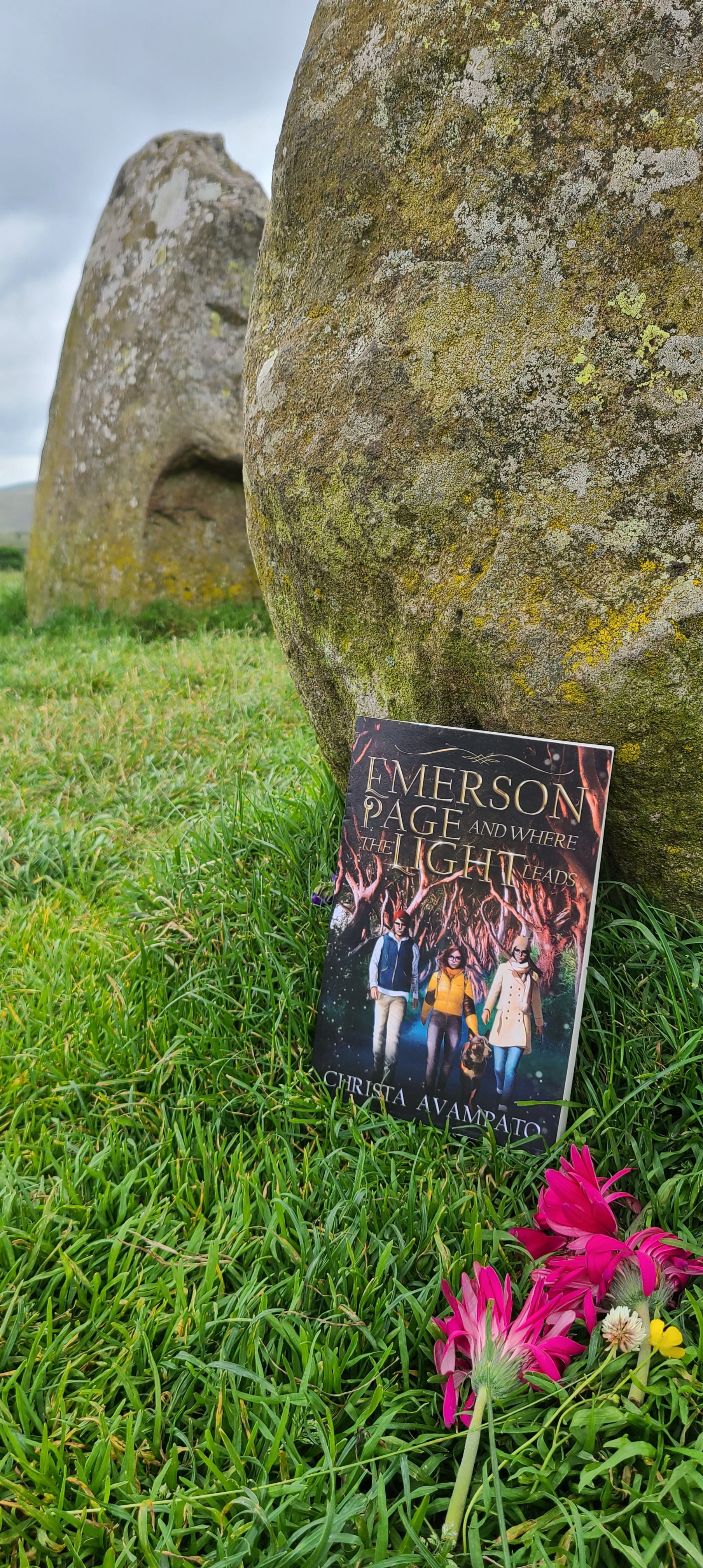
These two photos are from that same trip as the photos above. On the left, I’m at Castlerigg Stone Circle in Keswick, England, a town in the Lake District. On the right, that’s a photo I took on the Isle of Skye, Scotland. Both June / July 2024.
“Authoritarianism can’t destroy storytelling and imagination.” ~Chimamanda Ngozi Adichie
“Literature provides a respite.” ~Jennifer Egan
“Women are the greatest international power there is.” ~Burhan Sönmez
I consider myself incredibly lucky that I was able to attend “The PEN and the State: The Role of Novelists in Times of Crisis” – the opening night event for the 2025 PEN America World Voices Festival. In its 20th year, the festival celebrates international literature and writers. The event featured three of my favorite authors – Chimamanda Ngozi Adichie (Dream Count) from Nigeria who now resides most of the time in the U.S., Jennifer Egan (The Candy House) from the U.S. who is also a professor at University of Pennsylvania (my alma mater), and Burhan Sönmez (Lovers of Franz K.), a Kurdish author from Turkey who is also the President of PEN International and a Fellow at University of Cambridge (also my alma mater). The event was expertly moderated by Clarisse Rosaz Shariyf, PEN America interim Co-CEO and Chief Program Officer of Literary Programming.
While the event immediately acknowledged the difficult times we’re living in with words and language under attack, these authors refused to let that distract them from their critical work as novelists. They are moving forward. “As writers, we carry the responsibility for humanity,” said Burhan. “Every novelist creates a [new] language in their book.” Chimamanda agrees. “I will never give in to despair and self-censorship, and I will bear the consequences. The job of literature is not to be safe.” In response to an audience question, Jennifer reflected on what we, as writers and neighbors, can do now. “Keep literary culture strong. We need to stop scrolling and start reading, deeply. [As writers,] our voices are our livelihood. We have to be willing to listen to others and to speak out.”
In line with the title of the event, the authors reflected on the specific role of writers in these times as history is unfolding before our eyes. Burhan mentioned when horrific acts have occurred in earlier times, the news was delayed and could be obscured. With today’s technology, we bear witness to events happening across the world in real-time. He told a story about the relationship between Turkey and the U.S. “In the Mid 20th century, Turkey’s right wing had a slogan, “Make Turkey little America.” Now America is becoming a bigger Turkey.” He’s not wrong.
His perspective of time and living through societal difficulties was fascinating. He is a Kurdish writer raised in Turkey who then lived in exile after sustaining severe physical injuries was fascinating and also heartbreaking. In his childhood home in Turkey, they spoke Kurdish, but Turkey had outlawed that language for 100 years.
Chimamanda’s perspective of as a woman raised under two dictatorships in Nigeria also provided a nuanced view of U.S. politics. She is somewhat of an outsider as a legal U.S. resident with Nigerian heritage who grew up immersed in both countries’ cultures. She is attracted the personal stories shaped by politics. “I’m interested in politics as a human thing. Fiction is not a history book or instruction manual. It reminds us we’re all human. As writers, we want to write something beautiful. Our only responsibility as writers is to write what we want to write and make it beautiful.” She acknowledged that she wants the reader to have fun while reading her books and they often hold humor even while exploring dark subjects. “I’m drawn to novels where I learn while having fun,” she said. As a speaker, I found her to be incredibly funny!
Jennifer shares this view of literature with Chimamanda. She recounted her surprise when her literature students at Penn didn’t want to talk about politics at because reading and writing fiction gave them a break, an escape, from their lived experience. This resonated with her as a writer as well. “I want the reader to have fun reading my books. When that’s my focus as a writer, and if I keep that focus then the things I care about find their way into the story.”
She shared some background of what brought her to writing. “For me, it is a vocation though not the one I always wanted to pursue. Growing up, I wanted to be a surgeon and then an archaeologist. I wanted to look inside. Inside people and inside the Earth.” Then in college, she took off on a backpacking trip across the globe, and that’s how writing found her. “Writing made every experience I had complete. It gave it meaning. It became and is a spiritual practice for me.” Being a fiction writer has the same end goal as the goal of a surgeon and an archaeologist. “Fiction is the only art form that lets you be inside the minds of others. When you look at a picture, you are naturally on the outside looking in. As a reader, you are inside the minds of the characters.”
Burhan didn’t read a book in Kurdish until he was 35 years old and living in exile. He made the decision to write his most recent novel in Kurdish in honor of his ancestors, especially his mother. However, Kurdish was a language he only knew spoken so he had to study Kurdish grammar to write the book. “When I got injured, my health was very poor for a long time. I went through treatment for 8 years. I couldn’t read for 2 years. All I could do was watch TV and makes notes with pen and paper. That’s how I came to be a writer, through my injuries.”
Chimamanda echoed Burhan’s pull to writing from her own history. “My ancestors gave me the blessing of writing, telling stories, being curious, and not minding my business. I did not come to writing through reading as many people do. Writing came first for me. My love for beauty, for meaning, and the human connection brought me to writing fiction.”
These authors also framed the specific value of fiction in crisis as opposed to journalism and nonfiction (which they have also written.) “In nonfiction writing, there is a certain level of self-preservation,” said Chimamanda. “In fiction, you are free. There is an openness that doesn’t exist in nonfiction. A radical honesty that nonfiction doesn’t have. With fiction, you can say what has not been said because it’s not you [saying it]. It’s the character.”
Burhan quoted author Gabriel García Márquez and the Turkish concept of “Panjeta” meaning the 5th way. (My apologies if I misspelled that word – I couldn’t find it anywhere online!)“With a novel, we open a new window, a new way of seeing,” he said. “Gabriel García Márquez said, ‘Literature never enters the house of truth through the front door.’ As novelists, we use the backdoor to illuminate the truth.”
The evening concluded with one final question from the audience: How do we take risks right now and not self-destruct? The audience collectively held its breath.
These author did not flinch, nor hesitate. “Being afraid is human,” said Chimananda. “I’m afraid but I will still speak…If you are afraid, learn civics. Even if you think you know civics, study it. I have lots of friends who think they know civics and they are still asking, ‘Can he do that? Is that legal?’ Study and stay informed.” Jennifer nodded in agreement. “This is a moment to support every cause you care about in any way you can…Insist upon the importance of literature and those who embrace it in the face of everything that’s happening.”
On Sunday afternoon, I wrote “The End” on the first draft of my new novel. While my first two novels are young adult fantasy adventure, this one is historical fiction.
In December 1941 four friends graduate from an all-women’s college and seize new career opportunities in a world forever changed by war. I was so happy to sink back into the world of these four friends. The struggles they face are, unfortunately, highly relevant to the times we’re living in today. With themes of empowerment, being on the right side of history, speaking out against injustice, and the love story of female friendship, they’re determination made me more determined, too.
I’m hoping that it will be the first book in a series. The subsequent books will share the very different journeys that each of these women take in a new world order emerging before their eyes and how their friendship will pull them through.
This story began as a screenplay in 2020. It was a quarterfinalist in 3 international screenwriting competitions and received great feedback. Since then, most of my writing has focused on getting my second Emerson Page novel published and writing my master’s dissertation for University of Cambridge. With those projects complete, I returned to my historical fiction screenplay in January of this year.
It turns out that writing a screenplay is akin to having a very detailed outline for a novel:
All the dialogue is there.
The scenes and their sequence are set.
The characters and their relationships are developed.
The plot is charted.
I wouldn’t say going from a screenplay to a novel is a slam dunk, no-effort-needed project. As someone who dreads a blank page, the screenplay was my map, a guide that helped steer my writing sessions and make them productive.
I’ll take a short break from this story (to finish the first draft of another novel that’s also nearly done!) and let the first draft build up some dust so I can return to it in a few weeks with fresh eyes. Then I’ll dive back in to begin the work of editing and rewriting.
I much prefer to edit and rewrite rather than write a first draft. I no longer have any blank pages. Every time I sit down to write, it will be to refine and improve what I already have. I’ll immerse myself in extra research (something else I absolutely love to do!) and I’ll add much more detail, polishing the story one word at a time. Editing and rewriting is gratifying work because it’s all about making the story shine.
I’m hopeful that this new novel will do well in the query process and that I’ll be able to find a literary agent — a goal I’ve had for many years. For now, I’m celebrating this huge milestone of completing the first draft. It only gets better from here!
Here’s a reminder I know I need every day, and maybe it will help you, too — At any age and stage in life, you can:
– Start over – Start again – Try something brand new – Be a beginner – Learn – Grow – Change – Evolve – Say goodbye – Say hello – Forgive – Ask for forgiveness – Pause – Reflect – Discover
You are allowed to do all those things, and many at the same time. You are never just one thing or one way. Who you’ve been, what you’ve done, and where you’ve been are prologue to who you will be, what you will do, and where you will go. The past is merely setting the scene and dressing the set for all the choices you will make and the adventures you will have that lie ahead.







 Christa Avampato