Monument Valley 3, a gorgeous video game with heart, is now out in the world on Netflix. I’m honored to be a Climate Expert for the game. I wrote about it as part of my Master’s program in Sustainability Leadership at the the University of Cambridge. Goethe said, “In the end we retain from our studies only that which we practically apply.” I’m grateful that my applied learnings from Cambridge now have the potential to reach the 3 billion people around the world who play video games.
Of course I’m most proud of the exceptional group of talented people who made Monument Valley 3, especially the Game Director and my dear friend, Jennifer Estaris, whom I love and admire so much. May this game inspire all of us to care for each other, our communities, and this beautiful planet we share.
Please download, play, rate, review, and share Monument Valley 3, and let me know what you think! To play, click this link on your mobile device: https://go.ustwo.games/mv3
Do you know the story of the Rose of Jericho, also known as resurrection plant and flower of stone?
When subjected to drought, the plant curls inward into a tight ball. It can survive in this state for several years, losing 95% of its water. As it dries out, it produces a type of sugar to protect its cells from damage. It looks as if it’s dead, but it’s not. It’s just conserving its energy and waiting for more favorable conditions to arise.
If the drought goes on for an extended period of time, the plant may detach its roots and physically tumble to a new location. Once it comes in contact with even a small amount of water, the sugars and accumulated salts dissolve, it re-roots in its new location if it’s traveled, and the plant revives itself, carrying on with life as if nothing has happened.
What fascinates me most is that it produces that sugar to protect itself so it can flourish when the hard times pass. Also, it doesn’t force itself to stay put during difficulty. It takes action. It detaches its roots in search of nourishment and resources elsewhere.
As we look to the days ahead, what resources do you need to take care of yourself so you can flourish in the future? Can you make them? Can you get them from where you are? If not, where can you go to get what you need? These are crucial questions to ask now so we’re able to buffer ourselves during hard times and also be ready to revive ourselves during more favorable times. More tomorrow…
Hurricanes become especially dangerous when they can spend extended periods of time over warm water. Conventional thinking and history have shown us that when a hurricane reaches land, the land dissipates its strength and the storm, eventually, fizzles. This is why coasts have historically been in greater danger that inland areas. The brown ocean effect changes that.
When land is warm and saturated with water, as happened in Western North Carolina, it acts as something akin to ocean. While it doesn’t typically kick up the wind speed of a storm like Helene, it provides an excess of moisture and heat. Because the ground is saturated, the massive amount of rain can’t be absorbed. This leads to flooding and landslides. The devastation, loss of life, and high number of missing people in Western North Carolina caused by Helene is partially from the brown ocean effect. The heavy rains dumped on saturated land ravaged everything in their path from houses to infrastructure to power and communication lines. There is even footage of a casket unearthed from a cemetery and carried away by the rushing water.
The brown ocean effect can happen anywhere there’s land. As rains become heavier and more frequent from climate change and global warming, it can take hold in many more places. Every land mass can provide ocean-like fuel for a storm.
At the time of this writing, Hurricane Milton is barreling toward Florida. It’s a Category 5 with winds at 180 miles per hour, spinning over the hot waters of the Gulf of Mexico. Stronger than Hurricane Katrina. Even if it weakens, it still has all that water in it that it will drop when it hits land. Also, weakening in this case may be every bit as devastating as wind because it may slow down and pick up even more moisture from the Gulf. The land in Florida is already saturated, as the land in North Carolina was before Helene arrived. It’s a frightening alignment of circumstances.
On Monday night I watched hurricane specialist John Morales get choked up on air giving the news update on Milton becoming a Category 5. These storms are no longer once-in-a-century, once-in-a-lifetime, and perhaps not even once-in-a-season. This may now be our new normal that is anything but normal.
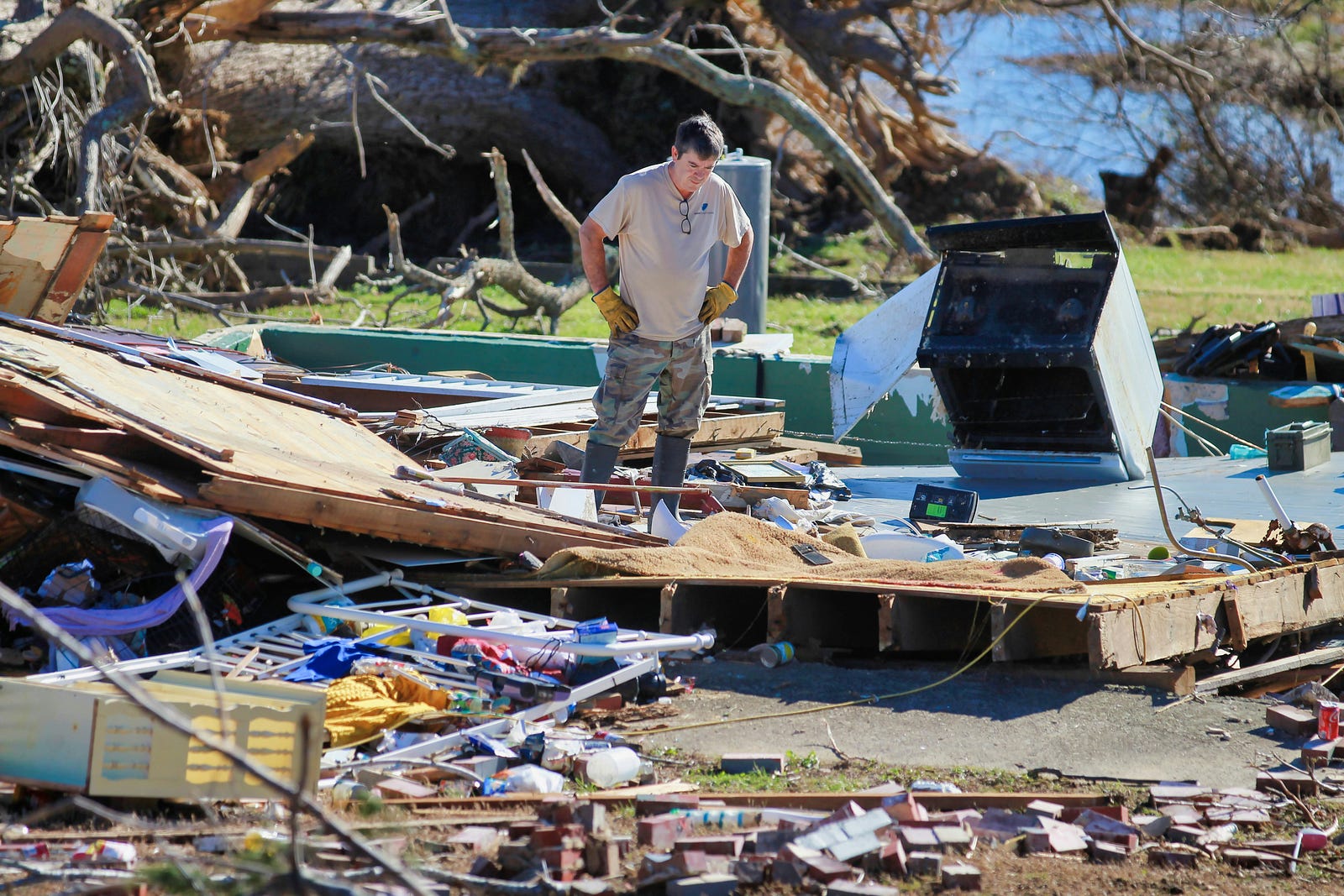
Man looking at loss of home to a tornado in Cambridge Shores, Kentucky in 2021. Photo by Chandler Cruttenden on Unsplash
If you’re a prospective homebuyer and concerned about climate risk, Zillow is about to make your search much easier. By the end of 2024, for-sale listings on Zillow’s website will include climate risk information for flood, wildfire, wind, heat, and air quality by partnering with First Street, the gold standard for climate risk financial modeling. First Street’s models are developed by leading scientists and vetted through a peer-review process to transparently calculate the past, present, and future climate risk for properties and make it available for all. This ensures the climate insights given on Zillow are both credible and actionable.
Zillow will also include insurance recommendations, climate risk scores, interactive maps, and show if and when a property has experienced past climate events. It will be the first and only real estate listing site to provide this detailed data, giving the company a significant point of differentiation.
Consumer demand Zillow decided to provide this data based on overwhelming consumer demand. Zillow research in September 2023 showed 83% of prospective U.S. home buyers consider climate risk. That percentage varies by geography—90% in the West, 85% in the Northeast, 79% in the South, and 77% in the Midwest. The average age of a U.S. homebuyer today is 39. Millennials and Gen Z are entering the home buying market and care deeply about climate. Zillow is centering their current and future users.
A potential shift in the real estate market This data could significantly shift the real estate market and the migration of home buyers within the U.S. because climate risk is growing more pervasive. Across all new listings in August 2024, 55.5% have a major risk of extreme heat, 1/3 for extreme wind exposure, 16.7% for wildfire, 13% for air quality, and 12.8% for flooding.
The risks vary widely by geography. Over 70% of new listings in the Riverside, California metro area have a major wildfire risk. Wildfire risks impact 47% of new listings in Sacramento, and roughly 1/3 of listings in Jacksonville, Phoenix, San Diego, and Denver. 76.8% of new listings in the New Orleans metro area have a major flood risk, while roughly 1/3 in Houston, Miami, and Tampa and over 1/4 in Virginia Beach are at risk of flooding. In general, Midwest markets hold the lowest climate risk with less than 10% of new listings having any major climate risk in Cleveland, Columbus, Milwaukee, Indianapolis, Minneapolis, Detroit, and Kansas City.
Accuracy of First Street climate risk data Some cities and the federal government through FEMA provide some climate risk information. This includes designated flood zones that help consumers partially assess risk. However, this is not comprehensive enough to help consumers holistically gauge insurance needs and potential future risks. This is where First Street’s modeling really shows its financial value.
Consider Hurricane Debby, the storm that wreaked havoc along the U.S. east coast in August 2024. First Street’s analysis found 78% of properties flooded by Debby were outside FEMA flood zones, meaning flood insurance isn’t mandatory. 85% of these properties would have received an insurance recommendation on Zillow, highlighting how First Street’s climate risk data can inform buyers during their home search.
Climate data can change where and how we build Not only does First Street’s data on Zillow inform prospective home buyers and real estate agents; it can also serve home builders, municipalities, and the federal government. Home builders can use it to assess the value of their potential construction sites. Municipalities can use it to assess where they need to focus their infrastructure dollars for climate resiliency and adaptation builds. The federal government can use the data to re-evaluate and assess FEMA designations for climate events and more effectively consider plans to support the expansion of the available housing market. It may also help us as a society plan for migration within the U.S. as we face climate change impacts.
What I find most refreshing about Zillow’s approach is that it’s not about politics or marketing. It’s about science and data. Zillow isn’t telling consumers which property to buy, or which risks they should consider. It’s providing the data in a clear, consistent manner so consumers can make the most clear-eyed choices possible. With this data in-hand, consumers can understand the risk they’re taking and how to prepare for it. In this risky world of ours, that’s data we all desperately need.
Metalplant co-founders Laura Wasserson, Eric Matzner and Sahit Muja with the Albanian farming team. Image: Metalplant
Plants like sunflowers are viable nature-based solutions that remove heavy metal from polluted soil through the scientific process of phytoremediation. The term is a combination of the Greek phyto (plant) and Latin remedium (restoring balance). Simply, brilliantly, and quickly, the plants take up the heavy metal in large quantities and store them in their fatty tissues. This causes no harm to the sunflowers, nor to the land. They also thrive in hot, dry climates. What a wonder for a world wracked by pollution and climate change impacts.
Now imagine taking this incredible adaptation even further. What if we extracted the metals from the plants and use these metals in our technology so we didn’t need to mine for them?
I worried about the impact of the rock dust on the soil and the life within that soil. Thankfully, enhanced rock weathering is a regenerative practice, using mycorrhiza and other fungi fostered by the roots of the plants absorbing the metal from the soil.
Curious and want to learn more? Metalplant would love to hear from you. Get in touch with them at https://metalplant.com/contact/.
While on vacation I wrote my first full piece of ecofiction for a climate fiction writing competition. It’s a short story (5,000 words) that provides a slice of life in New York City in the year 2200, and grew out of the research I did for my University of Cambridge dissertation.
It’s told through the eyes of a journalist walking his dog who by chance meets the 90-year-old former mayor who galvanized the rebuilding of NYC after it was destroyed by floods caused by climate change. Biomimicry figures prominently in it. I tried to incorporate humor, heart, and redemption alongside the heartbreak, loss, and destruction. Ultimately, it’s a story about leadership, community, and vision.
No matter the outcome of the competition, I enjoyed writing it and plan to do more with these characters and in this genre. The predominant channels and messages we’re using for climate storytelling now are not generating the scale and speed of the changes we need. Fiction can play a bigger role is painting the picture of what a world transformed can look like, what it will take to get there, and how we might work together to make it so. The fandoms around fiction can be a unifying force for good, which is exactly what we need, now more than ever.
(I created the images below with AI, inspired by the story I wrote.)
5 trees, actually, and in my kitchen. Two weeks ago, I planted 12 trees at their most vulnerable stage – grafts from existing trees sent to me by the Arbor Day Foundation that looked like nothing more than twigs. They’re in a planter in my Brooklyn kitchen. Of the 12, 5 now have tiny leaves: 2 Eastern Redbuds, 2 Washington Hawthorns, 1 White Flowering Dogwoods. This is thrilling because most trees at this stage rarely survive, and I’ve never planted trees in this stage before.
I’m very interested in learning more about tree propagation as the impacts of climate change grow more urgent every day. I’m thinking about a few tree-centered startups to pursue after I finish my Masters in Sustainability Leadership at University of Cambridge in two months. Growing these beauties counts as research! Nature’s wisdom is boundless, and I’m so happy to be her forever student.
Before you share one more post on social media about climate doom and gloom, please take a deep breath. And then, please post something else. Anything else.
The goal of sharing climate change stories is to drive actions that will halt and reverse climate change to protect the planet and human well-being. While doom and gloom stories such as alarming statistics (of which there are many, sadly!) drive more sharing, clicks, comments, and engagement on social media than any other type of climate story, the largest research study on the topic recently found they drive the least amount of climate action and do almost nothing to change climate change beliefs or support climate change policies. They actually backfire, even causing people concerned about climate change to take significantly less action than they otherwise would.
How could this be? Doesn’t instilling fear for the survival of our species cause so much alarm that of course we’d change our ways? That is a logical, rational assumption. For many years, this was the prevailing wisdom. If you just show people how much damage climate change can do, they’ll change their behaviors and habits to protect themselves and the people they love. This is why we see country leaders, the Secretary-General of the United Nations, leaders at environment nonprofits, and climate activists all over the world sounding the alarm. This is also why so many of us have posted about the climate emergency so often. It’s also why we aren’t seeing enough action taken at a fast enough rate. These stories depressed and demotivated people right into paralysis.
But if that’s the case, then why is there so engagement on climate stories? The clicks, likes, shares, and comments are through the roof. If there’s so much engagement, why is there not enough action? Being engaged on social media or with mass media isn’t the same as taking action in the real world. These stories have absolutely raised the consciousness around climate change, but they haven’t successfully moved people to physically do something about it. Fear-based messaging is somewhat effective at driving one-time actions. However, most climate action requires behavior, habit, and systems change, not one-time actions so the fear-based climate messages don’t give us the long-term and repeated actions we need.
So, what messages can we share that will drive climate action? That is an excellent question. Research points us to a few options that motivate climate action:
Scientific consensus coupled with a clear call-to-action Sharing the science of climate change, and that the vast majority of scientists agree on it, is critical. However, just providing the science isn’t enough. We also need to give people specific, actions to take. And all the better if we can give them a mix of one-time actions (such as voting) and remind them to take habitual actions (such as buying only the amount of goods we need to reduce waste). And we have to make them as simple as possible to get broad-based engagement.
Appeal to ethics and morality with a clear call-to-action Most people like to see themselves as having strong ethics and values. We want to protect our neighbors. We want to take care of our communities. We want to be healthy and happy, and we want people we love to be healthy and happy, too. Taking care of the planet is a way to take care of ourselves and others, and appealing to our collective nurturing nature makes a difference. And again, give people a clear call-to-action to help them do this.
There are other theories about what may work that need further study. There is a hole in the research about which messages will move people from engagement to action. We desperately need more research on this, so we tell the stories that motivate the actions we need to protect ourselves and all species with whom we share this planet. My master’s dissertation has a few additional findings that I’m excited to share soon, and I’m thinking of continuing this line of research and work because it’s so critical to protecting the health of the planet.
Water bears look like works of science fiction. The microscopic, 8-legged 1,300 species of water bears (tardigrades) are alive and well. Their remarkable abilities to survive and thrive in harsh conditions make them seem even more improbable. They’re one of the most resilient lifeforms that’s ever lived.
When I had 6 weeks of daily radiation to treat cancer, I thought a lot about the perseverance of water bears. The technicians would position me on the table, then close the heavy door behind them as they left the room to protect themselves from the radiation. Click. Through a small window, they’d watched me, alone, unmoving, exposed on a table with no protection from the radiation blasting my body. I imagined myself as a tardigrade, opening to the light and radiation, absorbing it to kill any microscopic cancer cells floating around my body. I would think of Rumi’s quote, “The wound is the place where the light enters you.”
By the end of week six, I had a painful burn the size of a baseball in the middle of my chest. “What would a tardigrade do with a burn like this?”, I wondered. They’d tend to what needed tending. So, that’s what I did. I changed dressings and applied the medication twice a day. I meditated on my wound, imagining it closing and healing. It was painful and frightening to have a wound like that, but like so much along my cancer journey, it passed. To my amazement and my doctors’, it healed in 2 weeks. Today it’s only a few freckles and the tattoo that marks the focus of the radiation beam, the place where the light entered me and healed me.
As we consider how to create a world resilient to climate change impacts, again I’m thinking of tardigrades. How can we withstand hardship, quickly and completely fixing what breaks? How can we endure? Nature-based solutions to our most dire challenges are found all around us if only we look, listen, and seek to understand. In a world where we constantly navigate change and manage difficulty, I want to be a tardigrade — repairing myself, my ecosystem, and all beings with whom I share it.
My last dose of Verzenio. Photo by Christa Avampato.
A little over two years ago, I wrote an article about my decision to take Verzenio to prevent breast cancer recurrence. On April 14th, I took my last dose of the medication and now I feel like a new person. Taking Verzenio at the maximum dose for two years was one of the most challenging parts of cancer treatment. Still, I’m glad I took it as part of doing everything I possibly can to stay healthy. I’m beyond grateful that the medication was delivered to my door every month free of charge to me because my health insurance paid the entire cost – $14,000 per month for a grand total of $336,000.
The indignities of cancer treatment are many, and I’ve experienced most of them. Verzenio certainly caused me a lot of anguish. Every day I had at least a low-grade stomach ache, and often much worse. I carried medication to deal with these issues everywhere I went, and often had to use it. Alcohol and grapefruit were off limits. I worried about everything I ate because anything could make me sick at any time. I had to constantly manage fatigue that sleep couldn’t fix, insomnia, depression, hair thinning, dry and sensitive skin, weight gain and aching joints, decreasing bone density, and the possibilities of developing liver and lung issues, being immunocompromised, and having anemia. Mercifully, my blood work was always normal when it was checked by my oncologist every three months – partly from my constant management of my diet and partly because I was very lucky.
Despite all that, that were bright spots, too, when I would discover something that helped, at least for some amount of time. Probiotics lessened the stomach issues, and I stopped drinking coffee, paired everything with carbs, upped my protein intake, and limited spicy, acidic, adventurous food. Audiobooks, an eye mask, and meditating helped me sleep, or at least rest. When I couldn’t sleep, I would often imagine myself traveling over coral reefs in the company of my dog, Phin, with a whale tour guide whom my imagination named Blue. Creativity was a great help on sleepless nights.
Shampoo and conditioner bars from Kitsch slowed the hair thinning. The dryness of my skin was eased by products from Good Molecules, Cetaphil, and HyaloGyn. Daily exercise and fish oil supplements eased my aching joints. The Zometa infusions I get every six months are helping me regrow the bone density I’ve lost. I kept anemia at bay with daily protein shakes. I bought a digital scale to monitor my weight every day, and experimented with recipes that were high nutrition, low-calorie, economical, and not too complicated to make.
Managing depression required a daily recalibration. My dog, Phineas, was my biggest support in that effort. Losing him in January of this year was a devastating loss and the grief at times felt unbearable. Verzenio made his passing even worse. To keep my head up, I did something every day that brought me joy – I spent time with friends, listened to music, watched movies, read books, visited museums, and did things I loved to do – writing, learning from and about nature, running, taking long walks, making art, and studying for my master’s program in sustainability. Joy was one of my saviors during active treatment and it helped with Verzenio, too. Though sometimes I had no choice but to just let myself feel sad, frustrated, and depressed. I cried a lot. Knowing the depression was driven by the medication helped. Knowing this was my now and not my forever encouraged me to keep going, to keep moving.
If all this sounds exhausting, I can assure you it was. Now that I’ve been off the medication for nearly a month, I can see how much effort it took to be on it. In the moment, I tried my best not to acknowledge that. I’ve spent most of the past four years since my diagnosis with my head down, focused on getting to this finish line.
Now that I feel better and lighter, I’m lifting my gaze. Right now, the field of my future is wide open. That’s equal parts exciting, and scary. I don’t know what lies ahead. Sometimes I feel like I’m on the edge of a cliff. And that’s okay because even on the cliff, I’m dancing, fully alive. I’m just glad to be here, and to be healthy. Verzenio was a part of making that possible.
So, if I had it to do over again, would I take Verzenio? Absolutely, unequivocally, yes. This is a life worth fighting for.