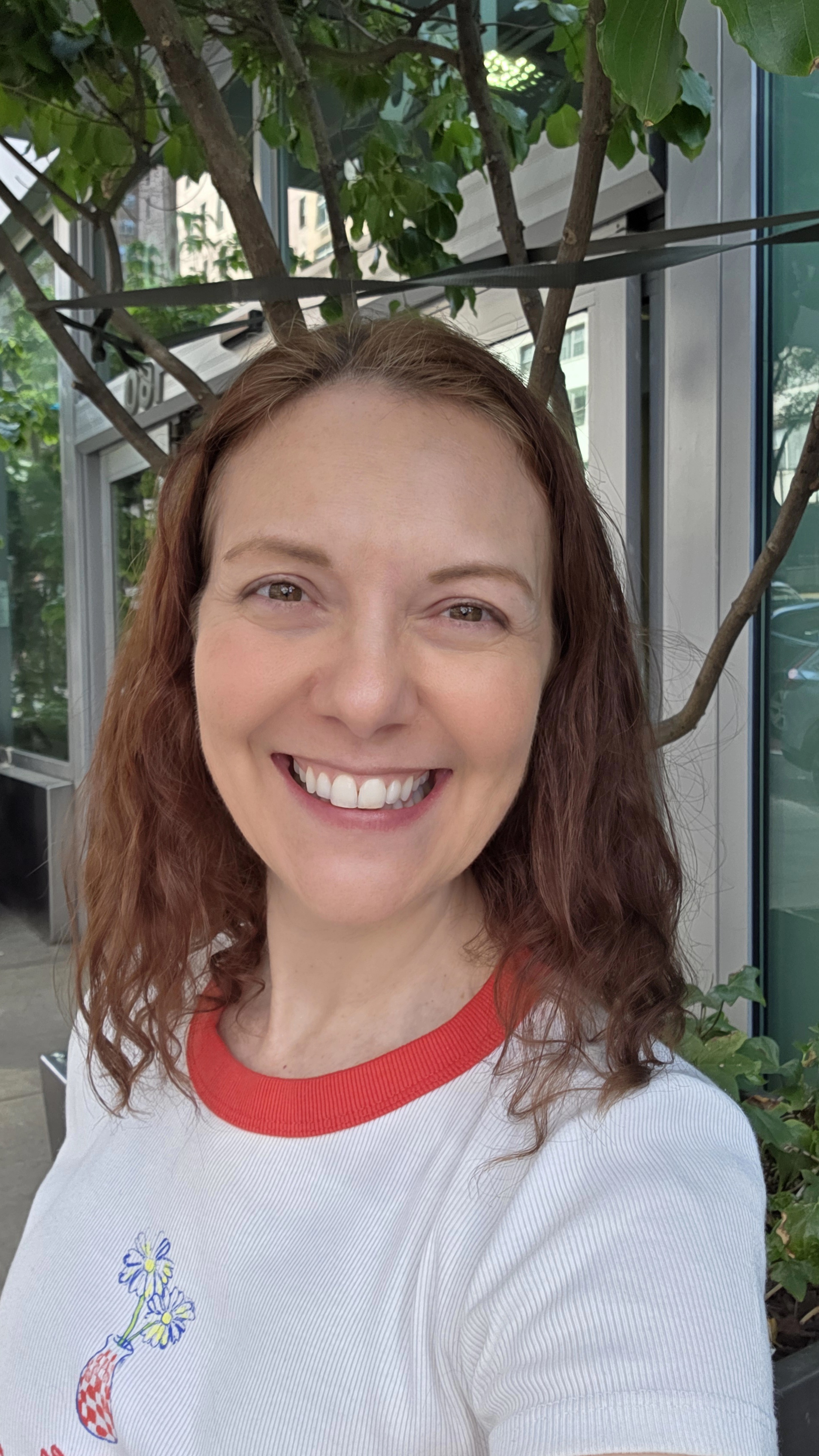
Yesterday, a new chapter in my life began. I got my last Lupron shot. This is a photo of me outside Perlmutter Cancer Center right after I got my shot. I couldn’t stop smiling, and right after this photo I cried many happy tears.
By the end of August, it will be out of my system and I’ll transition to a new medication regimen to keep cancer recurrence at bay now that I’m approaching the five-year mark since the end of active treatment. For a few weeks the old and new meds will mingle in my body — orchestrating the hand-off as one recedes into my past and the other ramps up to carry me into the future for the next 5 years. The hope is that this new medication will cause less chronic pain and fewer, less severe side effects than what I’ve been taking for 5 years while also protecting me from having a recurrence.
These past 5 years have required me to break down and rebuild every area of my life several times over. It’s felt like a constant dance of doing and undoing. Just as I started healing and getting my bearings, something else would send me back to square one. To get through, I reminded myself that this is exactly the process that also strengthens muscles. I’m very strong physically and mentally. I’m also very tired.
All I can do is what I’ve been doing. Living each day, one day at a time, as best I can. It’s all any of us can do.
After my June 18th storytelling show at the AKC Museum of the Dog, I’ll be taking it easy this summer, mostly because I need to start this new chapter as healthy as possible. As I bid farewell to these medications that massively impacted my body and mind, I’m grateful for their service and everything they taught me. I’m grateful that they worked as hoped, even though they made daily life difficult every day. I’m still here and that’s what matters.
This morning, I had my annual managed portfolio review call with Luke Brown, an Investment Management Consultant at Fidelity Investments. I’m especially grateful for their thoughtful insights and actions during this turbulent market.
Fidelity has 3 principles of investing 1. Asset Mix – which is personalized (more about that below) 2. The outside economic / business cycle of the market 3. Maintenance – the constant re-evaluation based on the 2 principles above
They recommend 3 buckets of portfolio assets 1. Cash emergency fund 2. Protected income – social security income and pensions 3. Growth – investments that compound over time
Finally, they consider 3 main inputs for the asset mix of the portfolio 1. Personal risk comfort (on a scale from 1 – 10)
2. Age / time left in market before retirement and withdrawal needs in the retirement To factor in all of this they use something called a Monte Carlo Analysis. They model how much money someone will have left at the time of their passing based upon the assets they have at the time of retirement, their retirement age, a potential age of their passing (which conservatively I have as 94 years old), the rate of withdrawal depending upon how they want to live in retirement, and three market scenarios – average, below average, and significantly below average.
3. A principle known as Sequence of Return Risk This principle adjusts the Monte Carlo Analysis based upon different withdrawal rates by year from different accounts (social security, pension, investment accounts, etc.) to find the optimal mix so someone does not outlive their money.
Putting it all together In the course of an hour talking to Luke, we mapped all of this information and then Luke explained the changes Fidelity recommended for me in real-time.
Two example of how these principles play out for me at this moment in time
1. In a balanced portfolio under average market conditions, foreign stocks are ~21% of an investment portfolio. However, given the current state of the global economy, Fidelity saw that there was additional opportunity in the global markets that match my personal goals, investment level, and risk level so my portfolio has ~25% foreign stocks.
2. A year ago, I was saving to buy an apartment within 5 years. However, over the course of this year that’s changed for me. I now plan to stay in my rent stabilized apartment until 3 years before retirement (when the rent stabilization on my apartment will expire). By that time, I will have saved enough money to buy an apartment. Because that account now has a much longer time horizon, we’ll now invest that account much more aggressively. More time in the market means more compounding and more growth.
Emotions around money
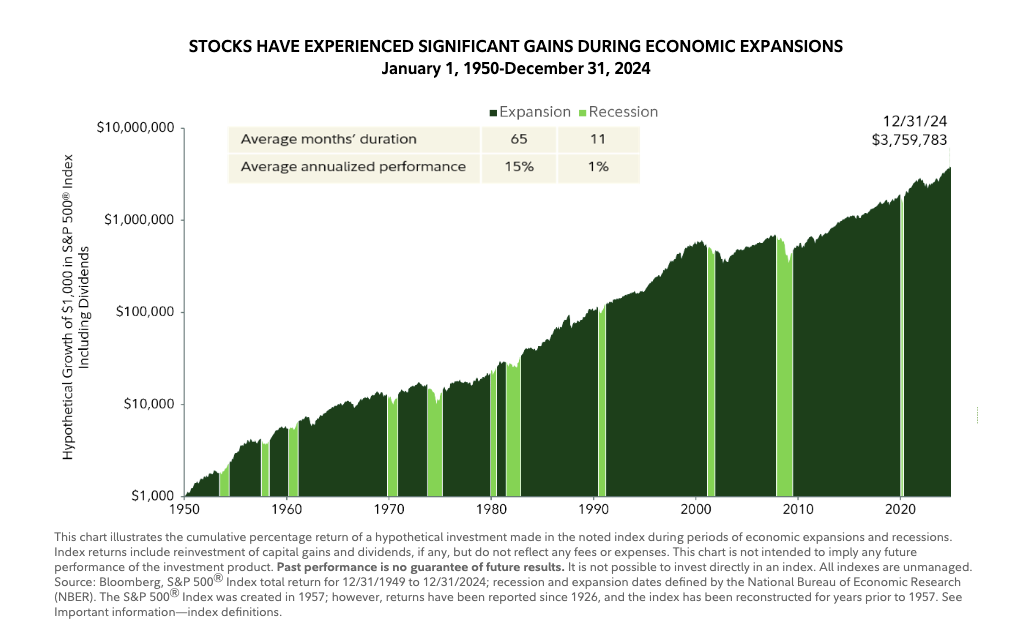
Financial planning is an emotional process. We are talking about the heavy topics of the future and death. Data, when presented as thoughtfully as it is by Fidelity, can bring peace of mind to an emotional discussion. For example, using data from 1950 – 2024, Luke showed me a graph that illustrates recessions (bear markets) last ~11 months. Expansion (bull) markets last ~5 years. So why are we so much more panicked about recessions and less joyful about prosperous cycles? Because loss is painful and dangerous. As humans, we are biologically and neurologically primed to anticipate and protect ourselves from pain and danger. We’re not as primed to be as celebratory and hopeful as we are to worry.
(Since I’m a public historian, here’s a cool piece of secret finance history: The names of the two market types are derived from the animals’ attacking styles: a bull thrusts its horns up (prosperous market), while a bear swipes its paws down (recession). These terms evolved organically in 18th-century London’s Exchange Alley.)
Priming myself for peace
I grew up poor. Because I didn’t have enough, I thought I wasn’t enough. While I have overcome much of that thanks to therapy and a lot of personal work on myself, I remember exactly how I felt as a child. Truthfully, I never thought I’d be able to retire. I assumed I’d have to work until I was dead. Working with Fidelity and people like Luke, I’m hopeful about the future. I printed out that graph about the length of bear and bull markets and taped it up at my desk. This way, whenever these fears about money creep in, which invariably they will, I’ll look at that graph and remember all I have to keep doing is exactly what I’m doing. I do have enough. I am enough.
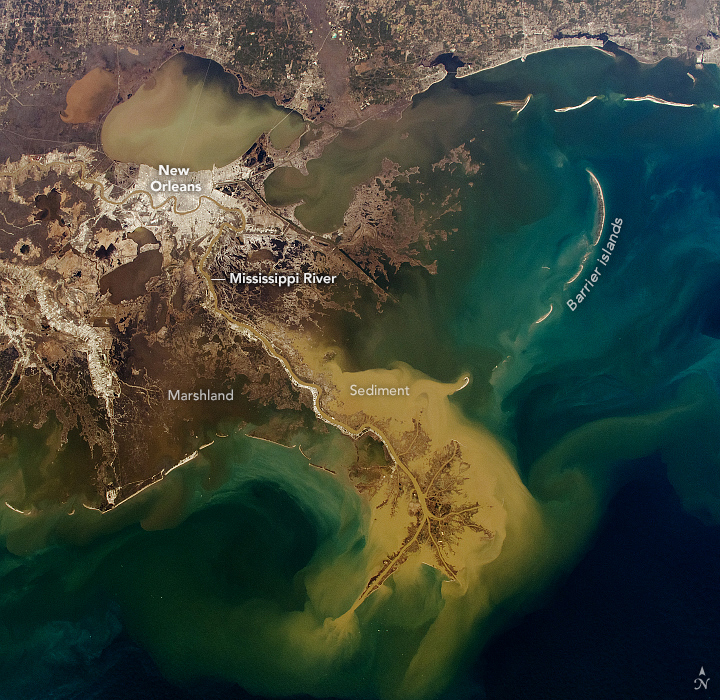
A Gulf Coast storm followed by snowmelt in January 2025 temporarily increased the Mississippi River’s outflow, sending a surge of sediment through the delta and into gulf waters. NASA.
We often talk about climate change in the future tense, but the physical reorganization of our world is already happening in real-time. It is a story of where we can stay, where we must leave, and how we might restore the land and waterways that connect all species that share this planet. For more than a century, people have built rigid concrete defenses against rising sea levels and in an attempt to dam and direct rivers to suit our immediate needs. But the physical reality of our planet is now demanding a total reorganization of where—and how—we live together as part of an ecosystem that is far bigger and more powerful than us rather basing our construction on the belief that people can dominate nature.
As we face this transition in mindset and practical living, we are guided by a fundamental climate choice first formulated by physicist and former presidential science advisor Dr. John Holdren:
We basically have three choices when it comes to our changing climate: mitigation, adaptation and suffering. Holdren acknowledges that we’re going to do some of each. The question he asks us is what the mix is going to be. Increase one of the three, and we will do less of the second and third. To many minds, this is the goal: the more mitigation we do, the less adaptation will be required and the less suffering there will be.
Following on from his framework of these three pie pieces, I’ve been thinking about three distinct pieces of research that point us toward where the climate transition is leading us.
1. The Physics of Departure: The Sinking Gulf
A new study recently published in Nature Sustainability brings the urgency of Dr. John Holdren’s triad into sharp focus for the American South. In the Gulf Coast, specifically around New Orleans and the surrounding delta, researchers have identified a compounding crisis: the land is physically sinking (subsidence) at the same time the ocean is rising. This is a perfect storm that threatens one of the most culturally rich cities in the U.S.
The Acceleration of Relative Sea-Level Rise
Using high-resolution satellite data and GPS monitoring, the study reveals that the land in this region is moving downward at a rate significantly higher than previously estimated. This creates a Relative Sea-Level Rise that is often double or triple the global average. While the world discusses centimeters of rise over decades, communities in the Gulf are dealing with inches of lost elevation in just a few years.
This subsidence is driven by a combination of natural sediment compaction and human activity, including the extraction of groundwater and fossil fuel. Because we have dammed the Mississippi River (as discussed in our next section), the natural delivery of new sediment that used to replenish the delta has been cut off. The land is starving for the very silt that used to keep it above water.
The Limits of Adaptation
When the land physically disappears, the limits of adaptation are breached. We reach a point where holding the line with higher levees and stronger pumps becomes a mechanical impossibility. We cannot prevent a flood with a tablespoon while the tap is turned up to full blast. This is rapidly shutting down the option mitigation. Therefore, it forces the zero-sum choice Holdren warned us about: New Orleans must choose between managed retreat—a proactive, planned relocation—or unavoidable suffering for those left behind.
Relocation in this context is not just a logistical move; it is a cultural crisis. To avoid mass suffering, we need a framework for place-making that moves entire community networks together. If we don’t plan for the transfer of the community—the music, food, heritage, and social bonds—we risk losing the soul of the Gulf to the rising water.
2. Working With the Water: America Undammed
While the coast sinks, our inland arteries are being liberated through a radical shift in infrastructure policy. As reported by theNew York Times, the United States is currently undergoing a massive effort to dismantle thousands of obsolete dams—many of which have outlived their 50-year lifespans and now pose significant safety risks to downstream communities.
This is proactive adaptation in its purest form. For over a century, we treated rivers as plumbing—static pipes to be redirected, blocked, and controlled. Now, we are learning that a free-flowing river is a far superior neighbor than one trapped behind aging concrete.
The Multi-Species Dividend of Restoration
When a dam is removed, the results are often instantaneous and transformative. By restoring the natural flow, we allow for the return of sediment—the literal building blocks of the land—which has been trapped in reservoirs for decades. This sediment is what naturally replenishes deltas and keeps coastal lands from sinking, directly impacting the crisis seen in and around New Orleans.
Furthermore, removing these barriers restores migratory paths for fish and wildlife that have been blocked for generations. It is an act of biological reconciliation that allows species to move toward cooler waters as temperatures rise, a key component of the Deep Adaptation required in a changing climate.
The Safety and Financial Calculus
Beyond ecology, the Undammed movement is a response to the mechanical failure of the 20th-century model. Aging dams are increasingly unable to handle the 1,000-year flood events that are becoming more frequent. Removing them is a strategic choice to avoid the catastrophic suffering of a dam failure. By restoring natural floodplains, we create massive, landscape-scale sponges that can absorb and slow down water surges, protecting human infrastructure by working with the water’s energy rather than trying to stifle it. We’ve made water a foe when we’re much better off giving it the room it needs to be our friend.
3. The Nomad Century: The Infrastructure of Global Movement
If the sinking Gulf represents the limits of adaptation and the undammed rivers represent the liberation of nature, then Gaia Vince’s book Nomad Century: How Climate Migration Will Reshape Our World represents the inevitable human response: The Great (Human) Migration. We are moving toward a reality where the map of human habitation must become as fluid as the climate itself.
To manage this transition without catastrophic suffering, we must move away from the 20th-century model of fixed borders and toward a 21st-century model of managed movement. Given our current geopolitics, this is getting more complicated (and contentious) by the day. There’s no doubt that this requires a radical rethink of our global systems across three specific pillars:
The Digital State and Portable Identity
In a world of mass movement, your identity cannot be tied to a physical piece of paper in a desk drawer that might be lost to a flood or a fire. We need a global framework for Digital Identity—portable, secure, and internationally recognized credentials that allow migrants to carry their medical records, professional certifications, and legal standing with them. This ensures that a doctor from a submerged coast can become a doctor in a receiver city on day one, rather than being trapped in a cycle of structural suffering and economic, intellectual, and talent waste.
The Rise of Receiver Cities
The green zones—latitudes in the north that will remain temperate—must proactively prepare to become Receiver Cities. This is the ultimate test of Holdren’s triad: by investing in massive adaptation now (housing, high-speed transit, and sustainable food systems), these regions can prevent the mass suffering of unplanned, chaotic arrivals. These cities must be designed as expandable machines, utilizing modular architecture and circular resource loops to integrate millions of new residents while maintaining ecological balance and social structures.
Deep Adaptation and the Preservation of Culture
Scholars like Jem Bendell have expanded on this reality through the framework of Deep Adaptation. It acknowledges that because global mitigation failed to prevent significant warming, we must now pivot toward valuing what we want to keep. As communities move, we must build systems to archive and carry forward the culture of humanity—languages, traditions, and social structures—so that when we relinquish the land, we do not lose the soul and the history of the people who lived there.
The Togetherhood Takeaway
We cannot command the planet to stay still. Our survival depends on our ability to move with the land and the water, rather than against them.
Audit the Mix: Look at your local climate initiatives. Are they focused on mitigation (reducing the cause), adaptation (living with the effect), or is your community opting for future suffering by ignoring the problem?
Audit the Choice: Demand that your leaders explain their Holdren Mix. Are they spending on adaptation now, or are they effectively budgeting for future suffering?
Map Your Resilience: Research the topography of your own region. Understanding whether your land is rising or sinking changes every conversation about long-term infrastructure and property.
Map Your Role: Research your own local geography. Is your community positioned to be a receiver of migration or a sender? This changes every conversation you have about local infrastructure and zoning.
Advocate for the Flow: Support local river restoration projects. Undamming a waterway is an act of long-term climate insurance for your entire watershed.
Practice Fluidity: In a Nomad Century, the most valuable skill is the ability to form deep community connections quickly.
Redefine Home: In a Nomad Century, home must shift from a static point on a map to a commitment to community resilience, wherever that community ends up.
The map is changing. To honor the planet and each other, we must have the courage to move with it. Will we each find it within ourselves to do the mitigation and adaptation needed to limit suffering? That remains the most potent question on the table today for every country, policy maker, and person. Eventually, nature will demand an answer.
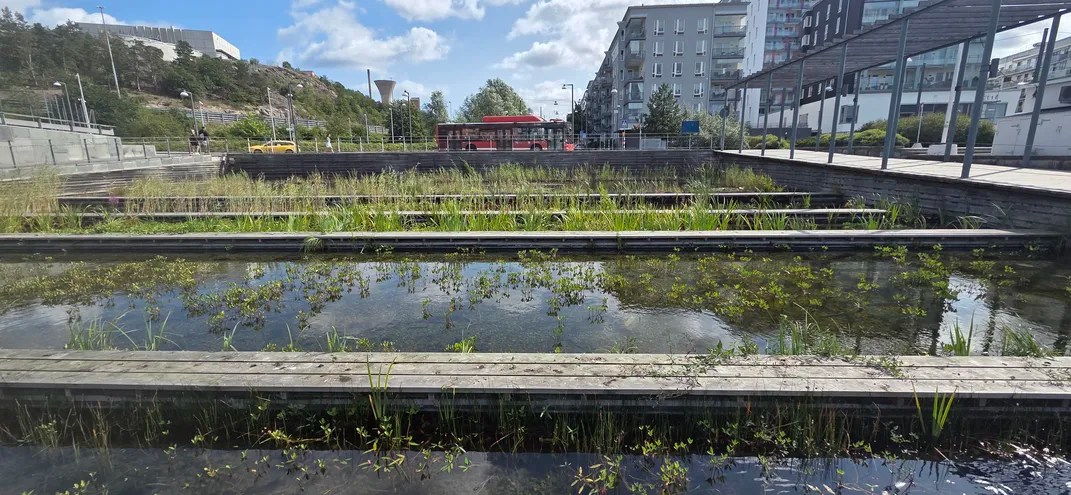
Just after graduating from my Master’s program at University of Cambridge / Cambridge Institute for Sustainability Leadership (CISL) last summer, I went to Stockholm, Sweden for vacation. While I was there, I stayed in a beautiful neighborhood that was a perfect melding of nature and city infrastructure.
Thanks to a very serendipitous bowl of soup, I learned from a waiter that this neighborhood had a secret – it had been transformed from a toxic, industrial wasteland into a living lab for climate action.
I had the opportunity to interview incredible people for this piece including the former finance minister of Sweden, the lead architect, energy and climate researchers, and the team members of ElectriCITY, the collective leading the district’s sustainability efforts. Their inspiring blueprint can be adapted and applied in every city, including my hometown of NYC.
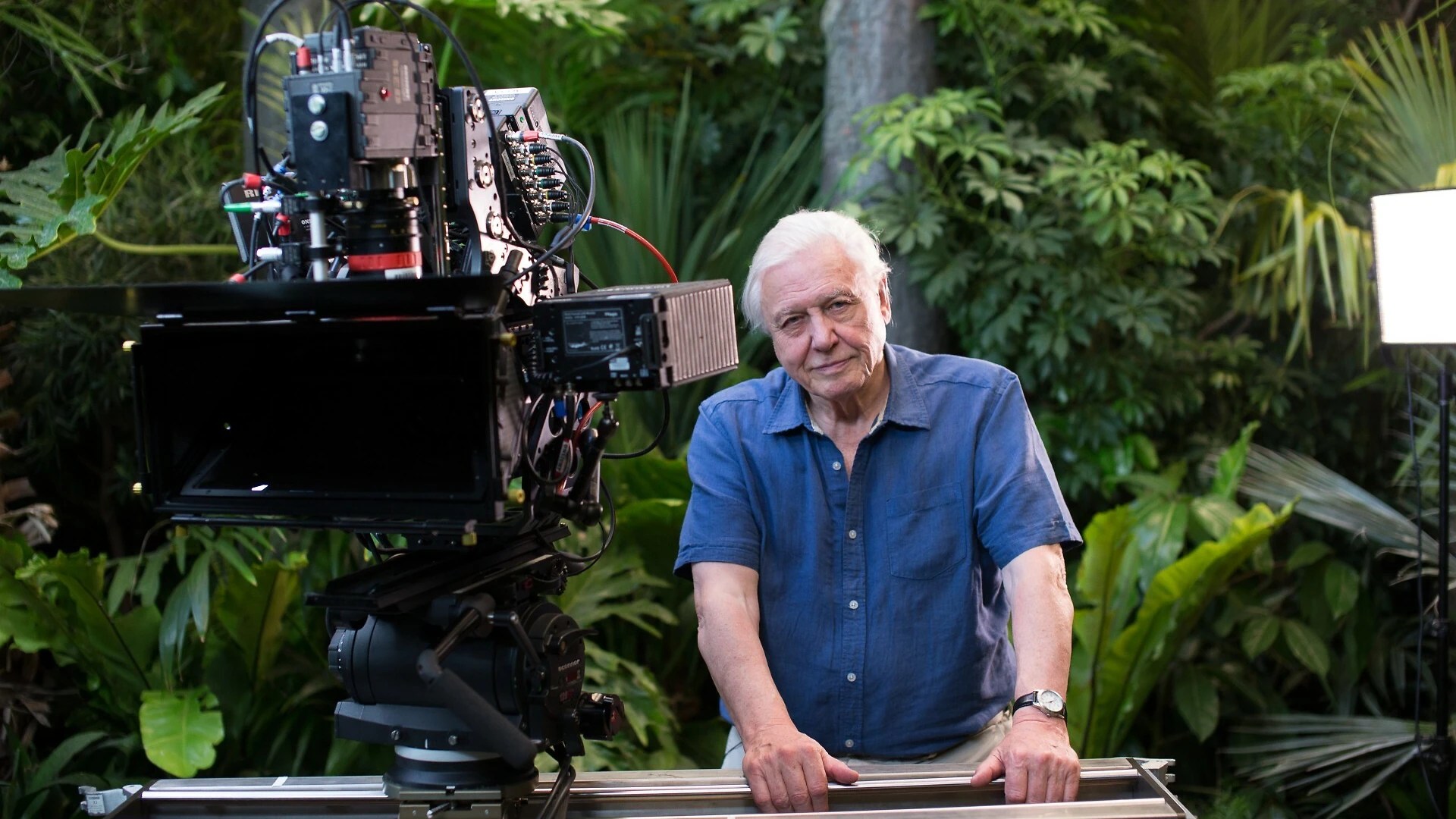
This Friday, the world celebrates a staggering milestone as Sir David Attenborough turns 100. For a century, he has served as one of nature’s fiercest advocates and storytellers, moving from showing us the beauty of the wild to imploring us to take a stand for nature’s survival and our own. His career proves that meaningful change is rarely a sprint; it is a relentless, lifelong commitment to shifting how we see the world and our place in it. I, like so many other people, have been profoundly influenced by him and his passion for our natural world. Graduating from University of Cambridge, as he did, after studying Sustainability Leadership set my life and career on a new course.
Doubling Down on the Blueprint
I have been thinking a lot about this long-term perspective lately, especially with the publication of my latest feature in Smithsonian Magazine. I spent months diving into the story of Hammarby Sjöstad, a neighborhood in Stockholm that set out with intensely ambitious sustainability goals in the 1990s.
When the project initially fell short of its targets, the community did not abandon the mission. They doubled down. A group of neighbors got together and created ElectriCITY Innovation. They treated their failures as data points and evolved their strategy, eventually creating a circular-economy blueprint that cities across the globe can adapt and apply. You can read the full story of their decades-long journey toward resilience in my new feature:
Whether we look at Attenborough’s hundred-year legacy or Stockholm’s thirty-year urban experiment, the lesson for our own communities remains clear: sustainability requires the stamina to stay in the game when things get difficult.
Celebrate the storytellers: Take a moment this Friday to watch a piece of Attenborough’s work and reflect on how his perspective shaped your own understanding of nature.
Audit your long game: Look at a sustainability project in your own neighborhood that feels stalled. Instead of viewing a missed goal as a failure, ask how you can double down and pivot the strategy like Stockholm did.
Share the blueprint: When you find a solution that works, document it and share it. Evolution happens when we learn from each other’s experiments, failures, and triumphs. Sustainability is not a one-and-done task. It’s a process of continuous improvement.
Nature and our cities both require us to think in decades, not just days. To honor Dr. David Attenborough and the beings with whom we share this planet, let’s keep building for the next century.