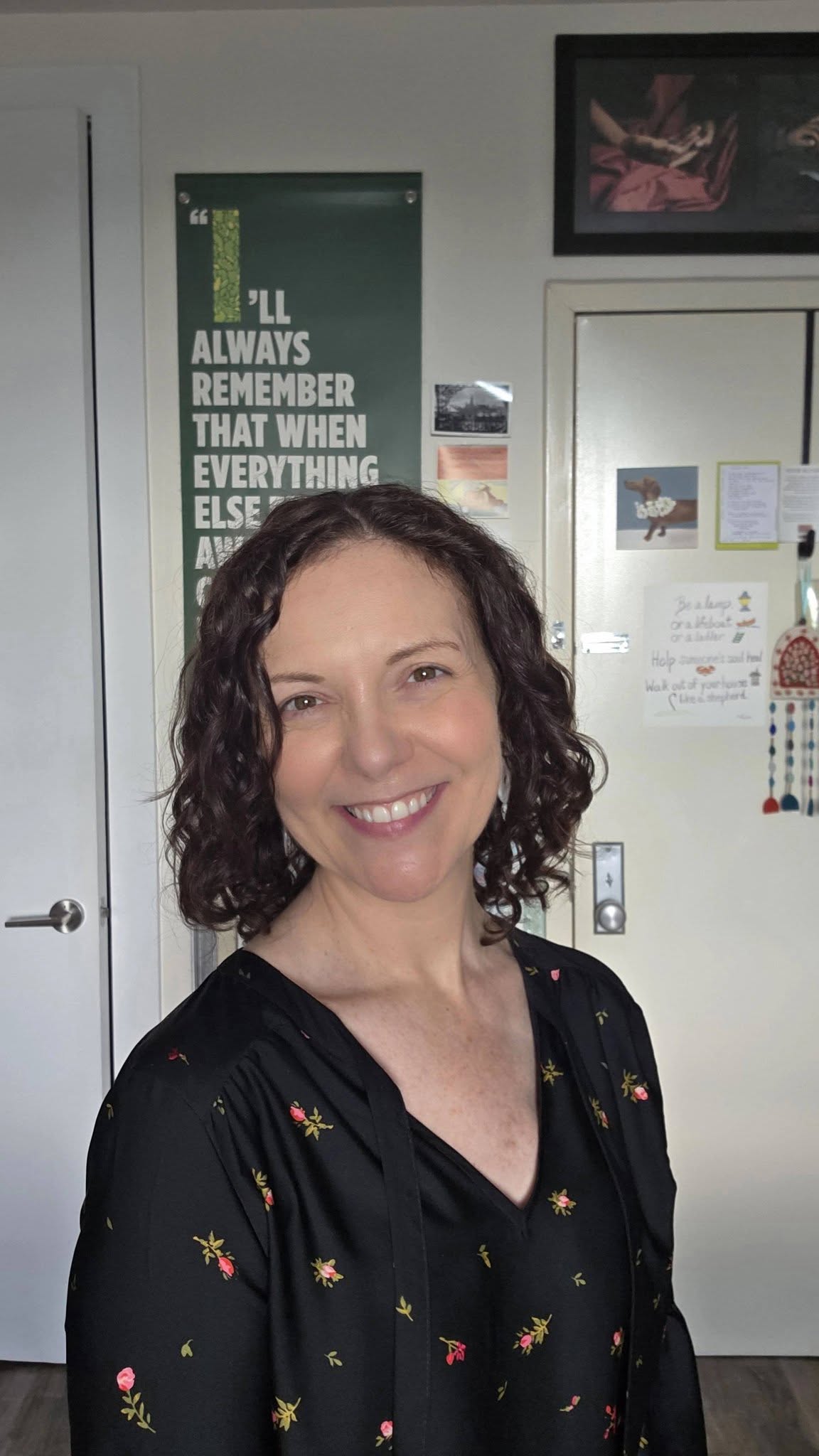
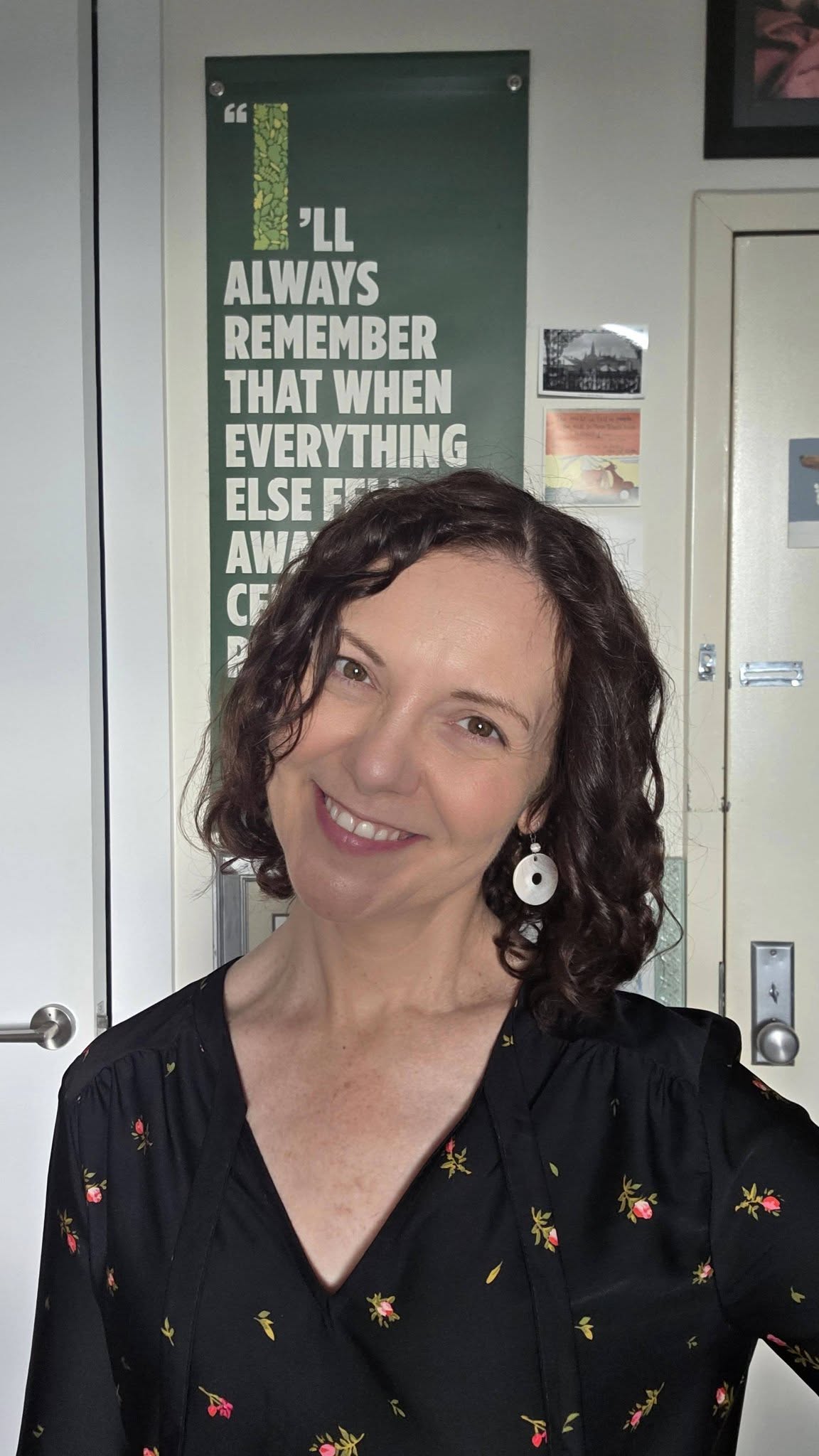
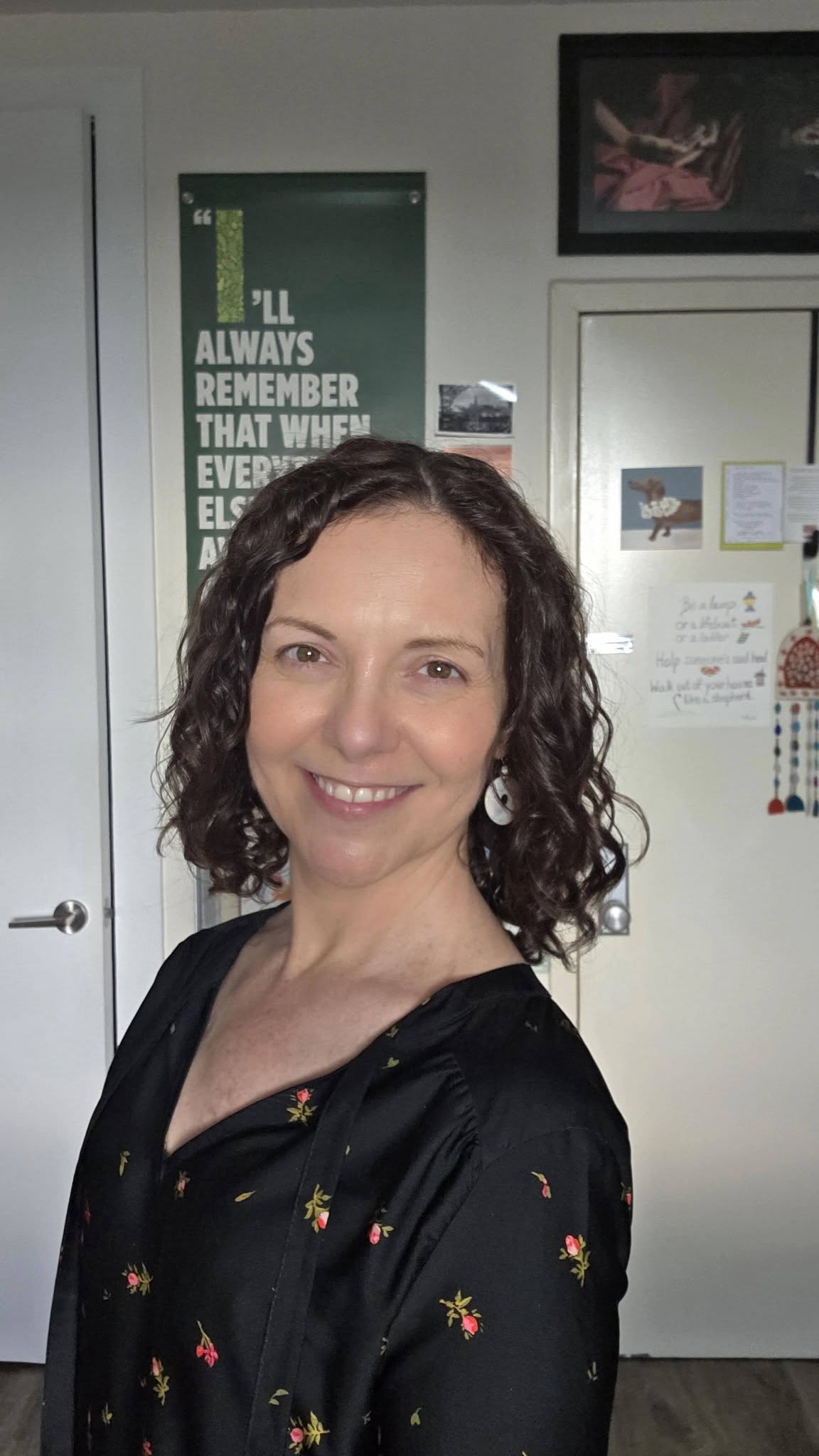
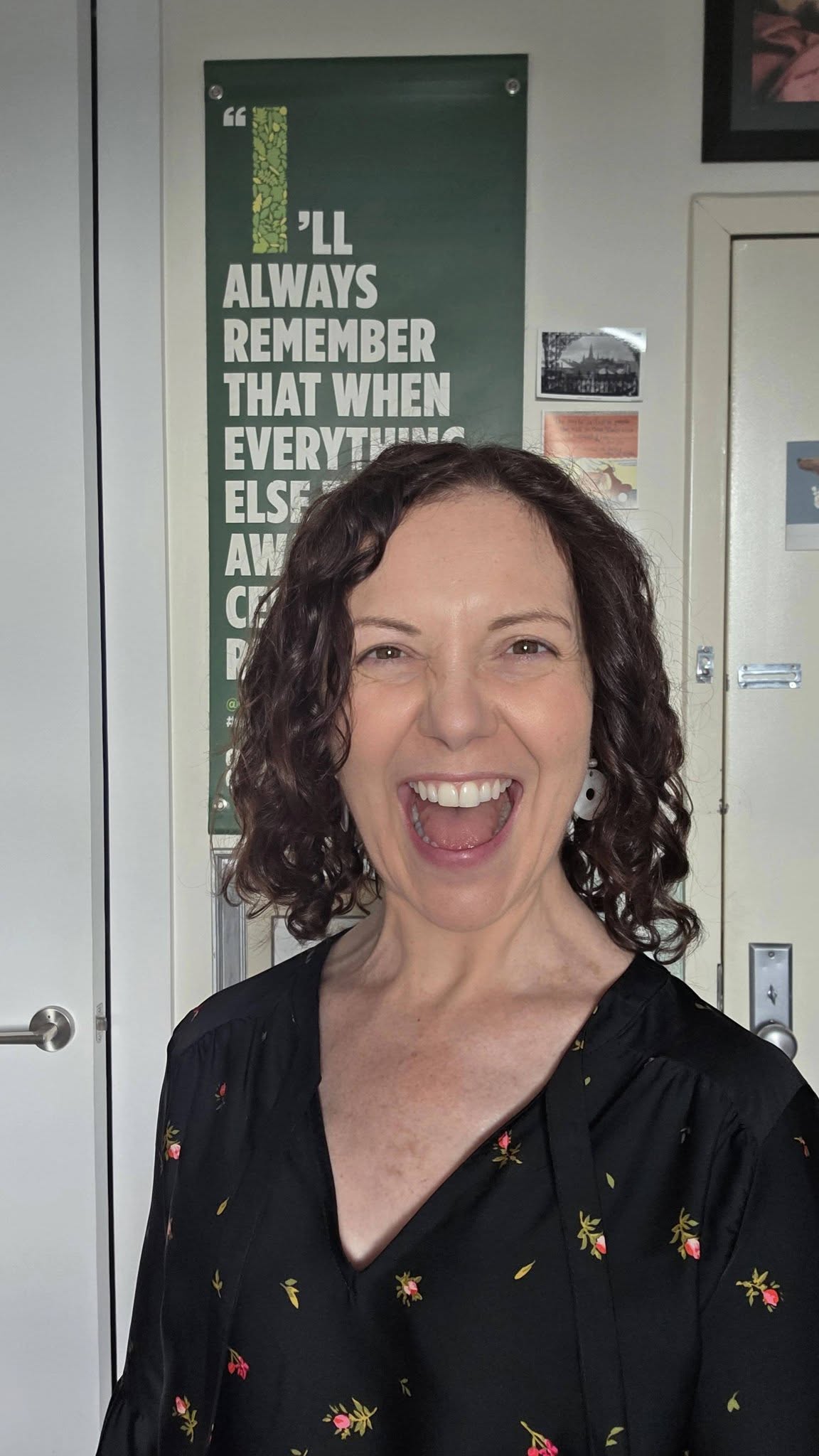
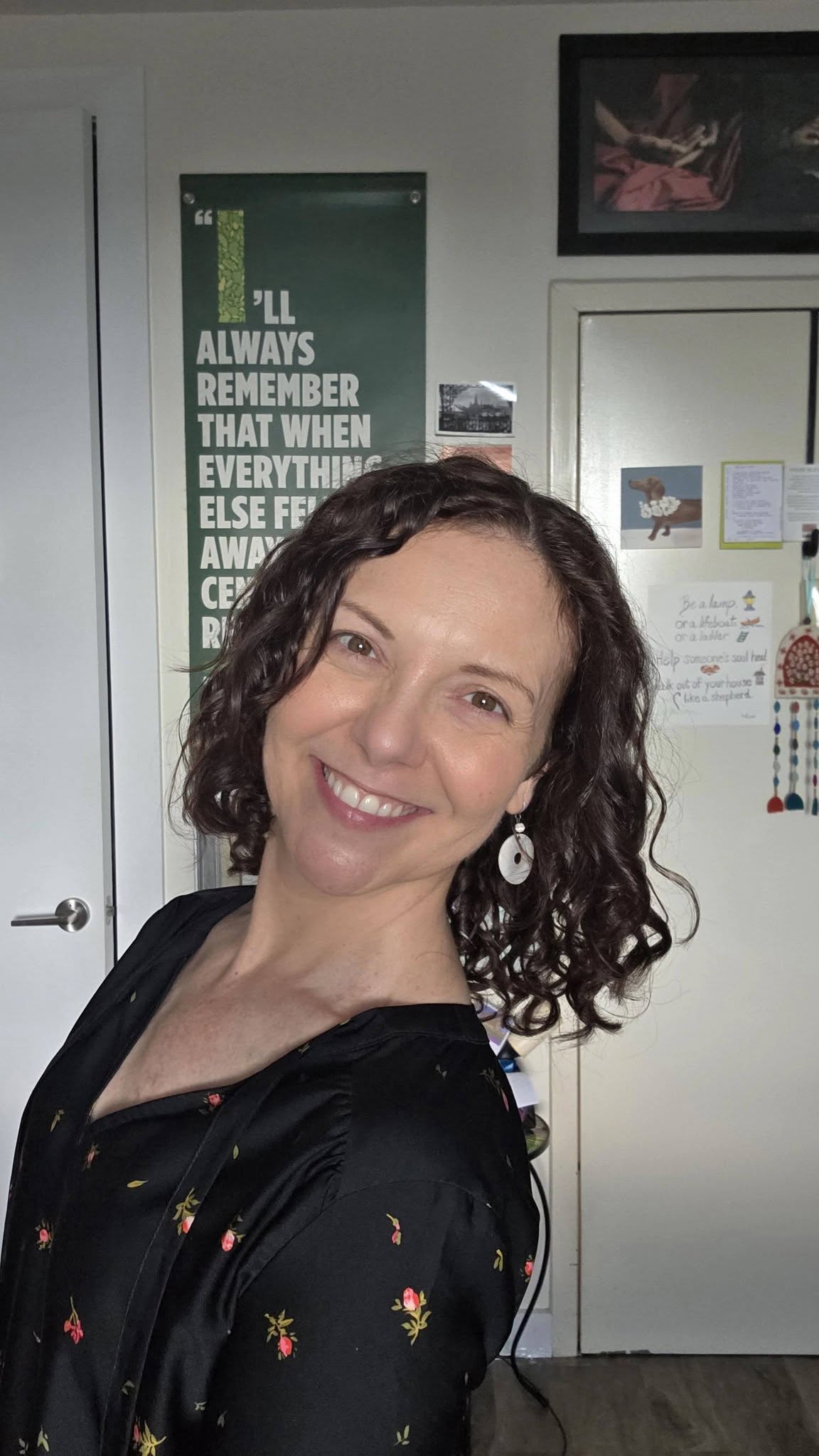
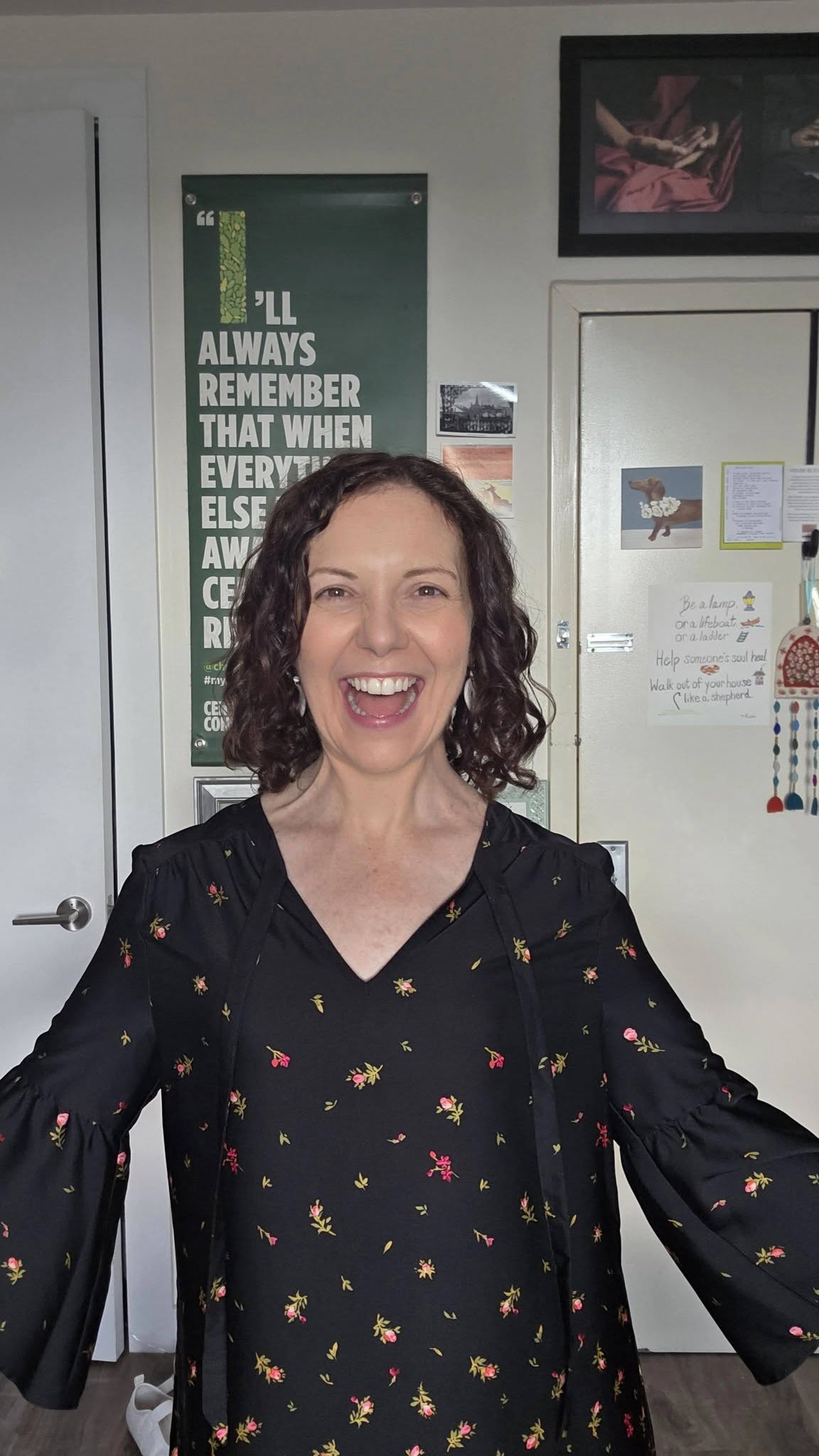
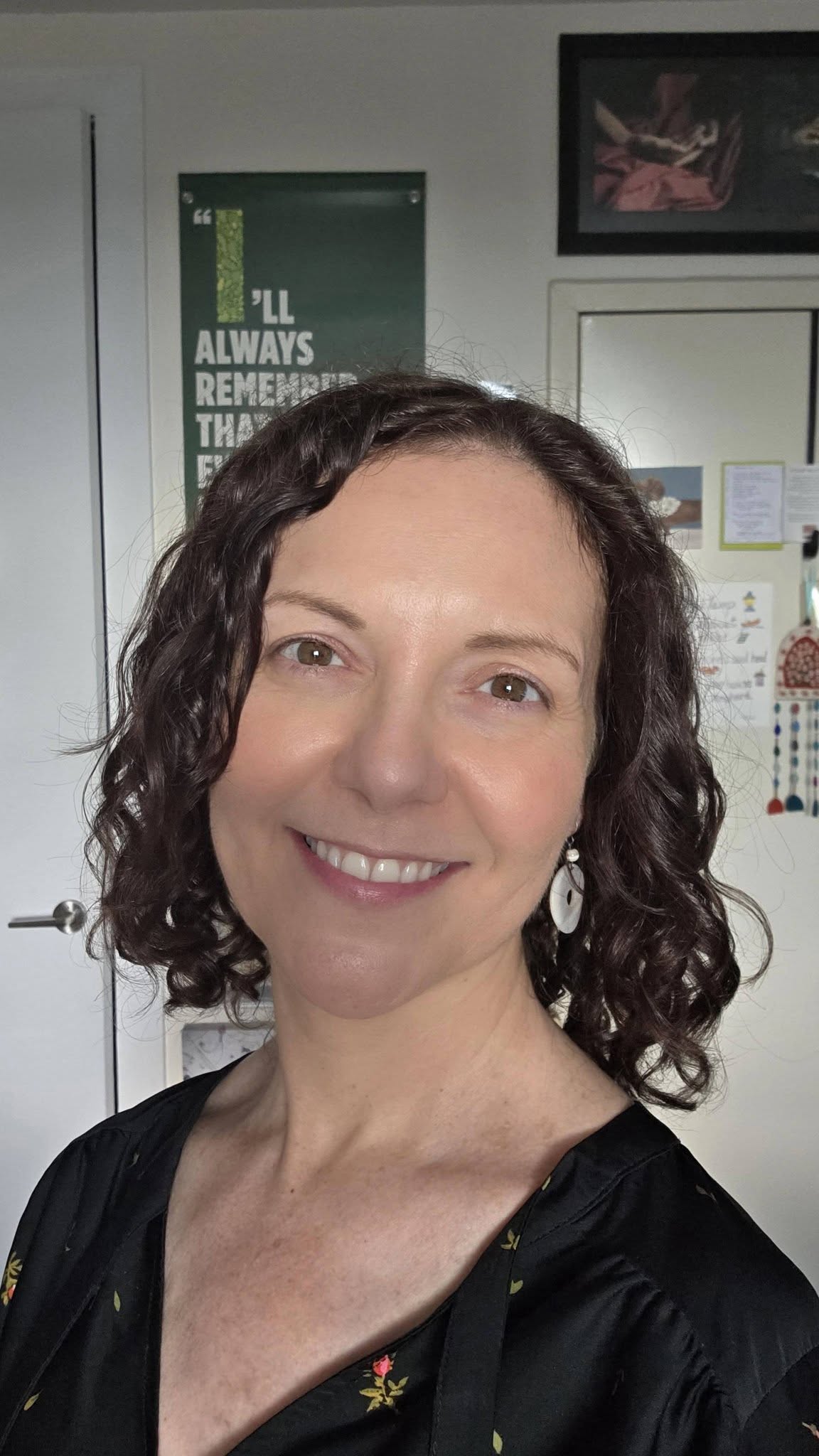
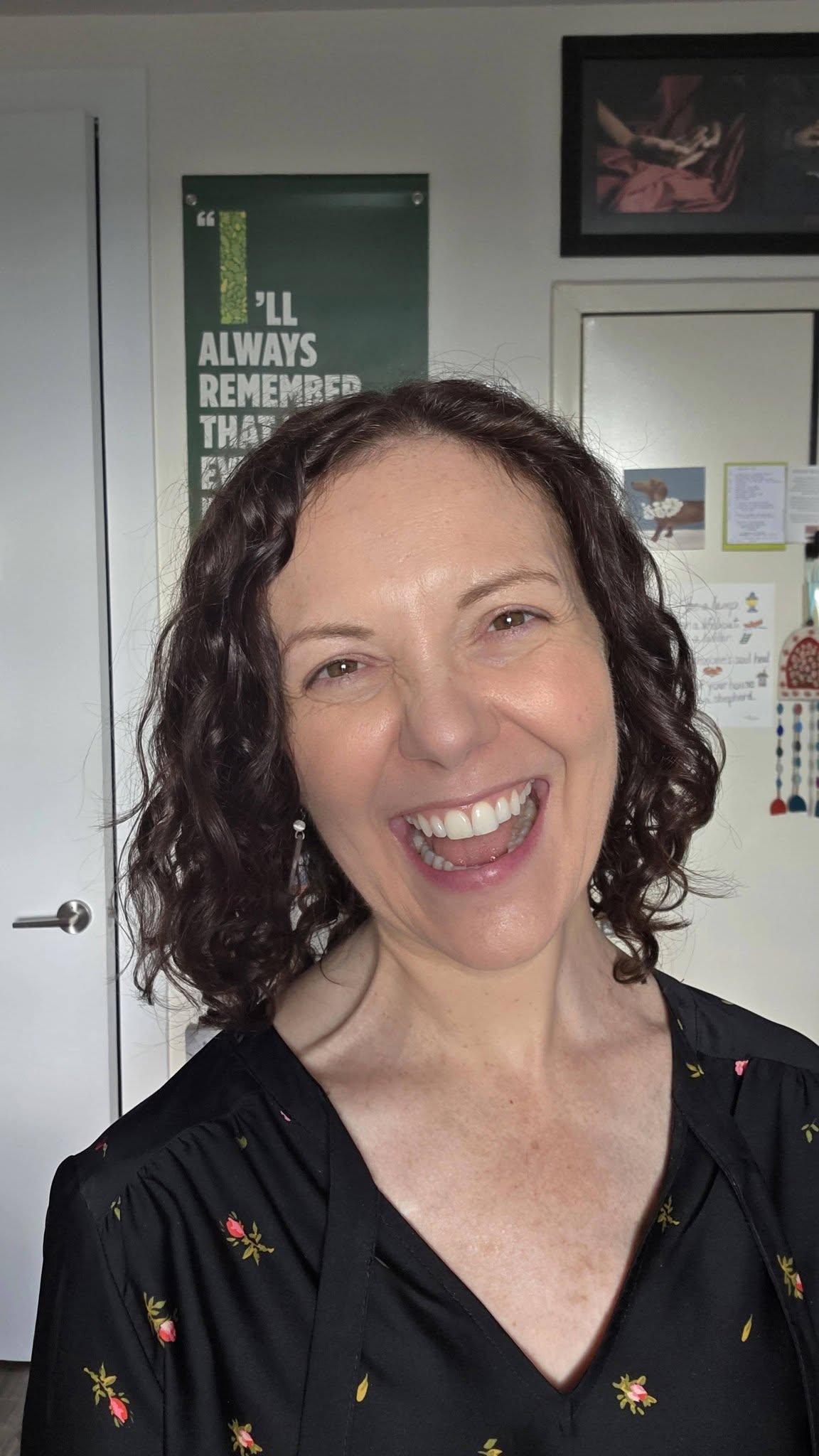
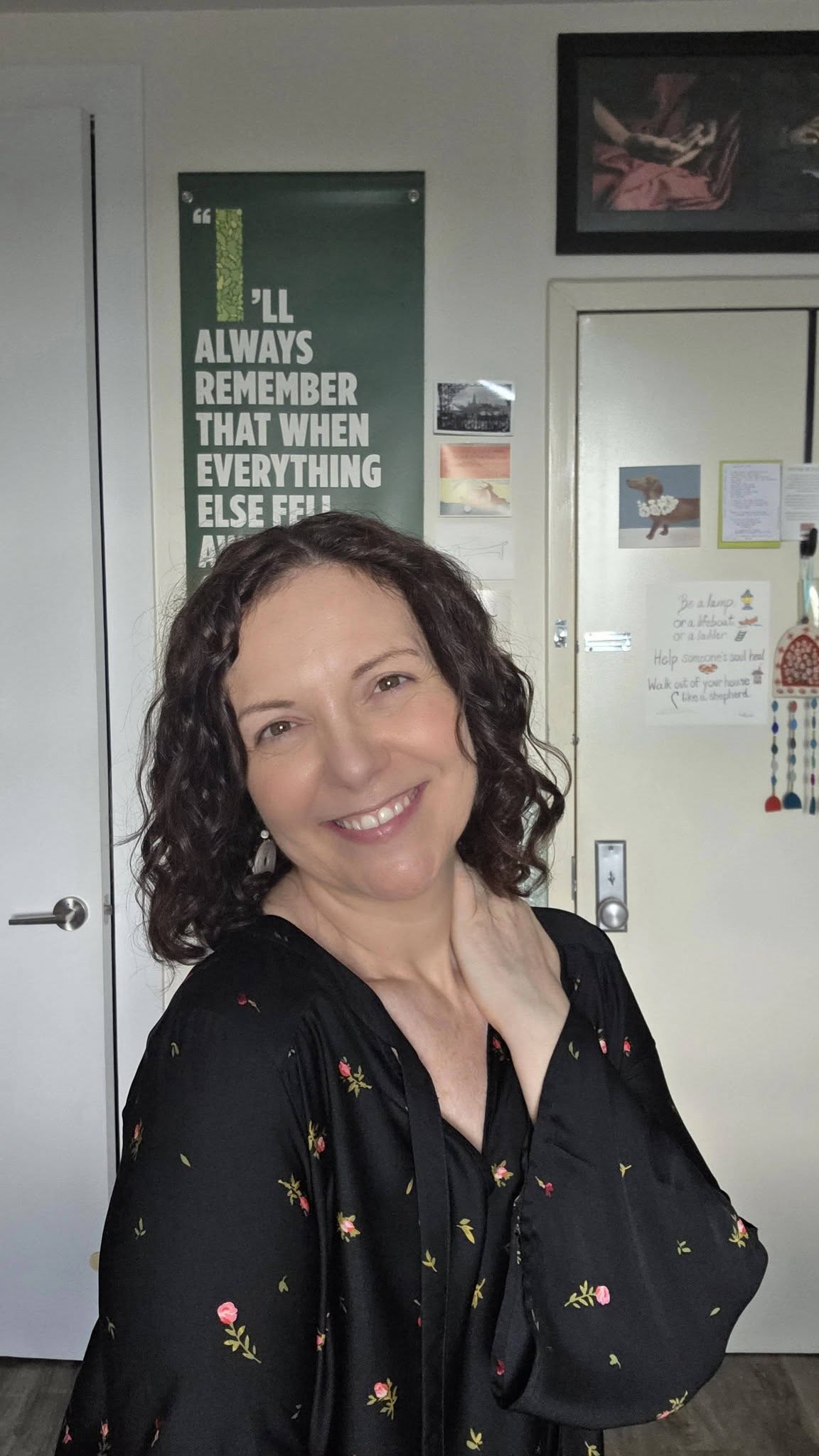
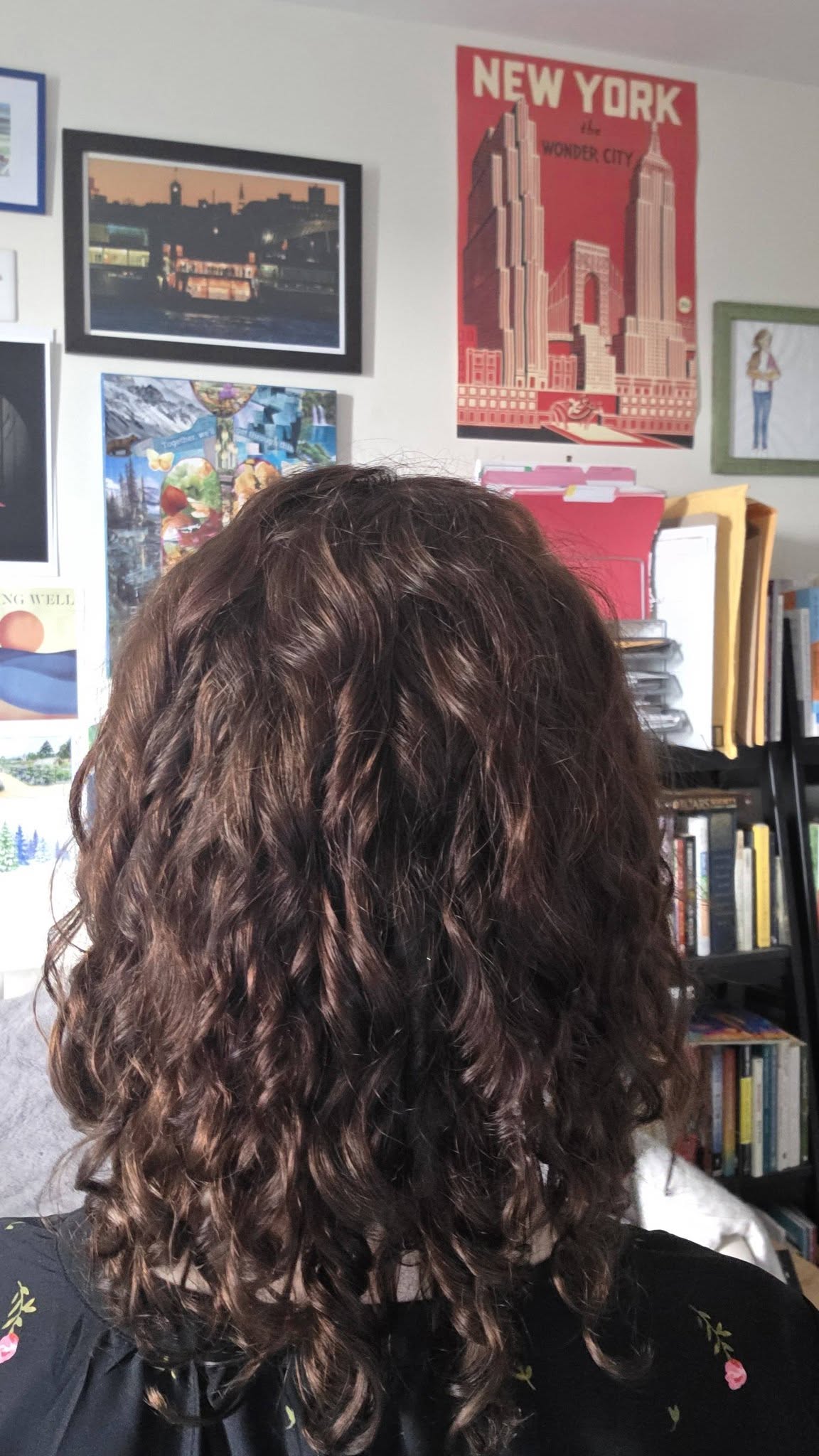
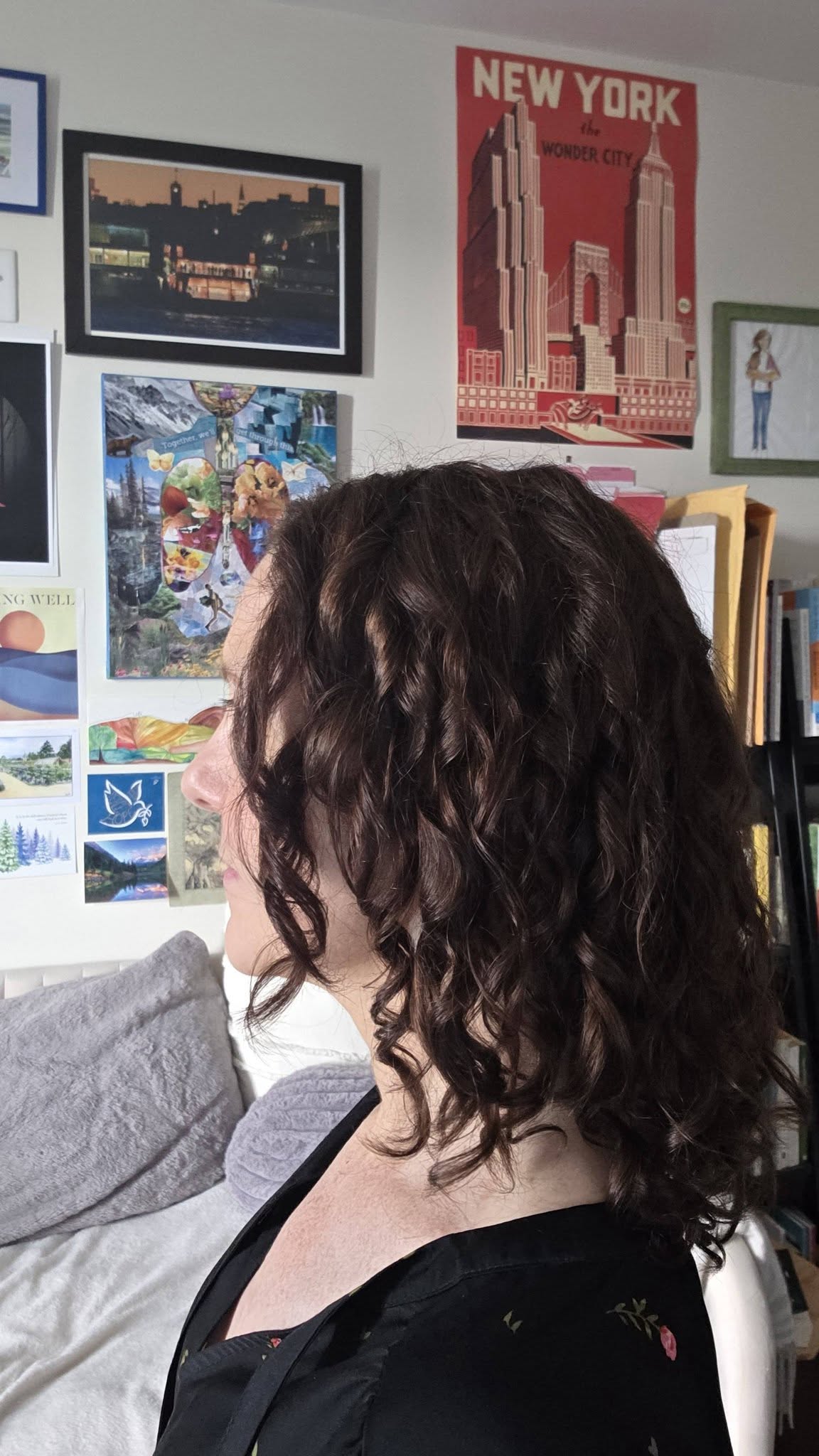
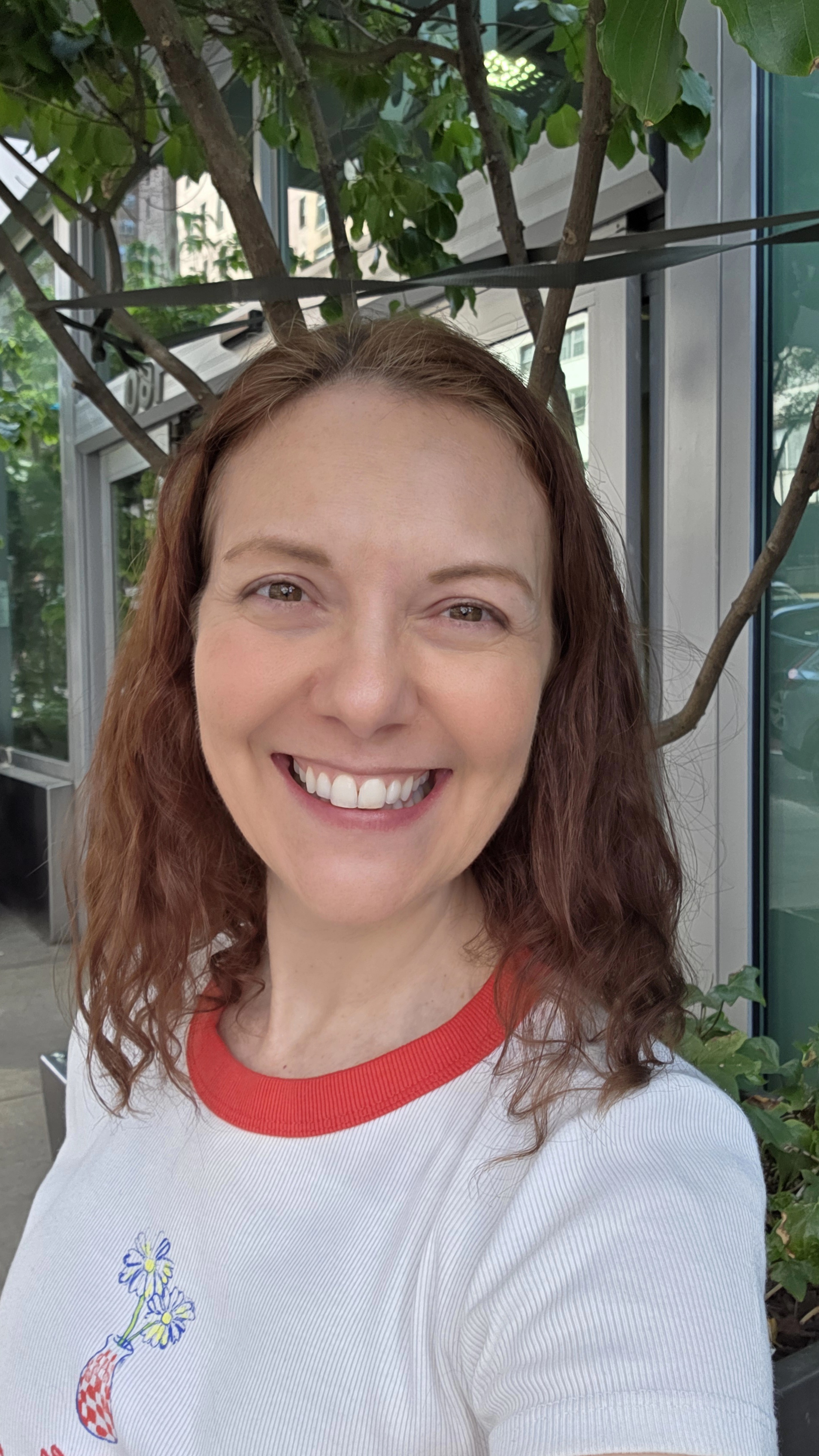
New hair. New me. My hair has quite a backstory. I haven’t sat in a hair salon chair in 5.5 years. Chemo, hormone suppression therapy, and regrowth took a lot longer than I expected, and the fear of letting go of any of my hair didn’t help. But I faced up to that fear, and here are the results from my first professional haircut since December 2020.
I’m so grateful to Penelope Love at Happy Sunshine Hair (and my wonderful Jane Cooke who connected me to Penelope!) for teaching me how to love and take care of my chemo curls that are now here to stay. She used my existing products. No upsells. No criticism. Just her talents, teaching, and support. She’s an independent stylist who rents her chair at a hair collective meaning the fee for the cut goes entirely to her, not a big brand. Happy Sunshine is a collective of 10 stylists making their way together in the beauty industry in NYC, a fashion capital of the world. (I’ll put a link to their site and Penelope’s in the comments below if you want to check them out!)
For most people, chemo curls fade after a couple of years, but I’m one of the few who is now a permanent curly girl. Penelope showed me how to own that with pride instead of mourning my original hair.
This weekend also marked a big medical shift. About 99% of the letrozole is now out of my system. The lupron will be hanging around in my system for a few more months while the tamoxifen ramps up. We’ll see how that goes!
I’m already feeling a lot better: less chronic pain in my joints and muscles, more flexibility, less fatigue and insomnia, fewer hot flashes, and less depression.
Cheers to starting a new chapter. I’m excited to celebrate with a vacation in Canada starting Monday. Let’s go have an adventure. I’m ready!
And here we go! This morning, I took my last pill of letrozole. This afternoon, I will see my oncologist, get the prescription for my new medication that will hopefully have fewer side effects and help me feel better, and start a cutting edge monitoring program that detects even a hint of recurrence at the cellular level. (More on that in a later post.) Happily, I will NOT have to get a lupron shot as part of my appointment; I’m done with those, too.
Just before I woke up this morning, I had a dream where I was standing at a podium, talking about what I learned from cancer. I woke up and wrote down as much as I could remember. Cancer taught me:
1.) to give myself grace and give myself a break
2.) I have the right to feel all my feelings
3.) to be tough and more empathetic
4.) I can feel complex, conflicting emotions
5.) to be fearless
6.) how to ask for help and stopped feeling any shame about anything
7.) to let my light shine.
8.) there’s absolutely nothing wrong with loving the crap out of everything.
9.) to go for it, whatever it is.
10.) to tell my friends I love them all the time.
11.) I don’t need to spend time doing anything I don’t want to do. If I can’t do it with my whole heart, then I just don’t do it. If I’m in the midst of something and getting no joy from it, I stop.
12.) stop pushing through just to prove I could. To live, sure. Out of of some made up obligation, nah. The word “should” has left my vocabulary.
13.) to love working out every day.
14.) to take a lot of pride in taking care of my health – my diet, my stress level, my mental, physical, and emotional health. I’m healthier and more whole than I’ve ever been.
15.) to be grateful for all of it.
Thank you to everyone who helped me along this journey. I still have 5 more years of medications, and I’m celebrating this milestone. I’ll take every win I can get. Long may they continue.
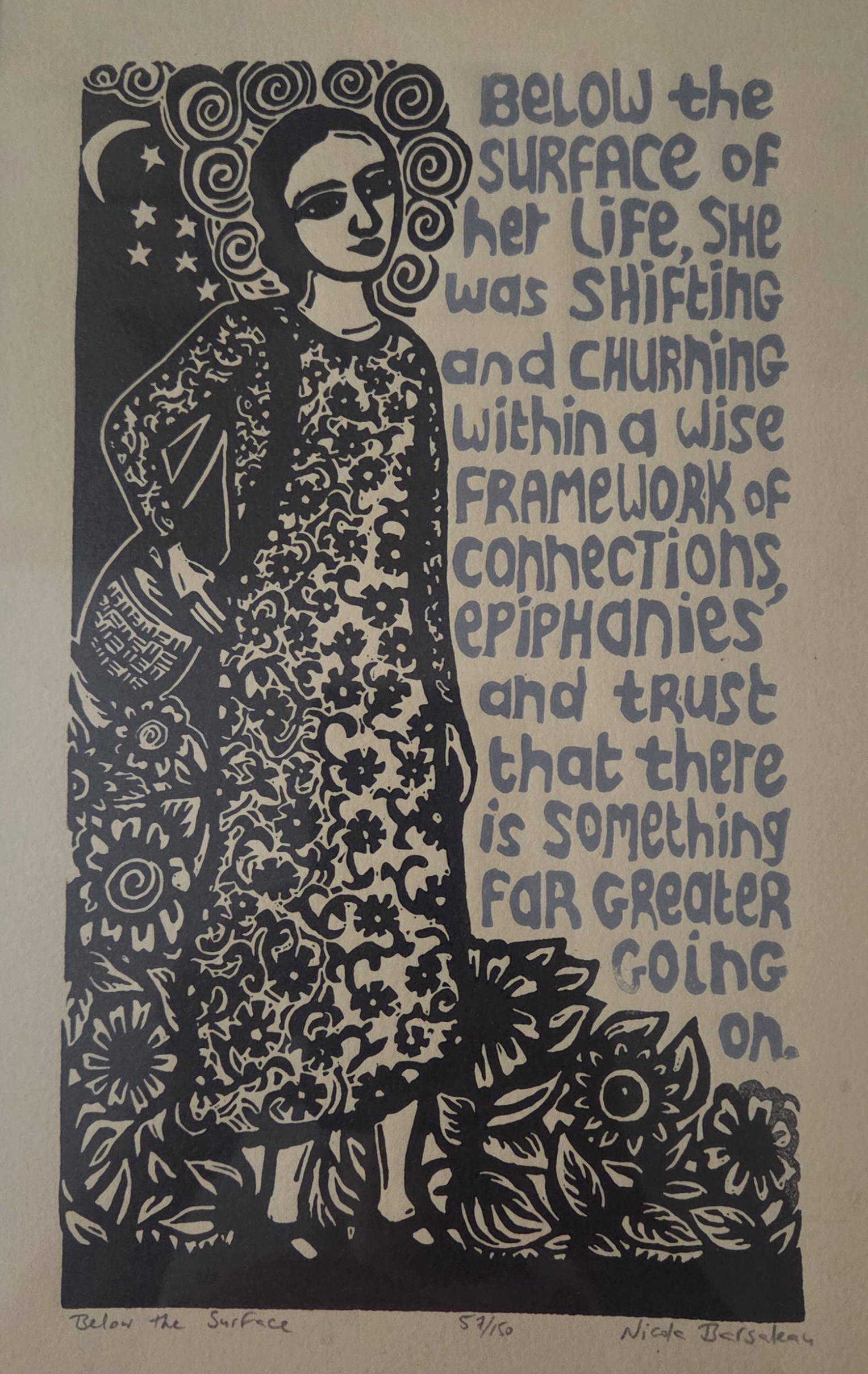
Print by Nicole Barsaleau. Photo by Christa Avampato.
My friend, Alex, sent me this print by Nicole Barsaleau a few years ago. I have it framed in my kitchen and I read it often. It reminds me of something my therapist, Brian, said to me many moons ago: “The prana (the all-knowing energy) cares about you and also cares about the system.” In other words, as we get better, we make everything around us better, too.
When I first got sick, I was angry and confused. How could this happen to ME? I try to do everything right. I follow all the rules and best practices. I take care of myself. How could I get cancer at a young age? Scientifically, I knew I was exposed to toxic fertilizers and industrial pollution in my hometown where I grew up. I understood cancer happens when one of our cells has a mutation that our immune system misses and then it quickly replicates while masquerading as a normal cell. Cancer is a sneaky little f*cker.
“This cancer came to hone you,” Brian said in one of our sessions as I was preparing for surgery and the long treatment road. “There will be a kind of death. And also a rebirth.”
To which I responded, “The Universe couldn’t hone me with something that WASN’T cancer?!”
I didn’t choose cancer but I could choose how to approach it and learn from it. Part of living is to make meaning of the things that happen to us. To do some good with whatever finds us, particularly if we didn’t choose it. What good was I going to do with cancer if I lived to restore my health? That puzzle kept me looking forward and reaching out. It still does. Universe willing, I’ll be learning from cancer and using what I learn to help others for many years to come.
I’ve coached people through their own illnesses, many of them different types of cancer. I’ve participated in clinical trials that yielded new medications and treatments. I’ve referred friends to my doctors. I’ve written articles and done interviews about my experience and they’ve helped thousands of patients and caregivers make a way out of no way. My nearly dying from Taxol changed the way my cancer center evaluates bloodwork to identify a rare but potentially lethal side effect at its earliest stages. I’ve signed off to have my data join with thousands of others in enormous databases for scientists to use today and in the future.
“Use this body for science,” I tell my doctors. They did. They still do. They will continue to.
In an ironic way, cancer made me healthier, happier, more grateful, and less stressed because I learned to make my own health my single biggest priority. Without it, I can’t do anything for anyone.
Do I wish I could have learned that without cancer? Sure. Do I think I would have? Maybe briefly but it wouldn’t have stuck. Now, my body, mind, and spirit force me to maintain it.
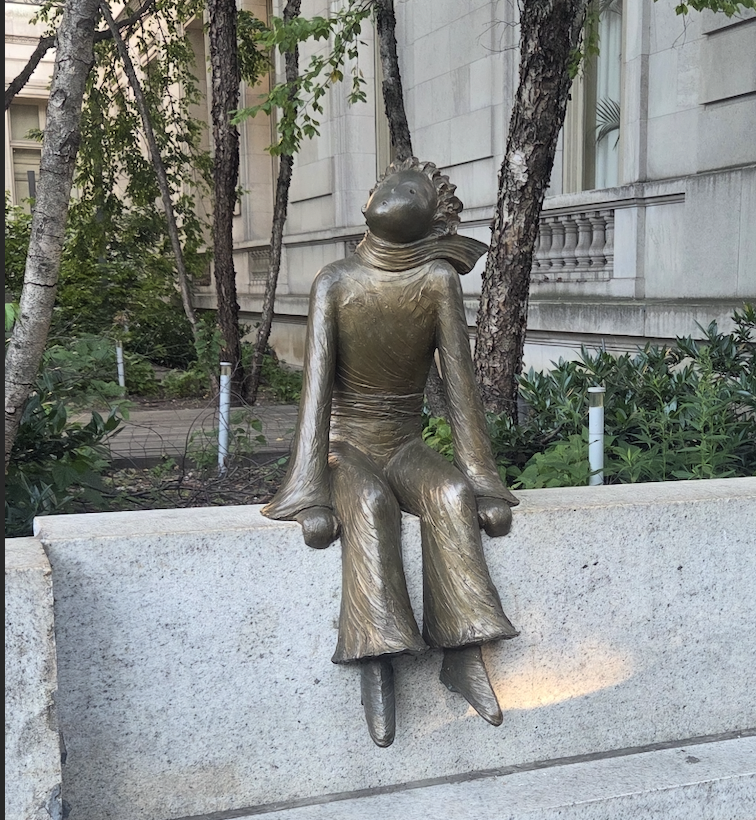
The Little Prince statue outside of Villa Albertine. NYC. Photo by Christa Avampato
“You never know how strong you are until being strong is your only choice.” ~Bob Marley
When I was going through cancer, a lot of people said to me that they couldn’t do what I was doing if faced with the same situation. They meant it as a compliment and I absolutely appreciated it. The truth is that strength was my only option. The choice was be strong or die. Blunt but true (this is basically the best description of me. Ha!)
A few years ago a dear friend of mine was diagnosed with breast cancer and she had to start making the lightning fast decisions I had to make. When I was going through it, she sent me care packages and messages of love and support. The first time I saw her after her diagnosis, she gave me a huge hug and said, “I knew you were going through a lot but I had no idea just how much it was. And you had to do it during the pandemic and on your own.”
She almost sounded apologetic. I told her very truthfully, “There’s no way you could have know. There’s no way to explain to someone what it’s like to have to face a bilateral mastectomy, reconstruction, chemo, radiation, and heavy doses of medications for a decade to try to save my life.” There just aren’t words to sum up all of that – the physical, mental, emotional, and spiritual strain. The only people who really understand are people who live it.
I recently heard about a program called Camp Breastie, a summer camp of sorts for breast cancer survivors organized by the nonprofit The Breasties. The article said one of the most profound benefits of the camp is that attendees don’t have to explain what they went through or how it felt because everyone there just knows. Everyone gets it. And there’s a real freedom in that. And so, I’m thinking about going next year. I’ve coached a number of people through cancer and health challenges after surviving my own. I think going to this kind of event would be a way to fill my own cup, to care for myself. It could be another source of strength; after all, building community builds us up.
So here we go – the first day of my month of reflection as I count down to my medication switch. One thing I’ve learned on this long cancer journey is that helping others helps me. Even when I feel down and out, and that’s happened many times over these past 5 years, helping others gives me a boost.
My souldog, Phineas, was a great comfort to me during this time so when he passed away in January 2024, I was absolutely gutted. That was the lowest I’ve ever been. A home without him was a terribly sad and lonely place. I tried everything to get through that time – grief counseling, donating, talking to friends, keeping myself busy with work and every activity I could find, writing my graduate school dissertation. I would love to tell you that helped but it barely moved the needle. You know what helped? Fostering dogs through Muddy Paws Rescue. Since November 2024, I’ve had 15 foster dogs and they gave me a place to pour my love for Phinny that was physically tangible. That’s what I needed.
That’s why I’m participating in the Muddy Paws Rescue Pack Challenge where I raise money to help save rescue dogs from now until July 23rd! And I’d personally love your support to help more people find their Phineas!
In addition to fostering with Muddy Paws, I also volunteer at events, review foster applications, do welcome calls for new fosters, and help the Development team raise money. Every dollar we raise goes to helping the dogs in our care. We get ~1,000 dogs adopted EVERY YEAR and this spring we celebrated our 10,000th dog getting adopted.
If you’ve been looking for a way to do something good for the world, this is it! Every single dollar helps me save more dogs. I’m so grateful for every single contribution, and so are the dogs.
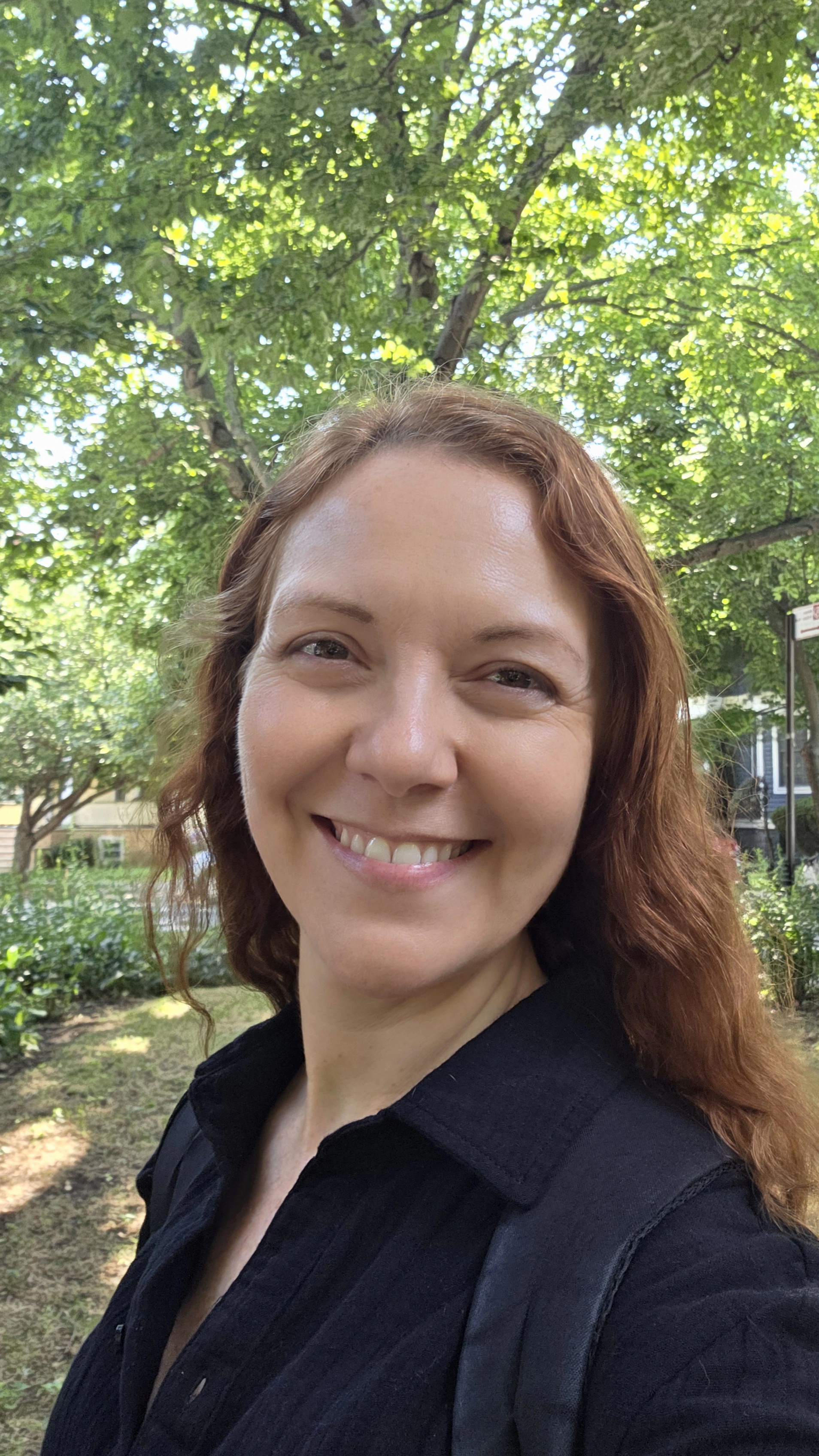
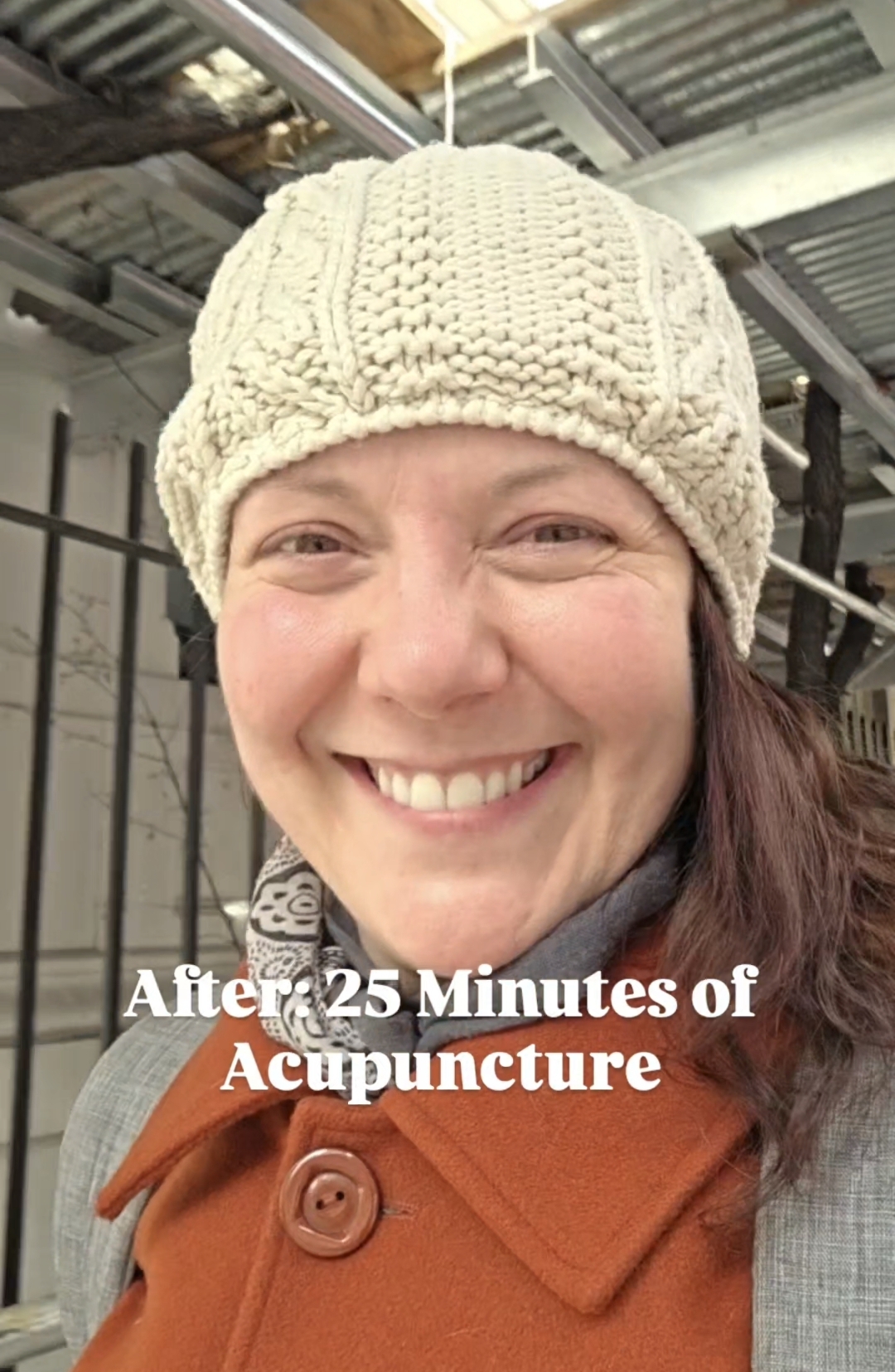
This is me after acupuncture today. It was my 10th session with the incredible Dr. Degenhardt at NYU Langone Health. My body’s responded so well to the treatments that I have no more blocks in my body. Now we are moving on to strength building in my core, left hip, and left leg. This is a huge milestone and we got here much faster than expected.
Tomorrow marks my 28 day countdown to my medication switch. Over the weekend, I opened my last bottle of letrozole – a medication I’ve taken for 5 years to prevent cancer recurrence. The side effects it’s caused, along with the side effects from my other treatments, are what brought me to Dr. Degenhardt. The medication did its job, and also took its toll. The hope is that this new medication will be easier on my body.
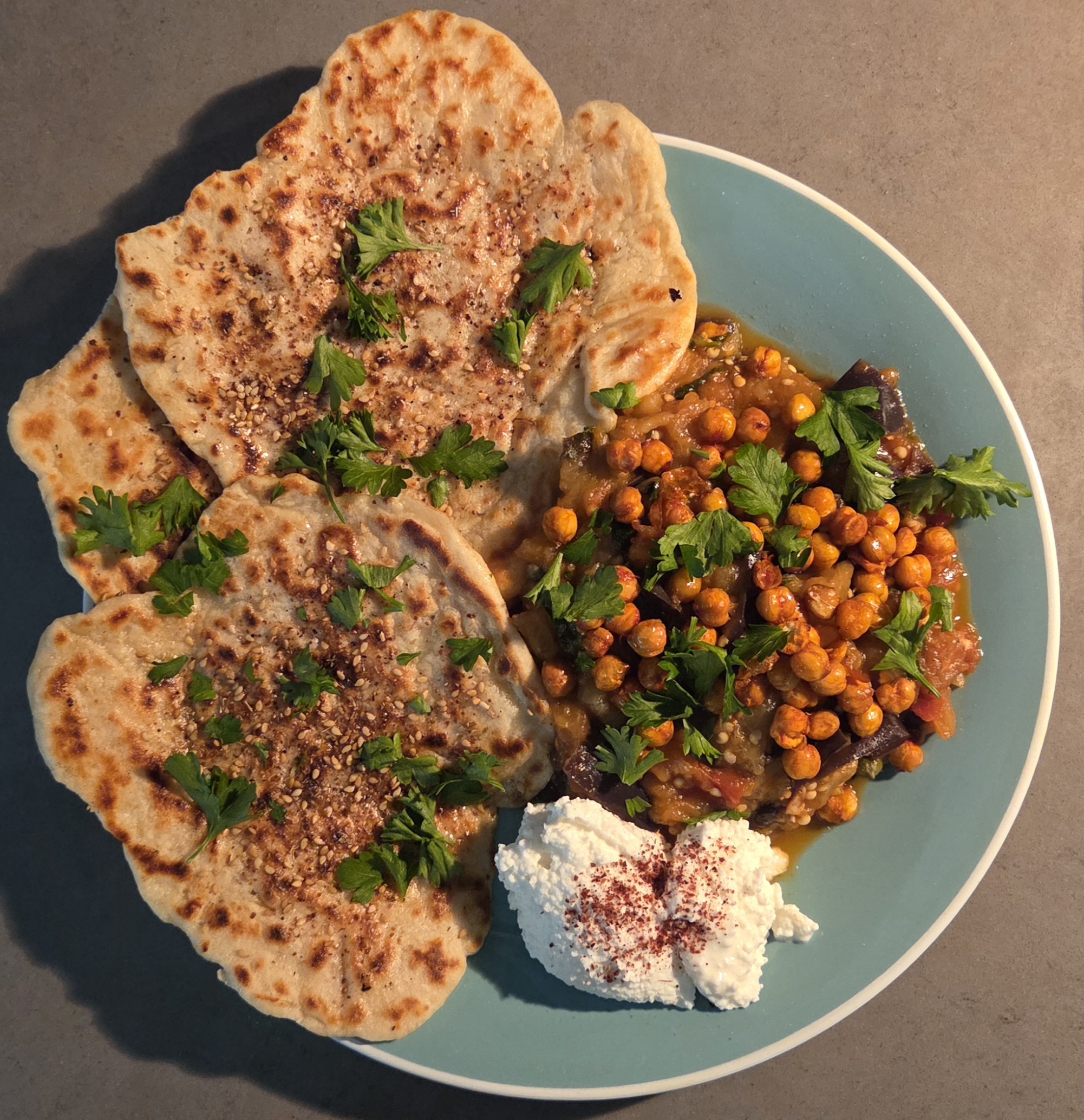
To mark this turning point, I made a special dinner: zaalouk, a Moroccan dish that is synonymous with celebration. It’s meant to be scooped up and savored with our hands – a tactile experience to nourish ourselves. I made these za’atar flatbreads by combining greek yogurt, flour, salt, baking powder, and olive oil. It’s all topped with toasted harissa chickpeas – a symbol of prosperity, continuity, the cycle of life, feminine health, the sustaining power of nature, and the desire for a good life. All fitting for this day.
When I was a kid, I loved making paper chains that countdown to Christmas. When I was going through radiation (another treatment that precipitated side effects Dr. Degenhardt is clearing!), I made a paper chain with inspiring quotes to count down the days of that treatment. I’m going to do that this month as well, but rather than a paper chain, I’m going to count down the days by sharing my thoughts about these past 5 years via writing.
Thank you to everyone who has played a part in this journey in so many ways. I’m so grateful. I’m the luckiest, and I know it.
Yesterday, a new chapter in my life began. I got my last Lupron shot. This is a photo of me outside Perlmutter Cancer Center right after I got my shot. I couldn’t stop smiling, and right after this photo I cried many happy tears.
By the end of August, it will be out of my system and I’ll transition to a new medication regimen to keep cancer recurrence at bay now that I’m approaching the five-year mark since the end of active treatment. For a few weeks the old and new meds will mingle in my body — orchestrating the hand-off as one recedes into my past and the other ramps up to carry me into the future for the next 5 years. The hope is that this new medication will cause less chronic pain and fewer, less severe side effects than what I’ve been taking for 5 years while also protecting me from having a recurrence.
These past 5 years have required me to break down and rebuild every area of my life several times over. It’s felt like a constant dance of doing and undoing. Just as I started healing and getting my bearings, something else would send me back to square one. To get through, I reminded myself that this is exactly the process that also strengthens muscles. I’m very strong physically and mentally. I’m also very tired.
All I can do is what I’ve been doing. Living each day, one day at a time, as best I can. It’s all any of us can do.
After my June 18th storytelling show at the AKC Museum of the Dog, I’ll be taking it easy this summer, mostly because I need to start this new chapter as healthy as possible. As I bid farewell to these medications that massively impacted my body and mind, I’m grateful for their service and everything they taught me. I’m grateful that they worked as hoped, even though they made daily life difficult every day. I’m still here and that’s what matters.
On Monday, I felt like I walked through a portal into a different world. Not through a book or movie, but in real life. This is a story about determination, the power of technology to improve our health, and the desire to heal through a combination of Eastern and Western medicine.
The Long Tail of Cancer Treatment
When I went through ACT chemo, a notoriously difficult treatment, I received acupuncture with Ryan Smith after every round. I responded exceptionally well, experiencing fewer side effects than most because of acupuncture. Now five years into cancer survivorship, I face a lot of daily side effects that I need to manage: fatigue, pain, anxiety, hot flashes, insomnia, and weight management are just a few of them. In August, my med regimen changes because I am (thankfully and gratefully!) five years out from active treatment and disease-free. Med changes are frightening for me because when I transitioned from ACT chemo to Taxol, Taxol nearly killed me twice. It turns out I have a deathly allergy to it and I received dense-dose treatment. So, add that to my anxiety load.
I knew acupuncture could help with these side effects and ease my August med transition. However, the cost of regular individual sessions has gotten prohibitive in NYC, where I live. I searched relentlessly for an acupuncturist skilled at cancer survivorship who also took my insurance. I came up empty-handed every time. For years, I heard the common refrain: acupuncturists do not take insurance. Stop looking, bite the bullet, and pay the small fortune as an investment in your health.
And then I tried one last time. I called United Healthcare, my insurance company, to ask if I could submit partial reimbursement for anyone in their network. The agent came back with something even better: a list of medical doctors practicing acupuncture in my insurance network. I was floored. And then I immediately assumed the experience would not match the care I received from Ryan during my chemo days.
Hacking the System with AI
I popped the list of providers into AI, explained my needs, and asked if it could identify a doctor who met my criteria. AI returned one name and identified the perfect provider for me: an MD, MPH, and acupuncturist who takes my insurance, conveniently located in midtown Manhattan at NYU Langone (where I already get all my medical care) with stellar reviews of 4.8 out of 5 stars after almost 3,000 patient ratings. Rather than paying almost $200 per session, I will pay my $40 co-pay. My mouth fell open. Could this be the diamond I searched for all these years?
I went in for my consultation a month ago, and in 15 minutes he showed me exactly how acupuncture could alleviate my side effects because they all stem from my body’s structure. I wrinkled my forehead. Structural? He explained the radiation I received on my left side essentially split my body in half, tightening my entire left side from my neck to my toes, which directly contributed to my symptoms. Through a few quick mobility tasks, he demonstrated that the strength and flexibility of my right and left sides were so different it felt as if I was two different people. All of that tension originated from the radiation on my left side, causing my left shoulder to tighten and roll forward compared to my right. Acupuncture, over time, could unblock all of that, allowing us to reteach my left side how to stay open.
I told him I believed completely in the power of acupuncture, and he said I did not have to believe. I will actually see the effects after every session. We do mobility tests before the treatment, and then we repeat the mobility tests afterward.
The Moment of Release
On Monday, he combined acupuncture, heat, and electrode stimulus for my first session. My body accepted the treatment so readily that my left side was actually freer than my right side post-treatment. Even he was surprised at how much my body wants to heal. That release lasted for about 72 hours. Not bad for being crunched for five years. As I left the office, I felt my life begin to shift. I felt unleashed.
What Comes Next
Our plan includes weekly sessions for four weeks. Then we will re-evaluate. We also plan to try a few other complimentary treatments, including a saline drip he developed to release the layers of fascia in my scar tissue from one another. I cannot wait to see what lies ahead, and how healing myself will help heal the world around me. And I cannot wait to share it all with you.
Me at Macy’s in NYC 5 years ago, right after my second surgery
Five years ago, I was marching from the subway to NYU hospital for yet another surgery—two weeks after a bilateral mastectomy—with the high-stakes knowledge that if cancer cells were hiding in my body, my surgeon was going in to find them. This photo memory, which Google popped up yesterday, was taken right after I left the hospital and showcases the hope I felt that day.
I had this second surgery because the lymph nodes that biopsied negative for cancer came back positive in the pathology. Out of an abundance of caution, my surgeon said she wanted to remove all the lymph nodes under my left arm to see if any of those axillary nodes were positive. (She removed all the lymph nodes under my right arm during my mastectomy, and they were all negative, thankfully.) If any nodes under my left arm were positive, that would mean the cancer could have spread. This also meant that I would be at risk of lymphedema (swelling) not only in my right arm but now in my left arm as well.
My surgeon was devastated that this happened to me. She said, “I hate that every time you come into my office it’s a horror show. I keep pulling the rug out from under you. But I promise you this – if there’s cancer in you, I’m going in there to get it.”
While I was disappointed to have another surgery so soon and with such high stakes in the outcome, I wasn’t nervous. My surgeon’s confidence in her abilities gave me confidence in mine. I marched from the subway to NYU hospital that morning, ready for battle. I felt powerful and strong, like a warrior. I remember thinking, “Cancer, if you’re hiding in me, we’re coming for you. You can’t hide from us.”
I woke up quickly in the recovery room after surgery, completely alert and sobbing. Crying is a common reaction from anesthesia. The nurse was concerned I was crying with worry. I explained I was crying with relief and gratitude. A wave of peace washed over me: whatever the final pathology report said, we had done everything we could.
My sister came to pick me up, and she said, “What do you want to do?” I said, “I want to go for a walk.”
We walked to Macy’s to see the Christmas decorations – that’s where she took this picture of me. Then we walked home to get my dog at doggy daycare and back home to my Upper West Side apartment. It was a total of 4 1/2 miles. Those twinkling lights, the love from my sister, and that long walk made me believe that against all odds, I’d be okay.
We waited for a week for the results. I should have been panicked waiting for the results of the surgery. Again, I wasn’t nervous. We’d done everything we could. The results would be the results.
While we waited, my sister and I watched every episode of The Great British Baking Show. I took naps. We walked my dog. Friends called, brought food, and sent care packages. I knew my sister was scared. She was making plans to stay with me longer, preparing for the worst.
My surgeon’s nurse practitioner called me a week later. There was a delay in the results because the lab was backed up. She was so upset I was waiting this long, and I told her, “Don’t worry. I’m not worried.”
She called me back 10 minutes later. I could hear her crying. The results were in. All the lymph nodes were negative. No sign of cancer.
I did have some evidence of cancer cells in my breast tissue trying to escape to the rest of my body (this is called “vascular invasion”). With the mastectomy, we’d stopped them in their tracks. Still, with vascular invasion, chemo was recommended for me by a panel of oncologists that my team had consulted, not only at NYU, but at top cancer institutes across the country. So, chemo would start in a month, just before Christmas.
Though I didn’t know at the time that the coming chemo treatments would nearly kill me twice, in that moment, standing at the precipice of a new fight, I was simply and profoundly grateful for my surgeon, the dream that drove me to get tested in the first place, my sister and friends, my dog, and every breath I took.
Last week on another long walk, I went by Macy’s on my way to meet friends for dinner. How far I’ve come since that long walk five years ago. Their theme this year of “Give Love” is spread across the outside of the building in bright lights. I smiled at those words because 5 years ago cancer showed me that giving love is the secret of life. To love and be loved in return, in all the ways love shows up in this world and in our lives, is a gift beyond measure. It’s a gift I give and receive in greater amounts every day, everywhere I go. It’s the gift that keeps on giving.
Me outside the Perlmutter Cancer Center in NYC on October 29th after seeing my surgeon on the 5-year anniversary of my discharge from surgery
Last week I celebrated 5 years since the bilateral mastectomy that saved my life and removed any sign of cancer from my body. My friend, Wayne, describes journeys like this as a log flume. When we begin, we’re at the top of a terrifying drop. We’re scared, nervous, unsure, hopeful, confused, anxious. All the emotions of the human condition are raw and tumbled in our minds and hearts. We’re trying to keep our head up and our eyes ahead. we don’t want to take that plunge into the unknown. But we have to. We can’t turn around. The only way out is through.
And so, we take a deep breath, and we let ourselves fall. We face all the things we were afraid of, and then some. In every health challenge journey, circumstances arise that we never expected. In my case, I had to have another surgery 3 weeks later because lymph nodes that biopsied negative came back positive in the pathology. All the nodes from that second surgery were, thankfully, negative. Then I nearly died, twice, from a life-threatening allergy to Taxol, a common chemo drug, that shut down my lungs in the middle of COVID. My oncologist at the time thought I was being overly dramatic about my side effects when in fact I was suffocating. (I fired her from my care team, and she no longer sees patients.) My pulmonology team thought my lungs might be permanently scarred and I may need to have an oxygen tank for the rest of my life. Thanks to science and diligence, I fully recovered and now I’m healthier and stronger than ever.
I spent the evening of my 5-year surgery anniversary producing and hosting NYC’s Secrets & Lies – Ghost Stories. The irony isn’t lost on me—that I nearly became a ghost myself with so much life I still wanted to live and that storytelling and creativity have been two of my greatest teachers and healers.
In the wee hours of the morning after my surgery, I woke up in recovery. High as a kite on a massive amount of drugs, my nurse ran around the hospital to find me a turkey sandwich and to this day it’s the best thing I’ve ever eaten. I happily gobbled it down, watched a Harry Potter film on my tablet, and cried enormous tears of gratitude. There was less of my body in the world, but I was still alive, still breathing, and cancer-free. My greatest wish that morning was to see the sunrise so my nurse got me out of bed and wheeled me to one of the lounge spaces in the recovery wing so I could see the sun come up over the East River and the FDR Drive. I will never forget that view.
My surgery team members came to see me before I was discharged. My plastic surgeon who had placed the first installment of my reconstruction – the tissue expanders that would go on to cause 14 months of constant pain – told me that I woke up from anesthesia very quickly, before I’d even left the operating room. I began gushing how grateful and thankful I was to the whole surgery team. She said the entire team was laughing and crying right along with me. I have zero memory of this, and I wish I’d been fully conscious to remember it. Leave it to me to bring the funny in the darkest of times!
Then my breast surgeon came to check me before discharge. Through our masks, I thanked her for saving me and she said, “Sweetie, I’m just part of the team. And every person in this hospital shows up every day with the only goal being to help you heal. And you will heal. And how you feel now – the pain and the fear – it won’t always feel this way. We’re going to get through this together.” My dear friend, Marita, picked me up from the hospital and drove me home to where my sister and my dog were waiting for me. In the following months, so many beautiful friends sent me care packages, messages, cards, and food, and came to visit me from a distance – outside and masked. The trying times we made it through! I’m so thankful for everyone who cheered me on and helped me in a million different ways. I wouldn’t be here without you.
It’s fitting that exactly 5 years at that exact time she came to see me in recovery that I had my 5-year check-up with my breast surgeon. She gave me a clean bill of health, and we talked about the next 5 years of meds. She eased my mind and soothed my heart, as she always does, with science and compassion. We have a plan to keep me cancer-free, and I feel ready to start this next chapter.
I left her office with tears in my eyes and my head, heart, and spirit filled with gratitude for every second of these past 5 years. I’m even grateful for the worst days on this journey because I got to live them. Every morning, my first thought is, “Whew, I got another one!” Long may that tradition continue.
Below are photos of me on the day of my surgery and the morning after when I woke up and saw the sunrise







 Christa Avampato