creativity

The West Coast Has Underwater Forests. NYC Could Have Underwater Farms.

Sugar kelp can grow in the waters around NYC, and thrives during the cold winter months

I recently read a fascinating piece in Smithsonian Magazine about the “underwater forests” returning to life off the coast of California. It details the restoration of Giant Kelpโ€”towering, 100-foot strands that form cathedrals of biodiversity, sequester carbon, and shelter marine life.

Itโ€™s an inspiring success story of ecological recovery. But as I read about the Chumash people and marine biologists working together in the Pacific, I couldn’t help but ask a question closer to home: Could we apply this to the waters of New York City?

The answer is a resounding yesโ€”but it looks a little different here. And itโ€™s already beginning.

Different Coast, Different Kelp

In California, the focus is on restoration: bringing back wild Giant Kelp forests that have been decimated by urchins and climate change.

In New York and the broader Northeast, our opportunity lies in regenerative ocean farming. We don’t have the deep-water Giant Kelp; we have Sugar Kelp (Saccharina latissima). This golden-brown algae is shorter, but it is a powerhouse. It thrives in our cold winter watersโ€”growing rapidly when most marine life is dormantโ€”and acts as a “scrubbing brush” for our harbors.

Sugar Kelp absorbs carbon dioxide (fighting ocean acidification) and, crucially for NYC, it soaks up excess nitrogen from urban runoff, which is the main driver of harmful algae blooms.

We aren’t just “restoring” nature here; we are building a blue economy. Here are the local pioneers turning this idea into reality right now.

1. The Indigenous Lead: Shinnecock Kelp Farmers

Just as the Chumash people are leading efforts in California, the Shinnecock Indian Nation is leading the way on Long Island. The Shinnecock Kelp Farmers are a multi-generational collective of Indigenous women leveraging thousands of years of traditional ecological knowledge to heal the water.

They have established the first Indigenous-owned kelp farm on the East Coast in Shinnecock Bay. Their work proves that kelp isn’t just a crop; it’s a tool for sovereignty and survival, actively filtering the waters that sustain their community.

2. The Science: It Works in the East River

You might think kelp needs pristine, open ocean to survive. Think again.

Researchers Dr. Christopher Gobler and Mike Doall from Stony Brook University have been running pilot studies to see if kelp could survive the urban waters of the East River. The results were surprising: the kelp didn’t just survive; in some cases, it grew better in the nutrient-rich waters of the harbor than in cleaner, deeper waters. This suggests that NYCโ€™s “working waterfront” could double as a biological filtration system.

3. The Pioneers: Breaking the Regulatory Barrier

The technology exists, but the permits have been the hard part. The industry is so new that New York State didn’t have a regulatory framework for it until very recently.

In 2023, Violet Cove Oyster Co., led by former WNBA star Susan Wicks, secured the first-ever commercial permit to grow kelp in New York state waters (Moriches Bay). It took years of advocacy to get there. Her success paves the way for oyster farmers across the region to become “multitrophic” farmersโ€”growing shellfish and seaweed together to maximize the environmental benefit.

The Vision for a “Blue” NYC

Organizations like GreenWave are already training the next generation of ocean farmers, with a goal of creating thousands of jobs. Imagine a future where the New York harbor isn’t just a transit lane for ferries and cargo, but a grid of regenerative farms.

These farms would provide local food, sustainable fertilizer, and bioplastics, all while cleaning the water and capturing carbon.

Californiaโ€™s underwater forests are a reminder of natureโ€™s resilience. NYCโ€™s underwater farms could be a testament to our innovation. The seeds (or rather, the spores) have been planted. Now, we just need to support the regulations and organizations that will let them grow.

creativity

Baking up NYC history in cookie form

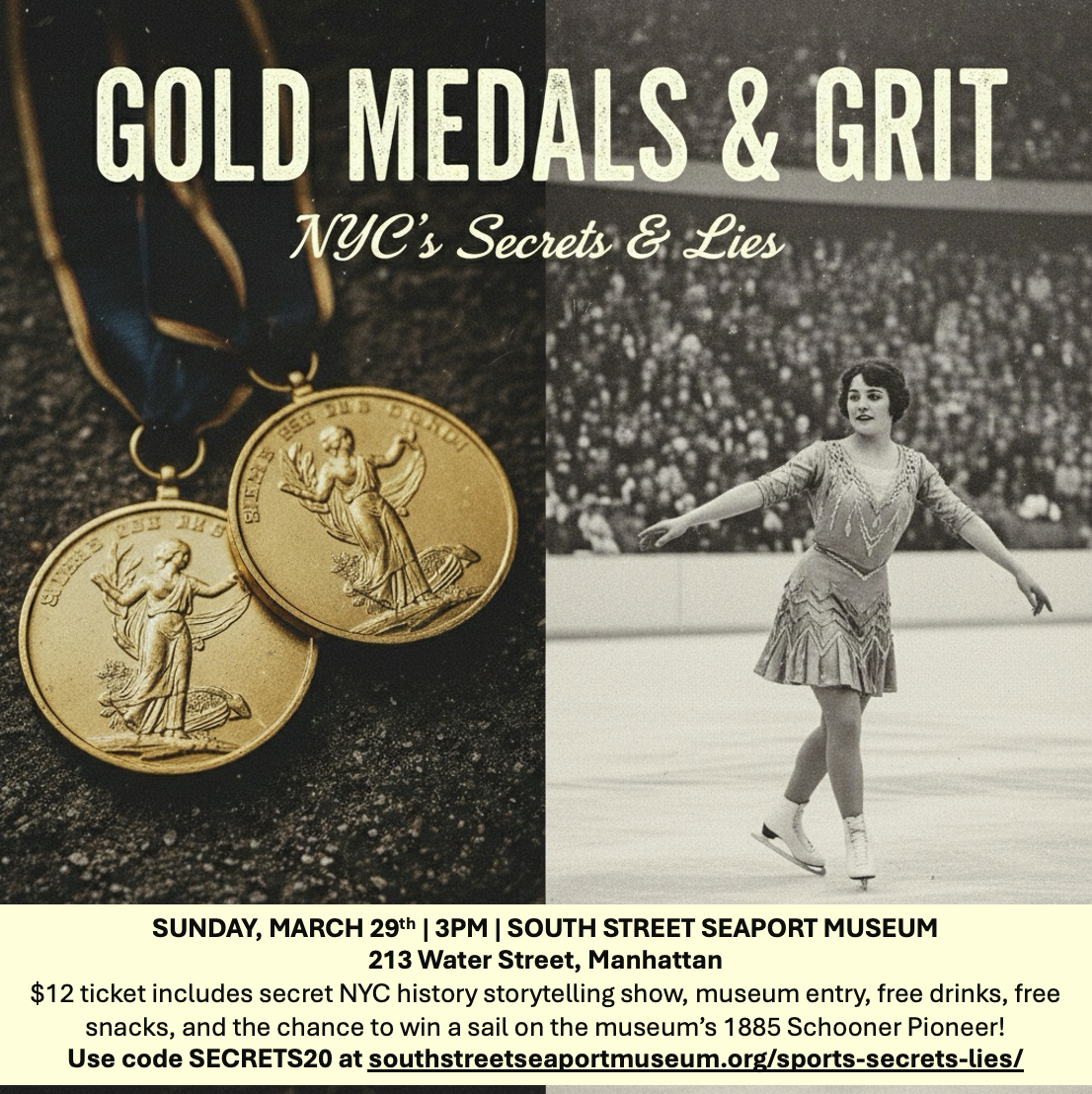
For the December NYC’s Secrets & Lies storytelling show at the South Street Seaport Museum, I baked 300+ cookies for our guests. All the recipes had a historical backstory and a maritime connection to match the theme of our show and the beautiful venue.

Iโ€™ve gotten messages asking for the recipes and the stories behind them, so here they are! Swipe through the photos to find the recipe cards and the history behind each cookie.

I hope you enjoy baking up a bit of NYC history with:

– The Captain’s Lie (New Amsterdam Lemon Jumbles)

– Sweet Corruption (Spiced Molasses Gingerbread)

– The Original Hustle (Dutch Shortbread Trefoils a la the Girl Scouts)

Since itโ€™s cookie season, I’d love to see your baking pics! Happy baking! โ„๏ธ

creativity

NYC’s Secrets & Lies: The Power of Partnership and Resilience in Live Events

Ashley Semrick, Erin Hunkemoeller, Carla Katz, and Christa Avampato

I’m proud to share that the NYC’s Secrets & Lies holiday show this week about secret NYC maritime history at the South Street Seaport Museum was a huge success! I’m still GLOWING from all the good cheer. โœจ๏ธ

This show is a dream passion project for me, and I feel so lucky to do this work. The phenomenal storytellers, the engaged and joyful audience, and the perfect museum partner team and venue made for such a special holiday celebration. I’m beyond grateful to everyone who came out to the show.

We had a packed house that enjoyed a special evening of history and stories, complete with snack table filled with historically accurate treats that all had a backstory! This event was our first location-based event; all the stories were thematically linked to the space where we performed creating an immersive environment where the audience didn’t just hear the stories but could feel them.

It was also a powerful case study in the critical value of collaboration. Working with the Seaport Museum team was seamless, proving that when partners share a clear vision, we can create an immersive meaningful experience for our audience that stays with them long after the show ends.

Live events are a masterclass in crisis management. As the creator and producer, successfully navigating the unexpected is part of the job description. Though it might sound crazy to some, this is what I love about producing: problem-solving, thinking on my feet, and taking care of everyone involved in making the show possible. The ultimate reward is delivering a high-quality experience for the audience and seeing the talented storytellers shine.

A little behind-the-scenes secret – I was more nervous about this show than any show we’ve ever done. Between my back injury, the cookie baking, a brand new venue with a brand new partner, this being our first location-based show, and a last minute emergency I didn’t expect, my natural stage fright was flying high. But through collaboration and partnership and joy, it all worked out. Once I focused solely on the storytellers, our audience, and our museum partner, the nerves finally faded. We are always stronger and better together.๐Ÿซถ

And good news (a la Buddy the Elf!): I saw a dachshund outside the museum as I arrived and another dachshund outside the museum on my way home. My Phinny is always with me!๐Ÿพ

Thank you again to the phenomenal team, the storytellers, and everyone who came out to support live storytelling and New York history. This is proof that focused passion and strong partnerships can achieve anything!

Below are some photos from the show. Happy Holidays!

creativity

My back, my base, my safe space

Me learning to take care of me

3 weeks ago, I hurt my back volunteering at a dog adoption event. Old shoes. 8 hours standing on concrete in cold weather. Lifting things far too heavy for me to lift alone and lifting them incorrectly. Anti-cancer meds for 5 years that impact my joints, muscles, and bones. A strenuous workout 2 days before. A big grocery shop and carry that evening. It was a recipe for a back emergency, and Iโ€™d served it up to myself like a master of disaster.

Healing isnโ€™t linear; itโ€™s a continuum. The last few weeks have been a bumpy road. I went to my oncology appointment on Tuesday. (I go every 3 months to see my team, get bloodwork, and get a shot and infusion.) I was in the waiting room for 30 minutes and wondered why I hadnโ€™t been called for my bloodwork yet. They forgot to tell me I needed to go to a different floor. I was worried all my appointments would now be delayed so I grabbed my bag in a hurry and threw my back into a spasm. I yelped.

Then of course my blood pressure and one of my blood levels thatโ€™s a marker for muscle damage was slightly elevated (weeks of back pain will do that.) With great empathy and understanding, my doctor gave me muscle relaxers. She said to come back in a month to recheck that blood level. โ€œIโ€™m not at all worried, Christa,โ€ she said. โ€œBut I know you and I know you’ll worry so weโ€™ll recheck for your peace of mind.โ€

When I got home, I sunk into a warm bath and cried because my back hurt; I hate the side effects of my meds; I miss my dog, so much of life feels unfair and out of my control. Sometimes it all feels like a house of cards; one shakes and the tower falters. So, I let it crash around me, shattering.

I pulled myself together and got out of the tub. A few minutes later the full extent of the spasm really kicked in. The pain surged to a frightening level-10/10โ€“ like my body was breaking. I gobbled the muscle relaxer and climbed into bed, praying it would kick in. I tried to empty my mind and count my blessings. Then I just let the thoughts come without trying to direct them. I had survived so many dark nights before. Surely this couldnโ€™t be as bad as the worst of them. I woke up 10 hours later. Stiff but the terrifying knot in my back was gone, replaced with a dull ache.

For the next few days, the pain kept moving around my back. My body was trying to re-center herself. Trying to protect me while also asking my mind for help. I was so afraid Iโ€™d never feel better. Now would I always be a person with a bad back?

I called my friend, Alex, which I often do when I donโ€™t know what to do. As always, she talked me down off the ledge. It turns out I donโ€™t have a bad back, I had a battered back. Alex assured me all my fears were normal. Get yourself a friend like Alex. Learning to move in a different and ever-changing body requires effort. With this injury, my mind and body were doing the necessary work. When we got off the phone, my back felt better. The next day it felt even better. I turned the corner thanks to muscle relaxers, heat therapy, massage, a sauna visit, stretching, time, and Alex. Healing isnโ€™t a solo sport; itโ€™s as much about community as it is about medicine.

Our back is the foundation of our health and ability to move, literally and figuratively. When the foundation falters, everything built on top of it shifts. We have to maintain the foundation. Castles in the air donโ€™t rise. They need a stable base, and so do we. Rest, heat, stretch, repeat until the healing’s complete.

My back showed me Iโ€™ve been holding myself back on a number of fronts, and Iโ€™m done doing that. As my therapist, Brian, has told me many times, our injuries often come to hone us, not harm us. Itโ€™s worth the time and energy to do this fundamental work. We are worthy of our own time, attention, and care.  

creativity

Why Iโ€™m taking โ€œSecrets & Liesโ€ to San Francisco: Discussing climate disinformation and the power of storytelling on the Earthworks podcast

Me at home in Brooklyn (and I took that photo behind me of a branch frosted with ice!)

I am so honored to be the first guest on Marina Psaros‘s new podcast, Earthworks.

We sat down to talk about two things that are deeply personal to me: the urgency of climate action and the power of a good story. Specifically, we discussed how I relaunched my live storytelling game show, NYC’s Secrets & Lies, at the Climate Group‘s Climate Week NYC this year.

Why mix storytelling with climate science? My goal has always been to combat misinformation and disinformation, particularly in climate. In a world of noise, storytelling promotes critical thinking and builds the kind of community and critical thinking we need to tackle big challenges. When we pique someone’s curiosity and wonder, which is what I do with the show and secret history, that encourages the audience want to take action and join a movement.

Big News: We are going to the West Coast! Marina actually reached out to me via LinkedIn when she saw my original post about the show at Climate Week NYC. That one connection has sparked a new plan: We are working to bring NYC’s Secrets & Lies (as San Francisco’s Secrets & Lies!) to SF Climate Week in San Francisco in April 2026!

Listen to our Earthworks episode here: https://www.marinapsaros.com/earthworks/christaavampato

Iโ€™d love to hear what you think about the intersection of history, nature, and storytelling. And to my friends in the Bay Areaโ€”stay tuned. We canโ€™t wait to see you and tell stories together!

creativity

Found: The Most Meaningful Dinner Reservation You Can Make in NYC Right Now

Community Kitchen. Lower Eastside – Manhattan.

Do you want to pay $15 or $125 for the same dinner in NYC? There’s a restaurant that lets you choose, no questions asked. And it showcases how nature and human communities work in sync to improve all lives.

Itโ€™s called Community Kitchen, located on the Lower East Side inside The Lower Eastside Girls Club. Most of us talk about “fixing the food system” in the abstract. But Community Kitchen is actually doing it. Founded by Mark Bittman, itโ€™s running a radical experiment: A sliding-scale restaurant where you pay pay what you wish for the same meal.

And it just keeps getting better:

– It heals the planet: The dinner menu served Wednesday – Saturday, created by James Beard award-winning chef Mavis-Jay Sanders, is plant-forward and prioritizes ingredients from farmers using agroecological (sustainable farming) practices. This minimizes chemicals running into our waterways and soil, and supports biodiversity, treating the farm as an ecosystem rather than a factory.

– It heals the community: They utilize a “sliding scale” payment model. You pay what you canโ€”$15, $45 (the cost of the meal), or $125 (to help others who can’t afford the meal.) If you have the means to pay the higher tier, you are directly helping a neighbor enjoy a nutritious, dignifying meal.

– It respects the worker: Unlike the industry standard, they pay a living wage with full benefits to their team members, correcting the inequities often found in restaurant labor.

– It’s delicious: They prepare top-quality food from scratch that appeals to all members of our communities, using primarily local and seasonal ingredients. Each meal has multiple courses.

It is a rare example of a “closed loop” of kindnessโ€”where caring for the soil and caring for the neighbor are part of the same meal.

If you are looking for a way to give back this season (or just want an incredible dinner), Community Kitchen is a wonderful place to dine with purpose. Itโ€™s a powerful reminder that “nature” isn’t just “out there”โ€”it’s on our forks, and in how we care for one another.

Learn more at https://www.communitykitchen.us/

๐Ÿฆƒ๐ŸŒฟHappy eating, and happy giving.


Key details about Community Kitchen:

  • Location: Lower Eastside Girls Club (East Village).
  • Chef: Mavis-Jay Sanders
  • Pricing: Sliding scale for the same meal – you choose the price you pay ($15/$45/$125)
  • Sustainability: Menu prioritizes plant-forward dishes and agroecological (sustainable farming) practices
  • Note: If you canโ€™t find the reservation youโ€™re looking for on the site, please check back! They release seats at all price levels gradually. Walk-ins are also welcome.
creativity

๐ŸŽ40,000 Pounds of Produce in 1 Morning. This is How We Fight Food Waste AND Food Insecurity in NYC

Our team of volunteers at last week’s City Harvest repack event

The Repack: What Happens When a Community Shows Up

Last week, I was deeply moved by the incredible generosity and hard work of the volunteers at City Harvest. We were there because of the enormous, urgent need created by current economic pressures and the fallout of the government shutdown, which is impacting vital food assistance programs for New Yorkers.

Together, we accomplished something phenomenal:

  • We helped repack 40,000 pounds of bulk fresh produce into 7,710 household-sized bagsโ€”the second-highest number of bags ever packed at the City Harvest Food Rescue Center since 2022!
  • This food is critical right now as City Harvest ramps up to serve neighborhoods with the highest populations of SNAP recipients. They expect to distribute over 1 million more pounds of food this November than they did last November.

We showed up and showed out, and it was a joy to be part of this community effort, even though I wish it wasn’t necessary.


The NYC Food Insecurity Crisis is Real

The need for this emergency support is stark, especially as the government shutdown has delayed or complicated critical aid. Our fellow workers, friends, and neighbors are struggling to put food on the table.

  • In New York City, approximately 1.73 million residents receive SNAP benefits. That’s 1 in 5 New Yorkers.
  • In Brooklyn alone (where I live and where City Harvest has its headquarters), that number is over 700,000. That’s 1 in 4 Brooklyn residents.

This work with City Harvest is personal to me because I grew up food insecure and my family received government-backed public assistance including WIC funding and at my school I was part of the free lunch program. As an adult who climbed out of that situation though education, hard work, and the generosity of these supportive government programs, giving back means a lot to me.


Why City Harvest is a Game-Changer (A Two-Part Solution)

City Harvest doesn’t just feed people; it’s a massive champion for the environment, tackling the staggering problem of food waste head-on.

From City Harvest

How You Can Be Part of the Solution

The work we did last week is ongoing. Join the City Harvest family!

This work isn’t just about charity; it’s about Togetherhood. Let’s continue to show up for our community and ensure that healthy, quality food goes to tables, not landfills.

Click to volunteer, donate, and advocate. I hope to see you at a future City Harvest event!

Mural at the City Harvest HQ in Brooklyn, NYC
creativity

The 4.5-Mile Walk: What Cancer Taught Me About Resilience and Love

Me at Macy’s in NYC 5 years ago, right after my second surgery

Five years ago, I was marching from the subway to NYU hospital for yet another surgeryโ€”two weeks after a bilateral mastectomyโ€”with the high-stakes knowledge that if cancer cells were hiding in my body, my surgeon was going in to find them. This photo memory, which Google popped up yesterday, was taken right after I left the hospital and showcases the hope I felt that day.

I had this second surgery because the lymph nodes that biopsied negative for cancer came back positive in the pathology. Out of an abundance of caution, my surgeon said she wanted to remove all the lymph nodes under my left arm to see if any of those axillary nodes were positive. (She removed all the lymph nodes under my right arm during my mastectomy, and they were all negative, thankfully.) If any nodes under my left arm were positive, that would mean the cancer could have spread. This also meant that I would be at risk of lymphedema (swelling) not only in my right arm but now in my left arm as well.ย 

My surgeon was devastated that this happened to me. She said, “I hate that every time you come into my office it’s a horror show. I keep pulling the rug out from under you. But I promise you this – if there’s cancer in you, I’m going in there to get it.”

While I was disappointed to have another surgery so soon and with such high stakes in the outcome, I wasn’t nervous. My surgeon’s confidence in her abilities gave me confidence in mine. I marched from the subway to NYU hospital that morning, ready for battle. I felt powerful and strong, like a warrior. I remember thinking, “Cancer, if you’re hiding in me, we’re coming for you. You can’t hide from us.”

I woke up quickly in the recovery room after surgery, completely alert and sobbing. Crying is a common reaction from anesthesia. The nurse was concerned I was crying with worry. I explained I was crying with relief and gratitude. A wave of peace washed over me: whatever the final pathology report said, we had done everything we could.

My sister came to pick me up, and she said, “What do you want to do?” I said, “I want to go for a walk.”ย 

We walked to Macy’s to see the Christmas decorations – that’s where she took this picture of me. Then we walked home to get my dog at doggy daycare and back home to my Upper West Side apartment. It was a total of 4 1/2 miles. Those twinkling lights, the love from my sister, and that long walk made me believe that against all odds, I’d be okay.ย 

We waited for a week for the results. I should have been panicked waiting for the results of the surgery. Again, I wasn’t nervous. We’d done everything we could. The results would be the results. 

While we waited, my sister and I watched every episode of The Great British Baking Show. I took naps. We walked my dog. Friends called, brought food, and sent care packages. I knew my sister was scared. She was making plans to stay with me longer, preparing for the worst.

My surgeon’s nurse practitioner called me a week later. There was a delay in the results because the lab was backed up. She was so upset I was waiting this long, and I told her, “Don’t worry. I’m not worried.”

She called me back 10 minutes later. I could hear her crying. The results were in. All the lymph nodes were negative. No sign of cancer. 

I did have some evidence of cancer cells in my breast tissue trying to escape to the rest of my body (this is called “vascular invasion”). With the mastectomy, we’d stopped them in their tracks. Still, with vascular invasion, chemo was recommended for me by a panel of oncologists that my team had consulted, not only at NYU, but at top cancer institutes across the country. So, chemo would start in a month, just before Christmas.ย 

Though I didn’t know at the time that the coming chemo treatments would nearly kill me twice, in that moment, standing at the precipice of a new fight, I was simply and profoundly grateful for my surgeon, the dream that drove me to get tested in the first place, my sister and friends, my dog, and every breath I took.

Last week on another long walk, I went by Macy’s on my way to meet friends for dinner. How far I’ve come since that long walk five years ago. Their theme this year of “Give Love” is spread across the outside of the building in bright lights. I smiled at those words because 5 years ago cancer showed me that giving love is the secret of life. To love and be loved in return, in all the ways love shows up in this world and in our lives, is a gift beyond measure. It’s a gift I give and receive in greater amounts every day, everywhere I go. It’s the gift that keeps on giving.

creativity

Beyond Extraction: How Janine Benyus Reveals Natureโ€™s Universal Patterns for a Thriving Future


In a recent episode of The Common Good from the Garrison Institute, science writer and Biomimicry Institute co-founder Janine Benyus joined host Jonathan F.P. Rose for an illuminating conversation. The topic was profound yet elegantly simple: uncovering โ€œnatureโ€™s universalsโ€โ€Šโ€”โ€Šthe deep, time-tested design patterns that silently guide all living systems, and how we can apply them to the human world.

Benyus, the pioneer behind the biomimicry movement, anchors her work on a single, powerful biological truth: Life creates conditions conducive to life.

This isnโ€™t a romantic notion; itโ€™s a design principle. Over billions of years, successful natural systemsโ€Šโ€”โ€Šfrom the vastness of a forest canopy to the complexity of a coral reefโ€Šโ€”โ€Šhave learned to thrive not through competition and extraction, but through cooperation, self-organization, and elegant networked intelligence. These are the strategies that generate abundance without consuming the system that supports them. When we look at nature, we are looking at a master class in sustainability, efficiency, and resilience.

The Blueprint for Human Innovation

The conversation moved beyond mere observation to practical application, identifying core natural principles that can and must guide human industry and ethics. Two standout concepts for redesigning our civilization are:

  1. Right-Sizing: In nature, nothing is over-engineered. Organisms do what is necessary, but no more, often using modularity and local resources to solve problems. Benyus challenges us to abandon the modern human impulse for massive, centralized, and often brittle systems. Instead, we should mimic natureโ€™s local, tailored, and efficient solutions.
  2. Distributed Abundance: Natureโ€™s design is fundamentally anti-monopoly. Resources and solutions are distributedโ€Šโ€”โ€Šsunlight, nutrients, and water flow through a network, ensuring that the health of the whole system supports the success of individual parts. Applying this principle to economic and social systems means designing for local self-sufficiency and ensuring resources are abundant and regenerative for all, rather than concentrated at the top.

A Call for Biological Literacy

Ultimately, the episode serves as a powerful call to re-embrace our own biological literacy. For too long, Benyus contends, Western culture has viewed the worldโ€Šโ€”โ€Šand our place in itโ€Šโ€”โ€Šas a collection of separate parts to be managed and exploited. This mindset has dictated our industrial processes, our economic models, and even our spiritual disconnection from the living planet.

The discussion highlights that re-embracing these universal patterns is not just about engineering better products; itโ€™s about reshaping our culture and spirituality. By learning from lifeโ€™s inherent genius, we move toward a worldview where we recognize the world as a single, living, interdependent whole. The greatest innovation of the next century will be applying natureโ€™s wisdom to create human systems that are as beautiful, cooperative, and conducive to life as a thriving ecosystem.


Iโ€™d love to hear your thoughts on how we can all embrace natureโ€™s principles to live our best lives and also care for the planet. What do you think?

creativity

Waste Heat Isn’t a Liability; It’s a Resource: How Finland’s Data Centers Heat Its Homes

Microsoft’s new data centers in Finland are designed to operate with 100 percent emission-free energy and will supply heat for the cities of Espoo and Kauniainen. Photo by Trellis.

This summer I went to Finland and this lesson has stuck with me: Finnish citizens don’t see themselves as apart from nature but as a part of nature. This is evident in how they eat, how they build their infrastructure, and now also how they heat their homes during their long winters.

We often talk about the enormous energy cost of digitalizationโ€”the vast server farms that consume electricity and generate a tremendous amount of waste heat. This is a core challenge of the AI era.

But what if that heat wasn’t a liability? What if it was a valuable, free community resource?

I went to Finland this summerIn Finland, cities like Espoo, Helsinki, and Hamina are pioneering the answer. Tech giants like Microsoft and Google (in partnership with energy companies like Fortum and Helen) are not dumping their server heat into the atmosphere. Instead, they are routing it into large-scale district heating networks to warm nearby homes, schools, and businesses.

The Impact is Circular:

The Lesson for NYC and Beyond:

This Nordic success is primarily a story of systems thinking and policy. Finland has a highly developed district heating infrastructure and smart government incentives (like reduced electricity tax on waste heat recovery). It shows that success is less about a single new technology and more about ecosystem collaboration.

The most important takeaway for sustainability leaders? The challenge isn’t technical; it’s often business and policy-relatedโ€”finding the right collaboration models and regulatory frameworks to view waste as a resource.

Iโ€™d love to hear your thoughts on this system:

Could this kind of large-scale circularity be implemented in a complex, dense city like New York? What are the biggest policy or infrastructure barriers we need to overcome first?