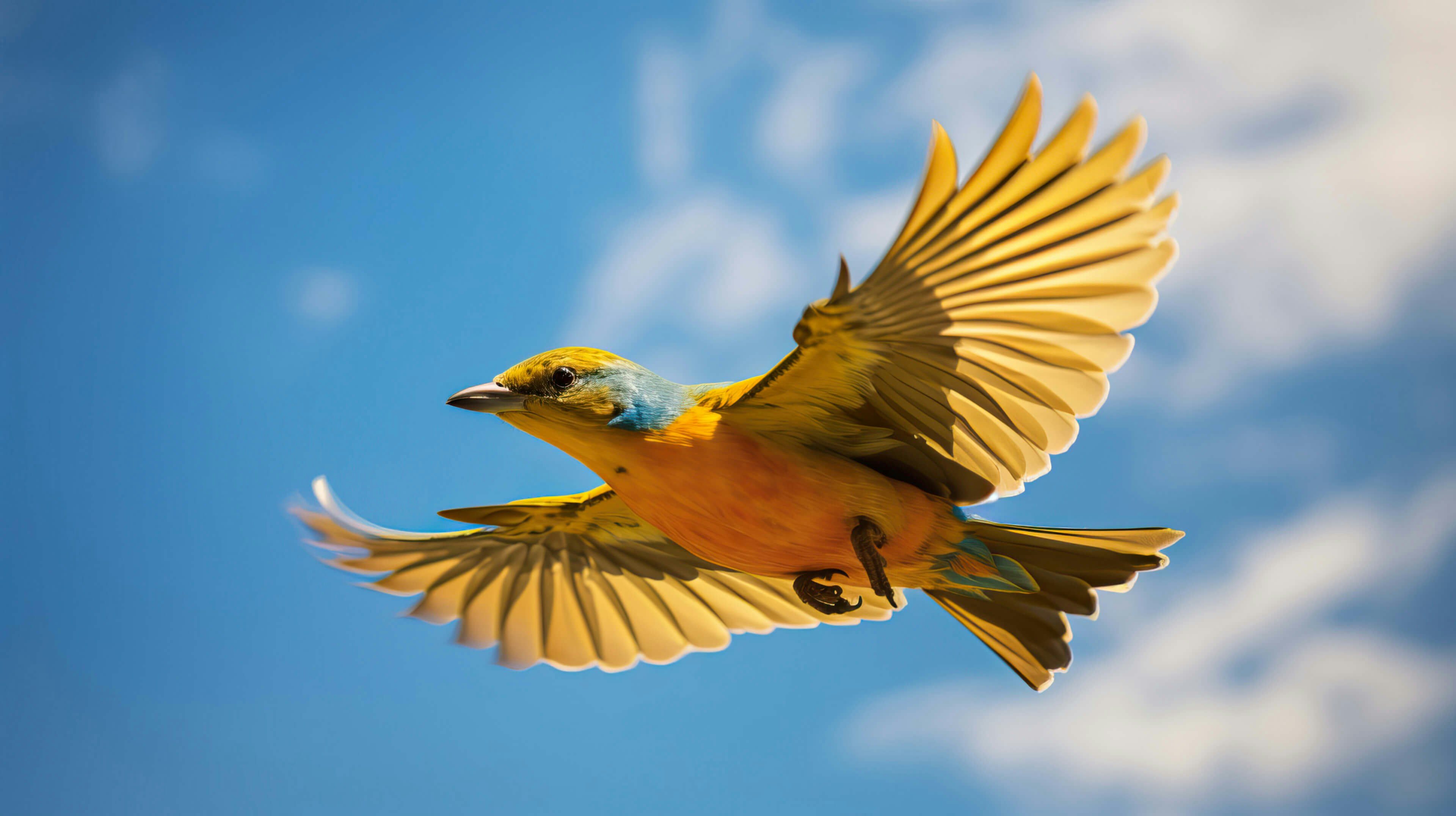
The Golden Tanager, a high-flying bird native to the Andes Mountains in South America. Photo by Bird Bird on Unsplash.
Last week we looked at why our dogs are sensitive to toxins. This week, we look up. Why birds are the most efficient breathers on Earth—and what they can teach us about stress, stamina, and clearing the air.
Last week, I wrote about how our dogs act as “biological sentinels” in our homes. Because they live on the floor and groom their fur, they are often the first to show the effects of the invisible toxins in our home environment.
But there is another biological sentinel we have relied on for centuries: The canary in the coal mine.
We often use that phrase to describe a warning sign. But have you ever stopped to ask why the canary dies first?
It isn’t just because they are small. It’s because they are superior breathers.
As I was digging into the research on environmental health last week, I learned that birds extract significantly more oxygen from the air than mammals do. While that makes them more vulnerable to pollution, it also makes them athletes of the sky.
The bar-headed goose (Anser indicus) is renowned for its ability to fly directly over the Himalayas during its biannual migration between Central Asia and India, with sightings recorded at altitudes exceeding 28,000 feet, nearly reaching the peak of Mount Everest. The air is so thin at that altitude that it would kill a human. Birds can not only survive but can exert themselves that high in the air because of the unique way they process breath.
Since February is often a month where we feel stifled by the cold of winter (especially this year!), I wondered: Can we learn to breathe like a bird?
The Science: The Circle vs. The Tide
The difference comes down to flow.
Humans breathe like the tide. We have a tidal breath system. We breathe air into an enclosed sac (our lungs), and then we have to push it back out the same way it came in. The problem? We are terrible at emptying the tank. We often leave “stale” air trapped in the bottom of our lungs, mixing fresh oxygen with old carbon dioxide. It’s inefficient.
Birds breathe in a circle. Birds have a system of air sacs that act like bellows. They push air through their lungs in one continuous direction.
When a bird inhales, it gets fresh oxygen.
The Mind-Blowing Part: When a bird exhales, it moves stored air from a rear sac into the lungs, meaning it gets fresh oxygen again.
They get oxygen on the inhale and the exhale. They never stop fueling the engine.
(If you want to see this in action, watch this 2-minute animation. It completely changed how I visualize breath: https://youtu.be/_NnBgM41jp0)
How Can We Adapt the Breath of a Bird: Focus on the Exhale
We cannot physically grow air sacs (unfortunately). But we can mimic the bird’s efficiency by changing one simple habit.
Most of us are shallow breathers. When we are stressed, we take tiny sips of air, leaving that stale air stagnant in our lungs.
To breathe like a bird, we don’t only need to inhale more; we need to exhale more.
Try this Biomimicry-inspired Bird Breath:
Empty the Tank: Instead of just letting your breath go, actively push the air out until your lungs feel completely empty. Squeeze the abs. Get rid of the “tidal” leftovers.
The Recoil: Once you are truly empty, your body will naturally reflexively gasp for a deep, full breath of fresh air.
Repeat: By focusing on the out, the in takes care of itself.
Nature designed birds to never waste a breath. We might not be able to fly over the Himalayas, but by clearing out the stale air, we can definitely navigate our day with a little more altitude.
IN BRIEF
Author, journalist, digital product manager, and licensed New York City tour guide. Creator and host of NYC's Secrets and Lies. Alumna of the University of Pennsylvania (BA), the Darden School of Business at the University of Virginia (MBA), Arizona State University (Biomimicry), and the University of Cambridge (MSt in Sustainability Leadership).
I build digital media platforms, report on urban climate resilience and biodiversity, and produce live narrative experiences that connect communities to history, nature, and place.
THE DEEP DIVE
My work centers on a single thread: building systems and stories that foster deep connection to our shared world. Across digital streaming, environmental reporting, and live civic storytelling, I design experiences that help people understand complex ideas and the environments around them.
DIGITAL PRODUCT STRATEGY & MEDIA LEADERSHIP
At Carnegie Hall, I serve as Digital Product Manager, leading product strategy, operations, and technical delivery for the video streaming platform Carnegie Hall+. I translate artistic mission into scalable, high-performance streaming architecture that reaches audiences globally. Previously, I led agile product and delivery teams across operations and compliance at American Express, managed Broadway theatrical productions and national tours, and guided strategic initiatives across cultural institutions.
ENVIRONMENTAL JOURNALISM & AUTHORSHIP
As a freelance journalist, I investigate how living systems, urban infrastructure, and human culture intersect. My reported features on urban decarbonization, biodiversity, coastal resilience, and biomimicry appear in publications including Smithsonian Magazine, The Washington Post, Mongabay, Natural History Magazine, and Foreign Policy Magazine. In fiction, I write the Emerson Page young adult novel series, alongside upcoming historical fiction and nonfiction works on New York history, mythology, and human resilience. I also write Togetherhood, a LinkedIn newsletter focused on urban ecology and community restoration, and co-host the podcast Frameworks in the Wild.
LIVE EXPERIENCE & CIVIC STORYTELLING
As a licensed New York City tour guide and live event producer, I transform urban landscapes into shared narrative encounters. I created, produce, and host NYC's Secrets and Lies, an interactive live storytelling series staged across cultural landmarks including the New York Transit Museum, the South Street Seaport Museum, and the historic tall ship Wavertree. I also design and lead site-specific walking tours exploring coastal ecology, food history, and neighborhood evolution, often with partners at Climate Week NYC and the Natural Areas Conservancy.
DOUBLE OR NOTHING MEDIA
Through my independent production studio, Double or Nothing Media, I develop ventures across media, ecology, and public history:
Digital Products & Strategy: Architecting scalable digital platforms, streaming experiences, and operational models for mission-driven institutions.
Environmental Reporting & Publications: Delivering long-form reporting, books, and newsletters grounded in climate resilience and regenerative design.
Site-Specific Live Storytelling: Producing immersive live shows and educational walking tours that engage public audiences in community history.
CONNECT
Website & Production Hub: doubleornothingmedia.com and christaavampato.com
Newsletter: Togetherhood on LinkedIn - linkedin.com/newsletters/togetherhood-7273771832221089792/
Instagram & Threads: @christarosenyc
Emerson Page Novels: emersonpagebook.wordpress.com/
View all posts by Christa Avampato
I'd love to know what you think of this post! Please leave a reply and I'll get back to you in a jiffy! ~ CRA Cancel reply