creativity

My book birthday wish for the world (and a free gift)

Me holding Emerson Page and Where the Light Leads on top of Arthur’s Seat, an ancient extinct volcano that is the main peak of the group of hills in Holyrood Park in Edinburgh, Scotland. June 2024.

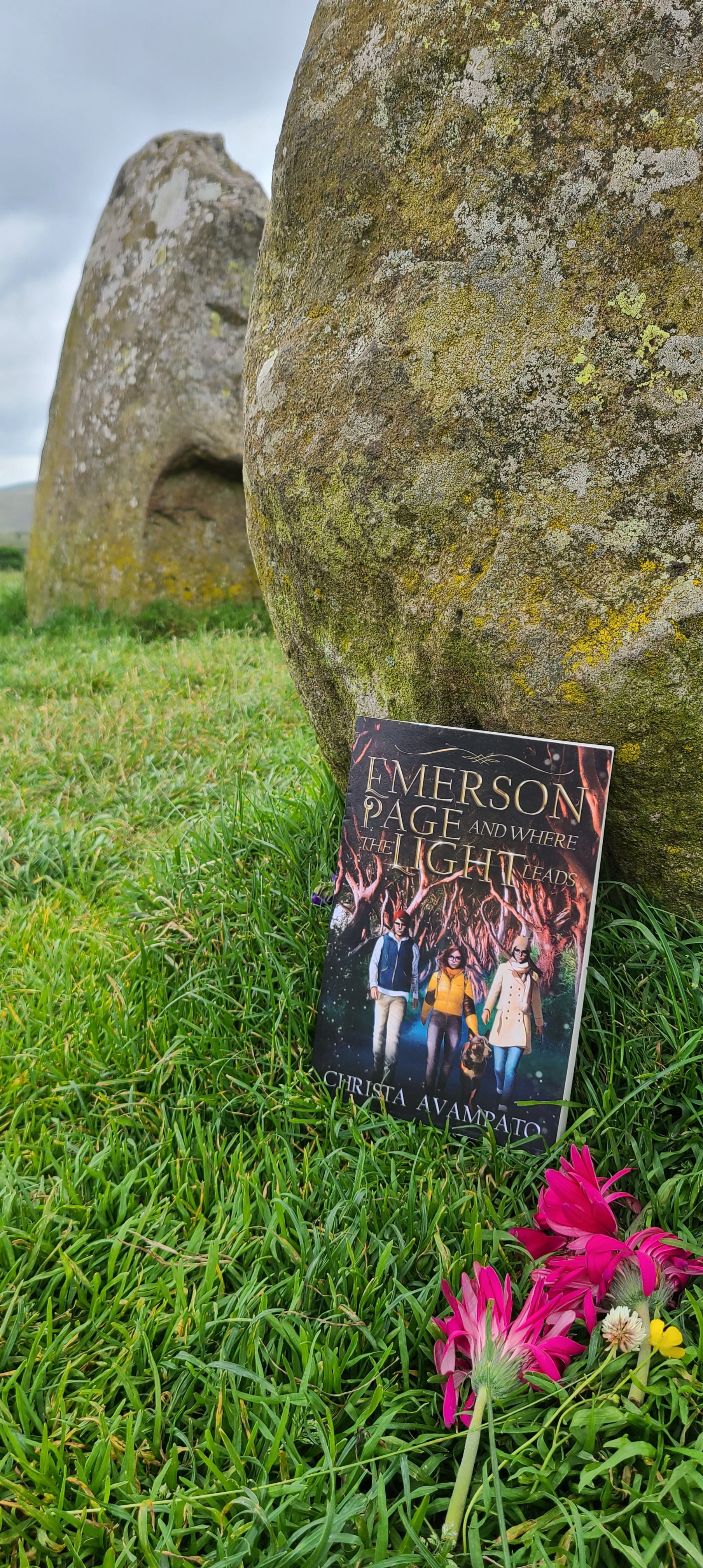
Today marks one year since my second novel, Emerson Page and Where the Light Leads, was published. To celebrate, the eBook of my first novel, Emerson Page and Where the Light Enters, is free today and tomorrow, May 14th and May 15th. Get it here.

Creativity is a lifeline for me. I’m so grateful to have writing as a spiritual practice that offers me the chance to bring my whole self to the page, and I’m grateful for every kind word, review, and note I’ve received from all of you. You raise me up.

In the author’s note of Emerson Page and Where the Light Leads, I wrote, “Since Emerson emerged in 2017 in my first novel, Emerson Page and Where the Light Enters, our world has been turned upside down. The pandemic, climate change, conflict across the world—all of it is cause for anxiety and distress. It’s okay to not be okay with any of this, to be scared in a world that seems so far out of our control. But what’s also true is that there is so much love, light, wonder, and beauty in this world, and in you. Emerson’s story is a mix of the joys and difficulties that are part of every life. She rises, falls, and rises again. And so do we.”  

I believed that when I wrote it on February 29, 2024, and I believe it today. If ever there was a time to create, celebrate, and elevate love, light, wonder, and beauty, it’s now. Right now.

So, on this first birthday of Emerson Page and Where the Light Leads, this is my book birthday wish for all of us: that we will continue to create and love, that we will live out loud, that we will express our joy, without fear and without reservation. As Mary Oliver so beautifully wrote in her poem, Don’t Hesitate: “Life has some possibility left…Joy is not made to be a crumb.” Please, make your joy the whole damn cake. Today and every day.

These two photos are from that same trip as the photos above. On the left, I’m at Castlerigg Stone Circle in Keswick, England, a town in the Lake District. On the right, that’s a photo I took on the Isle of Skye, Scotland. Both June / July 2024.

creativity

How to lead when we lose

Prospect Park, Brooklyn – Fall 2024. Photo by Christa Avampato.

On this difficult day, I have some things to say about gratitude, storytelling and leadership. Hundreds of thousands of people heeded the call ~100 days ago to not do something but do everything to try to help Vice President and Governor Walz win. I’m sorry neither of them took the stage at Howard University last night to say thank you, so I will. I’m abundantly grateful to all of you, and for everything you taught me during this campaign. You showed up, generously giving your money, time, and talents. That means a lot to me. You mean a lot to me.

On leadership:
It was a huge missed opportunity that they didn’t address supporters and the nation last night. Even though we didn’t know the final count, it was important to say something, anything, and then say they’d be back today to say more. We needed them, and they left without saying a word. That’s not leadership. It doesn’t matter how disappointed they were. We’re all disappointed. They had a real opportunity to maintain a connection with people and they didn’t. They went out the back door and sent the campaign manager to talk to the crowd at Howard and the nation. Vice President Harris will deliver remarks at Howard University today at 4pm. That’s too late. They missed the moment. And sadly, tragically, their opponents didn’t. There’s a lesson in that for us, too. Leaders have to lead, even when they lose. Especially when they lose.

On storytelling:
We have to take a long, hard look in the mirror, and at the words we said and didn’t say in this campaign. We need to meet the audience where they are, listen, understand, and work together to craft a better story for all of us. We didn’t do that and the election results show it. How things have been done on campaigns in the past no longer matters because we’re no longer living in the time of “how things are done.” We need better stories and methods. We need to be better listeners and storytellers. Plato said, “Those who tell stories rule society.” That’s true then and true now.

So that’s my focus moving forward – leadership and storytelling. I’ll stay curious, keep learning, improve my craft, and get better. I’ll continue to “be a lamp, or a lifeboat, or a ladder,” as Rumi so beautifully said. I will continue to, “walk out of my house like a shepherd” every single day. I will listen and love. I hope you’ll join me.

creativity

What I’ve learned in the 4 years since my bilateral mastectomy after breast cancer

Me today — 4 years post-surgery — outside of Perlmutter Cancer Center in New York City

Sunday marked 4 years since the bilateral mastectomy that removed cancer from my body and saved my life. I dropped off my absentee ballot for the election on October 26th, 2020 during early voting and in the depths of the pandemic before vaccines. The next day I went to NYU Langone Medical Center. The surgery was long and difficult. The recovery was painful. The many months of treatment and two additional surgeries, life-threatening setbacks, and healing were even worse. I didn’t know about any of that when I arrived at the hospital that day. All I knew then was I wanted to live, and I might not. My only goal was to wake up from that surgery and see the sunrise. And I did. Step 1, done.

After I woke up from anesthesia, I watched Harry Potter on my iPad, trying to invoke some kind of magic of my own. My angel nurse, Esther, ran all over the hospital to find me a sandwich since meal service had ended. To this day, that ordinary turkey sandwich was the best damn thing I’ve ever eaten. Then she showed me how to care for the 4 drains coming out of my body, a necessary evil after an extensive surgery.

When Dr. Schnabel, my surgeon, came to visit me, I thanked her for saving my life. Neither of us could see each other’s smiles because we were both double-masked. I remember her eyes looking deep into mine. “I’m just part of the team. Everyone in this hospital has one goal — to get you up and over the mountain. It won’t always feel like this. Someday you’re going to be very grateful you chose to take the hard road today.”

My friend, Marita, picked me up at the hospital and gave me the gentlest of hugs. I had a giant bag of meds. “How do you feel?” she asked me once I was settled into her car. I said, “I don’t know.”

Marita drove me home and handed me off to my sister, who dropped her whole life in Florida to take care of me (and my dog). My next goal was to be able to walk around my neighborhood by Halloween with my dog dressed as a pumpkin and my sister to see all the decorations and find some joy in my favorite season. Step 2, done.

My next goals — stay alive, restore my health, and thrive. Steps 3, 4, and 5, done, done, and a daily process.

I went for my annual check-up with my surgeon this morning. All clear! It happened to fall on the anniversary of that conversation we had about the choice to take the hard road. As I walked to the subway to head home in the sunshine, I thought about how right she was — she’s always right. I don’t feel the way I felt 4 years ago. Today, I’m hopeful and thankful for all of it, even cancer. We got up and over that mountain. There are so many people who made this trek possible. I was never alone in it. There were angels, guides, and teachers everywhere. There still are. The journey continues, and I’m very grateful for that.

Below: images from four years ago pre- and post-surgery.

creativity

My novel, Emerson Page and Where the Light Leads, is an official selection at the 2024 New Media Film Festival

https://emersonpagebook.wordpress.com/shop/

Closing out the week on a high! I just found out that my upcoming novel, Emerson Page and Where the Light Leads, is an official selection for the 2024 New Media Film Festival in Los Angeles in June. One of my big goals for Emerson is to have her story made into a film or series so bumps like this within the film industry mean a lot. I’m grateful for this honor and I’m hoping I can get to LA for the festival in June.

On Coverfly, a platform that curates film, book, and media awards, my book is ranked in the top 34% of over 135,000 projects in all genres and formats, and top 19% of books and manuscripts.

Thank you to everyone who continues to champion Emerson and support me in my creative work. Your encouragement means everything to us.

On May 14th, the book will be available everywhere books and eBooks are sold. Pre-orders can be placed now on Amazon, Bookshop, and Barnes & Noble. The first book in the series, Emerson Page and Where the Light Enters, is available now in paperback and as an eBook everywhere books are sold.

creativity

Your story is not about you

Photo by Brett Jordan on Unsplash

Had the most fascinating conversation with an expert in audience segmentation who is an oceanographer and thinks deeply about climate change communications. For our climate message to reach someone in a way that impacts their behavior, he said we need to be entrenched in the minds of the audience member we want to reach and be willing to change our story and language so it is created in that audience member’s mind in the way we want and need it to be. In this way, our story is not our story in the traditional sense. Our story is the imprint we want the audience member to experience and visualize when they hear our story.

He gave me this analogy: if someone wants to send a microwave signal across the city of Los Angeles, that signal will be distorted and filtered between the start and end points. Therefore, the person sending the signal needs to re-engineer the signal they send so the signal at the end point is what they want it to be.

Our stories are no different. They are filtered through an audience member’s language, prior life experience, biases, hopes, wants, needs, and fears. This is information that isn’t and can’t be aligned with an audience member’s base demographics that are easy to collect. Understanding an audience member on this level requires deep, intense, curious, and radically empathetic listening, a skill that is sadly in short supply in today’s world.

We also need to let go of the idea that there is one story to communicate one goal or one experience to a general audience. This understanding of the audience requires us as storytellers in any form to develop a library of stories that will reach audiences that are more thoroughly and thoughtfully segmented.

How to do this is the crux of my dissertation for University of Cambridge. I don’t know the answers yet, but I’m excited to find out as this dissertation unfolds. My hope is that my research will move the ball forward for the climate community in a way that benefits all beings.

creativity

The book Storyworthy by Matthew Dicks is a masterpiece about storytelling

The book Storyworthy: Engage, Teach, Persuade, and Change Your Life through the Power of Storytelling by Matthew Dicks is to storytelling what The Elements of Style by Strunk & White is to writing. Reading it immediately improves our craft because the advice is approachable and applicable. For every audience about any topic in any medium, every page of Storyworthy shows us how and why to tell stories, including the behind-the-scenes processes that make stories memorable and vehicles that can change hearts, minds, and behaviors.

When I first picked up Storyworthy, I didn’t expect much. I’ve read dozens of books on storytelling and many of them offer similar advice. When one of my best friends recommended Storyworthy, I was skeptical. However, my friend is a law professor who teaches writing and argument construction, and she is an exceptional storyteller whom I’ve worked with on storytelling shows. With her recommendation, I figured I could spend a few minutes flipping through it. My dissertation at University of Cambridge is centered around storytelling so if nothing else, I figured maybe I’d pick up one or two pointers that might be useful. 

By the time I got to page 2 of the preface, I was completely hooked even though Matt hadn’t yet given a scrap of advice on storytelling. His honesty is what got me. He opens the book with the first time he ever contemplated telling a story live on stage. He’s deeply conflicted about it. He has so much respect for the art form and he’s completely terrified of being judged. The stakes are high. His nervousness becomes my nervousness. I’ve felt that sick feeling in the pit of my stomach. I feel it every time I tell a story or do any kind of presentation in front of an audience. Terrified, he just goes for it. He takes his shot, and decides if his name gets picked he’ll just tell a story scared. He’s my kind of guy. I love risk-takers. I root for them. 

The book unfolds chapter after chapter with advice, exercises, and samples of Matt’s stories. These aren’t platitudes like “people love an underdog” or “start at the end and work backwards” that I’ve read in other storytelling how-to books multiple times. Both of those ideas are generally true and helpful but Matt goes so much further than that kind of advice. 

He explains exactly why and how he chooses his beginnings, endings, and the arc that connects them. He talks about pacing and timing, content and structure, word selection, story strategy, and storytelling devices to grab and hang onto an audience’s attention. Storyworthy is a playbook and it works for every story by every storyteller. It’s a compass, map, flashlight, and go-bag for everyone who has something to say that someone else needs to hear. It’s for all of us.

At one point, a friend of Matt’s whom I know and have told stories for, grabs his arm and tells him that he absolutely can’t tell anyone his secrets (or hers!) about how to create and tell a story. He laughs, ignores her, and thankfully we have Storyworthy. He’s given us the tools he has and uses every day. 

This might sound counterintuitive. Shouldn’t he keep some of this to himself so he can continue to make money from workshops, consulting, writing, and shows? Shouldn’t he hold back just a little? He’s the real trick: by telling his secrets I can’t wait to take a class with him to show him how I’m using these tools and to get his feedback so I can level up even further. 

Actually, I have to take a class with him. Here’s why: Matt is a lifelong learner. He wrote Storyworthy five years ago. I bet he’s got even more tools, tips, and advice to share now, especially after the pandemic. And I want to know all of them. 

My dissertation about storytelling involves interviewing storytelling experts. I want to interview Matt. My friend who recommended Storyworthy to me said he probably won’t agree to an interview. He’s busy. A man-in-demand. I wrote him an email anyway. Even if he said no or never responded, at least he’d know how much his book means to me and how much it’s helped me become a better storyteller and a better human. 

I’m a big believer in the idea that unexpressed gratitude is a horrible waste of a resource. Imagine what kind of world we’d have if people just said thank you more often.

So I go to Matt’s website. I navigate to his online contact form and put the advice in his book to work to craft my pitch. I was honest to the point of gushing about the book. All of it true. I gave some hints about my life. I told him about my dissertation’s research question and why it’s so important to me. I closed it by saying that this kind of request from someone he doesn’t know may feel a bit out of left field. It may not be of any interest to him, and if that’s the case that’s okay. Again I tell him that if all this message does is explain how much I appreciate the time and effort he took to write Storyworthy, then that’s what matters the most.

I click “submit form” and close my laptop. I take my dog outside for walk. I worry about my dissertation. I have to interview 30 — 40 experts. People are busy. What if they all say no? What if no one wants to talk to me? I better come up with a plan B just in case the worst happens. I should start that plan today because I have no idea how I’m going to explain this to Cambridge and keep my dignity. 

I go back up to my apartment and open my email. A note from Matt. “Well this is the second fastest rejection I’ve ever gotten,” I think. The first was from a literary agent I queried a few years ago when I was shopping my first novel. The response from the agent came back less than a minute after I sent it, and it had just one word. “No.” I should dig it out from my email archive and send it into the Guinness World Records. Fastest rejection ever—what a record to hold. 

I take a deep breath and open up Matt’s message. He says he appreciated my kind words about the book and he’s glad it helped me. Well, at least it’s a nice rejection, I think. 

Then he writes if we can make the timing work, he’d be happy to be interviewed. Hand to heart, I danced around my apartment. We figured out a date in short order and it’s in the calendar. I’ve got a few months to prepare for this interview, and I can’t wait for everything I’ll learn during it. Saying thanks really is an under-rated way to build a connection. 

creativity

JoyProject podcast: The Joy of Photography with Amy Selwyn

The Joy of Photography with Amy Selwyn

Smartphones have turned all of us into photographers. We take pictures of our friends and family, our food, pets, art, selfies, sunsets, gorgeous vistas. If we can see it, we’re taking photos of it. Smartphones changed the way we see and capture our world and experiences. 

Less than a year before the pandemic started, photographer Amy Selwyn gave herself a gift that completely and unexpectedly changed nearly every aspect of her life. A trip to Cuba not only transformed her career, but it gave her a totally new way of seeing the world and her place in it.

At the end of the podcast, I share something that brought me joy this week related to the episode. As she adjusts her life to make room for making more art, she’s downsizing her home. That inspired me to re-arrange my own home and declutter my life. Apartment Therapy is an Instagram account and website that offers fantastic ideas on how to organize and decorate a small space for it’s beautiful and functional.

Topics discussed in this episode:
– How Amy got interested in photography
– Traveling to Cuba and falling in love with street photography
– The joy of being a beginner
– Discovering and living out your passions at any age
– Mental health and the artist mindset

Links to resources:
– Amy on Instagram – @amyselwynphotographer
– Amy on Twitter – @amyselwyn
– Amy’s website – amyselwyn.photography
– Christa on Twitter – @christanyc
– Christa on Instagram – @christarosenyc
– Christa on Facebook – @AuthorChrista 
– Christa on Medium – @christaavampato
– Christa on TikTok – @christanyc
– Christa’s website – ChristaAvampato.com
– Apartment Therapy – www.apartmenttherapy.com

About Amy:
Amy Selwyn is a writer and fine arts photographer, and an utterly devoted dog mom to a sassy and adorable French Bulldog. 

Amy spent over 35 years working for and with news organizations around the world, including the BBC, The New York Times, the European Broadcasting Union,  and The Associated Press. Stories and storytelling are a lifelong passion. 

Amy is currently in a 3-year MFA program at Maine Media in Rockport, Maine, studying photography. This month, Amy will have one of her works in a juried show at the South East Center For Photography in Greenville, South Carolina. 

Originally from Hartford, CT, Amy and her beloved pup are currently based in Portsmouth, New Hampshire. 

creativity

How writing my Emerson Page novel trilogy saved my life—my conversation with Dr. Ed Freeman on The Stakeholder Podcast

In June 2022, I had the great good fortune to speak to my professor, mentor, and dear friend, Dr. Ed Freeman from the Darden School, on The Stakeholder Podcast.  

Link to the podcast episode: https://stakeholdermedia.libsyn.com/christa-avampato

Ed and I chat about:

  • how writing my Emerson Page novel trilogy saved my life
  • my live storytelling shows, screenwriting, and passion projects
  • my love for history, being a NYC tour guide, and how I got a tattoo live on stage
  • how product development helps me as a writer, and how being a writer helped me as a product developer 
  • living through difficult times and mental health challenges through creative work
  • my multi-faceted and varied career
  • making a living through a creative life
  • business and product development
  • building a better, more sustainable world

Ed is a treasure. He’s been one of the greatest influences on my work and life. He recently won University of Virginia’s highest honor: The Thomas Jefferson Award. Ed’s pioneering work on stakeholder theory changed the way we think about business and how businesses all over the world make decisions to create value. 

If you’ve ever used the word “stakeholder,” you can tip your cap to Ed. His writing about sustainability and stakeholder theory is what put UVA’s Darden School on the map for me, why I applied, and why I was honored to attend and graduate from the school with my MBA. He changed my life in incredible ways and I’m forever grateful for him. Thanks to Ed and producer, Ben Freeman, for having me on the podcast as a guest. 

creativity

Joy today: How making a movie teaches life lessons

Yesterday I had my first meeting to be considered as a director of photography on a small film. Still many more meetings to have and it’s by no means a done deal, but just the fact that this meeting happened at all so early on in my Double or Nothing Media venture is thrilling!

In my camera class we talked about the concepts of critical focus and framing each shot with the subject of greatest significance. Parallels between filmmaking and life aren’t lost on me. I’m grateful for the reminder and encouragement as I make massive changes in my life and career right now. It takes a village to start and run a business.

creativity

Joy today: On the passing of Toni Morrison

Toni Morrison taught me that prose can be poetry, that struggle can lead to freedom, that you get what you give in writing and life.

She gave me 2 priceless lessons: we all have time to write and never give up. As a single mom with 2 kids, Morrison wrote her first novel, The Bluest Eye, in 15-minute increments each day because that’s all the free time she had. It took her 5 years to write it.

She kept writing despite her novel’s low sales. 3 years later, her next novel, Sula, was nominated for the National Book Award. Her following novels received mixed reviews, but she remained determined.

In 1987, 17 years after publishing her 1st novel, she won the Pulitzer. If you have a dream project, work on it bit by bit. Don’t let critics sap the joy you get from your work. Toni Morrison lived her life with passion and unending grace. She taught me to keep writing.

You were the GOAT, Ms. Morrison. How lucky we are to forever inhabit your multitude of worlds through your gorgeous books. Rest in Power, because that is what you gave all of us—the power of our own language, our own stories. What a life. What a gift.