creativity

How I endured 2 years taking Verzenio

My last dose of Verzenio. Photo by Christa Avampato.

A little over two years ago, I wrote an article about my decision to take Verzenio to prevent breast cancer recurrence. On April 14th, I took my last dose of the medication and now I feel like a new person. Taking Verzenio at the maximum dose for two years was one of the most challenging parts of cancer treatment. Still, I’m glad I took it as part of doing everything I possibly can to stay healthy. I’m beyond grateful that the medication was delivered to my door every month free of charge to me because my health insurance paid the entire cost – $14,000 per month for a grand total of $336,000.

The indignities of cancer treatment are many, and I’ve experienced most of them. Verzenio certainly caused me a lot of anguish. Every day I had at least a low-grade stomach ache, and often much worse. I carried medication to deal with these issues everywhere I went, and often had to use it. Alcohol and grapefruit were off limits. I worried about everything I ate because anything could make me sick at any time. I had to constantly manage fatigue that sleep couldn’t fix, insomnia, depression, hair thinning, dry and sensitive skin, weight gain and aching joints, decreasing bone density, and the possibilities of developing liver and lung issues, being immunocompromised, and having anemia. Mercifully, my blood work was always normal when it was checked by my oncologist every three months – partly from my constant management of my diet and partly because I was very lucky.

Despite all that, that were bright spots, too, when I would discover something that helped, at least for some amount of time. Probiotics lessened the stomach issues, and I stopped drinking coffee, paired everything with carbs, upped my protein intake, and limited spicy, acidic, adventurous food. Audiobooks, an eye mask, and meditating helped me sleep, or at least rest. When I couldn’t sleep, I would often imagine myself traveling over coral reefs in the company of my dog, Phin, with a whale tour guide whom my imagination named Blue. Creativity was a great help on sleepless nights.

Shampoo and conditioner bars from Kitsch slowed the hair thinning. The dryness of my skin was eased by products from Good Molecules, Cetaphil, and HyaloGyn. Daily exercise and fish oil supplements eased my aching joints. The Zometa infusions I get every six months are helping me regrow the bone density I’ve lost. I kept anemia at bay with daily protein shakes. I bought a digital scale to monitor my weight every day, and experimented with recipes that were high nutrition, low-calorie, economical, and not too complicated to make.

Managing depression required a daily recalibration. My dog, Phineas, was my biggest support in that effort. Losing him in January of this year was a devastating loss and the grief at times felt unbearable. Verzenio made his passing even worse. To keep my head up, I did something every day that brought me joy – I spent time with friends, listened to music, watched movies, read books, visited museums, and did things I loved to do – writing, learning from and about nature, running, taking long walks, making art, and studying for my master’s program in sustainability. Joy was one of my saviors during active treatment and it helped with Verzenio, too. Though sometimes I had no choice but to just let myself feel sad, frustrated, and depressed. I cried a lot. Knowing the depression was driven by the medication helped. Knowing this was my now and not my forever encouraged me to keep going, to keep moving.

If all this sounds exhausting, I can assure you it was. Now that I’ve been off the medication for nearly a month, I can see how much effort it took to be on it. In the moment, I tried my best not to acknowledge that. I’ve spent most of the past four years since my diagnosis with my head down, focused on getting to this finish line.

Now that I feel better and lighter, I’m lifting my gaze. Right now, the field of my future is wide open. That’s equal parts exciting, and scary. I don’t know what lies ahead. Sometimes I feel like I’m on the edge of a cliff. And that’s okay because even on the cliff, I’m dancing, fully alive. I’m just glad to be here, and to be healthy. Verzenio was a part of making that possible.

So, if I had it to do over again, would I take Verzenio? Absolutely, unequivocally, yes. This is a life worth fighting for.

creativity

An orangutan practices medicine

The wonders of nature amaze me every day, and today a piece of natural news left me in awe. A paper was just published in the journal Nature about an orangutan who was observed self-medicating with remarkable effects that even trained medical doctors would have trouble reproducing.

In Sumatra, a 35-year-old orangutan known to researchers as Rakus had a large, deep, open wound on his face close to his eye. To look at it even made me wince, and I’m not at all squeamish about medical issues! With his teeth, he ground yellow root, an herb he rarely ate that has anti-inflammatory and anti-bacterial properties. He then applied the yellow root paste to his facial wound. In several days, it scabbed over. A little over a month later, it was barely noticeable with no sign of infection. (The images of Rakus above are from the paper in Nature.)

How could Rakus possibly act as his own doctor and healer? Where did he learn this yellow root technique? Scientists don’t know yet. While other animals have been observed in the wild tending to their injuries and the injuries of others, some even administering self-care and preventative-care, this was the first time an animal was observed medicinally treating a wound and with remarkable success.

There is so much we don’t know nor understand about the natural world. This is one of the many reasons why conservation is so vital for the health of people and our planet. Nature-based solutions to what ails us are everywhere, and to allow us to learn from them we must conserve the ecosystems where they occur. Perhaps Rakus has shown us a new medication that we could use to treat human wounds. He and his species are sentient, thoughtful beings who hurt and heal just as we do, deserve respect and concern, and have a right to survive and thrive.

creativity

The benefits of Zometa for early-stage breast cancer survivors

Me getting my recent Zometa infusion at Perlmutter Cancer Center

This is me at Perlmutter Cancer Center this week getting an infusion of Zometa, my own version of the Harry Potter Skele-Gro potion. The medications I take to prevent cancer recurrence have the unfortunate side-effect of decreasing my bone density. Zometa has the dual benefit of regrowing bone and reducing the risk of breast cancer recurrence. Isn’t that cool? The hope is I’ll only need 4 infusions (once every 6 months) so I’m halfway there! I also got all my annual bloodwork done and it’s perfect.

I get this infusion once every 6 months in the same chemo ward I went to during those dark days of active treatment in the midst of the pandemic before vaccines. I remember how sick and scared I was, how my dreams were on hold, and maybe out of reach. I’d flip through pictures of University of Cambridge and University of Oxford having put my graduate school applications to study environmental sustainability on hold, hoping I’d live to pursue those dreams.

Now I’m 3 months from finishing my degree at Cambridge Institute for Sustainability Leadership. The dream came true. It was a dream delayed but not a dream denied, thanks to the incredible care I received and the many people who made it possible for me to heal. Science and medicine are incredible. Better living through chemistry.

Managing through ongoing care can be exhausting. I’m also extraordinarily lucky to have access to the best medical care in the world. There are so many who don’t. And if this is what it takes to maintain my health and live the life I imagine, that’s fine with me. There is so much I’m learning on the journey, and I’m grateful to be able to use it to help others.

creativity

Trust the timing of your life

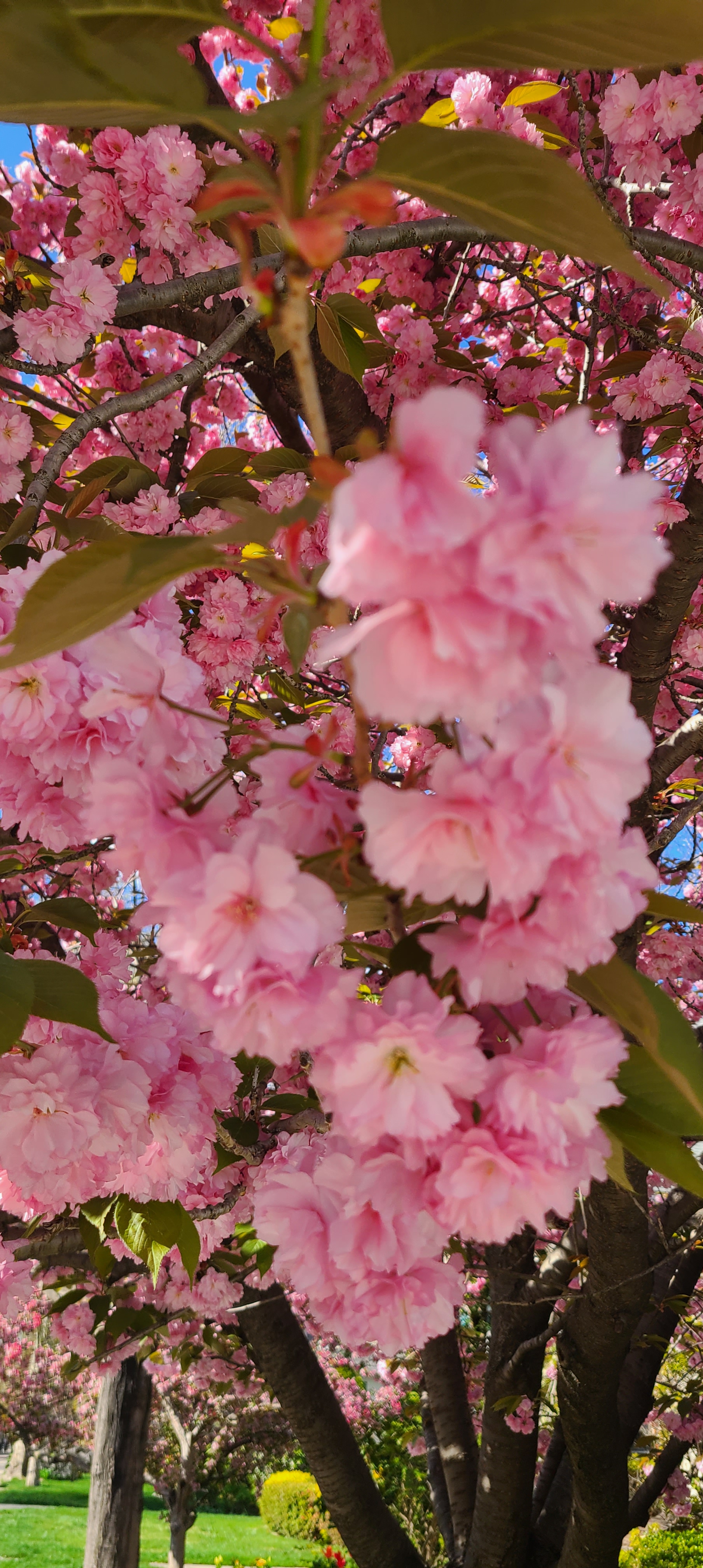
Flowering trees in my Brooklyn neighborhood. Photo by Christa Avampato.

Yesterday I should have been inside working but the warmth and sun kept me outside most of the day. I was walking around gobsmacked by my beautiful Brooklyn neighborhood bursting with flowering trees. Cherry, apple, pink dogwood, lilac, redbud.

I’ve been thinking of buying a small home outside the city. On my walk yesterday I realized my neighborhood has everything I want and then some. Walkable, friendly neighborhood feel, plenty of green space, good public transit, 20 minutes by train to the beach and 20 minutes by train into Manhattan, delicious food, local shops. And unlike most other New York City neighborhoods, it’s mostly single-family homes. I ended up in exactly the right place, exactly where I wanted to be. So now I’m thinking about buying a home right here.

Sometimes, I wish I’d already done certain things. I wish I’d already met the love of my life, owned a home, had or created my dream job. And then I remember how important it is to trust the timing of our lives. Maybe I haven’t been ready for any of those things until now. And because none of that has materialized yet, I did lots of other things that have been wonderful in their own right. Maybe there were certain things I needed to learn first.

It may have taken longer than I would have liked to reach this point in life, but we arrive when we arrive. Maybe I had to travel through many other lives first to fully appreciate this moment, when anything and everything feels possible. I see my dog, Phineas, in all of it. He led me right to where I needed to be, and only then did he know it was okay to go. I just wish he was still here to see own home in springtime.

(Below are photos I took in my Brooklyn neighborhood. I can’t believe I live here!)

creativity

Wrapping up my year as a pen pal with Letters to a Pre-Scientist

This was my first year as a pen pal for Letters to a Pre-Scientist (LPS), a nonprofit that pairs fifth to tenth grade students in low-income communities with a worldwide network of STEM professionals for a yearlong pen pal program to inspire all students to explore a future in STEM. I was matched with a student in Arizona. We exchanged eight letters during the school year and discussed higher education pathways, STEM (Science, Technology, Engineering, and Math) career journeys, and overcoming obstacles in life, school, and career.

I think that piece about overcoming obstacles and getting through difficulty in life is incredibly important. We all face challenges at some point. It’s important for young people to know the challenges can be overcome and provide examples of how we’ve faced challenges as a way to inspire them.

My pen pal was always very interested to know about my dog, Phineas. She has a dog, too, and this was something we bonded over from our first letters. I decided I had to be honest with her about Phin’s passing in January, how it made me feel, and how I was coping with grief. Something extraordinary happened in our last letter exchange; something I didn’t expect.

My pen pal showed such an incredible amount of empathy for my loss. To cheer me up, she made me these little reminders that show wisdom far beyond her years. The front sides of the notes say “It’s okay…” and “I’m not gone”. Inside, they say “A dog wags his tail with his heart. Don’t forget the love they shared” and “Dogs leave paw prints on our hearts.” Truer words were never written. I’ve placed them by my desk because they make me smile while I’m working. All the while I was hoping to inspire her; turns out she inspired me even more!

In her letter, she goes on to talk about how much her dog means to her, and to also express some challenges she’s having in school. She said even though school was very difficult for her right now, she believed in herself, loved learning new things, and knows she will get through these challenges. This student did not express this level of confidence in herself at the start of the school year, not by a long shot. Growth and evolution are beautiful gifts to witness.

My gifts to my pen pal

To further encourage her, I decided to put together a special package. I made her a book mark with charms I thought she’d like–a book, a paw print, a moon and star, and the planet Saturn. I also sent her one of my Emerson Page charms that I hide around the world for readers to find. It says, “She believed she could so she did” and has a tag with “Always believe in yourself.” My pen pal’s confidence reminds me of Emerson so I thought this was a fitting gift.

I wrote my reply letter to her on fancy paper. I told her how much her kindness meant to me and how I admired her belief in herself to overcome her challenges in school. I told her my dream for her is find something that brings her joy every day. I made sure to mention to love every day she has with her dog so she has a lot of wonderful memories with him, and that giving him his food and water, playing with him, taking walks together, and brushing his hair will make him so happy. I closed the letter with one of my favorite quotes by the great naturalist Mary Oliver who asks in one of her poems, “What will you do with your one wild and precious life?” I told her I can’t wait to see what she decides to do with her life.

We never know how our words and actions may impact someone. The important thing is that we keep putting our hearts out there, that we keep showing concern, empathy, compassion, and kindness at every turn, even when our world and the world at-large is heavy. Perhaps especially when it’s heavy. This might be the only way we’re going to save ourselves and each other–keep showing up and giving our best, honest, authentic selves.

creativity

Could the northeast earthquake on April 5th be a result of climate change?

USGS Shake Map for April 5, 2024 New Jersey earthquake https://earthquake.usgs.gov/earthquakes/eventpage/us7000ma74/shakemap/intensity

Yesterday while the northeast coast of the U.S. was reeling from a 4.8-magnitude earthquake and aftershocks, I was wondering if climate change could be playing any role in it. In a word, yes it can. Because of climate change, we may be at the beginning of a wave of increased seismic activity. Here’s the short of it from the World Economic Forum and The Conversation:

  • Climate change could cause more earthquakes and volcanic eruptions by increasing the weight of water on the Earth’s crust from increased precipitation and glacial melt.
  • When glaciers melt, the water can seep into cracks in the Earth’s crust, causing them to widen and weaken.
  • This can lead to earthquakes, especially in areas that are already seismically active.
  • Climate change can also cause more volcanic eruptions by increasing the amount of magma in the Earth’s mantle.

The tristate area has been caught in a seemingly endless cycle of storms and torrential rain so far in 2024. In March, New York City had double the amount of rain it usually has and April’s pattern is predicted to be similar. Geologists have previously explored the relationship between heavy rainfall and tremors in the Earth’s crust. Heavy downpours have triggered a pattern of seismic activity in some parts of the world such as the Himalayas but exactly how much rain is needed and what the full causal impact is still requires more research. Some climate models show more precipitation related to climate change is likely to trigger earthquakes and volcanoes in areas prone to them. 

The impact on seismic activity isn’t limited to precipitation. Remember, the determining factor is the change in the weight of water in the Earth’s crust. We must also account for the impact of climate change on the melting of glaciers as well. As the glaciers melt not only does that water seep into the Earth’s crust, but the melting glaciers also reduce the weight and pressure on the land that was under the glaciers. This release causes the land to rise, similar to a spring that was compressed and then releases once that compression is removed. When the last ice age ended ~10,000 years ago, the receding of the glaciers caused some of the land in Scotland to rise 45 meters above sea level! This kind of release can cause a spike in earthquakes, and historically some of these spikes have been severe in areas such as Scandinavia

In short, climate change may deliver a triple threat for earthquake activity: increasing the weight of water in the Earth’s crust from both an increased amount of rainfall and rapidly melting glaciers, and the added risk to the rising of land once the weight of those glaciers lightens or disappears altogether. The interconnections between all of the Earth’s systems and features is a delicate balance. Life on Earth has benefitted from a long stretch of stability and harmony. Our exploitation of nature, particularly our addiction to the drilling for and burning of fossil fuels, has put that stability and balance in jeopardy on numerous levels, many of which we’re only just beginning to understand. 

Nature is talking to us. Nature is warning us. Her voice and warnings will grow louder if we don’t listen and take action. Our artificial systems and incentives that we’ve invented in our economy and society will be no match for the wrath of nature. No amount of money nor ingenuity nor technology will protect us nor immunize us from the impacts of destroying the balance of natural systems on which we all depend. 

Every action we take now to reduce warming matters. The impacts of climate change are not for some distant generation. They are happening to us right now, and they will continue to happen and increase in intensity until we realize harmony with nature is the surest path to prosperity, health, wealth, and wellbeing for all beings. 

creativity

Humans aren’t wired to protect nature—but that’s not the whole story

“People partner with nature”. I created this image with the help of Canva’s Magic Media AI tool 

As a storyteller and sustainability advocate I focus on people who aren’t committed (yet) to protecting nature because that’s where the greatest change happens. This means I’m often faced with people who deny climate change, feel hopeless, or think technology and / or someone else will restore the planet’s health. 

As you can imagine, I have to employ a number of tactics to remain optimistic and motivated. One way I do this is by listening to podcasts about people doing incredible work in nature. I’m passionate about rewilding, or as David Balharry, CEO of Scotland’s John Muir Trust, reframes it “nature’s freedom to repair itself”. This passion led me to Ben Goldsmith’s Rewilding the World podcast. Ben spoke to David in episode 1 of the second season. They discuss rewilding the Scottish Highlands, an area I’m hoping to visit this summer. 

The entire episode is enlightening, and one point in particular helped me. No species in history, humans included, has ever been hardwired to protect the planet. They (we) are hardwired to promote the successful perpetuation of our genetics. Said another way, at their base all living things first focus on their future generations surviving and thriving. This means people aren’t naturally focused on environmental conservation. It must be intentional. It’s a skill that takes practice. Therefore, the work I’m doing with naysayers, the hopeless, and technocrats is training and re-skilling them. I’m a teacher, a guide, and learning takes times. That reframe is helping me think about my work with more compassion and patience. 

I also want to be clear that our instinct for genetic survival is only part of who we are. Human beings have an enormous cerebral cortex unique (as far as we know) in the animal kingdom. Our brains simultaneously act and reflect on our actions to inform our future behavior and shape our thoughts. We can think long-term, imagine future scenarios, and bring them to fruition, even if we don’t always exercise that ability as deftly as we could

Our long-term planning capabilities make us unique and distinct from other species. This doesn’t mean we’re smarter, wiser, or superior. It means we have a responsibility to be conscientious global citizens who care for each other and future generations, other species with whom we share this planet, and ecosystems that make our existence possible. 

Over half of our global GDP depends on nature, in addition to providing our basic needs for clean air, water, and food. We can’t live without nature. If we’re thoughtful about our behavior, we can help nature help us. Scientist Dr. Robin Wall Kimmerer’s research shows humans can assist and enhance nature’s regeneration. That’s a partnership and story well worth the investment of our time, efforts, and money. 

creativity

The National Climate Assessment shows us we can save the world

Photo by Shane Rounce on Unsplash

Look at your hands. Coupled with your mind and heart, your hands, joined with mine and with people across the globe, have the power to save the world. We can choose to be the artificers of our own bright and bountiful future.

Today we have a once-in-human-existence opportunity — the chance to create a healthy, vibrant, sustainable world for all beings. And not just for our children and grandchildren, but for ourselves and all beings alive right now.

The 2023 National Climate Assessment released Tuesday in the U.S. lays out the dire possibilities from global warming. It also shows that collectively we have all the knowledge, money, and creativity we need to halt emissions that cause global warming. There is proof the solutions work. Climate solutions are being deployed nationwide in every region and annual emissions dropped 12% from 2013–2019. We need them to drop much more but this is progress.

The one remaining hold out is us. Do we have the will to save ourselves and life on Earth?

“How much more the world warms depends on the choices societies make today,” states the report. “The future is in human hands.”

The report is hefty and so is the opportunity before us. Let’s not waste it.

creativity

Your story is not about you

Photo by Brett Jordan on Unsplash

Had the most fascinating conversation with an expert in audience segmentation who is an oceanographer and thinks deeply about climate change communications. For our climate message to reach someone in a way that impacts their behavior, he said we need to be entrenched in the minds of the audience member we want to reach and be willing to change our story and language so it is created in that audience member’s mind in the way we want and need it to be. In this way, our story is not our story in the traditional sense. Our story is the imprint we want the audience member to experience and visualize when they hear our story.

He gave me this analogy: if someone wants to send a microwave signal across the city of Los Angeles, that signal will be distorted and filtered between the start and end points. Therefore, the person sending the signal needs to re-engineer the signal they send so the signal at the end point is what they want it to be.

Our stories are no different. They are filtered through an audience member’s language, prior life experience, biases, hopes, wants, needs, and fears. This is information that isn’t and can’t be aligned with an audience member’s base demographics that are easy to collect. Understanding an audience member on this level requires deep, intense, curious, and radically empathetic listening, a skill that is sadly in short supply in today’s world.

We also need to let go of the idea that there is one story to communicate one goal or one experience to a general audience. This understanding of the audience requires us as storytellers in any form to develop a library of stories that will reach audiences that are more thoroughly and thoughtfully segmented.

How to do this is the crux of my dissertation for University of Cambridge. I don’t know the answers yet, but I’m excited to find out as this dissertation unfolds. My hope is that my research will move the ball forward for the climate community in a way that benefits all beings.

creativity

Trees show us how to survive in difficult times

Photo of Prospect Park by Christa Avampato

“I just want to live life all the way through. That is all.” ~Nan Shepherd

On my morning run in Prospect Park, I caught my first glimpse of autumn, my favorite season, one of catch and release, color and darkness, change and preservation, our two halves becoming whole. Trees changing and losing their leaves have so much to teach us about how we live and work. Biomimicry in action.

Deciduous trees let go of their leaves to survive the winter and live to see the next spring: it conserves energy and water, and allows wind to blow through the branches, putting less strain on the tree during winter storms.

In this next season of life, what will you do and what will you let go of so you can arrive in the next season rested and ready when the light and warmth return?

I am taking a little time every day to read place-based books about nature and landscape by people like Nan Shepherd and Robert Macfarlane who go out into the natural world and take it all in.

I am letting go of always thinking 10 ten steps ahead. Some amount of planning is necessary, but sometimes I get so caught up in the future that I don’t fully appreciate and learn from the now. So I’m going to make a conscious effort to love and be exactly where I am each day.

What about you? What will you do? What will you let go of?