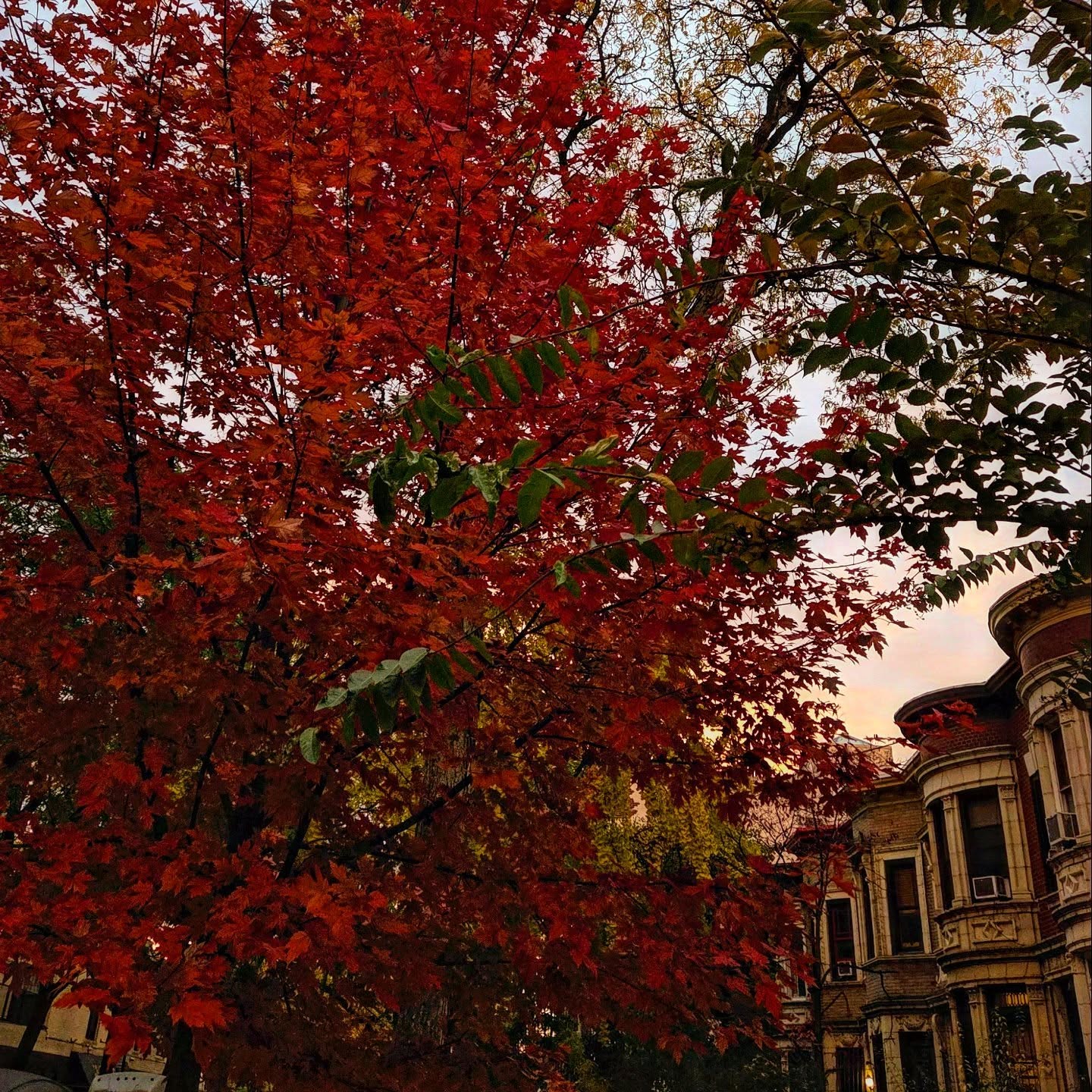
To be alive and healthy in a world with golden skies is no small thing. I went for a walk tonight in my beautiful Brooklyn neighborhood to clear my head, open my heart, and lift my spirits.
On that walk, I let myself hope for a brighter, better future. I let myself imagine my city transforming into a place where generosity and justice become an engine for progress.
I want New York City to become healthier, greener, safer, and more equitable for all beings who call this home. A place where dreams come true are not 1 in a million, but within reach for everyone who works hard and lifts others as they rise.
And I believe we can make all of that a reality, together, one day at a time.
Below are more photo from my walk tonight through Prospect Park.
Every day, the global citrus industry produces mountains of waste: billions of tons of leftover peels and pulp from juice extraction. Most of my immediate family lives in Florida now, and I’ve seen his waste first-hand. In nature, waste doesn’t exist; everything is a resource. So, what if we applied that wisdom—the principle of biomimicry—to the industrial challenge of food waste?
Enter Orange Fiber, an Italian company (from Sicily – where my ancestors are from!) that has cracked the code on circular fashion.
The Problem of Waste, Solved by Nature
Orange Fiber developed an innovative, patented process to extract the cellulose fiber that still exists within citrus juice by-products. They take the material left over from juicing and, through bio-based chemistry, transform it into a refined, high-quality fabric. The result is a refined, ethereal, and sensorial fabric that feels like a beautiful silk.
This is biomimicry in action: Nature’s design principle is to create closed-loop systems, and Orange Fiber has designed a zero-waste textile solution right inside a juice factory.
Why This is More Than Just a Fabric
This is a story of value creation and a new definition of luxury in the modern world.
Sustainable Innovation: It dramatically reduces agricultural waste and reliance on non-renewable resources (like petroleum-based synthetic fabrics).
Professional Validation: Since its launch, Orange Fiber has quickly scaled, partnering with brands like Salvatore Ferragamo, H&M Conscious Exclusive, and E. Marinella. If they trust the quality, the model is scalable.
The Secret is Simple: The success of Orange Fiber is a perfect example of a deep, simple secret often overlooked in product design: the solution is often hiding in plain sight, waiting to be repurposed.
The work of Orange Fiber reminds us that every challenge we face—from environmental pollution to resource depletion—can be solved by looking to the design wisdom of the natural world. It proves that the most beautiful, sustainable solutions are often discovered when we choose curiosity and embrace the design mindset of, “How can we make something beautiful while also protecting the natural world we all depend upon for survival?”
The urgent global challenge is feeding a rapidly growing population while fighting the uncertainty of climate change. As a storyteller and a biomimicry scientist, I often ask: How does nature solve a massive, existential crisis? The answer, it turns out, lies not in some distant super-technology, but in the subtle genius of a single plant cell.
New research from the Cold Spring Harbor Laboratory has illuminated a fundamental biological “master switch” in the DNA of food crops like corn, giving us an actual blueprint for creating a resilient, thriving future. This isn’t just botany; it’s a profound lesson in survival written right into the plant kingdom.
The Inner Wisdom of the Plant
Plant growth, from the deepest root to the ripest ear of corn, is governed by its stem cells—unspecialized cells that hold the potential to become any part of the plant. The challenge facing plant scientists has always been figuring out how to balance these cells: when should they grow and when should they specialize into, say, a fruit or a thick stalk?
In a breakthrough study, scientists mapped the gene expression in these cells, revealing the network of regulators that act as the plant’s precise internal control panel. This network balances growth and stress response, allowing the plant to strategically allocate its resources for survival.
This knowledge is a gift to us all because it shows how nature manages risk. A plant facing drought doesn’t just despair; it shifts resources to deepen its roots. A plant under pest attack doesn’t just succumb; it redirects energy to fortify its cell walls. It’s a marvelous, elegant system of risk mitigation through metabolic flexibility.
A Blueprint for Humanity’s Resilience
As my work focuses on biomimicry—integrating nature’s genius into the human world—I see in this discovery a direct path to solving our human challenge of food security. We are not meant to struggle endlessly against the elements; we are meant to learn from the masters of endurance.
This plant study provides us with three clear takeaways for building a better world:
Precision over Force: Instead of overwhelming fields with more fertilizer and water, we can use this genetic knowledge to engineer plants to be more efficient—to use nitrogen more effectively and direct energy precisely where it’s needed most for resilience.
Unlocking Latent Potential: We are now able to see and manipulate the plant’s own evolutionary solutions. We can develop crops with deep-seated, natural defenses against drought and disease, built on the plant’s own wisdom, not on chemical dependency.
The Power of the Foundational System: The corn stalk teaches us that true resilience comes from perfecting the foundation. By understanding and replicating the simplest, deepest biological controls, we can build human systems that are robust and adaptable, just like an ecosystem.
A Brighter Future Ahead
This breakthrough is more than just a scientific finding; it is a fundamental shift in our relationship with nature. By finally decoding the genetic “master switch” that plants use to govern their own destiny, we are handed a powerful blueprint for survival. The challenge of global food security has never been greater, but this research proves that the solution is not an endless technological sprint, but a deeper engagement with the patient, profound wisdom of the living world. The era of resilient agriculture is not just on the horizon—it has already begun, written in the complex, hopeful language of a plant’s own DNA.
I’m really happy to have joined a new collective created by Climate Film Festival that’s bringing together sustainability professionals with filmmakers to raise the bar on and expand opportunities for climate storytelling. As someone who has one foot in each of these worlds, I’m so excited to be part of this new professional group and to help craft and fund these stories that drive action.
Yesterday I went to the Essex Market coffee hour for our first in-person event and attended an excellent panel about climate documentary making. As someone who studied how to use storytelling to drive more climate investment from family offices, I felt like I was in just the right place at just the right time because financing was a key part of the conversation. I heard a number of filmmakers talk about the challenge of finding financing for their climate films, especially with the current situation in D.C.
What filmmakers need to consider is that private funders don’t want to just fund a movie. They want to fund systemic change, especially when it comes to protecting and restoring the health of the planet. Filmmakers need to show how their films, and the platforms and supports they are building around their films, will get viewers to engage in creating meaningful change. That change needs to be measured and reported on.
Is that asking more from filmmakers? Yes. Is it asking them to be skilled business people, entrepreneurs, and community leaders on top of their filmmaking expertise and beyond the creation of the film? Yes. Isn’t making a movie already a Herculean task? Yes. Is that a challenge? Yes. It’s also today’s funding reality.
You aren’t just making a movie, not anymore. You’re building a movement, and that movement is what’s fundable with a movie being one cornerstone of many.
I was saddened to hear about the passing of Robert Redford this morning. When I was an undergrad at the University of Pennsylvania, he came to campus to explore a film and storytelling partnership between the university, the West Philadelphia community, and his Sundance Institute. I remember seeing him from a distance and immediately noticing that there was a light about him, a kind of magical aura that emanated from his smile and ease of being.
In addition to championing filmmaking and storytelling, he was also incredibly passionate about the environment. He was a lifelong advocate for nature, beginning his activism in the 1970s by using his celebrity to promote causes like protecting air and water, and later founding the Redford Center to use storytelling to expand environmentalism. He spoke at the United Nations about climate change, was recognized by TIME magazine as a “Hero of the Environment” in 2007, and served for decades on the board of the Natural Resources Defense Council (NRDC). The NRDC’s Southern California headquarters in Santa Monica is named The Robert Redford Building to honor his long-standing support for the organization as a board member and environmental activist.
While we remember his outstanding career as an actor, director, writer, and producer, I’ll continue to hold him up as an example of someone who knew early on that storytelling was the key to protecting our planet and used his talents to further that mission. May we all carry forward his remarkable and beautiful legacy.
One of my great joys is to uncover stories about abandoned places sustainably retrofitted to get a new lease on life. This transformation made my heart sing: a former coal mine in Kentucky, once a symbol of industrial might and negative environmental impacts, is now gleaming with thousands of solar panels, powering a cleaner tomorrow. It offers a powerful beacon of hope for a sustainable future.
For generations, communities in places like Martin County, Kentucky, built their lives around coal. It was the “black gold” that fueled homes and industries across the nation while also degrading the land and human health. As the energy landscape shifted, so did these communities, often leaving behind economic hardship and vast, altered landscapes stripped bare of the nature they once harbored. The Martiki coal mine, closed in the 1990s, stood as a stark reminder of this past complicated, painful past.
A Phoenix Rising: The Martin County Solar Project
Today, that same landscape is being reborn. The Martin County Solar Project (MCSP) is transforming 900 acres of reclaimed mine land into a massive 111-megawatt solar farm. Picture this: over 214,000 bifacial solar panels, designed to capture sunlight from both sides, now stretch across the terrain where heavy machinery once toiled.
The Martin County Solar Project’s website shares that it began commercial operation in December 2024. It will generate enough quiet, clean renewable energy each year to power approximately 18,529 Kentucky homes.
This isn’t just about replacing one energy source with another; it’s about intelligent, hopeful repurposing. The beauty of this project lies not only in its clean energy output but also in its clever use of existing infrastructure. The former mine site, already flattened and with clear access to sunlight, still retained its transmission lines and substations. This meant less new construction, lower costs, and a faster path to bringing clean energy onto the grid—a truly smart way to leverage the past for the future.
Beyond Energy: A Boost for the Community
The benefits extend far beyond power generation. This project is a successful example of how the transition to a green economy can revitalize communities. The MCSP created hundreds of good-paying construction jobs, bringing much-needed employment to a region that had experienced significant job losses as coal production declined. Looking ahead, the solar farm will provide ongoing maintenance jobs and generate stable tax revenue for Martin County, helping to diversify its economy and build a more resilient future.
The Martin County Solar Project is more than just a power plant; it’s a testament to human ingenuity and our ability to adapt and innovate while reconciling with a difficult past. It’s a story of turning a painful environmental legacy into a vibrant, job-creating clean energy future. It shows us that even the most challenging landscapes can be repurposed for the good of both people and the planet. It’s an inspiring vision of what’s possible when we embrace sustainable solutions, proving that a green future is also a prosperous future.
I finally went to see Hadestown on Broadway. I know, I know. What took me so long?! After seeing it, I truly have no idea because it’s a transformative theater experience. A huge thank you to my dear friend, Dan Fortune, for taking me.
This was a very special performance because all 5 of the leads are brand new to the show. Music legend Kurt Elling, Jack Wolfe, Rebecca Naomi Jones, Morgan Dudley, and Paulo Szot knocked it out of the park, and the audience literally shouted with delight.
Yes, it’s all the things you’ve heard. It’s beautiful in every way, heart-filled, and filled with fascinating twists and turns woven between mythology and present day.
It’s also an incredibly effective climate story – the call to protect nature to reverse the harmful impacts of climate change on the food supply, mental and physical health, politics, and the economy.
It’s an immigration story, a migration story, a working class story about the power of generosity, community, and our own voices to lead change, to create a world where all beings are happy, healthy, and free. It’s a story of hope found in difficult, dark times and turning that hope into empowerment that leads to action. And art, specifically music, as a lever for all of that change.
Reminiscent of the call and response of spirituals with the essence of New Orleans, it’s a show that is of-the-moment even though it’s been on Broadway since 2019. Go see it. Cheer, clap, sing, get swept up in the beauty. And then carry all of it out into our world that is crying out for change. We are the ones we’ve been waiting for.
In the sun-drenched vineyards of Provence, France, where winemaking is an age-old tradition, a new kind of harvest is taking place. Instead of producing bottles of Rosé, one innovative company is collecting the leftover grape skins, seeds, and stems — known as “grape marc” — to create a revolutionary biomaterial. This is the story of Planet of the Grapes, a company proving that the solution to fashion’s waste problem might just be found at the bottom of a wine barrel.
Founded by Samantha Mureau, a fashion industry veteran, Planet of the Grapes was born out of her desire to counteract the devastating environmental and social impacts of fast fashion. She found her inspiration close to home when she realized the abundant grape marc left over from winemaking could be given a second life. Instead of being discarded or composted, it could be transformed into a high-performance, eco-friendly alternative to traditional leather and textiles.
The process is as fascinating as it is sustainable. Planet of the Grapes sources its grape marc from local, organic vineyards in Provence, fostering a low-carbon, community-driven supply chain. The grape waste is then dried, ground into a powder, and mixed with other natural ingredients to create a paste. This paste is spread out to create a supple, leather-like material. The entire process is designed to be as animal-free and petroleum plastic-free as possible, adhering to strict EU regulations.
The resulting biomaterial is not just a sustainable substitute; it’s a new material with its own unique character. Designers who have worked with it say you can feel the subtle texture of the broken-down grape marc, a tangible reminder of its natural origin. This “grape leather” can be colored using a palette inspired by different wine shades, from a rich merlot to a crisp chardonnay, making it a beautiful and versatile material for fashion and lifestyle products.
Planet of the Grapes is a prime example of the growing “biomaterials” movement, where companies are finding creative ways to turn agricultural waste into valuable resources. By valorizing what was once considered waste, they are creating a more circular economy and reducing the fashion industry’s reliance on harmful materials. It shows how innovation can be a powerful force for change, proving that a more beautiful, responsible, and nature-friendly future is within reach.
Copenhagen, the vibrant capital of Denmark, is renowned for its design, cycling culture, and high quality of life. But beneath the charming canals and green spaces, a pressing challenge looms: managing increasingly intense rainfall due to climate change. Rather than relying solely on traditional infrastructure like pipes and sewers, Copenhagen is embracing nature-based solutions, transforming itself into a “sponge city.”
The sponge city concept, originating in China, focuses on absorbing and retaining rainwater where it falls, mimicking how nature manages water. This involves integrating nature-based solutions into the urban landscape to capture, filter, and slowly release stormwater to mitigate flooding.
“If you want to survive, you have to be spongy,” says Yu Kongjian, dean of Peking University’s College of Architecture and Landscape Architecture, and founder of Turenscape, one of China’s largest landscape architecture firms. “Trying to protect cities with hard, gray infrastructure made of concrete is doomed to fail.”
Copenhagen is a frontrunner in the spongey revolution, and its journey offers valuable lessons for cities worldwide grappling with similar climate-related challenges. My dear archipelago home city of New York, I’m looking at you!
One of the key elements of Copenhagen’s sponge city transformation is the creation of what’s known as green infrastructure. Parks and green spaces are being redesigned to function as rainwater retention basins during heavy downpours. These areas, often featuring sunken lawns and permeable surfaces, can temporarily store significant volumes of water, reducing the strain on the city’s human-made drainage system and reducing the risk of flooding. For example, Enghaveparken has been renovated to include a large underground reservoir capable of holding approximately 22,700 cubic meters of water. This dual-purpose space serves as a recreational area for residents while providing crucial stormwater management capacity.
Beyond parks, Copenhagen is incorporating blue infrastructure into its urban fabric, giving water a place to flow. The city’s numerous canals and harbors are being leveraged to manage excess water. Innovative solutions like floating wetlands and constructed ponds not only enhance biodiversity but also help to filter and retain stormwater. Furthermore, permeable pavements are being increasingly adopted in streets and public squares, allowing rainwater to seep into the ground rather than running off into drains. This reduces surface runoff and helps to replenish groundwater levels.
The driving force behind Copenhagen’s commitment to becoming a sponge city is its ambitious Cloudburst Management Plan, developed after a severe storm in 2011 caused widespread flooding. This comprehensive plan outlines a series of long-term projects aimed at making the city more resilient to extreme weather events. It emphasizes a collaborative approach involving the municipality, utility companies, businesses, and citizens in implementing nature-based solutions across the urban landscape.
The benefits of Copenhagen’s sponge city approach are manifold. Beyond reducing flood risk and alleviating pressure on drainage systems, these green and blue infrastructure initiatives enhance the city’s livability. They create more green spaces for recreation, improve air quality, support biodiversity, and even help to cool urban heat islands during hot summer months.
Copenhagen’s journey to becoming a sponge city is not without its challenges. Retrofitting existing urban areas with green and blue infrastructure requires careful planning, investment, and community engagement. However, the city’s proactive and integrated approach serves as an inspiring model for how other cities can adapt to the increasing impacts of climate change by working with nature, rather than against it. As extreme weather events become more frequent, the lessons learned in Copenhagen offer valuable insights for building more resilient and sustainable cities for the future.
Imagine a future where the gentle, natural glow of wood guides you along a park path or illuminates your home, all without a single watt of electricity. This isn’t a scene from a fantasy movie; it’s a groundbreaking reality being forged by scientists who are harnessing the power of nature itself to create a sustainable alternative to traditional lighting. At the forefront of this innovation is Francis Schwarze, a fungal researcher at the Swiss Federal Laboratories for Materials Science and Technology (Empa), and his team, whose work on bioluminescent wood is nothing short of revolutionary..
In their research, Schwarze’s team demonstrated a remarkable example of biomimicry, the practice of drawing inspiration from nature to solve human design challenges. They looked to the forest floor and the eerie phenomenon of “foxfire,” the natural glow emitted by certain fungi in decaying wood. By isolating and studying the ringless honey fungus (Desarmillaria tabescens), they were able to understand and then replicate this process in a controlled laboratory setting. The team discovered that this particular fungus could be introduced into wood in a way that maintains the wood’s structural integrity while it is imbued with the fungus’s natural ability to glow.
The magic of the glow comes from a natural chemical reaction involving an enzyme called luciferase, the very same enzyme that makes fireflies light up the night. When the fungus-treated wood is exposed to air, the enzyme triggers a reaction that produces a soft, green light. The result is a completely self-sustaining, non-toxic, and non-electric light source that could one day transform our approach to lighting.
While the current glow is comparable to the light of a candle and lasts for about 10 days, the research represents a crucial proof of concept. The team, including researcher Giorgia Giovannini, is actively working on optimizing the process to increase the brightness and longevity of the luminescence.
The practical applications of this innovative material are as numerous as they are inspiring. Imagine urban spaces where bus shelters and street signs are naturally illuminated, reducing light pollution and energy consumption. Think of a park where benches and pathways glow gently, eliminating the need for harsh electric lamps. In homes, this biohybrid material could be used for designer furniture, artistic wall panels, or even subtle safety markers, all glowing without a power source. This innovation could also inspire a new class of biomimicry products, moving beyond wood and into other materials that could be made to self-illuminate or possess other natural properties.
Ultimately, this research highlights the immense potential of looking to nature for solutions. By collaborating with living organisms, scientists are not just creating a new product; they are pioneering a new field of sustainable materials science. The work of Schwarze and his team is a shining example of how understanding and working in harmony with the natural world can lead to a brighter, more sustainable future for us all. It reminds us that some of the most profound innovations aren’t about building something entirely new, but about learning from and enhancing what already exists.