creativity

Can ecofiction inspire climate action?

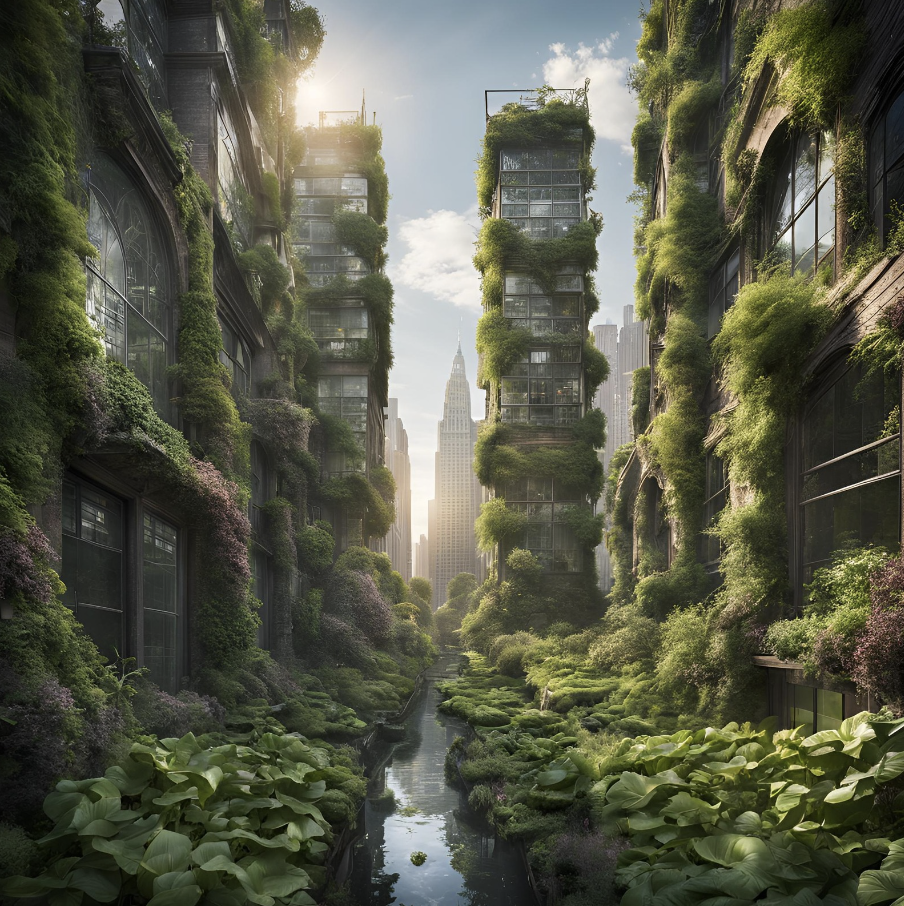
Created by Christa Avampato using AI.

While on vacation I wrote my first full piece of ecofiction for a climate fiction writing competition. It’s a short story (5,000 words) that provides a slice of life in New York City in the year 2200, and grew out of the research I did for my University of Cambridge dissertation.

It’s told through the eyes of a journalist walking his dog who by chance meets the 90-year-old former mayor who galvanized the rebuilding of NYC after it was destroyed by floods caused by climate change. Biomimicry figures prominently in it. I tried to incorporate humor, heart, and redemption alongside the heartbreak, loss, and destruction. Ultimately, it’s a story about leadership, community, and vision.

No matter the outcome of the competition, I enjoyed writing it and plan to do more with these characters and in this genre. The predominant channels and messages we’re using for climate storytelling now are not generating the scale and speed of the changes we need. Fiction can play a bigger role is painting the picture of what a world transformed can look like, what it will take to get there, and how we might work together to make it so. The fandoms around fiction can be a unifying force for good, which is exactly what we need, now more than ever.

(I created the images below with AI, inspired by the story I wrote.)

creativity

I’m a guest on the nature podcast, Unearthing Wild Wonders

A few months ago, I met Nicky Jenner, a gardener, conservationist, and nature lover who lives in Devon in the southeast of the U.K. Though I’ve only known her a short while, the moment we met I knew she was a kindred spirit. 

She told me she was starting a podcast called Unearthing Wild Wonders about the wisdom and wonder of nature, and how we bring about positive change in our deeply troubled world. I was honored when she asked if I’d be a guest and I immediately accepted. Our episode, Nature inspired — home, healing, and biomimicry with Christa Avampato , is out now. Unearthing Wild Wonders is beautiful, uplifting, and hopeful, and each episode leaves me newly inspired to continue my work to protect the planet. Also, Nicky’s voice immediately puts me at ease. 

In our conversation, Nicky and I talk about how the challenges I’ve faced in my life and with my health ignited my passion and commitment to make a difference for all beings on our precious planet. We talk about biomimicry and how the most unlikely species have inspired phenomenal innovations that we now use in our daily lives. We chat about the many languages we need to speak to bridge the divide between science, conservation, business, and finance.

I talk about my University of Cambridge dissertation that uses storytelling to connect climate entrepreneurs developing nature-based solutions with family offices looking for new investment opportunities that deliver a financial return and have a higher purpose.

I also share stories about my journey to overcome cancer, and how learning to heal my own body helped better prepare me to heal the planet. One of them I’m sharing publicly for the first time — how lying in a hospital bed seriously ill from chemotherapy helped me realize the immensity of the plastic waste problem and made me even more determined to do something about it.

I’m so grateful to Nicky for having me on the podcast. Our conversation happened just days after the passing of my sweet soul dog, Phineas, one of the worst losses of my life. Talking to Nicky helped me begin to heal and honor him. I’m so grateful for that. Let us know what you think of the episode.

I’m excited for the day when I’ll get to Devon, give her a hug, and walk through her garden with her. Nicky has a wonderful website and newsletter at https://www.hawksdawn.co.uk/ that I highly recommend. You can also find her on Instagram @nickyjenner_hawksdown posting gorgeous pictures of nature along with inspiring quotes and stories.

creativity

What we can learn from Eastern Redbud trees

Eastern Redbud. Brooklyn, NY. Photo by Christa Avampato.

My Brooklyn neighborhood is in full bloom with flowering trees putting on a colorful show for all of us. One of the trees that always catches my eyes this time of year is the Eastern Redbud. They grow bright pink, purple, and red buds directly from their trunks. Known as cauliflory and found mostly in the tropics in species such as cacao, jackfruit, and papaya, the evolutionary purpose of this adaptation has a few hypotheses.

1.) Foster as many partnerships as possible
With the ability to grow flowers on the trunk, the Eastern Redbud can produce more flowers, allowing for more seed dispersal and pollination opportunities. Additionally, more animals can act as pollinators. For example, small mammals climbing onto the tree trunks wouldn’t normally play a role in pollination when the flowers are on delicate branches that cannot support the weight of these mammals. However, with flowers growing on the main trunk that can support them, they act as pollinators for the redbuds just as much as birds and small insects.

For us, emulating a redbud means considering all of the potential partnerships we have around us. How can we change what we’re doing to help them help us? Even if someone doesn’t normally play a certain role, could they fill that role if we altered the system in a way that allows them to participate?

Eastern Redbud. Brooklyn, NY. Photo by Christa Avampato.

2.) Energy and resource savings
Without the need to grow a network on many delicate branches, flowering directly on the trunk saves the tree energy, water, and food. These resources can be poured into creating more flowers and therefore greater pollination and seed dispersal. The redbud certainly takes advantage of this, and in full bloom appears to explode with flowers.

There is nothing worse in nature than waste. Wasted energy can and often does mean the difference between life and death. Are we using all the resources we have in the most optimal way? Can we change how we operate to make better use of the resources we have to meet our ends goals?

3.) A matter of physics
In the case of trees such as cacao, jackfruit, and papaya, the fruit is too heavy for small delicate branches to bear. The weight of the fruit requires a sturdier structure so they grow directly from the trunk. This also allows the fruit to grow to a larger side, and again, allows for greater seed dispersal.

Sometimes we’re forced to do things a certain way for the sake of practicality and to best meet our end goal. Necessity may be the mother of invention, but practicality is the agent of adaptation, moving us along to do exactly what needs to be done.

Eastern Redbud. Brooklyn, NY. Photo by Christa Avampato.

creativity

What does a sustainable New York City look like?

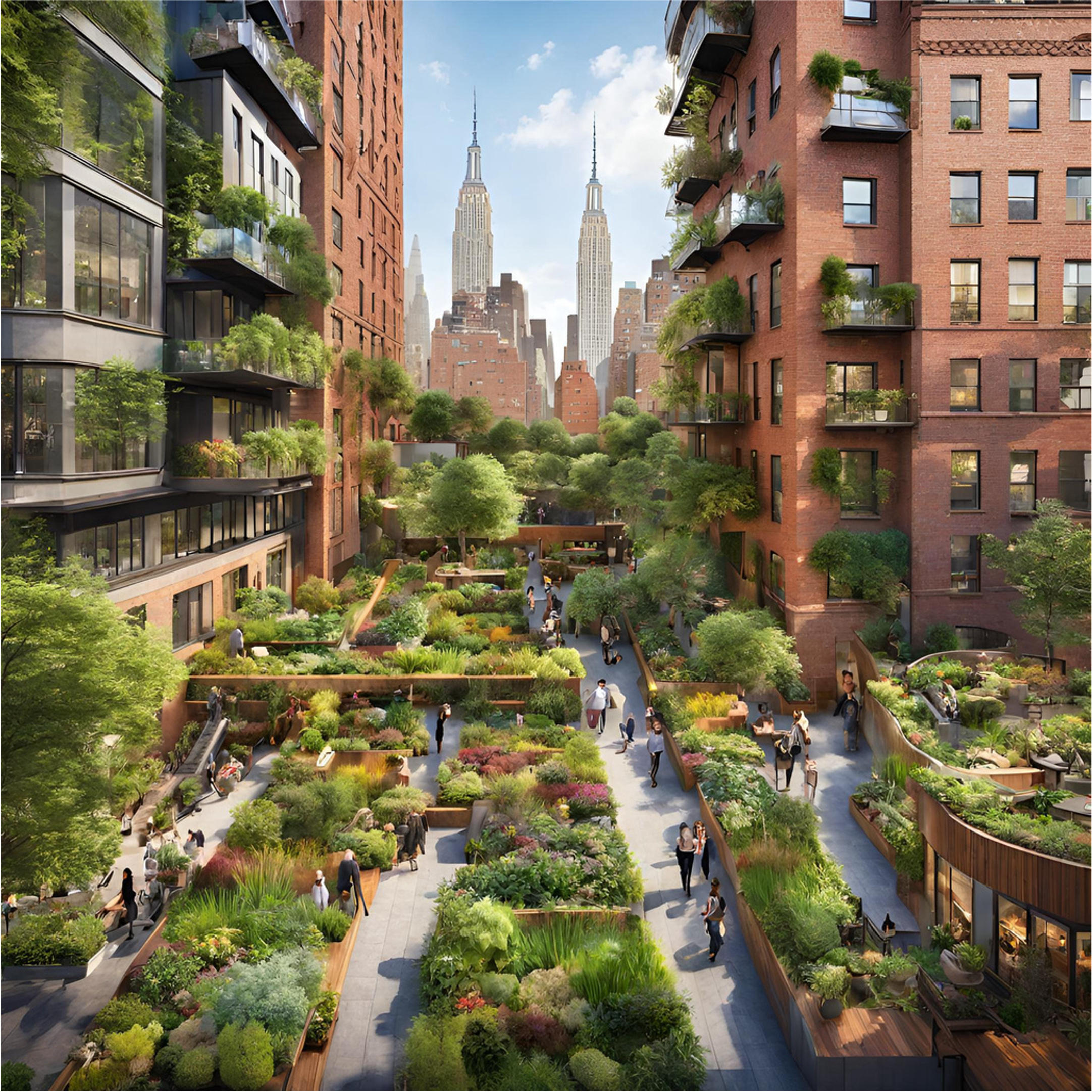
What does a sustainable New York City look like to you? I imagine lush micro gardens, biophilic architecture (a building methods that connects people with nature), rooftop farms, and clean transit, air, and water as pathways that give people, plants, and wildlife the opportunity to live side-by-side-by-side in ways that benefit all.

In biomimicry, we begin our design process by asking how nature would solve a specific problem we have with a question framed as “How would nature (the problem we want to solve)?”. My question above would be framed as “How would nature build a sustainable New York City?” This is a question that has occupied by headspace for years as I traverse through different projects and future visioning sessions.

In the spirit of an image being worth 1,000 words, I created these images with Canva Magic Studio AI to show how nature might build a sustainable New York. Is this a city you’d like to visit? Is this a city where you’d be happy to live? What are the first steps we can take now to make this our New York?

creativity

My leadership practice framework is a forest

Illustration by Natural Areas Conservancy. https://naturalareasnyc.org/

In my Masters in Sustainability Leadership program at University of Cambridge / Cambridge Institute for Sustainability Leadership (CISL)Dr. Louise Drake and Dr. Tanja Collavo wrote a beautiful module on leadership. They feature Elspeth Donovan who encourages us to develop a leadership practice framework that helps us understand how and why we respond, make decisions, and act.

For weeks I’ve thought about what my framework might be. Finally, I’ve found a perfect fit: the layers of a forest — soil, understory, vinelayer, midstory, understory, and atmosphere. As a biomimicry scientist and storyteller, this model fits my passions for building my life inspired by nature’s wisdom and the power of story to shift hearts, minds, and actions. It’s fitting that the word “story” is present in the layers of this incredible ecosystem that fosters life.

Soil — home of the earthly nutrients that give rise to the forest
This is what I read, see, hear, feel, and experience that feeds into my imagination and creativity. This houses my personal history, my core memories from the time I was a child to the present day. In that way the soil and what feeds me is always changing and evolving.

Understory — seedlings and saplings that will be the forest’s future
This is where I constantly cultivate new ideas, interests, and connections. Not all of them will mature but they all teach me something. I’m always learning, growing, evolving, and living my life spherically, in many different directions. Here my imagination and creativity have no limits.

Vinelayer — connects the forest from soil to canopy
These are the throughlines of my life and work: nature, stories, and business. These are my vines that run through my work and feed my creativity, and the use of resources that make my creative work possible to share with the world.

Midstory — made up of diverse shrubs and young trees
This is yesterday’s understory, the ideas and relationships that began there that have emerged as those that I’ll cultivate and nurture to their fullest potential.

Overstory — the top layer of mature tree crowns that connect to form the canopy
This is where the ideas I’ve nurtured have come to fruition and reached their full potential. The books I write. The products I create. The relationships that are core to my community. This is also where I fully connect to the wider world, and where the exchange of ideas and perspectives happens.

Atmosphere — with the nutrients from the soil, the atmosphere’s sunlight, air, and rain allow a forest to be sustainable and create an ecosystem where other beings can also thrive
For me, this is the love, care, concern, and support I receive from my community and the wider world. Just as the sunlight, air, and rain pour down through the forest and back into the soil to create a full loop, love nurtures my spirit, refills my cup, and allows me to continue my work. Just like a forest, my work also involves nurturing the lives and work of others.

creativity

Trees show us how to survive in difficult times

Photo of Prospect Park by Christa Avampato

“I just want to live life all the way through. That is all.” ~Nan Shepherd

On my morning run in Prospect Park, I caught my first glimpse of autumn, my favorite season, one of catch and release, color and darkness, change and preservation, our two halves becoming whole. Trees changing and losing their leaves have so much to teach us about how we live and work. Biomimicry in action.

Deciduous trees let go of their leaves to survive the winter and live to see the next spring: it conserves energy and water, and allows wind to blow through the branches, putting less strain on the tree during winter storms.

In this next season of life, what will you do and what will you let go of so you can arrive in the next season rested and ready when the light and warmth return?

I am taking a little time every day to read place-based books about nature and landscape by people like Nan Shepherd and Robert Macfarlane who go out into the natural world and take it all in.

I am letting go of always thinking 10 ten steps ahead. Some amount of planning is necessary, but sometimes I get so caught up in the future that I don’t fully appreciate and learn from the now. So I’m going to make a conscious effort to love and be exactly where I am each day.

What about you? What will you do? What will you let go of?

creativity

Fun and play are a part of work

Photo by LI FEI on Unsplash

For my University of Cambridge dissertation, I’ve been thinking about ways to bring my passion for biomimicry into the research without causing my own scope creep. Now deep into my literature review reading, I found a way to not only avoid scope creep but to use biomimicry and my intense love for nature-based solutions as a way to focus my dissertation. I’m so firmly planted in my happy place now that the hours of work fly by until my sweet old dog toddles over to my desk to tell me it’s time to go out for a walk.

Charles Darwin, legendary naturalist and Cambridge alum, is one of my fun at work icons. He wrote tens of thousands of personal letters over the course of his lifetime. (A collection of the 15,000 that have been found to-date are accessible in the University of Cambridge’s collections). What those letters communicate that his formal academic writing does not show is that his work was so much fun for him that it felt more like play. If Darwin can have fun while doing his research, then I can, too.

So whatever you’re doing today from wherever you are in the world, I hope you’re having fun and that your work lights you up in a way that also lightens your spirit. It’s not too much to ask.

I’ve had moments in my career when my work felt like drudgery. I’m really glad and grateful that I made the changes to change that. It wasn’t easy but for me it was worth it.

creativity

The genius of NYC’s London Plan trees that can help us thrive

I was worried about my trees. My block in Brooklyn, my whole neighborhood of Ditmas Park, is covered with gorgeous 100+-year-old, 100+-foot-tall London Plane trees. They’re a cross between oriental plane tree and the American sycamore, and so named because they were hardy enough to withstand London’s air pollution during the Industrial Revolution. Its leaf is the NYC Parks Department logo because Robert Moses loved these trees. The comprise 10% of NYC’s 592,130 street trees.

A few weeks ago, during an intense heatwave, they started shedding their bark. And I don’t mean a bit of peeling here and there. It was raining bark, with swaths so big that my dog, Phin, and I had to dodge them on our neighborhood walks. Was the heat, caused by climate change, killing my trees? Were they resilient enough to survive the Industrial Revolution only to be destroyed by the fallout of today’s emissions?

Mercifully, it appears not, for now at least. Thanks to the wonderful team at Madison Square Park I learned this adaptation of bark shedding was developed by London Planes to protect themselves and help them thrive. It happens when they detect some type of enemy invasion, for example by an insect or fungus, or when they are growing, similar to how a snake sheds their skin in order to grow.

Maybe there is something in your life that needs shedding, that is no longer serving you. Like the London Plane, let it go so you can grow and thrive. These trees are our elders, mentors, and guides. We have so much to learn from them about how to live through turbulent times.

I took the photos below of the London Plane trees on my Brooklyn block.

creativity

What will the world be like if we take no climate action now?

We hear a lot about climate change and how devastating the impacts will be if we do nothing. To save the planet is the reason I decided to go back to graduate school at University of Cambridge in Sustainability Leadership and pivot my career to focus on this cause. But what does a lack of climate action mean specifically, decade by decade? What happens to the planet, and to us, if we stay on our current trajectory? And just as importantly, where do we go if we have an idea for climate action?

The World Economic Forum (WEF) has a 2-minute video outlining some of the specific impacts of continued climate change on our current path starting in the year 2030 and going through 2100. The impacts are sobering, backed up by scientific research referenced in the video, and outlined in the list below.

But all isn’t lost. We do have a short period of time right now to make massive changes to save the planet, the species with whom we share it, and create 395 million jobs with the transition to a nature-positive economy. Said another way, biomimicry and creating our built environment, products, and services based on nature’s design principles is the answer—we must transition to a nature-positive economy and society.

And if have an idea for climate action, WEF wants you to share that idea and get involved through their free online community portal called UpLink where you’ll find hope, information, data, and updates on climate action projects that are underway right now.

What does the world look like in the coming decades if we don’t take climate action. Here’s a sampling of that future:

The 2030s:

  • Ice caps and crucial ice sheets continue to melt, swelling sea levels by 20 centimeters [7.87 inches]
  • 90% of coral reefs threatened by human activity, while 60% are highly endangered
  • Dwindling crop yields push more than 100 million more people into extreme poverty
  • Climate change-related illnesses kill an additional 250,000 people each year

The 2040s:

  • The world has shot past its 1.5-degree Celsius [2.7-degree Fahrenheit] Paris Agreement temperature rise limit
  • Bangladesh, Vietnam, and Thailand are threatened by annual floods, sparking mass migration
  • 8% of the global population has seen a severe reduction in water availability
  • The Arctic is now ice-free in summer
  • Sea levels have risen 20 centimeters [2 feet] in the Gulf of Mexico, where hurricanes deliver devastating storm surges

The 2050s:

  • 2 billion people face 60-degree Celsius [140 degrees Fahrenheight] temperatures for more than a month every year
  • In much of the world, masks are needed daily–not for disease prevention, but to protect our lungs from smog
  • The Northeast United States now sees 25 major floods a year, up from 1 in 2020
  • 140 million people are displaced by food and water insecurity or extreme weather events

2100 and beyond:

  • The average global temperature has soared more than 4 degrees Celsius [7.2 degrees Fahrenheit]–and even more in northern latitudes
  • Rising sea levels have rendered coastlines unrecognizable, and Florida has largely disappeared
  • Coral reefs have largely vanished, taking with them 25% of the world’s fish habitats
  • Insects have been consigned to history, causing massive crop failures due to the lack of pollinators
  • Severe drought now affects more than 40% of the planet
  • An area the size of Massachusetts burns in the US every year
  • Southern Spain and Portugal have become a desert, tipping millions into food and water insecurity

This is a terrifying, painful future and it’s only a few years away right now. But again, we know what we need to do—create our built environments, products, and services to mimic those of the natural world. Biomimicry can save us and the natural world. This means we must:

  • exit fossil fuels in favor of renewable energy sources
  • restore, protect, and expand natural habitats and wild areas
  • end the use of single-use plastic and harmful chemical pesticides

None of this will be easy but the choice is truly one of life—ours and all the other species who are counting on us to change our ways and clean up how we live on this planet—or death. Either we choose to make these difficult choices now in our companies and governments, or we are forced to make them later when it may be too late. To learn more and get involved, please visit UpLink: https://uplink.weforum.org/uplink/s/. We have no time to waste and the planet needs all of us to take action.

creativity

How my life and career prepared me to work on climate change

When people ask me, “what do you do?” my response is always, “have you got a minute?” If they say yes, I say, “I’m a digital product developer / business leader / journalist / author / biomimicry scientist / public historian / tour guide, and I kicked cancer’s ass during a pandemic. Now I’m bundling up all of that experience together to fight climate change and protect the planet. Do you have any questions?”

Some of the most important research on climate change has yet to be done: What happens in a worst-case scenario? This week, an international team of scientists led by the University of Cambridge (where I will start my graduate studies in Sustainability Leadership in September) published a paper about the urgent need to do this work. As I read the piece and considered my experience, I realized my life and career have primed me to be a part of this endeavor.

Cancer during COVID-19
At the height of the COVID-19 pandemic I was diagnosed with early stage breast cancer. You think taking precautions to protect yourself and others from COVID is inconvenient? You think changing your lifestyle so we curb climate change in inconvenient? Trying getting cancer. Now that’s inconvenient. 

Cancer upends every facet of life to battle it. And even if you do everything right, there’s no guarantee you’ll be cancer-free. Having to face that demon and my own mortality (several times thanks to a life-threatening chemo allergy I had and never knew about) changed me. Then to find out that my cancer had a strong environmental component added insult to injury. It also lit a fire under me to change my life and dedicate my career to healing this injured planet. 

Nothing teaches you how to live like having your life on the line. I wouldn’t wish it on anyone. Since I had to go through it, and have emerged on the other side cancer-free, I’m determined to use what I learned to help make this world a better place for all beings.

Hope for the best; expect the worst
I’ve lived my entire life by this philosophy. At times, it’s exhausting but the tremendous upside is that I’m often prepared and rarely surprised. This thinking gave me a stiff upper lip as I’m not someone who runs from conflict or difficulty. I’m incapable of deluding myself or anyone else with any kind of pollyanna scenarios. Just give me the facts. Tell me what I could be up against and I’ll take it from there. I’ve mastered pro-con list making and I love a good SWOT analysis. Difficulty doesn’t depress me. I can sit with suffering and not be consumed by it. I’m not afraid of the future; I’m here to shape it. 

Product development
All product development, regardless of the product, service, or system being built is anchored in two principles: what problem are you trying to solve and who are you trying to solve it for? I don’t fall in love with anything I build or any idea I have. A long time ago, I fell in love with serving others and making the world a better place. My ego and my fear of rejection hover near zero. Being a product developer requires me to be measured and methodical, to care about the grand vision and every tiny detail. Strategy and tactics are two sides of the same coin and they serve each other. I like both of them equally. 

Business and leadership
I’d love to tell you that well-meaning governments, NGOs, and nonprofits are going to save the planet and humankind from destruction. They aren’t because they aren’t the problem. Business, and how we conduct business, is the problem. Because business is the problem it’s also the solution. 

Business is responsible for climate change because of the way it operates. Change the operations and you see progress toward solving the challenge. It’s not easy work. There are a lot of stakeholders with conflicting interests and priorities. Then you add the whammy of many people in the world being down on business and capitalism, and rightly so. Given all that, it’s easy to see why some businesses toss up their hands with a “I can’t do anything right so I’m just going to soldier on as I always have.” 

Except they can’t. Business and businesses will have to change and evolve. It’s not a choice anymore. Destroy the planet and every business, every person perishes. So business colleagues: buck up, roll up those sleeves, humble yourself, and get to work to make your business sustainable. I’ll be in the trenches with you and I’ll help you.  

Scientific studies in biomimicry and sustainability
Biomimicry begins and ends with the mindset of looking at a problem and asking, “how would nature solve this?” It’s a fascinating, hopeful, and wonderful way to live and work. I feel fortunate to be a biomimicry scientist. I’m excited to begin my studies at Cambridge to extend my work in biomimicry and business through sustainability leadership and bring them together to build a better world. 

Digital media
I’m often asked, “do you make your whole living in biomimicry?” No. I don’t. I have an MBA from the Darden School at the University of Virginia and I’ve worked for years to become a storyteller in a variety of mediums. I make the majority of my income working as a product developer for a media company and from my writing. I also produce and host a podcast about joy called JoyProject, used to manage Broadway shows and national theater tours, and hope to get back to producing and hosting storytelling shows, in-person and on screens large and small.

Science is what I do because I love it and it’s a force for good in the world. With my studies at Cambridge, I’m hoping to work with energy companies to end the production of fossil fuels. You can read more about my career plans here

Being a journalist and a fantasy and science fiction author
Writers make stuff up and write it down. We love playing out scenarios and asking questions like, “What if…?”, “And then what happened?”, and “How did we end up here?”. We research. We interview people. We observe. We dig through historical documents and archives. We create characters and we put them into impossible situations. This is the kind of thinking and acumen the climate change movement needs. 

Public historian and tour guide
Science was my first love. History was my second. I was a history and economics major in college at the University of Pennsylvania. I majored in history because everything has a history. It felt to me like I could do anything if I was a historian. I can happily spend countless hours reading and uncovering history, talking to people about history, showing people history, and imagining what once was, why it impacts what is, and how it will shape what’s yet to be. 

I’ve never been a person who easily fit into a box of any kind. I had no interest in that. When I was interviewing for my first job out of business school, a man interviewing me commented that my resume looked like I had done a lot of exploring. He didn’t mean this as a compliment; he was criticizing me because he thought I lacked focus. I didn’t. My focus just happened to be on anything and everything that interested me, and a lot interests me. 

I got the job, but that guy who called me an explorer was never approved of me. That’s okay. He just couldn’t see what I knew to be true—the solutions to worldwide problems need worldwide views. They need lots of different types of experience to create something that’s never been done before. Turns out all my exploring gave me exactly everything I needed to make the world a better place, and that’s what I will do.