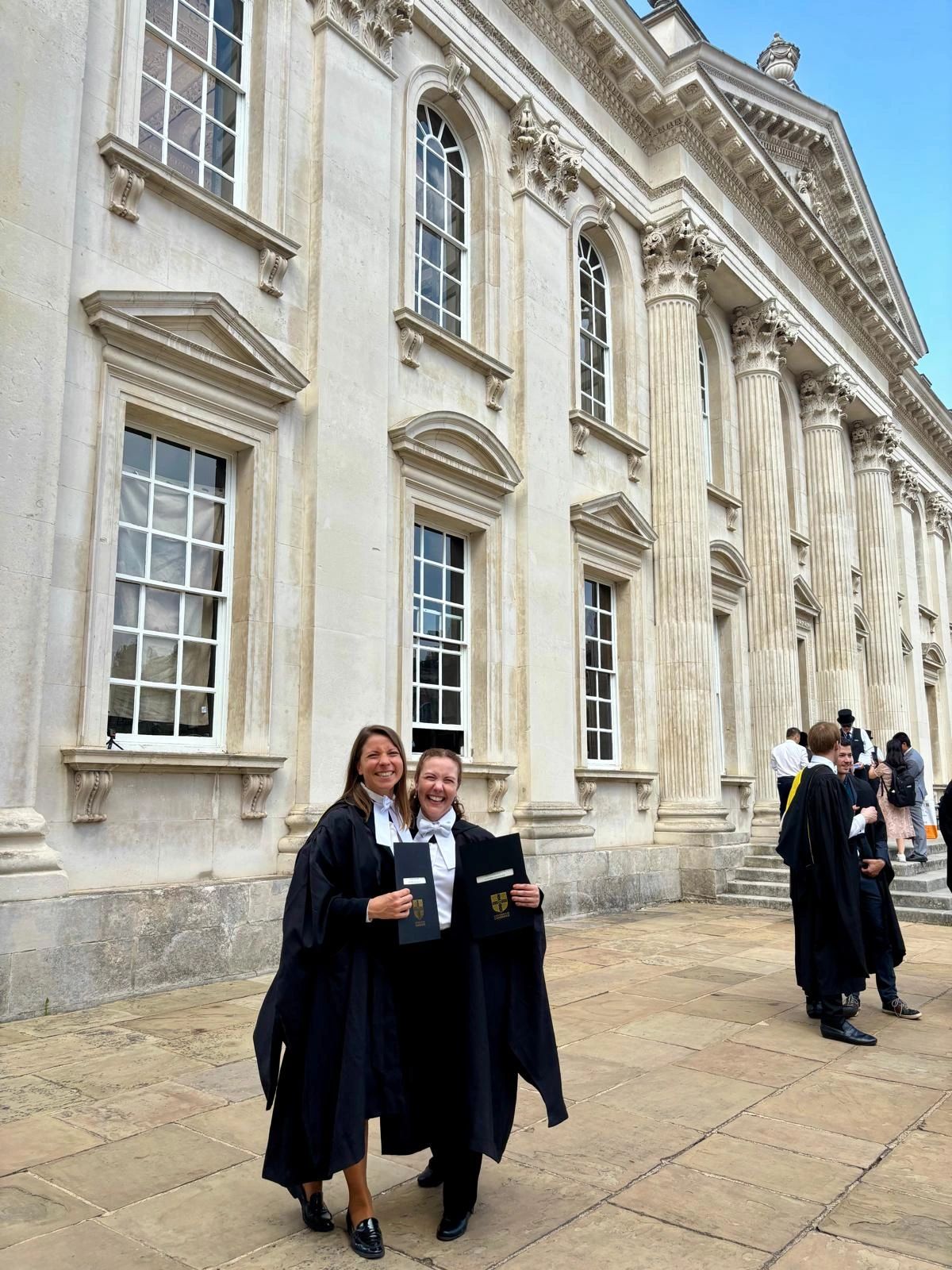
It happened! A dream deferred, but not denied. The hope of going to and graduating from University of Cambridge was part of what kept me alive during my cancer journey in 2020 / 2021. On Friday, that hope became a reality — I graduated with my Master’s in Sustainability Leadership with my friends, family, and faculty there.
The best part of these years has been to do this programme with such a stunning group of people who have inspired me from day one when we started down this path together in September 2022 – students, faculty, and staff. No one’s more fortunate than me to have had this experience with them and to call them dear friends.
In this uncertain world, I’m not sure what my next chapter holds. I do know I’m on my way and all the better for having these gorgeous people as fellow travelers.
A profound thank you full of love and an enormous congratulations to everyone in Cohort 13. I’m beyond proud to be one of you and I’m already looking forward to our next reunion.💚 (Happy photos below!)
The Stories We Eat: Narratives to Shape Stakeholder Behavior and Policy for Sustainable Food Futures
Narrative Power: Using Digital Media to Convey the Voice of Future Generations and Nature in Sustainability Storytelling
From Self-Interest to Shared Benefit: How to Adapt Finland’s Exemplar of Public Trust Amidst Power Asymmetries in U.S. Businesses
I’m so grateful for this opportunity to learn and engage with these incredible people in one of the most sustainable communities in the world. I’m most looking forward to spending time with my professor, mentor, and dear friend R. Edward Freeman, who is one of my heroes and the founder of the seminar. As the originator of stakeholder theory that transformed business ethics, his work has fundamentally changed how businesses and business leaders around the world operate. He’s the reason I went to Darden and he changed how I see the world and my role in it. I’m honored to have had his support and encouragement for all these years.
It’s going to be an incredible summer of learning. I’m excited to experience all of it and to see where it leads! Nähdään pian, Finland!
Ever stepped out of an air-conditioned building into a city street and felt like you’d walked into an oven? That’s exactly how I felt last week in New York City. This is known as the urban heat island (UHI) effect. It makes cities significantly warmer than their surrounding rural landscapes, particularly at night. Why does this happen, and what are cities doing about it?
The Science Behind the Sizzle:
The UHI effect is largely a byproduct of how we build our cities. Here’s a quick breakdown of the culprits:
Dark Surfaces & Materials: Concrete, asphalt, and dark rooftops absorb and store vast amounts of solar radiation during the day. Unlike natural landscapes (think forests or water bodies) that reflect more sunlight and release moisture, these urban materials slowly re-emit that stored heat into the surrounding air, keeping temperatures elevated long after sunset.
Lack of Vegetation: Trees and plants provide natural cooling through shade and a process called evapotranspiration (where they release water vapor, like sweating). Cities, with their limited green spaces, miss out on these vital cooling benefits. The apartment building where I live straddles a city block. On one side, it’s a tree-lined street that’s almost completely shaded. On the other side of the building, there aren’t any trees at all. The temperature difference between the two entrances is often 10 degrees or more.
Urban Geometry: Tall buildings and narrow streets can create “urban canyons” that trap heat and block wind flow, preventing cooler air from circulating and dissipating trapped warmth.
Waste Heat: All the human activity in a city – cars, factories, air conditioning units – generates a significant amount of waste heat, further contributing to the overall temperature rise.
The consequences of the UHI effect are serious: increased energy consumption (more AC means more power plants working overtime), elevated air pollution and greenhouse gas emissions, and significant health risks, especially for vulnerable populations, including heat-related illnesses and even fatalities. In the United States, heat is indeed the deadliest weather-related hazard, claiming more lives annually than other extreme weather events like hurricanes, floods, or tornadoes
Cities Taking Innovative Action:
The good news is that cities around the world are recognizing this challenge and implementing clever, innovative solutions to cool down from cool pavement surfaces to using plants as part of walls, roofs, corridors, and increased green spaces. Here are a few inspiring examples:
Singapore: The “Garden City” Goes Further Singapore is a leader in green infrastructure. Beyond its lush parks, the city-state is integrating vegetation into buildings with impressive “green walls” and “sky gardens.” They’re also exploring district-level cooling systems, which are more energy-efficient than individual air conditioning units, and prioritizing science-based policies to reduce urban heat risks. Their commitment to planting millions of trees and creating numerous parks is paying off in tangible temperature reductions.
Los Angeles, USA: Paving the Way with Cool Pavements Known for its expansive roadways, Los Angeles has been actively experimenting with “cool pavements.” These lighter-colored surfaces reflect more sunlight and absorb less heat than traditional asphalt, significantly reducing surface temperatures. The city has already coated over a million square feet of pavement with these innovative materials. It is also experimenting with applying this coating to rooftops as well.
Rotterdam, Netherlands: Embracing Green Rooftops Rotterdam is literally building a cooler future from the top down. The city is actively promoting and implementing green rooftops on a massive scale, aiming to green over 900,000 square meters of rooftops. These vegetated roofs not only reduce ambient temperatures by acting as insulation and through evapotranspiration but also help with stormwater management.
Medellín, Colombia: Cultivating Green Corridors Medellín has transformed its urban landscape by creating a network of 30 “green corridors.” These shaded routes, lined with thousands of native trees, palms, and other plants, offer cooler pathways for people to travel and gather, directly combating heatwaves and improving air quality.
Paris, France: Creating “Cool Islands” Paris is tackling its urban heat with a strategic approach to “cool island” spaces. The city has identified and is creating 800 such spaces, including parks, water fountains, and public buildings like swimming pools and museums, which are significantly cooler than surrounding streets. They also have ambitious plans to plant 170,000 trees by 2026.
Seville, Spain: A “Policy of Shade” In a city accustomed to scorching summers, Seville has adopted a “policy of shade.” This includes installing more awnings, planting 5,000 trees annually, switching to heat-reflective construction materials, and installing more public fountains – all aimed at providing respite from the intense heat.
These examples demonstrate that while the urban heat island effect is a significant challenge, it’s not insurmountable. By embracing a combination of green infrastructure, cool materials, and thoughtful urban design, cities worldwide are proving that a cooler, more livable urban future is within reach.
What can you do?
Even as individuals, we can contribute to mitigating the UHI effect. Consider:
Support local initiatives for tree planting and green spaces.
Call your reps and offer these examples as something your city could try.
Choose lighter-colored materials for your own property if applicable.
Advocate for sustainable urban planning in your community.
Let’s work together to make our cities cooler, healthier, and more sustainable for everyone!
The ocean’s depths have always held secrets, a vast, unexplored frontier teeming with life that defies our conventional understanding. Just when we think we’ve seen it all, nature delivers another astonishing revelation. Recently, a groundbreaking discovery has captivated the scientific community and nature enthusiasts alike: the first-ever methane-powered sea spiders, thriving in the extreme conditions of the ocean floor.
Imagine a world where sunlight never penetrates, where pressures are crushing, and life seems impossible. Yet, in these seemingly inhospitable environments, vibrant ecosystems flourish, often fueled by chemosynthesis—a process where organisms derive energy from chemical reactions rather than sunlight. While hydrothermal vents and cold seeps are known hubs for such life, the discovery of methane-powered sea spiders introduces a new, fascinating chapter to this narrative.
These remarkable creatures, belonging to the ancient order of Pycnogonida, or “sea spiders,” have long been a source of wonder with their spindly legs and delicate forms. But what makes this new find truly extraordinary is their unique metabolic pathway. Scientists have observed these deep-sea arachnids congregating around methane seeps, areas where hydrocarbon gases leak from the seafloor. Through meticulous research, it was determined that these spiders don’t just live near the methane; they actively utilize it.
The research suggests a symbiotic relationship, perhaps involving specialized bacteria within the spiders’ gut or on their external surfaces, that can metabolize methane. This process converts the potent greenhouse gas into a usable energy source for the spiders, allowing them to thrive in an environment previously thought devoid of complex life forms that could directly tap into methane as fuel. It’s a biological marvel, showcasing evolution’s incredible adaptability.
This discovery has profound implications. It expands our understanding of life’s resilience and the diverse ways organisms can harness energy. It prompts us to reconsider the potential for life in other extreme environments, both on Earth and perhaps beyond. Furthermore, studying these methane-powered spiders could offer insights into novel biochemical processes, potentially leading to advancements in areas like bioremediation or sustainable energy.
The deep sea continues to be an endless source of inspiration and scientific inquiry. The methane-powered sea spider is not just a new species; it’s a testament to the ocean’s boundless capacity for wonder, reminding us that even in the most extreme corners of our planet, life finds a way, often in the most unexpected and awe-inspiring forms. As we continue to explore, who knows what other incredible adaptations await discovery in the mysterious depths below?
Award-winning artist and NJ native Rich Tu designed the NY/NJ poster intended to “reflect the vibrancy and diversity that define this region.” Image from City of Jersey City Official Government Facebook Page.
The excitement for the 2026 FIFA World Cup is already building, and as New York and New Jersey prepare to host a significant portion of this global spectacle including the final at MetLife Stadium on July 19, 2026, there’s a powerful opportunity to set a new standard for environmentally sustainable mega-events. Large-scale sporting events inherently have a substantial environmental footprint, from carbon emissions due to travel and energy consumption to vast amounts of waste generated. However, by embracing innovative and comprehensive green strategies, the NY/NJ World Cup can truly “score green goals” and leave a lasting positive legacy for our planet.
FIFA has already outlined a sustainability and human rights strategy for the 2026 World Cup, focusing on sustainable infrastructure, mitigating climate impact, reducing air pollution, and promoting water efficiency. Building on this, here’s how New York and New Jersey can lead the way:
1. Transportation Transformation: Moving the Masses Sustainably
Prioritize Public Transit: This is perhaps the single most impactful area. With New York and New Jersey’s extensive public transportation networks, a concerted effort to heavily promote and incentivize their use for fans, staff, and athletes is crucial. This includes clear signage, dedicated routes, extended service hours, and potentially even event-specific transit passes.
Active Travel Promotion: Encourage walking and cycling to venues where feasible. This means creating safe and accessible pedestrian pathways and ample, secure bike parking facilities.
Low-Emission Fleets: For official tournament vehicles, prioritize electric or hybrid vehicles. This extends to shuttle services for teams and VIPs.
Efficient Air Travel: Work with airlines to encourage direct flights and optimize routes to reduce emissions from air travel, which is a major contributor to the event’s carbon footprint.
2. Venue Virtuosity: Sustainable Infrastructure and Operations
Energy Efficiency and Renewables: Leverage existing stadiums like MetLife Stadium and Red Bull Arena. Implement aggressive energy efficiency measures, such as LED lighting and smart HVAC systems. Explore opportunities for on-site renewable energy generation (solar panels) and ensure all electricity used for the tournament is sourced from renewable energy providers.
Waste Not, Want Not: Implement a robust, multi-stream waste management system across all venues and fan zones. This means clearly labeled bins for recycling, composting, and landfill. The goal should be to minimize waste to landfill, focusing on a circular economy approach where materials are reused or recycled. Eliminate Single-Use Plastics: Ban single-use plastic bottles and foodware, encouraging reusable alternatives or offering compostable options. Food Waste Reduction: Partner with local food banks to donate unconsumed food and implement composting programs for food scraps.
Water Conservation: Implement water-saving fixtures and practices at venues and associated facilities. Explore rainwater harvesting for irrigation and other non-potable uses.
Sustainable Procurement: Prioritize sourcing materials, merchandise, and food from local, ethical, and environmentally responsible suppliers. This reduces transportation emissions and supports the local economy. Consider sustainable building certifications for any necessary temporary structures.
3. Fan and Community Engagement: A Collective Effort
Educate and Empower: Use the World Cup platform to raise awareness about environmental issues and promote sustainable practices among fans. This can be done through interactive displays, public service announcements, and engagement campaigns.
“Green Team” Volunteers: Recruit and train a dedicated “green team” of volunteers to assist with waste sorting, guide fans on sustainable transportation, and promote eco-friendly behaviors. If you’d like to get involved as a volunteer for the event in any capacity (green or otherwise!), you can sign up now at https://www.fifa.com/en/tournaments/mens/worldcup/canadamexicousa2026/volunteers
Local Partnerships: Collaborate with local environmental organizations, community groups, and businesses to implement sustainability initiatives and foster a lasting green legacy beyond the tournament.
Carbon Offsetting: While reduction is paramount, for unavoidable emissions, invest in high-quality, verifiable carbon offsetting projects that benefit local communities and ecosystems. However, transparency and accuracy in reporting are crucial to avoid “greenwashing.”
A Lasting Legacy
The 2026 FIFA World Cup offers more than just thrilling matches; it’s a chance for New York and New Jersey to demonstrate global leadership in sustainable event management. By meticulously planning and rigorously implementing these green initiatives, the tournament can inspire future large-scale events and leave a tangible, positive environmental legacy for generations to come. Let’s make the 2026 World Cup a true testament to the power of sport to drive positive change for our planet.
For a city known for its concrete jungle, New York City is making a bold and exciting commitment to its natural side — the city’s first-ever Urban Forest Plan, a monumental undertaking that promises to transform our urban landscape and bring the benefits of nature to every corner of the five boroughs.
What is the Urban Forest Plan?
Mandated by Local Law 148 of 2023, this groundbreaking plan sets an ambitious goal: to increase New York City’s tree canopy cover from its current 22% to a robust 30% by 2035. But it’s more than just planting trees; it’s a comprehensive roadmap for managing, protecting, and equitably expanding the city’s entire “urban forest”—which includes over 7 million trees on public and private land, from street trees and parks to natural forests and even private yards.
Why is this Plan So Important?
The benefits of a thriving urban forest are immense and crucial for a city like ours:
Cooler City: Trees are natural air conditioners, mitigating the urban heat island effect that makes our city hotter, especially in neighborhoods with less green space. They can lower street temperatures by several degrees, providing vital relief during scorching summers.
Cleaner Air: Our urban trees act as natural filters, removing thousands of tons of air pollutants annually, which can significantly improve public health, particularly for those with respiratory issues.
Stormwater Management: Tree roots absorb millions of gallons of stormwater runoff, helping to reduce flooding and protect our waterways from pollution.
Enhanced Well-being: Studies consistently show that access to green spaces improves mental health, reduces stress, and promotes physical activity. A greener city means a healthier, happier populace.
Biodiversity Boost: Expanding the tree canopy creates vital habitats for birds, insects, and other wildlife, enriching the city’s biodiversity.
Environmental Justice: Historically, tree canopy has been unequally distributed across the city, with lower-income neighborhoods often having fewer trees and facing greater environmental burdens. This plan aims to address these disparities by prioritizing equitable tree planting in disadvantaged communities.
Community at the Core
One of the most exciting aspects of the Urban Forest Plan is its emphasis on community involvement. The city recognizes that for this plan to truly succeed, it needs the input, experiences, and recommendations of New Yorkers from all walks of life. Various community engagement events—including workshops and “walk-shops” in different boroughs—have been held, and a public survey is open (though note that the deadline for input is June 30, 2025 – so if you haven’t participated, there’s still a brief window!). This collaborative approach ensures that the plan reflects the diverse needs and desires of our neighborhoods.
Looking Ahead
The Urban Forest Plan is a testament to New York City’s commitment to a more sustainable, resilient, and livable future. It acknowledges that trees are not just a luxury, but essential infrastructure that provides invaluable services to our communities. As this plan takes root, we can look forward to a greener, healthier, and more equitable New York City for generations to come.
A gnarled, ancient bristlecone pine on White Mountain Road in Bishop, California. Photo by Donna Elliot on Unsplash
Have you ever wondered what it takes to survive for thousands of years in some of the most unforgiving environments on Earth? Look no further than the remarkable bristlecone pine (Pinus longaeva.) They are living legends, silent witnesses to millennia of history, and powerful teachers for us all.
Found clinging to rocky, high-altitude slopes in the White Mountains of California, the Great Basin, and other western ranges, bristlecone pines endure brutal winds, extreme temperature swings, nutrient-poor soil, and minimal moisture. Yet, they don’t just survive; they thrive with an astonishing longevity. One of the oldest known living organisms on Earth is a Bristlecone Pine named Methuselah, estimated to be over 4,800 years old! Imagine, it was a seedling when the pyramids of Egypt were being built!
What’s their secret to such incredible resilience?
Slow and Steady Wins the Race: Unlike many faster-growing trees, bristlecones grow incredibly slowly. They conserve energy and resources, focusing on long-term survival over rapid expansion. (In our world obsessed with growth, what a business lesson that is!)
Always Run Defense: Their dense wood contains a high amount of resin — a sticky substance produced by trees as a defense mechanism. It hardens when exposed to air and that forms a protective barrier, making them highly resistant to insects, fungi, and rot.
Adaptability is Key: Their root systems are shallow but extensive, allowing them to capture what little moisture and nutrients are available from a wide swath of land. Their needles, which they can retain for decades, are adapted to retain water in dry conditions.
Embrace Adversity and Go Where Others Won’t: The very conditions that would kill other trees seem to strengthen bristlecones. The harsh winds sculpt their trunks into gnarled, twisted masterpieces, giving them a unique and beautiful character that inspires every artist who sees them. The lack of competition at high altitudes allows them to dominate their niche. (As we know, unsexy business niches can be wildly successful for this reason, too!)
The Power of Perseverance: Even when parts of the tree die, the bristlecone continues to live and grow from the remaining sections, often forming dramatic “flagged” branches that appear to be dead or dying. These branches are like scars worn as badges of honor — testaments to the tree’s enduring struggles.
What can these ancient sages teach us about navigating our own lives?
The bristlecone pine offers profound lessons in resilience, adaptability, and perseverance — qualities that are invaluable in our fast-paced and often challenging world, especially in business.
Embrace “Slow Growth”: In a society that often glorifies rapid success, the bristlecone reminds us of the power of steady, sustainable progress. Don’t be discouraged by seemingly slow advancements; true strength and longevity often come from a deliberate, methodical approach. I recently read a quote by Sharon Olds that really hit home: “I was a late bloomer. But anyone who blooms at all, ever, is very lucky.”
Find Your Niche and Adapt: Like the bristlecone thriving where others falter, identify your unique strengths and adapt to your environment. Instead of fighting against challenges, look for ways to work with them, turning obstacles into opportunities.
Resilience Through Adversity: Life will inevitably throw harsh conditions our way. The bristlecone teaches us that these very struggles can sculpt us, making us stronger and more unique. Don’t fear the difficult times; learn from them and let them shape your character.
Persevere, Even When Parts Feel Worn: There will be moments when we feel depleted or broken. The bristlecone shows us that even when parts of us feel exhausted, we can continue to grow and thrive from the remaining, healthy parts. Focus on what still functions and keep moving forward.
Find Beauty in Your Scars: The gnarled, twisted forms of the bristlecone pines are considered incredibly beautiful. Our own struggles and challenges leave marks on us, but these scars can be a testament to our strength and resilience, making us uniquely beautiful with stories to tell.
The next time you face a challenge, take a moment to reflect on the bristlecone pine. Let its ancient wisdom inspire you to stand tall, adapt to the winds of change, and embrace the slow, steady process of becoming stronger, wiser, and more resilient.
Summer is calling, and with it, the urge to explore! But as nature lovers, we’re always looking for ways to minimize our footprint while maximizing our adventures. Beyond the well-known tips, there are some truly surprising and delightful ways to make your summer travels more sustainable. Get ready to rethink your next getaway!
1. Embrace the “Slow Travel” Revolution (Beyond Just Trains!):
We often hear about taking trains instead of planes, which is fantastic! But “slow travel” can be so much more. This summer, consider:
Barge Holidays: Imagine gently gliding along canals in Europe or the UK, powered by electric or hybrid engines. You unpack once, enjoy stunning scenery, and dock in charming villages – all while leaving a minimal carbon footprint. Many offer bike rentals for shore excursions! Google “barge holidays” and you’ll find so many options. Add a location to your search if you fancy traveling to a specific area.
Long-Distance Cycling Tours (with luggage transport): Not an ultra-cyclist? No problem! Companies now specialize in multi-day cycling tours where your luggage is transported for you. You get the incredible experience of human-powered travel and the joy of exploring at a leisurely pace, truly connecting with the landscape. Intrepid Travel has many global options, caters to cyclists of all skill levels, and they are a B-Corp with a commitment to sustainability and wildlife welfare. Backroads is another great company with destinations all over the world and in the U.S., and they also have a strong purpose-driven commitment to communities and the environment.
River Cruises on Electric/Hybrid Vessels: Look for smaller, eco-conscious river cruise lines that are investing in greener technologies. These offer a unique perspective on landscapes and cultures, often with a focus on local experiences and less mass tourism. Several companies are actively developing and deploying these vessels, with notable examples like A-ROSA Cruises, Viking River Cruises, and Hurtigruten.
2. The Power of the “Micro-Adventure” & Hyper-Local Exploration:
Sustainable travel doesn’t always mean going far. This summer, recharge your personal battery by rediscovering the magic close to home:
Backyard Camping (or Glamping!): Transform your own outdoor space into a nature retreat. It eliminates travel emissions entirely and allows you to enjoy the stars, build a campfire (responsibly), and reconnect with nature right outside your door.
“Staycations” with a Green Twist: Instead of just staying home, actively seek out eco-friendly businesses, farmers’ markets, and natural areas in your own region. Discover hidden gems, support local sustainable initiatives, and reduce your travel impact significantly.
Paddle Power Adventures: Kayaking, canoeing, or stand-up paddleboarding on local lakes, rivers, or coastlines offers an incredible way to experience nature from a new perspective, with zero emissions. Pack a picnic and make a day of it!
3. Rethink Your Accommodation (Beyond Eco-Lodges):
While dedicated eco-lodges are wonderful, there are other creative sustainable options:
Farm Stays: Many working farms now offer accommodation, allowing you to connect with the land, learn about sustainable agriculture, and often enjoy farm-to-table meals. It’s an authentic, low-impact way to experience rural life. Farmstay has U.S. locations and Farm Stay Planet has global locations. These are two of many organizations that can help you find this type of accommodation. If you’re interested in spending some time working on an organic farm, check out WWOOF.
House Swapping/Sitting: Exchange homes with someone in a different location. This not only saves money on accommodation but also minimizes the environmental impact associated with building and maintaining commercial lodging. Plus, you get to live like a local! HomeExchange is one platform that facilitates home swaps and they’re also a B Corp.
Camping (Low-Impact Style): Even traditional camping can be made more sustainable. Choose designated campsites, practice Leave No Trace principles diligently, use reusable cooking gear, and minimize your water and energy consumption. Backcountry’s free online guide is a good place to start to learn about this style of camping.
4. The Art of Packing Light & Smart:
This isn’t just about avoiding baggage fees; it’s about reducing the fuel needed to transport heavier loads.
Multi-Purpose Items: Think sarongs that double as towels, blankets, or skirts. Solid shampoo bars that eliminate plastic bottles. Travel-sized, concentrated products.
Sustainable Fabrics: Choose clothing made from natural, breathable, and durable fabrics that don’t require frequent washing (e.g., merino wool, hemp, organic cotton).
This is a tough one for me so I’m consulting REI’s free online guide with step-by-step tips and starter packing list.
This summer, let’s challenge ourselves to travel not just for leisure, but with intention. By embracing these surprising sustainable travel methods, we can nurture our wanderlust while protecting the very natural world that inspires it. Happy and sustainable travels!
As spring flourishes in all its glory (hello, sunshine!), you might be eyeing that lawnmower with a familiar sigh. But what if I told you less work for you could mean more life in your lawn? This week, let’s talk about a trend that’s buzzing with benefits: letting your lawn go a little wild!
Forget the pressure of a perfectly manicured green carpet. In reality, that perfect lawn is nearly dead. A wilder lawn isn’t about letting things run completely rampant (unless that’s your jam!). It’s about consciously creating a more natural, vibrant, and wonderfully low-maintenance space that’s teeming with life. And that wild lawn has benefits for you, your bank account, wildlife, and this beautiful planet we all share.
Why Let Your Lawn Loosen Up? More Buzz, Less Fuss!
Become a Local Wildlife Hotspot: Think of it — your very own mini-nature reserve! Longer grasses and native “weeds” (I prefer “wildflowers-in-disguise” like clover and dandelions) become a five-star restaurant and hotel for bees, butterflies, ladybugs, and songbirds. You’ll be amazed at who shows up!
Kick Back & Relax (More!) and Save Money: Less mowing, less watering, less fertilizing… need we say more? A wilder lawn means more time for you to actually enjoy your outdoor space, not just work on it. And it also saves you money.
Better For You, Better for the Planet: Wild lawns are surprisingly powerful. Their diverse plant life helps soak up rainwater (reducing runoff), improves soil health, and even captures more carbon. You’ll also naturally reduce (or eliminate!) the need for chemical pesticides and fertilizers, which is a win for everyone. And again, it saves you money.
A Feast for the Senses: Swap out the monotonous green for a shifting tapestry of textures, colors, and gentle movement. Watch wildflowers bloom and seed, listen to the hum of happy pollinators, and discover the intricate beauty of a natural ecosystem right outside your door.
Ready to Embrace Your Lawn’s Wild Side? It’s Easier (and Less Expensive) Than You Think!
Going wild doesn’t mean your yard needs to look messy. It’s about intentional choices that welcome and embrace nature. Here’s how to get started:
Start Small, Mow Tall: You don’t have to go all-in at once. Designate a section of your lawn — maybe the back corner, or a strip along the fence — to let grow longer. Even raising your mower blades to 3–4 inches on the parts you do mow makes a big difference for tiny critters and plant health.
“No Mow May” (and Beyond!): You might have heard of “No Mow May” — it’s a fantastic initiative by Bee City USA, a nonprofit that connects communities of people and pollinators in mutually-beneficial ways, to give emerging pollinators a head start! Why not extend the idea? Try mowing less frequently throughout the growing season. Every two weeks? Once a month for certain areas? Experiment and see what works for you.
Love Your “Weeds”: Those dandelions? Early spring food for bees! Clover? It’s a nitrogen-fixer, meaning it naturally fertilizes your soil, and pollinators adore it. There’s a lot to love about these volunteer plants.
Sprinkle Some Native Charm: Consider overseeding parts of your lawn with native low-growing wildflowers (spread wildflower seed over an existing lawn without disturbing the soil) or a “bee lawn” mix suitable for your geographic region. These plants are adapted to our climate and provide the best resources for local wildlife. A quick search for “bee lawn” mix or a visit to a local native plant nursery can provide great options.
Create “Cues to Care”: Worried about what the neighbors might think? Keep the edges of your wilder areas neatly mown. This creates a look of “intentional wildness” and shows your landscape is cared for, not neglected. A small, friendly sign explaining your lawn is a “Pollinator Paradise” or “Wildlife Life” area can also work wonders and tell your story, raising awareness, advocating for wildlife, and encouraging your neighbors to give it a try, too.
Patience is Your Superpower: Transforming a conventional lawn into a mini-meadow takes time. Don’t get discouraged. Enjoy observing the changes each week and season. You’re creating a living landscape, and every small step is a win.
Wild Fact: Allowing your grass to grow taller encourages deeper root systems, making your lawn more drought-tolerant. Less watering for you, less money spent, fewer resources used, and more resilience for your yard!
Ready to trade some mowing time for more butterflies and birdsong? Letting your lawn go a little wild is a simple, rewarding way to make a big difference for your local ecosystem and your own well-being.
It’s fresh fig season! I picked up these beauties at my neighborhood produce market. My favorite way to have them is sliced with a dab of goat cheese and drizzled with honey. (I’m so lucky to have delicious local honey from a beekeeper friend.)
As I prepared my plate, I felt a twinge of sadness that fresh fig season is so short – only a few weeks. Yes, you can dry them or turn them into jam but nothing beats fresh figs.
Loving every bite, I reminded myself that maybe the short window for anything – produce, cherry blossoms, and even the blip of a long life on the scale of deep time – is exactly the point. Savor what we have while we have it so that we always have the memory to enjoy.





















 Christa Avampato