creativity

How to lead when we lose

Prospect Park, Brooklyn – Fall 2024. Photo by Christa Avampato.

On this difficult day, I have some things to say about gratitude, storytelling and leadership. Hundreds of thousands of people heeded the call ~100 days ago to not do something but do everything to try to help Vice President and Governor Walz win. I’m sorry neither of them took the stage at Howard University last night to say thank you, so I will. I’m abundantly grateful to all of you, and for everything you taught me during this campaign. You showed up, generously giving your money, time, and talents. That means a lot to me. You mean a lot to me.

On leadership:
It was a huge missed opportunity that they didn’t address supporters and the nation last night. Even though we didn’t know the final count, it was important to say something, anything, and then say they’d be back today to say more. We needed them, and they left without saying a word. That’s not leadership. It doesn’t matter how disappointed they were. We’re all disappointed. They had a real opportunity to maintain a connection with people and they didn’t. They went out the back door and sent the campaign manager to talk to the crowd at Howard and the nation. Vice President Harris will deliver remarks at Howard University today at 4pm. That’s too late. They missed the moment. And sadly, tragically, their opponents didn’t. There’s a lesson in that for us, too. Leaders have to lead, even when they lose. Especially when they lose.

On storytelling:
We have to take a long, hard look in the mirror, and at the words we said and didn’t say in this campaign. We need to meet the audience where they are, listen, understand, and work together to craft a better story for all of us. We didn’t do that and the election results show it. How things have been done on campaigns in the past no longer matters because we’re no longer living in the time of “how things are done.” We need better stories and methods. We need to be better listeners and storytellers. Plato said, “Those who tell stories rule society.” That’s true then and true now.

So that’s my focus moving forward – leadership and storytelling. I’ll stay curious, keep learning, improve my craft, and get better. I’ll continue to “be a lamp, or a lifeboat, or a ladder,” as Rumi so beautifully said. I will continue to, “walk out of my house like a shepherd” every single day. I will listen and love. I hope you’ll join me.

creativity

Can ecofiction inspire climate action?

Created by Christa Avampato using AI.

While on vacation I wrote my first full piece of ecofiction for a climate fiction writing competition. It’s a short story (5,000 words) that provides a slice of life in New York City in the year 2200, and grew out of the research I did for my University of Cambridge dissertation.

It’s told through the eyes of a journalist walking his dog who by chance meets the 90-year-old former mayor who galvanized the rebuilding of NYC after it was destroyed by floods caused by climate change. Biomimicry figures prominently in it. I tried to incorporate humor, heart, and redemption alongside the heartbreak, loss, and destruction. Ultimately, it’s a story about leadership, community, and vision.

No matter the outcome of the competition, I enjoyed writing it and plan to do more with these characters and in this genre. The predominant channels and messages we’re using for climate storytelling now are not generating the scale and speed of the changes we need. Fiction can play a bigger role is painting the picture of what a world transformed can look like, what it will take to get there, and how we might work together to make it so. The fandoms around fiction can be a unifying force for good, which is exactly what we need, now more than ever.

(I created the images below with AI, inspired by the story I wrote.)

creativity

My novel, Emerson Page and Where the Light Leads, is an official selection at the 2024 New Media Film Festival

https://emersonpagebook.wordpress.com/shop/

Closing out the week on a high! I just found out that my upcoming novel, Emerson Page and Where the Light Leads, is an official selection for the 2024 New Media Film Festival in Los Angeles in June. One of my big goals for Emerson is to have her story made into a film or series so bumps like this within the film industry mean a lot. I’m grateful for this honor and I’m hoping I can get to LA for the festival in June.

On Coverfly, a platform that curates film, book, and media awards, my book is ranked in the top 34% of over 135,000 projects in all genres and formats, and top 19% of books and manuscripts.

Thank you to everyone who continues to champion Emerson and support me in my creative work. Your encouragement means everything to us.

On May 14th, the book will be available everywhere books and eBooks are sold. Pre-orders can be placed now on Amazon, Bookshop, and Barnes & Noble. The first book in the series, Emerson Page and Where the Light Enters, is available now in paperback and as an eBook everywhere books are sold.

creativity

My letter to President Biden after the World Central Kitchen tragedy in Gaza

From World Central Kitchen. https://wck.org/

In the aftermath of the World Central Kitchen tragedy that took the lives of 7 humanitarian aid workers in Gaza this week, I wrote a letter to President Biden on Wednesday evening. The text of my letter is below. My hope is that my letter will inspire other people to not just post on social media but also to write to all of their elected officials and policy makers as a way of pushing for change at a system level.

“Dear President Biden,

On the news tonight, I heard you’re speaking to Prime Minister Netanyahu tomorrow. I know you receive a multitude of letters and that mine will likely never reach you but I’ve been so racked by grief at the tremendous loss of life in Gaza, especially the aid workers from World Central Kitchen, that I had to write to you.

This war’s made it unsafe for Americans to be abroad and unsafe to be Jewish, even in a city as diverse and accepting as New York City, where I live. This war is starving millions of people. It’s killed tens of thousands, the majority children and women. It’s maimed, disabled, and orphaned an untold number of innocent people. The people of Gaza are penned in with nowhere to go, no safe passage out and no safe space within.

I know the situation is complicated. I know the Jewish people have suffered for decades, for centuries. I know October 7th was a horrific unspeakable act by Hamas. And I also know what Netanyahu’s government is doing now is as cruel and inhumane as what has been done to them. The people of Gaza and Israel deserve better. They deserve peace. Netanyahu will never give them peace. And so, we have to use every resource we have to stand for peace: A stop on weapons, funding, and support for Netanyahu.

The second term of your presidency is on the line, and with it the future of our nation and the world. We’re asking you to lead, to protect us, to stand on the side of humanity and peace, and that means we cannot stand with Netanyahu. That way lies another Trump presidency, more anti-Semitism, and more anti-American sentiment. We and the world cannot afford any of that.

This war must end and Netanyahu must go. And you must be the one to take that stand. It’s as simple and as complex as that. I know it’s painful. I know it’s difficult. It must be done and you must do it, for all our sakes.

Sincerely yours,
Christa Avampato”

creativity

Pre-order links for my new novel, Emerson Page and Where the Light Leads, are live

Breaking news! My new novel, Emerson Page and Where the Light Leads, will be released on May 14th, and the pre-order links are live. You can order it in paperback or in eBook format via Amazon now. The book will be available everywhere books are sold on May 14th. If you’d like to get a copy of the first book, Emerson Page and Where the Light Enters, it’s available now in paperback and eBook. You can order it on Amazon or request it at your favorite local bookstore.

I’m so excited for this next chapter of her adventure to be out in the world. A million thanks to everyone who’s loved us and cheered us on through our journey.

creativity

Second season of JoyProject podcast in the works

Season 2 of my podcast JoyProject is in the works!

In 2022, I started this podcast to ask people what brings them joy and share our conversations with listeners so they feel like they’re at the table with us. I booked the guests, recorded and edited all the episodes, and did all of the marketing and promotion. Joy was a big part of my daily care plan when I was going through cancer treatment during the pandemic in 2020–2021, and I wanted to create a podcast that amplified joy in its many forms and the healing it provides.

With my Masters program at University of Cambridge and my book launch this spring, I had to hold off on a second season of JoyProject because I didn’t have the time to do it well. Later this year, I’m going to release another season and I’m now in the story planning phase for it. I’m very excited to get back to it and can’t wait to find and meet the new guests.

I’d love for you to listen and let me know what you think. You can hear the first season here or anywhere you listen to podcasts: https://christaavampato.com/joyproject/

creativity

My leadership practice framework is a forest

Illustration by Natural Areas Conservancy. https://naturalareasnyc.org/

In my Masters in Sustainability Leadership program at University of Cambridge / Cambridge Institute for Sustainability Leadership (CISL)Dr. Louise Drake and Dr. Tanja Collavo wrote a beautiful module on leadership. They feature Elspeth Donovan who encourages us to develop a leadership practice framework that helps us understand how and why we respond, make decisions, and act.

For weeks I’ve thought about what my framework might be. Finally, I’ve found a perfect fit: the layers of a forest — soil, understory, vinelayer, midstory, understory, and atmosphere. As a biomimicry scientist and storyteller, this model fits my passions for building my life inspired by nature’s wisdom and the power of story to shift hearts, minds, and actions. It’s fitting that the word “story” is present in the layers of this incredible ecosystem that fosters life.

Soil — home of the earthly nutrients that give rise to the forest
This is what I read, see, hear, feel, and experience that feeds into my imagination and creativity. This houses my personal history, my core memories from the time I was a child to the present day. In that way the soil and what feeds me is always changing and evolving.

Understory — seedlings and saplings that will be the forest’s future
This is where I constantly cultivate new ideas, interests, and connections. Not all of them will mature but they all teach me something. I’m always learning, growing, evolving, and living my life spherically, in many different directions. Here my imagination and creativity have no limits.

Vinelayer — connects the forest from soil to canopy
These are the throughlines of my life and work: nature, stories, and business. These are my vines that run through my work and feed my creativity, and the use of resources that make my creative work possible to share with the world.

Midstory — made up of diverse shrubs and young trees
This is yesterday’s understory, the ideas and relationships that began there that have emerged as those that I’ll cultivate and nurture to their fullest potential.

Overstory — the top layer of mature tree crowns that connect to form the canopy
This is where the ideas I’ve nurtured have come to fruition and reached their full potential. The books I write. The products I create. The relationships that are core to my community. This is also where I fully connect to the wider world, and where the exchange of ideas and perspectives happens.

Atmosphere — with the nutrients from the soil, the atmosphere’s sunlight, air, and rain allow a forest to be sustainable and create an ecosystem where other beings can also thrive
For me, this is the love, care, concern, and support I receive from my community and the wider world. Just as the sunlight, air, and rain pour down through the forest and back into the soil to create a full loop, love nurtures my spirit, refills my cup, and allows me to continue my work. Just like a forest, my work also involves nurturing the lives and work of others.

creativity

Your story is not about you

Photo by Brett Jordan on Unsplash

Had the most fascinating conversation with an expert in audience segmentation who is an oceanographer and thinks deeply about climate change communications. For our climate message to reach someone in a way that impacts their behavior, he said we need to be entrenched in the minds of the audience member we want to reach and be willing to change our story and language so it is created in that audience member’s mind in the way we want and need it to be. In this way, our story is not our story in the traditional sense. Our story is the imprint we want the audience member to experience and visualize when they hear our story.

He gave me this analogy: if someone wants to send a microwave signal across the city of Los Angeles, that signal will be distorted and filtered between the start and end points. Therefore, the person sending the signal needs to re-engineer the signal they send so the signal at the end point is what they want it to be.

Our stories are no different. They are filtered through an audience member’s language, prior life experience, biases, hopes, wants, needs, and fears. This is information that isn’t and can’t be aligned with an audience member’s base demographics that are easy to collect. Understanding an audience member on this level requires deep, intense, curious, and radically empathetic listening, a skill that is sadly in short supply in today’s world.

We also need to let go of the idea that there is one story to communicate one goal or one experience to a general audience. This understanding of the audience requires us as storytellers in any form to develop a library of stories that will reach audiences that are more thoroughly and thoughtfully segmented.

How to do this is the crux of my dissertation for University of Cambridge. I don’t know the answers yet, but I’m excited to find out as this dissertation unfolds. My hope is that my research will move the ball forward for the climate community in a way that benefits all beings.

creativity

The book Storyworthy by Matthew Dicks is a masterpiece about storytelling

The book Storyworthy: Engage, Teach, Persuade, and Change Your Life through the Power of Storytelling by Matthew Dicks is to storytelling what The Elements of Style by Strunk & White is to writing. Reading it immediately improves our craft because the advice is approachable and applicable. For every audience about any topic in any medium, every page of Storyworthy shows us how and why to tell stories, including the behind-the-scenes processes that make stories memorable and vehicles that can change hearts, minds, and behaviors.

When I first picked up Storyworthy, I didn’t expect much. I’ve read dozens of books on storytelling and many of them offer similar advice. When one of my best friends recommended Storyworthy, I was skeptical. However, my friend is a law professor who teaches writing and argument construction, and she is an exceptional storyteller whom I’ve worked with on storytelling shows. With her recommendation, I figured I could spend a few minutes flipping through it. My dissertation at University of Cambridge is centered around storytelling so if nothing else, I figured maybe I’d pick up one or two pointers that might be useful. 

By the time I got to page 2 of the preface, I was completely hooked even though Matt hadn’t yet given a scrap of advice on storytelling. His honesty is what got me. He opens the book with the first time he ever contemplated telling a story live on stage. He’s deeply conflicted about it. He has so much respect for the art form and he’s completely terrified of being judged. The stakes are high. His nervousness becomes my nervousness. I’ve felt that sick feeling in the pit of my stomach. I feel it every time I tell a story or do any kind of presentation in front of an audience. Terrified, he just goes for it. He takes his shot, and decides if his name gets picked he’ll just tell a story scared. He’s my kind of guy. I love risk-takers. I root for them. 

The book unfolds chapter after chapter with advice, exercises, and samples of Matt’s stories. These aren’t platitudes like “people love an underdog” or “start at the end and work backwards” that I’ve read in other storytelling how-to books multiple times. Both of those ideas are generally true and helpful but Matt goes so much further than that kind of advice. 

He explains exactly why and how he chooses his beginnings, endings, and the arc that connects them. He talks about pacing and timing, content and structure, word selection, story strategy, and storytelling devices to grab and hang onto an audience’s attention. Storyworthy is a playbook and it works for every story by every storyteller. It’s a compass, map, flashlight, and go-bag for everyone who has something to say that someone else needs to hear. It’s for all of us.

At one point, a friend of Matt’s whom I know and have told stories for, grabs his arm and tells him that he absolutely can’t tell anyone his secrets (or hers!) about how to create and tell a story. He laughs, ignores her, and thankfully we have Storyworthy. He’s given us the tools he has and uses every day. 

This might sound counterintuitive. Shouldn’t he keep some of this to himself so he can continue to make money from workshops, consulting, writing, and shows? Shouldn’t he hold back just a little? He’s the real trick: by telling his secrets I can’t wait to take a class with him to show him how I’m using these tools and to get his feedback so I can level up even further. 

Actually, I have to take a class with him. Here’s why: Matt is a lifelong learner. He wrote Storyworthy five years ago. I bet he’s got even more tools, tips, and advice to share now, especially after the pandemic. And I want to know all of them. 

My dissertation about storytelling involves interviewing storytelling experts. I want to interview Matt. My friend who recommended Storyworthy to me said he probably won’t agree to an interview. He’s busy. A man-in-demand. I wrote him an email anyway. Even if he said no or never responded, at least he’d know how much his book means to me and how much it’s helped me become a better storyteller and a better human. 

I’m a big believer in the idea that unexpressed gratitude is a horrible waste of a resource. Imagine what kind of world we’d have if people just said thank you more often.

So I go to Matt’s website. I navigate to his online contact form and put the advice in his book to work to craft my pitch. I was honest to the point of gushing about the book. All of it true. I gave some hints about my life. I told him about my dissertation’s research question and why it’s so important to me. I closed it by saying that this kind of request from someone he doesn’t know may feel a bit out of left field. It may not be of any interest to him, and if that’s the case that’s okay. Again I tell him that if all this message does is explain how much I appreciate the time and effort he took to write Storyworthy, then that’s what matters the most.

I click “submit form” and close my laptop. I take my dog outside for walk. I worry about my dissertation. I have to interview 30 — 40 experts. People are busy. What if they all say no? What if no one wants to talk to me? I better come up with a plan B just in case the worst happens. I should start that plan today because I have no idea how I’m going to explain this to Cambridge and keep my dignity. 

I go back up to my apartment and open my email. A note from Matt. “Well this is the second fastest rejection I’ve ever gotten,” I think. The first was from a literary agent I queried a few years ago when I was shopping my first novel. The response from the agent came back less than a minute after I sent it, and it had just one word. “No.” I should dig it out from my email archive and send it into the Guinness World Records. Fastest rejection ever—what a record to hold. 

I take a deep breath and open up Matt’s message. He says he appreciated my kind words about the book and he’s glad it helped me. Well, at least it’s a nice rejection, I think. 

Then he writes if we can make the timing work, he’d be happy to be interviewed. Hand to heart, I danced around my apartment. We figured out a date in short order and it’s in the calendar. I’ve got a few months to prepare for this interview, and I can’t wait for everything I’ll learn during it. Saying thanks really is an under-rated way to build a connection. 

creativity

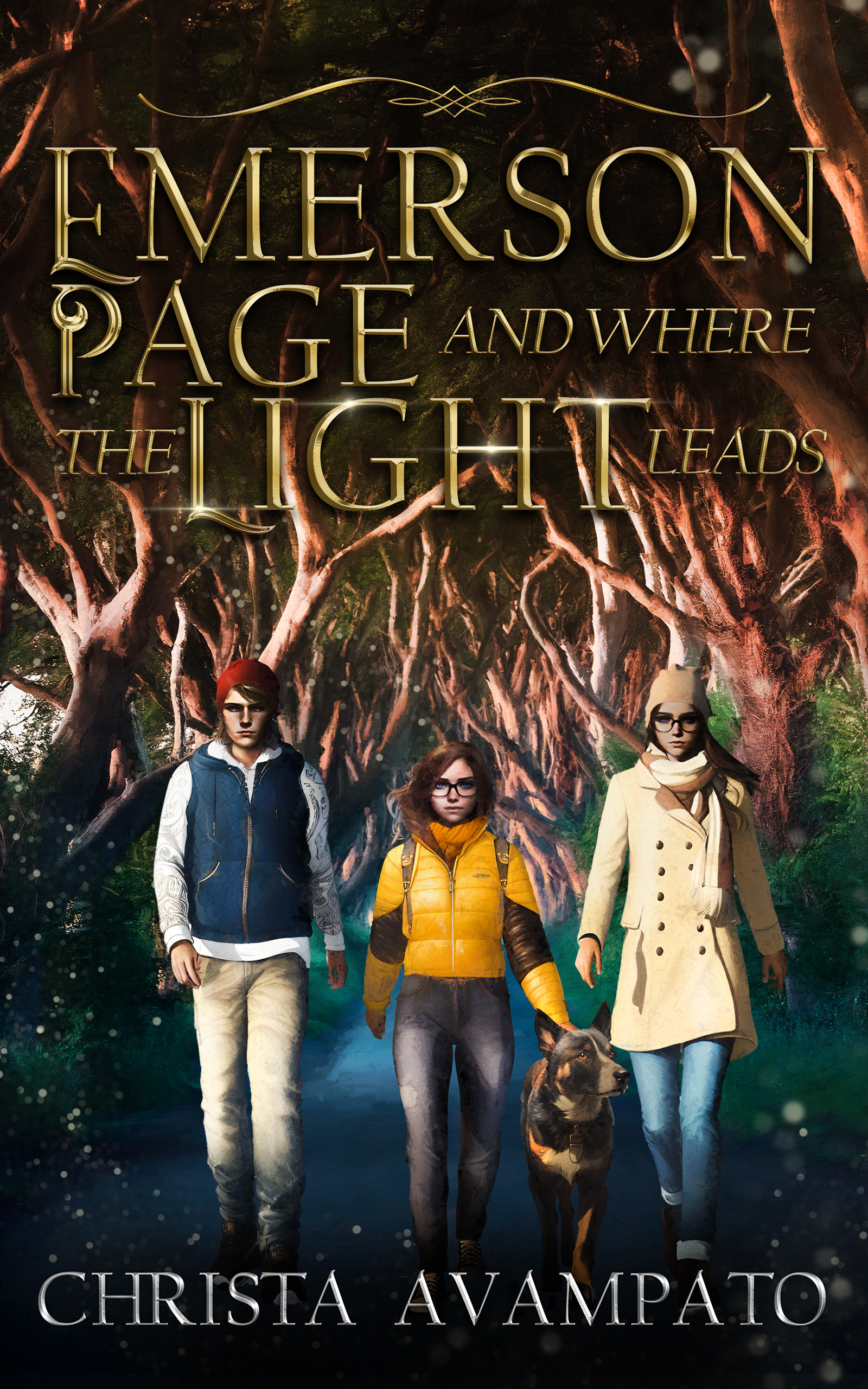
Cover reveal for my second novel, Emerson Page and Where the Light Leads

Emerson Page and Where the Light Leads by Emerson Page

Drumroll please! Here is the book cover for my second novel, Emerson Page and Where the Light Leads. What do you think?! 

Emerson’s joined here by her three best friends: Skylar, Truman, and her service dog, Friday. This scene captures the moment when they arrive at a magical location where they encounter several mythological creatures who never quite reveal themselves as friends or foes. Can you guess the real-life location in Northern Ireland that inspired the cover? Can you guess which mythological creatures they find there and what they reveal to our favorite quartet?

I’ll share the answers tomorrow along with some fun photos and stories. For now, I’d love to hear your reactions to the cover and your guesses to the two questions above.