creativity

Embracing stakeholder theory in Finland this summer

Photo from https://events.tuni.fi/stakeholdertheory/sustainability/

Finland, I can’t wait to meet you! I was accepted into the 2025 Summer Seminar in Stakeholder Theory at Tampere University with University of Virginia Darden School of Business (my alma mater), Darden-The Institute for Business in Society (IBIS), and RESPMAN Research Group. I’ll join an incredible global group of faculty, researchers, and PhD students to learn and share how to best integrate stakeholder theory into my work in sustainability and climate change mitigation. As part of the program, I’m revising and refining the work I started in my University of Cambridge / Cambridge Institute for Sustainability Leadership (CISL) dissertation on the role of storytelling to engage family offices in climate investments. I’ve spent the last 2 months editing (cutting it in half!) and am excited to get feedback on it. In addition to that paper, I’ll also work on 3 more research projects:

  • The Stories We Eat: Narratives to Shape Stakeholder Behavior and Policy for Sustainable Food Futures
  • Narrative Power: Using Digital Media to Convey the Voice of Future Generations and Nature in Sustainability Storytelling
  • From Self-Interest to Shared Benefit: How to Adapt Finland’s Exemplar of Public Trust Amidst Power Asymmetries in U.S. Businesses

I’m so grateful for this opportunity to learn and engage with these incredible people in one of the most sustainable communities in the world. I’m most looking forward to spending time with my professor, mentor, and dear friend R. Edward Freeman, who is one of my heroes and the founder of the seminar. As the originator of stakeholder theory that transformed business ethics, his work has fundamentally changed how businesses and business leaders around the world operate. He’s the reason I went to Darden and he changed how I see the world and my role in it. I’m honored to have had his support and encouragement for all these years.

It’s going to be an incredible summer of learning. I’m excited to experience all of it and to see where it leads! Nähdään pian, Finland!

creativity

Feeling the Heat? How Cities Worldwide Are Cooling Down!

A worker who is part of the Cool LA initiative applying a pavement cooling coating. https://streetsla.lacity.org/marquerite-street-cool-pavement

Ever stepped out of an air-conditioned building into a city street and felt like you’d walked into an oven? That’s exactly how I felt last week in New York City. This is known as the urban heat island (UHI) effect. It makes cities significantly warmer than their surrounding rural landscapes, particularly at night. Why does this happen, and what are cities doing about it?

The Science Behind the Sizzle:

The UHI effect is largely a byproduct of how we build our cities. Here’s a quick breakdown of the culprits:

  • Dark Surfaces & Materials: Concrete, asphalt, and dark rooftops absorb and store vast amounts of solar radiation during the day. Unlike natural landscapes (think forests or water bodies) that reflect more sunlight and release moisture, these urban materials slowly re-emit that stored heat into the surrounding air, keeping temperatures elevated long after sunset.
  • Lack of Vegetation: Trees and plants provide natural cooling through shade and a process called evapotranspiration (where they release water vapor, like sweating). Cities, with their limited green spaces, miss out on these vital cooling benefits. The apartment building where I live straddles a city block. On one side, it’s a tree-lined street that’s almost completely shaded. On the other side of the building, there aren’t any trees at all. The temperature difference between the two entrances is often 10 degrees or more.
  • Urban Geometry: Tall buildings and narrow streets can create “urban canyons” that trap heat and block wind flow, preventing cooler air from circulating and dissipating trapped warmth.
  • Waste Heat: All the human activity in a city – cars, factories, air conditioning units – generates a significant amount of waste heat, further contributing to the overall temperature rise.

The consequences of the UHI effect are serious: increased energy consumption (more AC means more power plants working overtime), elevated air pollution and greenhouse gas emissions, and significant health risks, especially for vulnerable populations, including heat-related illnesses and even fatalities. In the United States, heat is indeed the deadliest weather-related hazard, claiming more lives annually than other extreme weather events like hurricanes, floods, or tornadoes

Cities Taking Innovative Action:

The good news is that cities around the world are recognizing this challenge and implementing clever, innovative solutions to cool down from cool pavement surfaces to using plants as part of walls, roofs, corridors, and increased green spaces. Here are a few inspiring examples:

  • Singapore: The “Garden City” Goes Further Singapore is a leader in green infrastructure. Beyond its lush parks, the city-state is integrating vegetation into buildings with impressive “green walls” and “sky gardens.” They’re also exploring district-level cooling systems, which are more energy-efficient than individual air conditioning units, and prioritizing science-based policies to reduce urban heat risks. Their commitment to planting millions of trees and creating numerous parks is paying off in tangible temperature reductions.
  • Los Angeles, USA: Paving the Way with Cool Pavements Known for its expansive roadways, Los Angeles has been actively experimenting with “cool pavements.” These lighter-colored surfaces reflect more sunlight and absorb less heat than traditional asphalt, significantly reducing surface temperatures. The city has already coated over a million square feet of pavement with these innovative materials. It is also experimenting with applying this coating to rooftops as well.
  • Rotterdam, Netherlands: Embracing Green Rooftops Rotterdam is literally building a cooler future from the top down. The city is actively promoting and implementing green rooftops on a massive scale, aiming to green over 900,000 square meters of rooftops. These vegetated roofs not only reduce ambient temperatures by acting as insulation and through evapotranspiration but also help with stormwater management.
  • Medellín, Colombia: Cultivating Green Corridors Medellín has transformed its urban landscape by creating a network of 30 “green corridors.” These shaded routes, lined with thousands of native trees, palms, and other plants, offer cooler pathways for people to travel and gather, directly combating heatwaves and improving air quality.
  • Paris, France: Creating “Cool Islands” Paris is tackling its urban heat with a strategic approach to “cool island” spaces. The city has identified and is creating 800 such spaces, including parks, water fountains, and public buildings like swimming pools and museums, which are significantly cooler than surrounding streets. They also have ambitious plans to plant 170,000 trees by 2026.
  • Seville, Spain: A “Policy of Shade” In a city accustomed to scorching summers, Seville has adopted a “policy of shade.” This includes installing more awnings, planting 5,000 trees annually, switching to heat-reflective construction materials, and installing more public fountains – all aimed at providing respite from the intense heat.

These examples demonstrate that while the urban heat island effect is a significant challenge, it’s not insurmountable. By embracing a combination of green infrastructure, cool materials, and thoughtful urban design, cities worldwide are proving that a cooler, more livable urban future is within reach.

What can you do?

Even as individuals, we can contribute to mitigating the UHI effect. Consider:

  • Support local initiatives for tree planting and green spaces.
  • Call your reps and offer these examples as something your city could try.
  • Choose lighter-colored materials for your own property if applicable.
  • Advocate for sustainable urban planning in your community.

Let’s work together to make our cities cooler, healthier, and more sustainable for everyone!

creativity

My favorite organizations for Giving Tuesday

Photo by Sticker Mule on Unsplash

Today is Giving Tuesday, a day during the holiday season that raises awareness for giving to nonprofit organizations. I’ve worked professionally in the nonprofit space for many years in different capacities including fundraising, product development and product management, program direction, strategy, operations, and communications. These have been some of my most gratifying career experiences. I’ve also been fortunate to be an active volunteer and donor.

If you want to make donations this holiday season, and / or get more involved with nonprofit organizations, here is a list of the ones I support as a donor and volunteer:

Animals and Pets
Muddy Paws Rescue
I’m a foster parent for dogs through Muddy Paws Rescue. The support, guidance, advice, and services they provide to dogs, fosters, and adopters is unparalleled. Through a partnership with Tito’s Vodka, donations today will be matched.

Animal Care Centers of NYC (NYCACC)
This is our city shelter system for animals who are homeless. They don’t turn away any animals and work closely with groups such as Muddy Paws to help these animals find forever homes. With the help of the Mayor’s Office of Animal Welfare, they also provide support for people who are struggling financially to take care of their pets with food assistance and medical care so that people can keep their beloved pets. With the help of the pet food company, Ollie, I’ve arranged to have an entire pallet of Ollie treats shipped to NYCACC to support the shelter pups.

White Whiskers Senior Dog Sanctuary
I learned about this organization when I wanted to make a gift to a senior dog organization in honor of my soul dog, Phineas, who passed away in January. I love their mission to find loving homes for sweet senior pups.

15/10 Foundation
This organization is doing the tough work of providing funds for medical care for pets to help them find forever homes. This is the same group that runs We Rate Dogs, famous for their joyful posts on social media that make everyone’s day. I adore them. I became a monthly donor as a way to thank all the people who have supported my Emerson Page novels which feature Friday, Emerson’s service dog who is also a rescue!

Climate and Environment
Prospect Park Alliance
I moved to Brooklyn in June 2023, a short 15-minute walk to Prospect Park. I love having that nature sanctuary as my backyard and I’m happy to support them. Today, your donations will be doubled.

National Parks Association
The U.S. is so fortunate to have so much protected public land in our national parks. In 2025, they will need our help more than ever as we navigate a new federal administration. Today, all donations will be tripled!

Arbor Day Foundation
Trees provide us with so many gifts – clean air, water filtration, food, and storm protection to name just a few! A gift to the Arbor Day Foundation makes sure our trees receive the protection and care they deserve.

The Climate Reality Project
Since 2006, Vice President Al Gore has trained over 45,000 climate leaders and change makers in all 50 states and 190 countries, me included. (I was trained in NYC in April 2024.) Today, all gifts will be matched.

Humanitarian and Health
World Central Kitchen
Hands-down, World Central Kitchen founded by Chef Jose Andres is the premiere organization for humanitarian relief. With a small staff, mostly employing local people on the ground in areas they serve, they feed anyone and everyone in need. I’m a proud monthly donor.

Coalition for the Homeless
This year I provided a donation to support their back-to-school program that provides new backpacks filled with new school supplies for New York City children who are homeless. They do so much to help our most vulnerable neighbors.

Fisher House Foundation
Most of the members of my small family have served in the U.S. military. As a Christmas gift every year for my uncle who served in Vietnam, I donate to Fisher House. With 98 locations, they have housed 500,000 military families for free when a loved one is in the hospital.

Education
Brooklyn Public Library
I use my local library all the time and our city is made better for all of the services our library systems provide to everyone. All donations to Brooklyn Public Library will be matched today!

Letters to a Pre-Scientist (LPS)
I’m now in my second year of being a STEM pen pal for students in grades 5 through 10 in low-income communities. LPS pairs students with a worldwide network of STEM professionals for a yearlong pen pal program during science class. We help broaden students’ awareness of what STEM professionals look like and do at work and inspire all students to explore a future in STEM.

creativity

Hope is a Renewable Resource

With everything happening in the world now, hope may feel in short supply. I’ve got something that will help. I had the honor of being a guest on the Art Heals All Wounds podcast with host Pam Uzzell. 

During our conversation, I share my journey from growing up on a rural apple farm amidst adversity to becoming a climate advocate. I talk about my passion for reshaping the narratives and storytelling around sustainability and human design, and how my process of healing from cancer in the depths of the pandemic gave me perspective on healing the planet and the collective responsibility we all share for our planet’s future. This echos what the climate scientist, Dr. Michael Mann, calls “channeling dooming into doing.”

I also make the case for kindness (especially in urban settings), the urgency of transitioning to clean energy, and my plans for fostering environmental restoration, rewilding, and community engagement so we grow stronger together. Thank you, Pam, for the opportunity to talk about everything I love.

Listen to our conversation at https://www.buzzsprout.com/2053590/episodes/16000698

creativity

How the brown ocean effect changes everything we know about hurricanes

This satellite image shows Hurricane Ida bearing down on the Gulf Coast in 2021, a storm fed by the brown ocean effect. Image from NOAA.

When Helene devastated North Carolina, it had been downgraded from a hurricane to a tropical storm. (Sustained wind speed alone is what determines the type and category of a storm.) North Carolina didn’t get the eye of the storm either. That didn’t matter. What devastated North Carolina was the amount and rate of rainfall. 

The mountains of western North Carolina were thought to be as climate proof as a place could be. 350 miles from the coast. Over 2,000 feet above sea level. Helene showed us a dangerous aspect of storms that means there are no more climate havens — the brown ocean effect. 

Hurricanes become especially dangerous when they can spend extended periods of time over warm water. Conventional thinking and history have shown us that when a hurricane reaches land, the land dissipates its strength and the storm, eventually, fizzles. This is why coasts have historically been in greater danger that inland areas. The brown ocean effect changes that. 

When land is warm and saturated with water, as happened in Western North Carolina, it acts as something akin to ocean. While it doesn’t typically kick up the wind speed of a storm like Helene, it provides an excess of moisture and heat. Because the ground is saturated, the massive amount of rain can’t be absorbed. This leads to flooding and landslides. The devastation, loss of life, and high number of missing people in Western North Carolina caused by Helene is partially from the brown ocean effect. The heavy rains dumped on saturated land ravaged everything in their path from houses to infrastructure to power and communication lines. There is even footage of a casket unearthed from a cemetery and carried away by the rushing water. 

The brown ocean effect can happen anywhere there’s land. As rains become heavier and more frequent from climate change and global warming, it can take hold in many more places. Every land mass can provide ocean-like fuel for a storm. 

At the time of this writing, Hurricane Milton is barreling toward Florida. It’s a Category 5 with winds at 180 miles per hour, spinning over the hot waters of the Gulf of Mexico. Stronger than Hurricane Katrina. Even if it weakens, it still has all that water in it that it will drop when it hits land. Also, weakening in this case may be every bit as devastating as wind because it may slow down and pick up even more moisture from the Gulf. The land in Florida is already saturated, as the land in North Carolina was before Helene arrived. It’s a frightening alignment of circumstances. 

On Monday night I watched hurricane specialist John Morales get choked up on air giving the news update on Milton becoming a Category 5. These storms are no longer once-in-a-century, once-in-a-lifetime, and perhaps not even once-in-a-season. This may now be our new normal that is anything but normal.

creativity

Zillow will provide climate risk data on for-sale listings

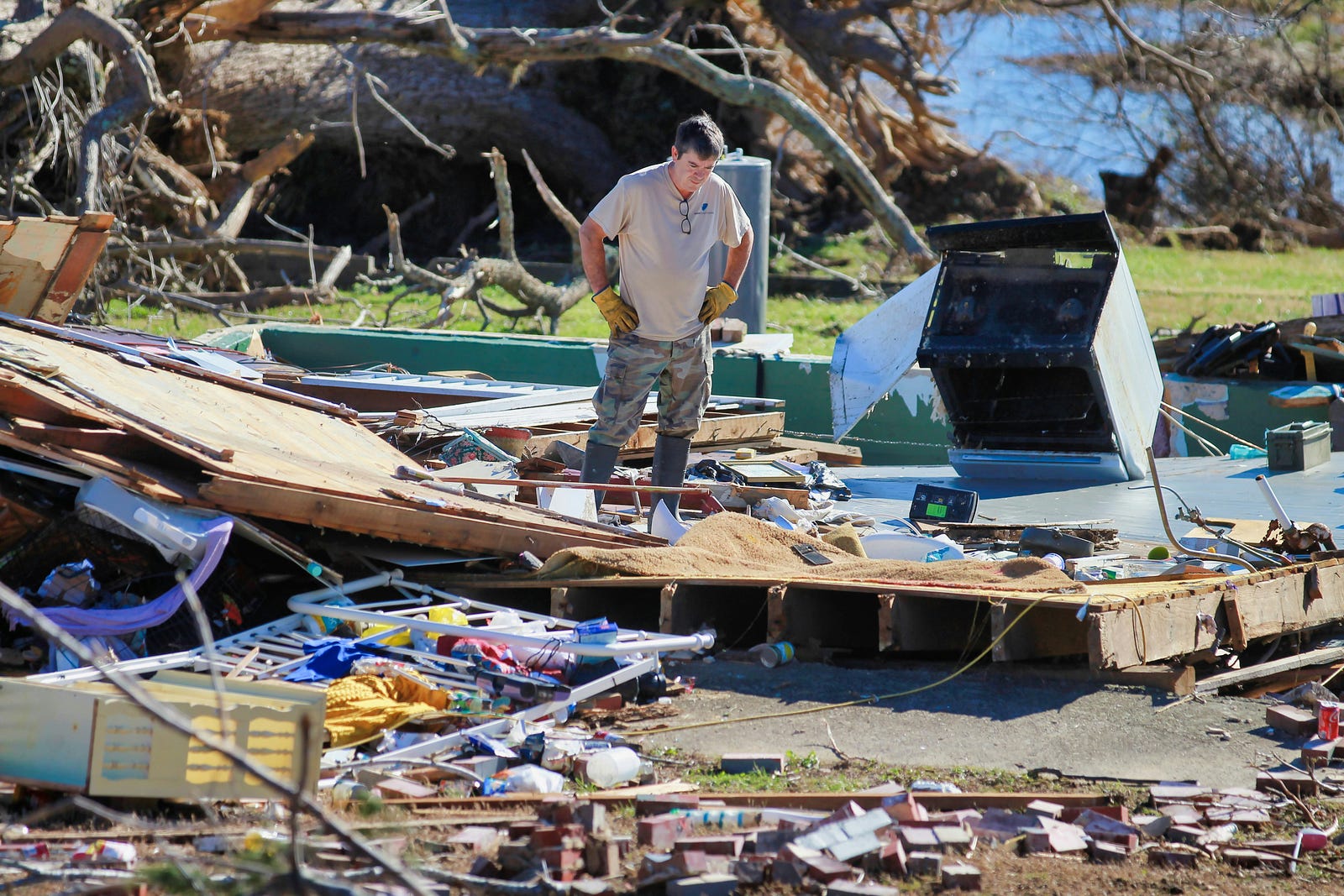
Man looking at loss of home to a tornado in Cambridge Shores, Kentucky in 2021. Photo by Chandler Cruttenden on Unsplash

If you’re a prospective homebuyer and concerned about climate risk, Zillow is about to make your search much easier. By the end of 2024, for-sale listings on Zillow’s website will include climate risk information for flood, wildfire, wind, heat, and air quality by partnering with First Street, the gold standard for climate risk financial modeling. First Street’s models are developed by leading scientists and vetted through a peer-review process to transparently calculate the past, present, and future climate risk for properties and make it available for all. This ensures the climate insights given on Zillow are both credible and actionable.

Zillow will also include insurance recommendations, climate risk scores, interactive maps, and show if and when a property has experienced past climate events. It will be the first and only real estate listing site to provide this detailed data, giving the company a significant point of differentiation.

Consumer demand
Zillow decided to provide this data based on overwhelming consumer demand. Zillow research in September 2023 showed 83% of prospective U.S. home buyers consider climate risk. That percentage varies by geography—90% in the West, 85% in the Northeast, 79% in the South, and 77% in the Midwest. The average age of a U.S. homebuyer today is 39. Millennials and Gen Z are entering the home buying market and care deeply about climate. Zillow is centering their current and future users. 

A potential shift in the real estate market
This data could significantly shift the real estate market and the migration of home buyers within the U.S. because climate risk is growing more pervasive. Across all new listings in August 2024, 55.5% have a major risk of extreme heat, 1/3 for extreme wind exposure, 16.7% for wildfire, 13% for air quality, and 12.8% for flooding. 

The risks vary widely by geography. Over 70% of new listings in the Riverside, California metro area have a major wildfire risk. Wildfire risks impact 47% of new listings in Sacramento, and roughly 1/3 of listings in Jacksonville, Phoenix, San Diego, and Denver. 76.8% of new listings in the New Orleans metro area have a major flood risk, while roughly 1/3 in Houston, Miami, and Tampa and over 1/4 in Virginia Beach are at risk of flooding. In general, Midwest markets hold the lowest climate risk with less than 10% of new listings having any major climate risk in Cleveland, Columbus, Milwaukee, Indianapolis, Minneapolis, Detroit, and Kansas City.

Accuracy of First Street climate risk data
Some cities and the federal government through FEMA provide some climate risk information. This includes designated flood zones that help consumers partially assess risk. However, this is not comprehensive enough to help consumers holistically gauge insurance needs and potential future risks. This is where First Street’s modeling really shows its financial value. 

Consider Hurricane Debby, the storm that wreaked havoc along the U.S. east coast in August 2024. First Street’s analysis found 78% of properties flooded by Debby were outside FEMA flood zones, meaning flood insurance isn’t mandatory. 85% of these properties would have received an insurance recommendation on Zillow, highlighting how First Street’s climate risk data can inform buyers during their home search.

Climate data can change where and how we build
Not only does First Street’s data on Zillow inform prospective home buyers and real estate agents; it can also serve home builders, municipalities, and the federal government. Home builders can use it to assess the value of their potential construction sites. Municipalities can use it to assess where they need to focus their infrastructure dollars for climate resiliency and adaptation builds. The federal government can use the data to re-evaluate and assess FEMA designations for climate events and more effectively consider plans to support the expansion of the available housing market. It may also help us as a society plan for migration within the U.S. as we face climate change impacts. 

What I find most refreshing about Zillow’s approach is that it’s not about politics or marketing. It’s about science and data. Zillow isn’t telling consumers which property to buy, or which risks they should consider. It’s providing the data in a clear, consistent manner so consumers can make the most clear-eyed choices possible. With this data in-hand, consumers can understand the risk they’re taking and how to prepare for it. In this risky world of ours, that’s data we all desperately need.

creativity

How trees are saving our morning cup of coffee

Nespresso Colombian coffee farm using agroforestry. Photo from Nespresso.

As I sip my morning coffee, I am grateful for trees. What do trees have to do with our coffee? In Colombia, everything. Trees are changing Colombian coffee, and the planet, for the better.

Arabica coffee grows at altitudes between 1,500 and 2,000 feet, on the sides of steep mountains. Colombian farmers have to consider ways to decrease soil erosion and increase biodiversity to pollinate their coffee crops. Collaborating with Nespresso, Cornell Lab of Ornithology, and PUR, they are rewilding their land and everyone is benefitting.

At Climate Week NYC, Andrew Nobrega at PUR, Julie Reneau at Nespresso, and Viviana Ruiz-Gutierrez at Cornell Lab of Ornithology reviewed their research, actions, and inspiring outcomes. Below, the picture on the left is a coffee monoculture in Colombia just south of Bogotá, meaning it only has coffee planted. The picture on the right shows agroforestry and regenerative agriculture— same amount of land, same amount of coffee planted, and filled in with other tree and plant species.

Nespresso presentation at 2024 Climate Week NYC. Photo by Christa Avampato.

In less than a decade, biodiversity above and below ground has increased between 10% and 20%. Farmers have diversified their income streams with additional crops, improved soil quality and water resources, decreased soil erosion, increased land resilience to storms and other climatic events, and sequestered carbon. Most importantly to the farmers, they have improved the quality of their coffee. 

Coffee was never meant to be a monoculture. It’s a forest plant that thrives in shade, which is exactly the optimal environment that agroforestry and regenerative agriculture practices provide. For more information on these programs at Nespresso, visit https://www.sustainability.nespresso.com/regenerative-agriculture.

creativity

Can clean electricity for everyone everywhere end poverty?

Photo by Kendall Ruth on Unsplash

700 million people have no electricity. 3.1 billion people don’t have enough. Could changing that change everything?

Rajiv J. Shah, President of the Rockefeller Foundation and author of “Big Bets: How Large-Scale Change Really Happens”, published a New York Times opinion essay this week that makes the case for clean electrification as THE driver to end poverty, reduce violence, and drastically improve well-being including health, nutrition, jobs, and education, not to mention how it would provide us with cleaner water, air, soil, and crops.

I appreciate the holistic nature of the 17 Strategic Development Goals (SDGs). I also agree with Shah that we have to rethink how we’re approaching them by solving the few (or perhaps the one, as Shah suggests) underlying challenge(s) common across all the SDGs. The bureaucracy and complexity of 17 sets of solutions to meet 17 goals is enough to make anyone’s head spin, and it could very well be slowing our progress toward achieving any of them by 2030. These 17 goals may define symptoms, with the underlying disease being lack of clean electricity. 

If Shah is right, and clean electrification is the root challenge of all these goals, how might that change financial investment and policy? How might our climate actions and climate storytelling shift if our one united goal was to provide every person with clean electricity by 2030? What would it take to get there?

creativity

If you care about babies, you must care about bats

Image created by Christa Avampato using Canva Magic Media

When you think about ways to improve the health of human babies, you may not immediately think of helping bats stay healthy. You should. The journal Science published a shocking paper this month linking a rise in human infant mortality to a declining bat population.

In addition to being pollinators that bring us the gifts of flowers and food, bats also consume massive amounts of insects that infest our crops and cause us endless hours of itching from bug bites. A single bat can eat up to 1,200 mosquito-sized insects every hour, and each bat usually eats 6,000 to 8,000 insects each night. That’s a helpful service but what does that have to do with infant mortality? It’s a direct cause and effect. 

Plagued by an outbreak of the deadly white-nose syndrome, a fungal disease that kills bats, North American bat populations are dropping. This means there are fewer bats to eat insects that infest crops. That’s caused farmers to use more chemical insecticide. This insecticide leaches into crops, land, and water. This toxin has increased infant mortality. It’s also lowered crop yields, decreasing farmers’ crop revenue and the availability of fresh fruits and vegetables. 

This is just the latest study to show how the health of ecosystems is directly linked to human health and the economy. As much as I’d love for municipalities and companies to care about the planet because we depend on nature for our survival, as climate communicators and nature advocates we often have to make the economic business case to drive change. Studies like the one in Science linking bats and infant mortality provide a solid example of how to quantify the cost and value of biodiversity and ecosystem health.

I often hear the media vilify animals like bats without recognizing the vital role they play in our lives and in nature. If we can’t get people to care about bats because they are sentient beings and a part of nature, maybe now we can get people to care about them because they affect babies, the food supply, and our economy. If that’s the argument that works, it’s the argument I’ll make, backed up with research-based science and facts. 

Protect babies. Protect bats. 

creativity

Governor Tim Walz made Minnesota a climate action powerhouse

Minnesota Governor Tim Walz has spent the better part of the last decade instituting climate policies that make economic sense and help all Minnesota residents live healthier, happier lives. Let’s dive into what he’s done in Minnesota and how this could help the entire country. 

1.) Minnesota is a clean energy leader

Like many states, Minnesota was long powered by coal. Today, 50% of the state’s power comes from wind, solar, and nuclear power, thanks to Walz. It’s one of the fastest transitioning states in the country. In 2023, he signed the Minnesota Clean Energy Bill into law, ensuring Minnesota is fossil fuel-free by 2040. (If you want to see how all U.S. states stack up with their energy sources, check out this cool interactive created by Nadja Popovich.) 

2.) Minnesota is a climate policy leader

On Walz’s watch in 2022, Minnesota launched the Climate Action Framework. This plan is preparing the state for climate change impacts, taking immediate and near-term actions to make the state “carbon-neutral, resilient, and equitable.” To-date, this plan has prompted the Minnesota Legislature to approve over 40 climate initiatives across industries including energy, health, agriculture, construction, and transportation. 

3.) Minnesota policies connect everyday local concerns with climate solutions 

Minnesotans have acutely felt the impacts of climate change over the past 5 years — drought caused economic losses for farmers and ranchers, wildfire smoke inundated cities and towns leading to health challenges, and a lack of snow and ice caused economic losses in the fishing and winter tourism industries. The state’s climate policies focus on climate solutions that create jobs, protect land and water vital for farmers and ranchers, reduce energy costs for consumers, and improve air quality to improve the health of residents, particularly children, the elderly, and those with existing health conditions. 

Walz’s simple, straightforward, optimistic, and solution-oriented communication style unites people, makes them feel hopeful, and connects the challenges they face with policy solutions that will directly solve those challenges. This makes him wildly popular with constituents across the political spectrum. People trust him because he’s helping them. This has helped turn Minnesota into a climate action powerhouse. Using his playbook, we could do this for the entire country.