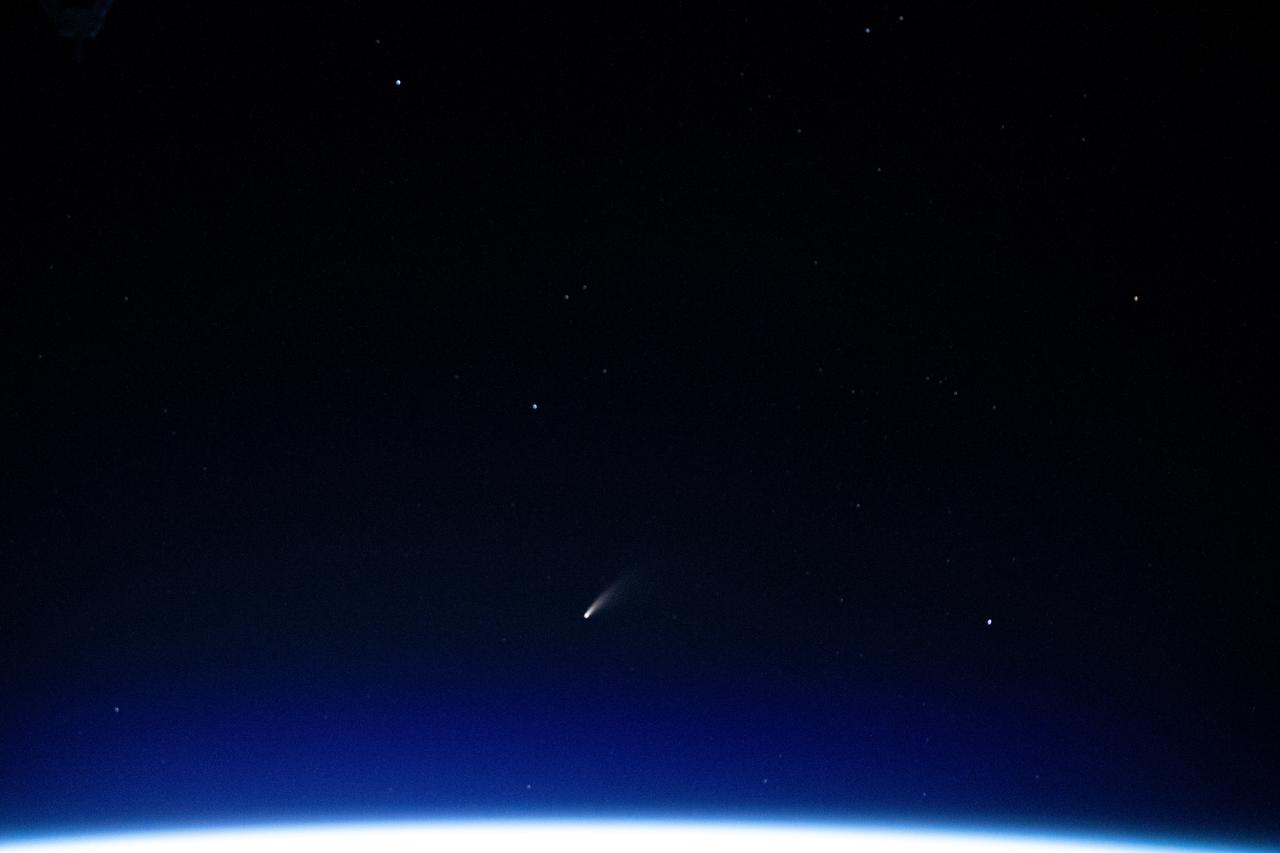
The tiny shooting star in the lower center of this image is Comet Neowise pictured from the International Space Station as it orbited above the Mediterranean Sea in between Tunisia and Italy. July 5, 2020. NASA’s Johnson Space Center. Original image: images-assets.nasa.gov/image/iss063e040067/iss063e040067~orig.jpg
“Twenty years from now you will be more disappointed by the things that you didn’t do than by the ones you did do. So throw off the bowlines. Sail away from the safe harbor. Catch the trade winds in your sails. Explore. Dream. Discover.” ~ Author H. Jackson Brown, Jr.
Here’s something I caught myself saying too often for a long time, “I’ll do X when…” as if I was waiting for the perfect time, the perfect circumstances, the perfect me to emerge to do something.
Every once in a while I still find myself in that headspace. Habits are hard to break and they are annoyingly good at re-emerging just when we thought we’d changed them for good. Thankfully I catch myself when this happens now. As soon as this thought crosses my mind, I give myself a talking to.
“Honey,” I say to myself, “Perfection isn’t on its way. Not today. Not ever. Do it. Or don’t. But stop waiting. Just choose.”
Then I laugh and get on with it, or decide not to.
I’ve got a little list of things I’ve been waiting to do. Slowly but surely, I’m getting them done or at least giving them my best shot.
Three fun things I did recently:
1.) I applied to be an independent content creator for NASA. It was quite the administrative web to navigate but I did it and put in my application just before the deadline.
2.) I submitted a vulnerable piece of writing for the Modern Love column in The New York Times.
3.) I put in my application to be a volunteer at the 2028 Olympics.
Will any of this work out? Maybe, maybe not! But you know what? I’ll always be glad I shot my shot!
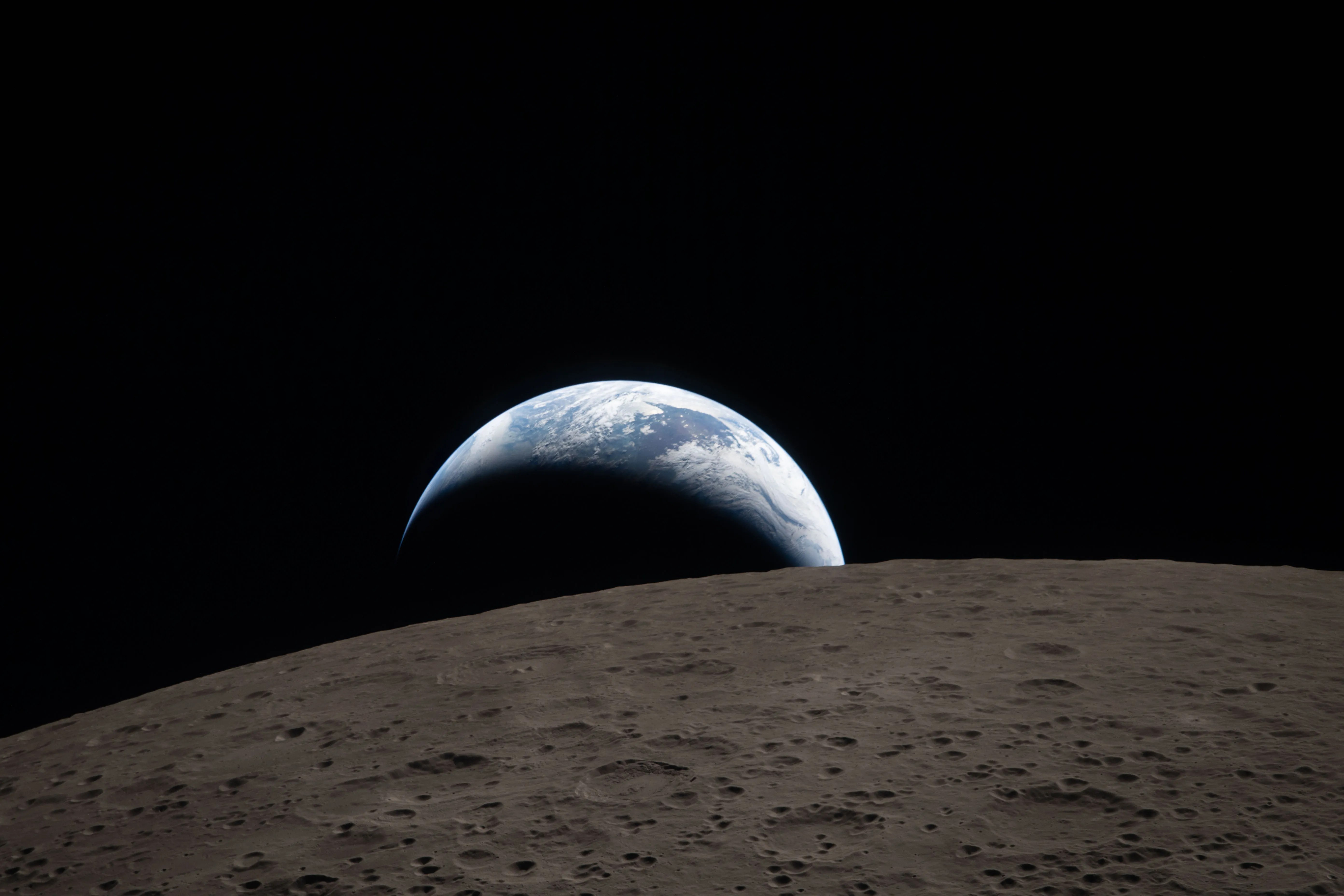
This week, four astronauts aboard the Artemis II Orion spacecraft achieved something humanity has not done in over fifty years. They flew around the far side of the moon, traveling farther from Earth than any humans in history – 252,760 miles. As they passed behind the lunar surface, they turned their cameras back toward home and captured a breathtaking Earthset, watching our bright blue planet sink behind the desolate, cratered edge of the moon. Looking at all of the media coming from the mission gives me chills in the best way.
The Cognitive Shift When astronauts view our planet from this immense distance, they often experience a profound cognitive shift known as the Overview Effect. From 250,000 miles away, they can’t see political borders, neighborhood disputes, or ideological divides. They see a single, fragile ecosystem. They realize that every being, be they a person, animal, or plant, shares the same life support system and collectively, the same destiny. We all only have one home and it belongs to all of us.
A Floating Laboratory for a Sustainable Earth People frequently wonder why we invest in space exploration when we face so many massive challenges right here on Earth. The answer is that a deep space capsule is the ultimate testbed for our future. We do not explore space to abandon our home planet; we explore space to discover the exact tools necessary to protect it.
To survive a lunar mission, astronauts cannot waste a single resource and a vast group of people with different talents and experiences must work together as a cohesive team with a singular shared mission – bring them all home safely. They must operate a circular economy. NASA engineers design advanced filters to scrub carbon dioxide directly out of the cabin air—technology that now forms the foundation of direct air capture facilities fighting global warming today. They develop systems to recover and purify every drop of moisture, translating directly to water filtration for drought-stricken communities. They conduct experiments on high-yield indoor agriculture to feed the crew without the benefits of direct sunlight or nutrient-rich soil, helping us understand how we can grow food in harsh environments. Staging this mission also requires the development of stronger, lighter materials that translates into the conservation of valuable resources.
Alongside this climate engineering, the Artemis II crew is conducting experiments that directly advance medical science. They carry microchips containing living human bone marrow tissue to study exactly how deep-space radiation and microgravity affects human cells. They monitor their own biological responses to understand why and how extreme stress alters the human immune system. Solving these medical challenges in space paves the way for individualized cancer treatments, tools to predict and treat chronic conditions, and advanced healthcare innovations that test drugs and vaccines. All of this research means that the astronauts are both scientists and test subjects. What we learn from these missions directly translates to helping all of us build a better healthcare system.
Orchestration on a Massive Scale The mission also represents the ultimate example of community orchestration. Sending a crew around the moon and safely bringing them back is never the work of one isolated visionary. It requires a massive, synchronized ecosystem of engineers, technicians, and scientists across the globe. Thousands of people must set aside their individual egos and operate with absolute trust in one another to navigate the unknown.
The Takeaway We do not need to launch into orbit to apply the Overview Effect to our daily lives. When we get stuck in the weeds of local disputes or feel overwhelmed by the friction of community building, we simply need to change our vantage point.
We can actively choose to step back and look at our neighborhoods as unified ecosystems.
Change your altitude to change your attitude: When a conflict arises in your community, intentionally zoom out. Ask yourself how this specific disagreement affects the overall health of the neighborhood ecosystem rather than just your immediate block. Then help other people zoom out as well to gain the same benefits of perspective.
Acknowledge the shared ship and the shared journey: Remind yourself and your neighbors that you all rely on the same local infrastructure and green spaces, and that collectively you are building your local economy to benefit everyone. You succeed or fail together.
Orchestrate across borders: Look for ways to connect your local initiatives with efforts in neighboring communities. A thriving garden in your neighborhood benefits the pollinators across your city and beyond.
Translate the research: Take inspiration from the Artemis crew. Look for ways to do small experiments and use the solutions you develop through those experiments to help your community and share with adjacent communities.
Nature requires us to act as a unified whole. We just need the right perspective to see it. Luckily for us, the crew of Artemis II is helping all of us to keep looking up.
Happy 50th birthday to the moon landing! If you are anywhere near NYC before Sept 22nd, I highly recommend seeing The Metropolitan Museum of Art, New York‘s exhibit Apollo’s Muse: The Moon in the Age of Photography, a beautiful combo of science, art, & dreams.
Among my favorite pieces there:
Images from and of the refracting telescope at Lick Observatory (1870s and 1880s)
The first book entirely dedicated to the moon (from 1647)
Images from the lunar atlas created at the Lick Observatory (1897)
Venice by the light of the moon (a trick of photography by Carlo Naya – 1875)
A light-refracting telescope similar in technology to the one used by Galileo (1800)
Opportunity’s last words from Mars: “My battery is low & it’s getting dark.”
May we all have lives as rich with discovery and a final chapter as peaceful. We’re lucky to have known you, Opportunity, and to see this world through your eyes. Thank you for your service.
This week I was watching an episode of Cosmos, and Neil deGrasse Tyson told the story of how Carl Sagan invited him to Ithaca when Tyson was just 17 years old and growing up in the Bronx. Sagan encouraged him to pursue his passion in science. It was a pivotal moment in Tyson’s life, a moment he’s never forgotten.
That’s the power of mentorship, of caring about the future and the success of young people. Carl Sagan had plenty of other ways to spend his time. He chose to make time to help young people, to support their dreams and aspirations, to share his love for science.
Whatever your talents, I hope you’ll find a way to use them to help our youngest generations. They need us, and we need them.



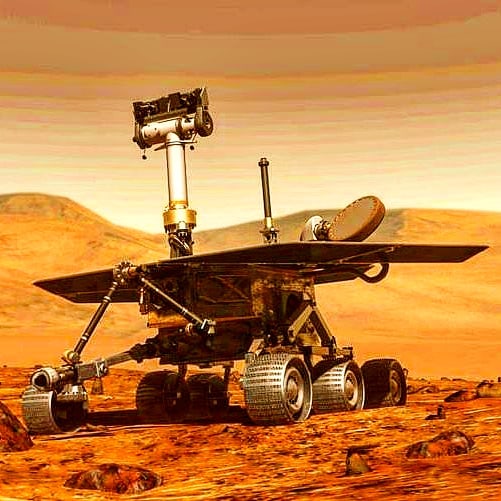 Opportunity’s last words from Mars: “My battery is low & it’s getting dark.”
