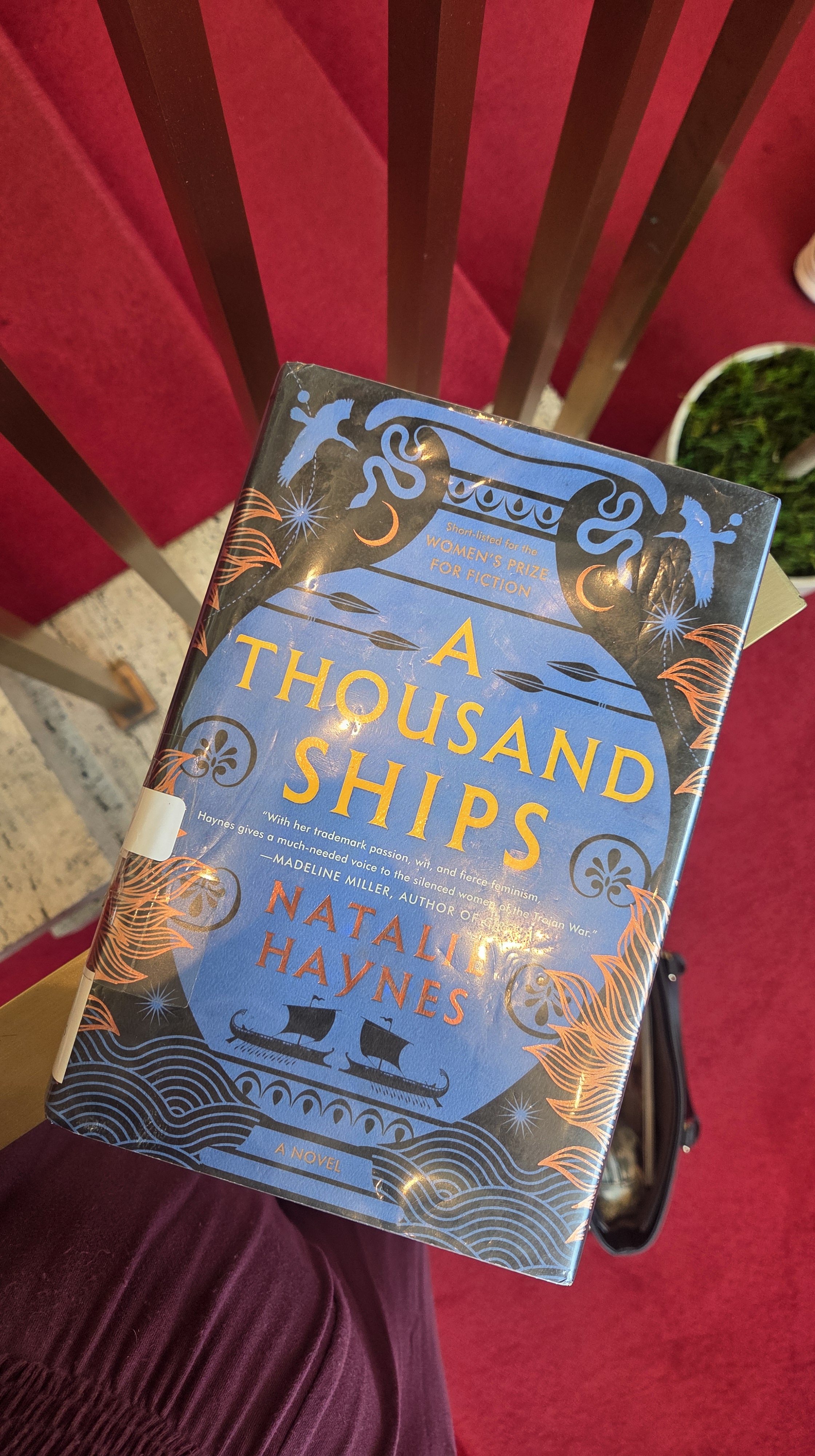
I write stories about women who are underestimated and determined to rise. On the recommendation of my dear friend and storytelling mentor, John Bucher, I just finished the book A Thousand Ships by Natalie Haynes. It’s a retelling of Trojan War from the perspective of the women who have too often been relegated to the sidelines. A number of years ago, I wrote a screenplay about underestimated women during wartime that did well in the competition circuit. John was the first person to read it and his feedback made it better. He also said to me, “This would make a great novel.” If there’s anything I’ve learned about John in the years we’ve been friends it’s that his story instincts are always right.
Slowly I’ve been chipping away at transforming my screenplay into a book, and though it’s taking me longer than I’d like to get this draft to a place I’m happy with, I still love these characters and their story as much as I did when I started it. Still, when a project stretches over years and has been interrupted (in a good way!) by other projects, the momentum can be tough to maintain. After I finished Natalie’s book, I wondered if John might have known that this was the push I needed to keep going. Again, he was right. Here’s are some snippets from Natalie’s book that inspired me to keep writing:
“The casualties of war aren’t just the ones who die.“
This is the reason I was originally drawn to the story I’m writing. While war stories focus on the frontlines, there is a whole narrative that plays out off the battlefield. Those people silently bear an immense weight that is no less painful but often neglected or ignored, or worse, not even considered.
“War is not a sport, to be decided in a quick bout on a strip of contested land. It is a web which stretches out to the furthest parts of the world, drawing everyone into itself.”
Wars always go on for too long. Those who try to stay neutral or out of the fray are drawn in, willing or not. And so often those people are women. In my story, this is exactly what happens and once they see the inevitable, they rise up despite being pushed down.
“This is the women’s war, just as much as it is the men’s.”
When my screenplay received feedback from writing competition judges, one thing that they consistently liked was that the story was about a war without the war being the whole story. It’s also about their friendships, dreams, heartbreaks, and the difference between how society views them and how they view themselves.
“A woman who lost so much so young deserves something, even if it’s just to have her story told.”
Even though these women aren’t fighting on the frontlines, the war is no less theirs and their stories are just as valid. Maybe even more so because they are who relate to most. From the very beginnings of storytelling, which coincide with the beginning of humanity, all people have ever wanted was to be heard and understood. It’s why we tell stories at all. It’s also why we write them.
“There are so many ways of telling a war: the entire conflict can be encapsulated in just one incident.”
The inciting incident is where a story begins to skyrocket. It sets in motion the conflict and the action. It is what sets everything in motion. So it was in the mythology of the Trojan War. So it is in my story that I’m writing. So it is in every book and film. And also in our lives. There are defining moments where something happens and everything after is forever changed by it. It’s rarely something we choose. It’s something that happens, and then we must make meaning from it. I write to make meaning from things in my own life; I think most writers do.
“All that matters is the telling.”
There may be people who write to get an agent, a publishing contract, fortune, and fame. I write because I like writing. I write because it’s just who I am. I write to make sense of the world, and to put together an image of the world I want to live in. Are all those external benefits lovely? I’m sure they are. But they aren’t my reasons for putting fingers to keyboard or pen to paper. They would be a bonus, and if they never come my way, that’s okay. I’ll keep writing. I’ll keep telling stories because it makes me happy.