The moon and the stars through the trees. Image by Christa Avampato.
Tonight, as we usher in the longest night of 2025, may we give ourselves the permission and grace to rest. Yes, the light begins to return slowly and surely as we move forward. But before us tonight lies the gift of darkness.
It is a time for dreaming, for reflecting, for remembering. It allows the light to shine brightest—from stars, from the moon, and from the people around us. Just as stars require the dark to be seen, we often find the best in others and ourselves during the darkest times. When confronted with difficulty, we rise to help each other.
We cannot get through this life alone. Relationships are the center of everything. Love is the center of everything.
This winter, I wish you peace. As the daylight grows, I hope the light within you and the light within me grows, too.
Sugar kelp can grow in the waters around NYC, and thrives during the cold winter months
I recently read a fascinating piece in Smithsonian Magazine about the “underwater forests” returning to life off the coast of California. It details the restoration of Giant Kelp—towering, 100-foot strands that form cathedrals of biodiversity, sequester carbon, and shelter marine life.
It’s an inspiring success story of ecological recovery. But as I read about the Chumash people and marine biologists working together in the Pacific, I couldn’t help but ask a question closer to home: Could we apply this to the waters of New York City?
The answer is a resounding yes—but it looks a little different here. And it’s already beginning.
Different Coast, Different Kelp
In California, the focus is on restoration: bringing back wild Giant Kelp forests that have been decimated by urchins and climate change.
In New York and the broader Northeast, our opportunity lies in regenerative ocean farming. We don’t have the deep-water Giant Kelp; we have Sugar Kelp (Saccharina latissima). This golden-brown algae is shorter, but it is a powerhouse. It thrives in our cold winter waters—growing rapidly when most marine life is dormant—and acts as a “scrubbing brush” for our harbors.
Sugar Kelp absorbs carbon dioxide (fighting ocean acidification) and, crucially for NYC, it soaks up excess nitrogen from urban runoff, which is the main driver of harmful algae blooms.
We aren’t just “restoring” nature here; we are building a blue economy. Here are the local pioneers turning this idea into reality right now.
1. The Indigenous Lead: Shinnecock Kelp Farmers
Just as the Chumash people are leading efforts in California, the Shinnecock Indian Nation is leading the way on Long Island. The Shinnecock Kelp Farmers are a multi-generational collective of Indigenous women leveraging thousands of years of traditional ecological knowledge to heal the water.
They have established the first Indigenous-owned kelp farm on the East Coast in Shinnecock Bay. Their work proves that kelp isn’t just a crop; it’s a tool for sovereignty and survival, actively filtering the waters that sustain their community.
2. The Science: It Works in the East River
You might think kelp needs pristine, open ocean to survive. Think again.
Researchers Dr. Christopher Gobler and Mike Doall from Stony Brook University have been running pilot studies to see if kelp could survive the urban waters of the East River. The results were surprising: the kelp didn’t just survive; in some cases, it grew better in the nutrient-rich waters of the harbor than in cleaner, deeper waters. This suggests that NYC’s “working waterfront” could double as a biological filtration system.
3. The Pioneers: Breaking the Regulatory Barrier
The technology exists, but the permits have been the hard part. The industry is so new that New York State didn’t have a regulatory framework for it until very recently.
In 2023, Violet Cove Oyster Co., led by former WNBA star Susan Wicks, secured the first-ever commercial permit to grow kelp in New York state waters (Moriches Bay). It took years of advocacy to get there. Her success paves the way for oyster farmers across the region to become “multitrophic” farmers—growing shellfish and seaweed together to maximize the environmental benefit.
The Vision for a “Blue” NYC
Organizations like GreenWave are already training the next generation of ocean farmers, with a goal of creating thousands of jobs. Imagine a future where the New York harbor isn’t just a transit lane for ferries and cargo, but a grid of regenerative farms.
These farms would provide local food, sustainable fertilizer, and bioplastics, all while cleaning the water and capturing carbon.
California’s underwater forests are a reminder of nature’s resilience. NYC’s underwater farms could be a testament to our innovation. The seeds (or rather, the spores) have been planted. Now, we just need to support the regulations and organizations that will let them grow.
In a recent episode of The Common Good from the Garrison Institute, science writer and Biomimicry Institute co-founder Janine Benyus joined host Jonathan F.P. Rose for an illuminating conversation. The topic was profound yet elegantly simple: uncovering “nature’s universals” — the deep, time-tested design patterns that silently guide all living systems, and how we can apply them to the human world.
Benyus, the pioneer behind the biomimicry movement, anchors her work on a single, powerful biological truth: Life creates conditions conducive to life.
This isn’t a romantic notion; it’s a design principle. Over billions of years, successful natural systems — from the vastness of a forest canopy to the complexity of a coral reef — have learned to thrive not through competition and extraction, but through cooperation, self-organization, and elegant networked intelligence. These are the strategies that generate abundance without consuming the system that supports them. When we look at nature, we are looking at a master class in sustainability, efficiency, and resilience.
The Blueprint for Human Innovation
The conversation moved beyond mere observation to practical application, identifying core natural principles that can and must guide human industry and ethics. Two standout concepts for redesigning our civilization are:
Right-Sizing: In nature, nothing is over-engineered. Organisms do what is necessary, but no more, often using modularity and local resources to solve problems. Benyus challenges us to abandon the modern human impulse for massive, centralized, and often brittle systems. Instead, we should mimic nature’s local, tailored, and efficient solutions.
Distributed Abundance: Nature’s design is fundamentally anti-monopoly. Resources and solutions are distributed — sunlight, nutrients, and water flow through a network, ensuring that the health of the whole system supports the success of individual parts. Applying this principle to economic and social systems means designing for local self-sufficiency and ensuring resources are abundant and regenerative for all, rather than concentrated at the top.
A Call for Biological Literacy
Ultimately, the episode serves as a powerful call to re-embrace our own biological literacy. For too long, Benyus contends, Western culture has viewed the world — and our place in it — as a collection of separate parts to be managed and exploited. This mindset has dictated our industrial processes, our economic models, and even our spiritual disconnection from the living planet.
The discussion highlights that re-embracing these universal patterns is not just about engineering better products; it’s about reshaping our culture and spirituality. By learning from life’s inherent genius, we move toward a worldview where we recognize the world as a single, living, interdependent whole. The greatest innovation of the next century will be applying nature’s wisdom to create human systems that are as beautiful, cooperative, and conducive to life as a thriving ecosystem.
I’d love to hear your thoughts on how we can all embrace nature’s principles to live our best lives and also care for the planet. What do you think?
To be alive and healthy in a world with golden skies is no small thing. I went for a walk tonight in my beautiful Brooklyn neighborhood to clear my head, open my heart, and lift my spirits.
On that walk, I let myself hope for a brighter, better future. I let myself imagine my city transforming into a place where generosity and justice become an engine for progress.
I want New York City to become healthier, greener, safer, and more equitable for all beings who call this home. A place where dreams come true are not 1 in a million, but within reach for everyone who works hard and lifts others as they rise.
And I believe we can make all of that a reality, together, one day at a time.
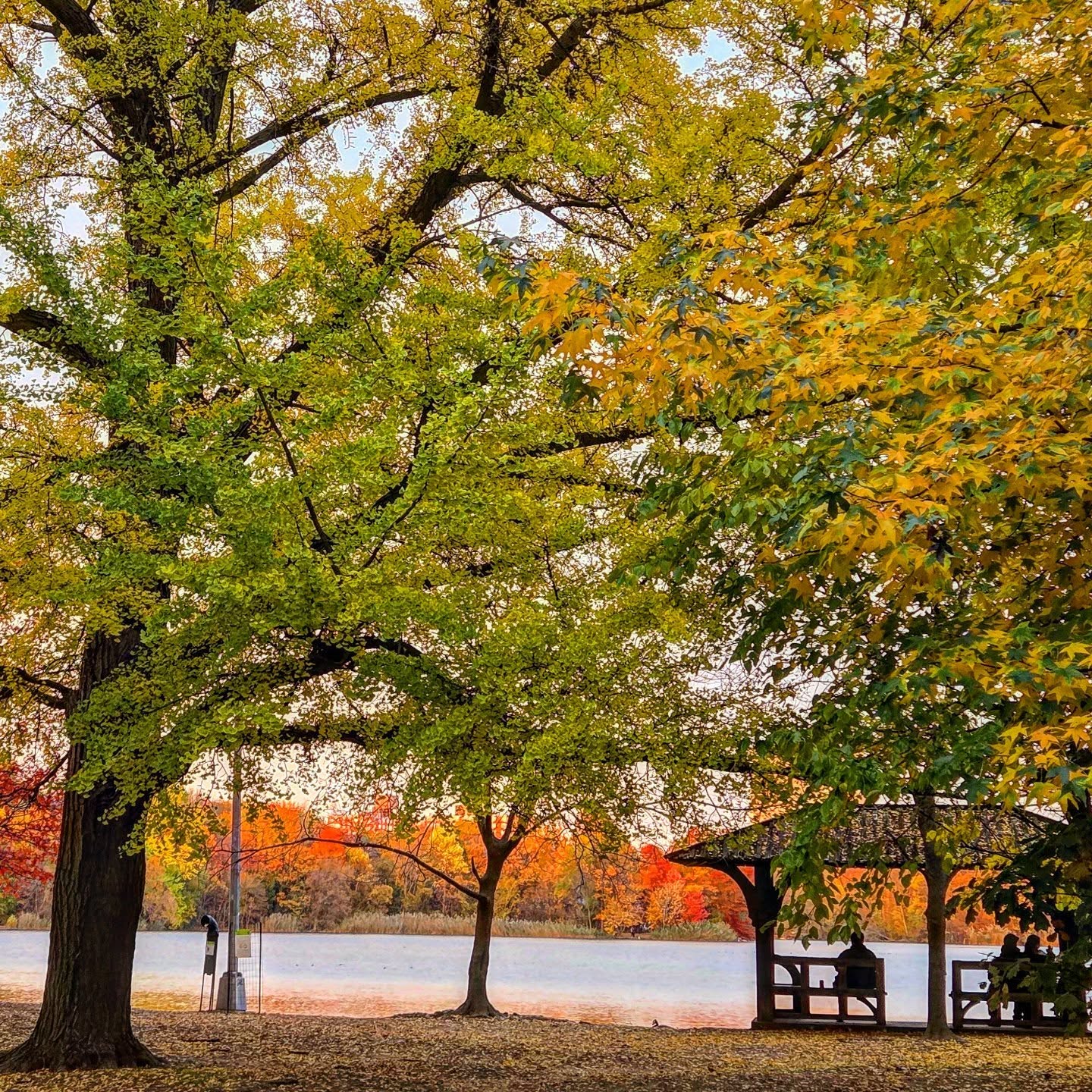
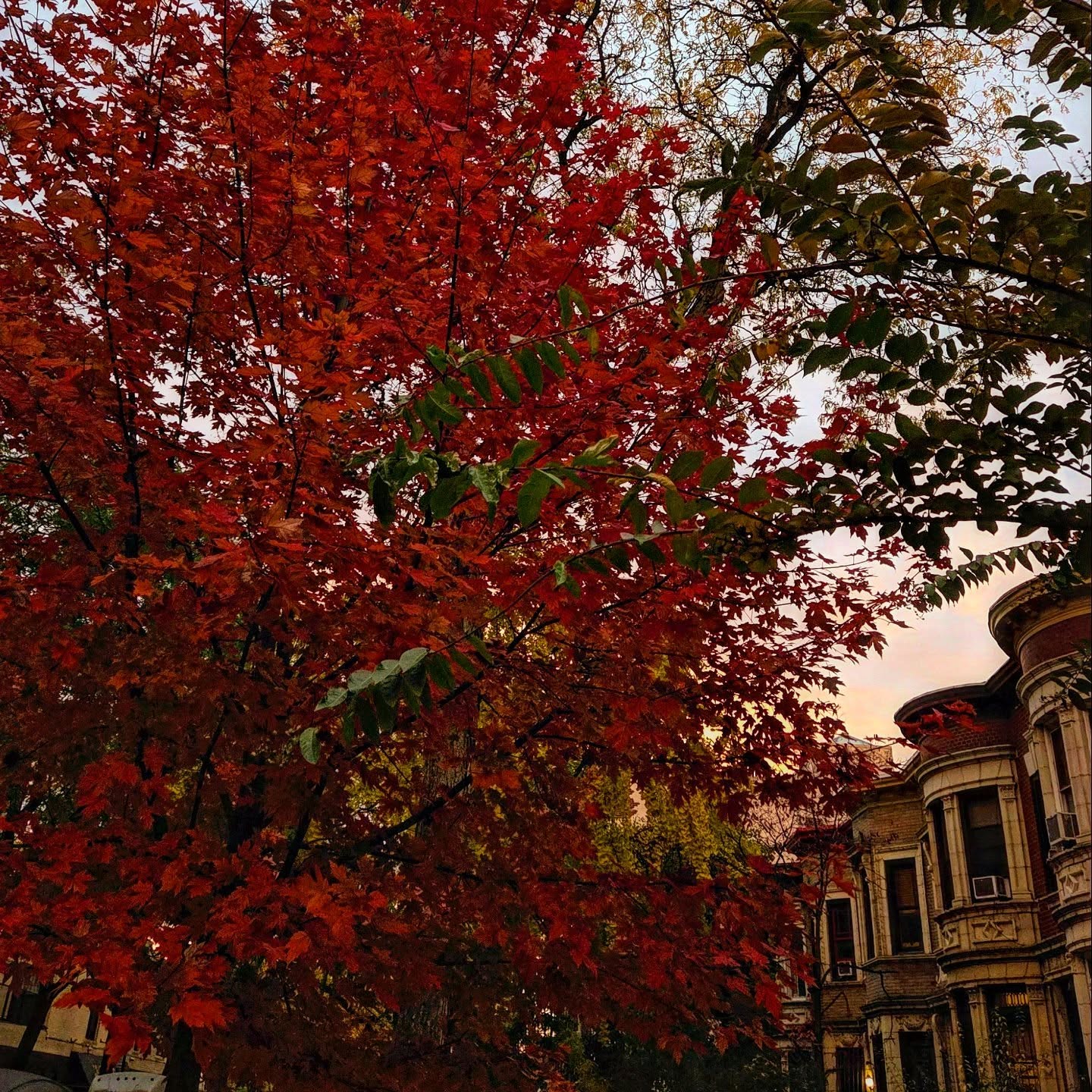
Below are more photo from my walk tonight through Prospect Park.
Every day, the global citrus industry produces mountains of waste: billions of tons of leftover peels and pulp from juice extraction. Most of my immediate family lives in Florida now, and I’ve seen his waste first-hand. In nature, waste doesn’t exist; everything is a resource. So, what if we applied that wisdom—the principle of biomimicry—to the industrial challenge of food waste?
Enter Orange Fiber, an Italian company (from Sicily – where my ancestors are from!) that has cracked the code on circular fashion.
The Problem of Waste, Solved by Nature
Orange Fiber developed an innovative, patented process to extract the cellulose fiber that still exists within citrus juice by-products. They take the material left over from juicing and, through bio-based chemistry, transform it into a refined, high-quality fabric. The result is a refined, ethereal, and sensorial fabric that feels like a beautiful silk.
This is biomimicry in action: Nature’s design principle is to create closed-loop systems, and Orange Fiber has designed a zero-waste textile solution right inside a juice factory.
Why This is More Than Just a Fabric
This is a story of value creation and a new definition of luxury in the modern world.
Sustainable Innovation: It dramatically reduces agricultural waste and reliance on non-renewable resources (like petroleum-based synthetic fabrics).
Professional Validation: Since its launch, Orange Fiber has quickly scaled, partnering with brands like Salvatore Ferragamo, H&M Conscious Exclusive, and E. Marinella. If they trust the quality, the model is scalable.
The Secret is Simple: The success of Orange Fiber is a perfect example of a deep, simple secret often overlooked in product design: the solution is often hiding in plain sight, waiting to be repurposed.
The work of Orange Fiber reminds us that every challenge we face—from environmental pollution to resource depletion—can be solved by looking to the design wisdom of the natural world. It proves that the most beautiful, sustainable solutions are often discovered when we choose curiosity and embrace the design mindset of, “How can we make something beautiful while also protecting the natural world we all depend upon for survival?”
The urgent global challenge is feeding a rapidly growing population while fighting the uncertainty of climate change. As a storyteller and a biomimicry scientist, I often ask: How does nature solve a massive, existential crisis? The answer, it turns out, lies not in some distant super-technology, but in the subtle genius of a single plant cell.
New research from the Cold Spring Harbor Laboratory has illuminated a fundamental biological “master switch” in the DNA of food crops like corn, giving us an actual blueprint for creating a resilient, thriving future. This isn’t just botany; it’s a profound lesson in survival written right into the plant kingdom.
The Inner Wisdom of the Plant
Plant growth, from the deepest root to the ripest ear of corn, is governed by its stem cells—unspecialized cells that hold the potential to become any part of the plant. The challenge facing plant scientists has always been figuring out how to balance these cells: when should they grow and when should they specialize into, say, a fruit or a thick stalk?
In a breakthrough study, scientists mapped the gene expression in these cells, revealing the network of regulators that act as the plant’s precise internal control panel. This network balances growth and stress response, allowing the plant to strategically allocate its resources for survival.
This knowledge is a gift to us all because it shows how nature manages risk. A plant facing drought doesn’t just despair; it shifts resources to deepen its roots. A plant under pest attack doesn’t just succumb; it redirects energy to fortify its cell walls. It’s a marvelous, elegant system of risk mitigation through metabolic flexibility.
A Blueprint for Humanity’s Resilience
As my work focuses on biomimicry—integrating nature’s genius into the human world—I see in this discovery a direct path to solving our human challenge of food security. We are not meant to struggle endlessly against the elements; we are meant to learn from the masters of endurance.
This plant study provides us with three clear takeaways for building a better world:
Precision over Force: Instead of overwhelming fields with more fertilizer and water, we can use this genetic knowledge to engineer plants to be more efficient—to use nitrogen more effectively and direct energy precisely where it’s needed most for resilience.
Unlocking Latent Potential: We are now able to see and manipulate the plant’s own evolutionary solutions. We can develop crops with deep-seated, natural defenses against drought and disease, built on the plant’s own wisdom, not on chemical dependency.
The Power of the Foundational System: The corn stalk teaches us that true resilience comes from perfecting the foundation. By understanding and replicating the simplest, deepest biological controls, we can build human systems that are robust and adaptable, just like an ecosystem.
A Brighter Future Ahead
This breakthrough is more than just a scientific finding; it is a fundamental shift in our relationship with nature. By finally decoding the genetic “master switch” that plants use to govern their own destiny, we are handed a powerful blueprint for survival. The challenge of global food security has never been greater, but this research proves that the solution is not an endless technological sprint, but a deeper engagement with the patient, profound wisdom of the living world. The era of resilient agriculture is not just on the horizon—it has already begun, written in the complex, hopeful language of a plant’s own DNA.
I’m really happy to have joined a new collective created by Climate Film Festival that’s bringing together sustainability professionals with filmmakers to raise the bar on and expand opportunities for climate storytelling. As someone who has one foot in each of these worlds, I’m so excited to be part of this new professional group and to help craft and fund these stories that drive action.
Yesterday I went to the Essex Market coffee hour for our first in-person event and attended an excellent panel about climate documentary making. As someone who studied how to use storytelling to drive more climate investment from family offices, I felt like I was in just the right place at just the right time because financing was a key part of the conversation. I heard a number of filmmakers talk about the challenge of finding financing for their climate films, especially with the current situation in D.C.
What filmmakers need to consider is that private funders don’t want to just fund a movie. They want to fund systemic change, especially when it comes to protecting and restoring the health of the planet. Filmmakers need to show how their films, and the platforms and supports they are building around their films, will get viewers to engage in creating meaningful change. That change needs to be measured and reported on.
Is that asking more from filmmakers? Yes. Is it asking them to be skilled business people, entrepreneurs, and community leaders on top of their filmmaking expertise and beyond the creation of the film? Yes. Isn’t making a movie already a Herculean task? Yes. Is that a challenge? Yes. It’s also today’s funding reality.
You aren’t just making a movie, not anymore. You’re building a movement, and that movement is what’s fundable with a movie being one cornerstone of many.
I was saddened to hear about the passing of Robert Redford this morning. When I was an undergrad at the University of Pennsylvania, he came to campus to explore a film and storytelling partnership between the university, the West Philadelphia community, and his Sundance Institute. I remember seeing him from a distance and immediately noticing that there was a light about him, a kind of magical aura that emanated from his smile and ease of being.
In addition to championing filmmaking and storytelling, he was also incredibly passionate about the environment. He was a lifelong advocate for nature, beginning his activism in the 1970s by using his celebrity to promote causes like protecting air and water, and later founding the Redford Center to use storytelling to expand environmentalism. He spoke at the United Nations about climate change, was recognized by TIME magazine as a “Hero of the Environment” in 2007, and served for decades on the board of the Natural Resources Defense Council (NRDC). The NRDC’s Southern California headquarters in Santa Monica is named The Robert Redford Building to honor his long-standing support for the organization as a board member and environmental activist.
While we remember his outstanding career as an actor, director, writer, and producer, I’ll continue to hold him up as an example of someone who knew early on that storytelling was the key to protecting our planet and used his talents to further that mission. May we all carry forward his remarkable and beautiful legacy.
One of my great joys is to uncover stories about abandoned places sustainably retrofitted to get a new lease on life. This transformation made my heart sing: a former coal mine in Kentucky, once a symbol of industrial might and negative environmental impacts, is now gleaming with thousands of solar panels, powering a cleaner tomorrow. It offers a powerful beacon of hope for a sustainable future.
For generations, communities in places like Martin County, Kentucky, built their lives around coal. It was the “black gold” that fueled homes and industries across the nation while also degrading the land and human health. As the energy landscape shifted, so did these communities, often leaving behind economic hardship and vast, altered landscapes stripped bare of the nature they once harbored. The Martiki coal mine, closed in the 1990s, stood as a stark reminder of this past complicated, painful past.
A Phoenix Rising: The Martin County Solar Project
Today, that same landscape is being reborn. The Martin County Solar Project (MCSP) is transforming 900 acres of reclaimed mine land into a massive 111-megawatt solar farm. Picture this: over 214,000 bifacial solar panels, designed to capture sunlight from both sides, now stretch across the terrain where heavy machinery once toiled.
The Martin County Solar Project’s website shares that it began commercial operation in December 2024. It will generate enough quiet, clean renewable energy each year to power approximately 18,529 Kentucky homes.
This isn’t just about replacing one energy source with another; it’s about intelligent, hopeful repurposing. The beauty of this project lies not only in its clean energy output but also in its clever use of existing infrastructure. The former mine site, already flattened and with clear access to sunlight, still retained its transmission lines and substations. This meant less new construction, lower costs, and a faster path to bringing clean energy onto the grid—a truly smart way to leverage the past for the future.
Beyond Energy: A Boost for the Community
The benefits extend far beyond power generation. This project is a successful example of how the transition to a green economy can revitalize communities. The MCSP created hundreds of good-paying construction jobs, bringing much-needed employment to a region that had experienced significant job losses as coal production declined. Looking ahead, the solar farm will provide ongoing maintenance jobs and generate stable tax revenue for Martin County, helping to diversify its economy and build a more resilient future.
The Martin County Solar Project is more than just a power plant; it’s a testament to human ingenuity and our ability to adapt and innovate while reconciling with a difficult past. It’s a story of turning a painful environmental legacy into a vibrant, job-creating clean energy future. It shows us that even the most challenging landscapes can be repurposed for the good of both people and the planet. It’s an inspiring vision of what’s possible when we embrace sustainable solutions, proving that a green future is also a prosperous future.
I finally went to see Hadestown on Broadway. I know, I know. What took me so long?! After seeing it, I truly have no idea because it’s a transformative theater experience. A huge thank you to my dear friend, Dan Fortune, for taking me.
This was a very special performance because all 5 of the leads are brand new to the show. Music legend Kurt Elling, Jack Wolfe, Rebecca Naomi Jones, Morgan Dudley, and Paulo Szot knocked it out of the park, and the audience literally shouted with delight.
Yes, it’s all the things you’ve heard. It’s beautiful in every way, heart-filled, and filled with fascinating twists and turns woven between mythology and present day.
It’s also an incredibly effective climate story – the call to protect nature to reverse the harmful impacts of climate change on the food supply, mental and physical health, politics, and the economy.
It’s an immigration story, a migration story, a working class story about the power of generosity, community, and our own voices to lead change, to create a world where all beings are happy, healthy, and free. It’s a story of hope found in difficult, dark times and turning that hope into empowerment that leads to action. And art, specifically music, as a lever for all of that change.
Reminiscent of the call and response of spirituals with the essence of New Orleans, it’s a show that is of-the-moment even though it’s been on Broadway since 2019. Go see it. Cheer, clap, sing, get swept up in the beauty. And then carry all of it out into our world that is crying out for change. We are the ones we’ve been waiting for.







 Christa Avampato