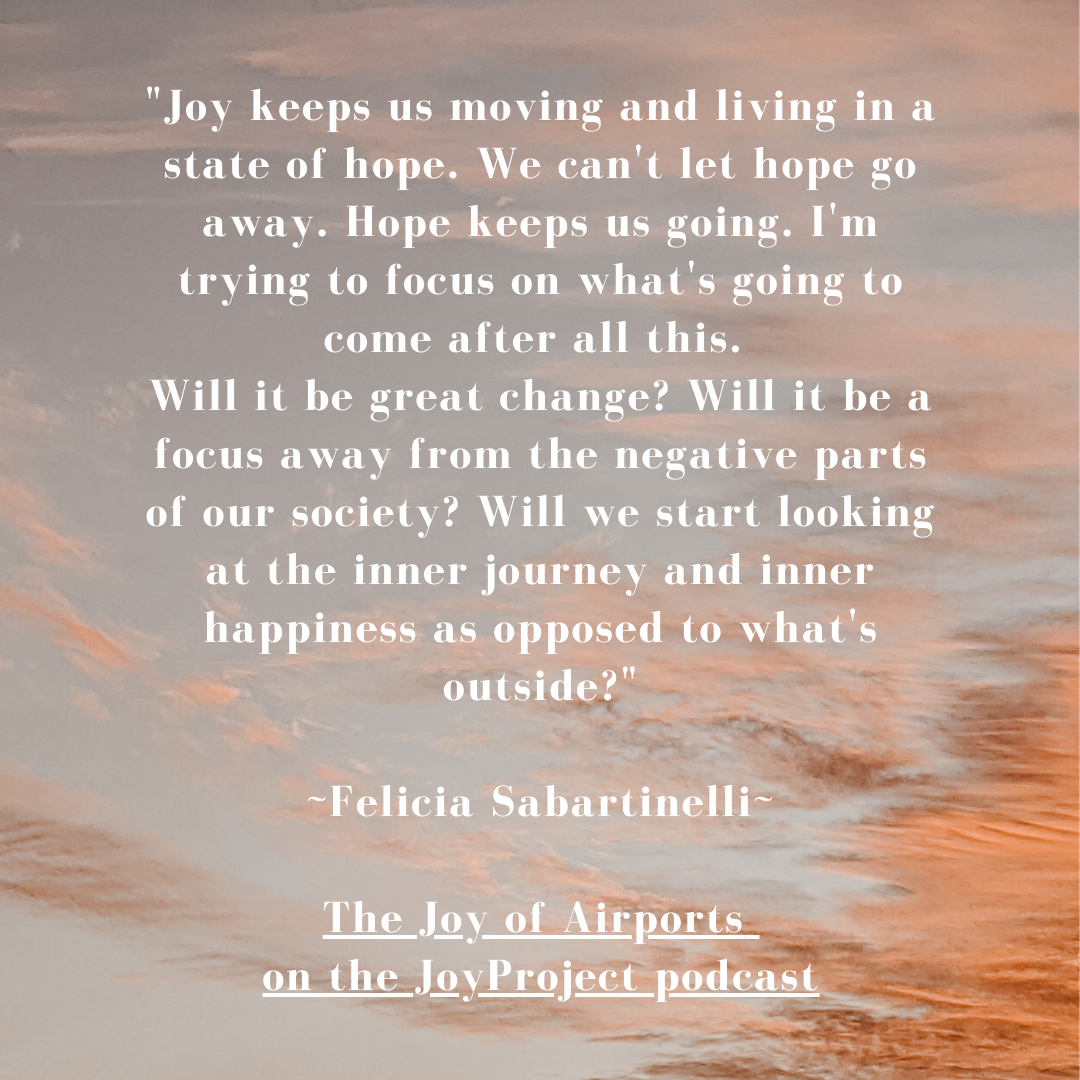
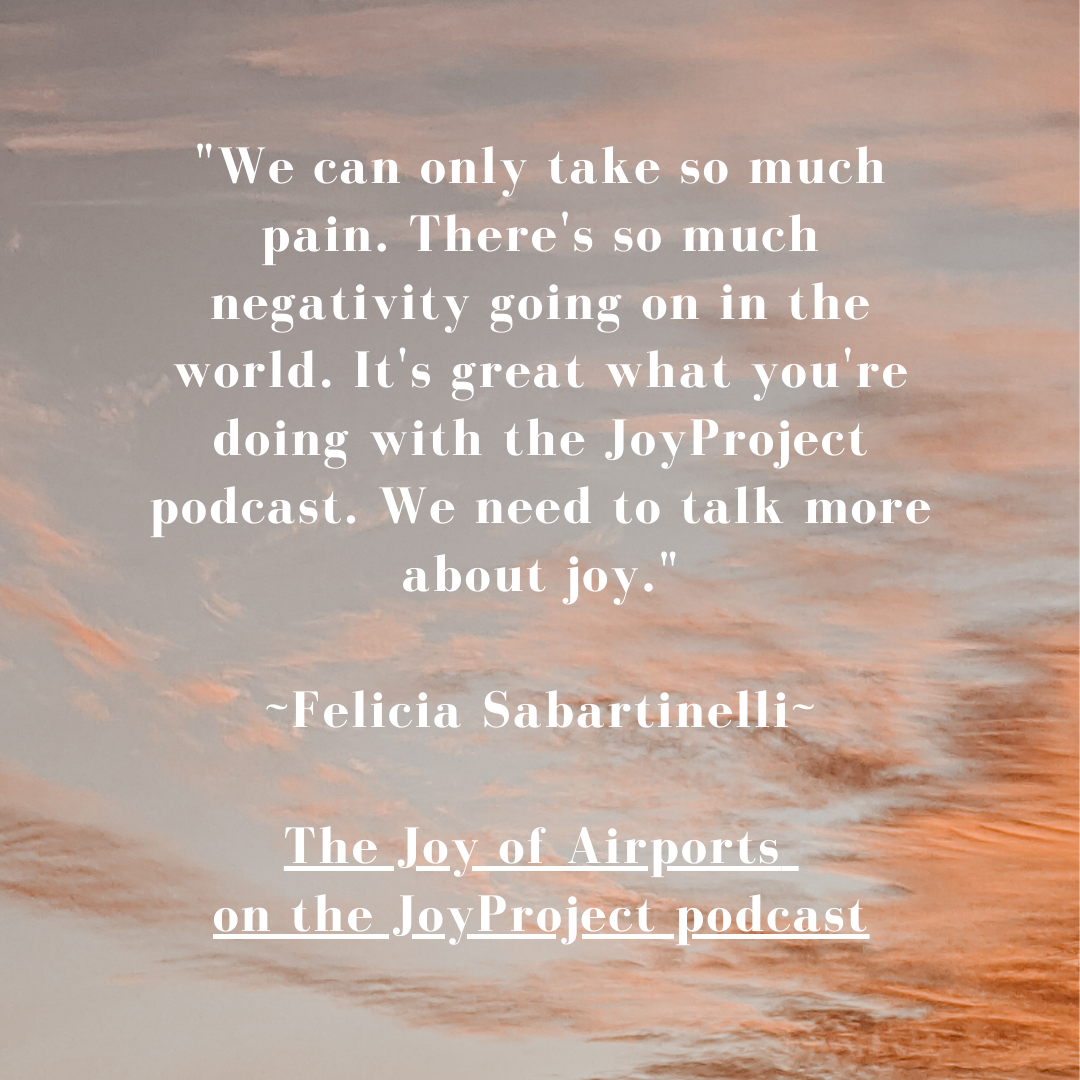
Think you can’t find joy in an airport? Think again! Felicia Sabartinelli is a seasoned world traveler and once you hear her wax poetic about airports, you’ll see them and experience them differently. She explains that airports are the rarest of gems that help us to discover “a state of childlike wonderment.”
At the end of the podcast, I share something that brought me joy this week. It was a stressful and frightening one for me, and I say a heartfelt and grateful thank you to the Animal Medical Center of New York doctors and staff who saved my dog’s life when I was afraid I may have to say goodbye to him too soon.
The Joy of Airports with Felicia Sabartinelli
Topics discussed in this episode: – Felicia’s definition of joy – The importance of finding joy during the most challenging times – All the places to find and experience joy in an airport – How airports are becoming a destination – Felicia’s travels to Spain, Turkey, Iceland, Sweden, China, Alaska, Finland, Mexico, Jamaica, and Austria – Her upcoming book, Good Girl – Writing while traveling – The Denver airport and the mysteries it holds – The art of the Seattle airport – Her upcoming Masters program in the UK – How the joy of musicals found their footing in society after WWII

A little bit about Felicia: Felicia Sabartinelli is a fifth-generation Coloradoan whose poetry and personal essays have been published in major magazines, newspapers, and anthologies. Many of her personal essays are still in wide circulation today like, My Miscarriages Ruined My Marriage, The Invisible Hierarchy of Grief which recently won a Writer’s Digest award, and I’m So Allergic, Event Fruits and Veggies Can Kill Me. When she is not writing, you can find her acting, painting, traveling the world, binge-watching her favorite TV shows, or speaking on the topics of creativity and self-realization.
Have you ever been in the messy middle of a writing project? It’s the point where you’re not quite sure how to get from the middle of the narrative to the satisfying conclusion you have planned. It feels like you’re in quicksand, unable to clearly see the path forward. Your characters look to you for guidance, you look to them for guidance, and none of you have any answers so you just spin place, or worse—you abandon the project altogether.
The wisdom and guidance you need to get out of the messy middle is research. Right now I’m working on a historical fiction novel. The main tentpoles of the plot have remained the same but I’ve brought in many new details to make the script come alive. It’s set in an Italian bakery in New York City in 1910, a dynamic and wild time in the city, country, and world. A myriad of historical events would have had an outsized impact on my characters so I have to research that time to get the details just right. It’s a heavy lift, and ultimately worth the time and attention.
I got myself out of that messy middle by digging into The New York Times archive for specific dates and events that figure prominently into the lives of my characters. In that research I found a plethora of information, and that information created the map I needed to find my way to the conclusion.
If you’re in the messy middle now and ready to throw in the towel out of frustration, take a deep breath and go to the archives. Let history be your guide. Research your way across the channel to safely emerge on shore on the other side. It’s only a matter of time. The world needs your story.
Joyful News is a set of stories I’ve gathered from around the world that spark joy. In this episode I share these joyful news stories about books, exercise, meditation, food, and travel:
Thank you! This podcast has had almost 500 visits in its first 4 weeks!
Are you eager to get back out there on the open road and travel? Memorial Day marks the start of the summer travel season. Now with prices and demand high and the COVID-19 virus still circulating with shifting travel rules, travel requires more planning than ever before. This week on the JoyProject podcast, Dr. Edith Gonzalez, an anthropologist, professor, and expert travel planner is here to help us with tips, ideas, and experiences to make our travel easier and more joyful. Listen here and wherever you get your podcasts. The website for the episode also has a transcript of the episode and photos from Edith.
At the end of the podcast, I share something that brought me joy this week related to the episode. This week, I tell you about the Netflix food travel series Somebody Feed Phil and the free app, Word of Mouth, an independent restaurant guide powered by a global community of culinary experts.
Topics discussed in this episode: – Our mutual love of spreadsheets and maps – How to optimize your packing – Trip planning research – Traveling with kids – Traveling as a food lover and taste testing food specialties wherever we travel – Bullet journals – The wonder of Google maps and guide books – Having a schedule versus winging it versus the happy medium – Edith’s travels to the U.K., Venice, New Orleans, and Cuba – A special shout-out to Phil Rosenthal, Somebody Feed Phil, and the Word of Mouth restaurant guide app
The Vertical Forest in the Porta Nuova area of Milan is an understated marvel and an innovative prototype for how modern cities with deep historical roots can help humans, animals, and plants cohabitate for everyone’s benefit.
The two residential buildings create space for 800 trees, 15,000 plants, and 5,000 shrubs. This is the same number of plants you’d find on ~90,000 square feet of woodland on just ~9,000 square meters of urban space. The Vertical Forest reduces heat when it’s warm, regulates humidity, provides insulation when it’s cold, and cleans the air. And by the way, plants help humans by lowering our stress and anxiety. This greenery has provided a home for 1,600 species of butterflies and birds. An added bonus—if we building our cities vertically, we prevent them from sprawling horizontally which saves more land and the species that call that land home.
This kind of living architecture is a financial and health win for people and nature, and one we cannot afford to ignore. Cities across the world can adopt the ethos of the Vertical Forest and we will all benefit.
A lot of my writing life revolves around science, environmental sustainability, and biomimicry. This Fall, I’m starting a graduate program in Sustainability Leadership at University of Cambridge. As I prepare for that program, I’m researching different programs around the world that are restoring land and protecting species from the effects of climate change.
I recently learned about a project called the Great Green Wall. From their website:
Growing a World Wonder The Great Green Wall is an African-led movement with an epic ambition to grow an 8,000km natural wonder of the world across the entire width of Africa. Once complete, the Great Green Wall will be the largest living structure on the planet, 3 times the size of the Great Barrier Reef.
A decade in and roughly 15% underway, the initiative is already bringing life back to Africa’s degraded landscapes at an unprecedented scale, providing food security, jobs and a reason to stay for the millions who live along its path.
The Wall promises to be a compelling solution to the many urgent threats not only facing the African Continent, but the global community as a whole–notably climate change, drought, famine, conflict, and migration.
Improving Millions of Lives The Great Green Wall is taking root in Africa’s Sahel region, at the southern edge of the Sahara desert – one of the poorest places on the planet.
More than anywhere else on Earth, the Sahel is on the frontline of climate change and millions of locals are already facing its devastating impact. Persistent droughts, lack of food, conflicts over dwindling natural resources, and mass migration to Europe are just some of the many consequences.
Yet, communities from Senegal in the West to Djibouti in the East are fighting back.
Since the birth of the initiative in 2007, life has started coming back to the land, bringing improved food security, jobs and stability to people’s lives.
A Global Symbol The Great Green Wall isn’t just for the Sahel. It is a global symbol for humanity overcoming its biggest threat – our rapidly degrading environment.
It shows that if we can work with nature, even in challenging places like the Sahel, we can overcome adversity, and build a better world for generations to come.
Growing More Than Trees More than just growing trees and plants, the Great Green Wall is transforming the lives of millions of people in the Sahel region.
The Great Green Wall makes a vital contribution to the UN Sustainable Development Goals (known as the SDGs)—a global agenda which aims to achieve a more equitable and sustainable world by 2030. It’s rare to find a project that impacts all of the SDGs and the Great Green Wall does just that.
It’s almost the weekend so here’s something fun. I was interviewed for the They Had Fun podcast. Hear how my ability to wax poetic about New York City pizza in The New York Times sparked my friendship with the host, Rachel Josar, why my pandemic was a little extra, and the fun I had on The Drew Barrymore Show. It’s been a long 2 years for all of us. Let’s have more fun together!
On this week's episode, co-guests (!) and co-hosts of the podcast Debt Heads, Rachel Webster and Jamie Feldman, tell us about heading out for a night in 90s NYC with no plans, and winding up at a sold-out Moby show!Check out Rachel, Jamie, and Debt Heads on InstagramHave fun like RachelDonate to NYPLCheck out this week's Rachel's Recs on our Substack!What did you think of this week's episode?They Had Fun on Instagram, YouTube, and our website 🥳
In this episode, Carolyn shares her journey and joy behind the microphone as she lifts up the stories of her guests.
At the end of the episode, I share the tools I use to create JoyProject: Zencastr for interviews, Otter_ai for transcripts, WordPress for the website, Headliner Video for audiograms, Unsplash for photos, Anchor for podcast hosting and distribution, Canva for quote posters that I share on social media, & Twisted Wave for audio editing.