creativity

The Climate Film Festival Storytelling Collective

I’m really happy to have joined a new collective created by Climate Film Festival that’s bringing together sustainability professionals with filmmakers to raise the bar on and expand opportunities for climate storytelling. As someone who has one foot in each of these worlds, I’m so excited to be part of this new professional group and to help craft and fund these stories that drive action.

Yesterday I went to the Essex Market coffee hour for our first in-person event and attended an excellent panel about climate documentary making. As someone who studied how to use storytelling to drive more climate investment from family offices, I felt like I was in just the right place at just the right time because financing was a key part of the conversation. I heard a number of filmmakers talk about the challenge of finding financing for their climate films, especially with the current situation in D.C.

What filmmakers need to consider is that private funders don’t want to just fund a movie. They want to fund systemic change, especially when it comes to protecting and restoring the health of the planet. Filmmakers need to show how their films, and the platforms and supports they are building around their films, will get viewers to engage in creating meaningful change. That change needs to be measured and reported on.

Is that asking more from filmmakers? Yes. Is it asking them to be skilled business people, entrepreneurs, and community leaders on top of their filmmaking expertise and beyond the creation of the film? Yes. Isn’t making a movie already a Herculean task? Yes. Is that a challenge? Yes. It’s also today’s funding reality.

You aren’t just making a movie, not anymore. You’re building a movement, and that movement is what’s fundable with a movie being one cornerstone of many.

creativity

Remembering Robert Redford, an expert storyteller and nature ally

I was saddened to hear about the passing of Robert Redford this morning. When I was an undergrad at the University of Pennsylvania, he came to campus to explore a film and storytelling partnership between the university, the West Philadelphia community, and his Sundance Institute. I remember seeing him from a distance and immediately noticing that there was a light about him, a kind of magical aura that emanated from his smile and ease of being. 

In addition to championing filmmaking and storytelling, he was also incredibly passionate about the environment. He was a lifelong advocate for nature, beginning his activism in the 1970s by using his celebrity to promote causes like protecting air and water, and later founding the Redford Center to use storytelling to expand environmentalism. He spoke at the United Nations about climate change, was recognized by TIME magazine as a “Hero of the Environment” in 2007, and served for decades on the board of the Natural Resources Defense Council (NRDC). The NRDC’s Southern California headquarters in Santa Monica is named The Robert Redford Building to honor his long-standing support for the organization as a board member and environmental activist.

While we remember his outstanding career as an actor, director, writer, and producer, I’ll continue to hold him up as an example of someone who knew early on that storytelling was the key to protecting our planet and used his talents to further that mission. May we all carry forward his remarkable and beautiful legacy. 

creativity

How writing a screenplay helped me write the first draft of a novel

Photo by hannah grace on Unsplash

On Sunday afternoon, I wrote “The End” on the first draft of my new novel. While my first two novels are young adult fantasy adventure, this one is historical fiction. 

In December 1941 four friends graduate from an all-women’s college and seize new career opportunities in a world forever changed by war. I was so happy to sink back into the world of these four friends. The struggles they face are, unfortunately, highly relevant to the times we’re living in today. With themes of empowerment, being on the right side of history, speaking out against injustice, and the love story of female friendship, they’re determination made me more determined, too. 

I’m hoping that it will be the first book in a series. The subsequent books will share the very different journeys that each of these women take in a new world order emerging before their eyes and how their friendship will pull them through.

This story began as a screenplay in 2020. It was a quarterfinalist in 3 international screenwriting competitions and received great feedback. Since then, most of my writing has focused on getting my second Emerson Page novel published and writing my master’s dissertation for University of Cambridge. With those projects complete, I returned to my historical fiction screenplay in January of this year.

It turns out that writing a screenplay is akin to having a very detailed outline for a novel:

  1. All the dialogue is there.
  2. The scenes and their sequence are set.
  3. The characters and their relationships are developed.
  4. The plot is charted.

I wouldn’t say going from a screenplay to a novel is a slam dunk, no-effort-needed project. As someone who dreads a blank page, the screenplay was my map, a guide that helped steer my writing sessions and make them productive.

I’ll take a short break from this story (to finish the first draft of another novel that’s also nearly done!) and let the first draft build up some dust so I can return to it in a few weeks with fresh eyes. Then I’ll dive back in to begin the work of editing and rewriting.

I much prefer to edit and rewrite rather than write a first draft. I no longer have any blank pages. Every time I sit down to write, it will be to refine and improve what I already have. I’ll immerse myself in extra research (something else I absolutely love to do!) and I’ll add much more detail, polishing the story one word at a time. Editing and rewriting is gratifying work because it’s all about making the story shine.

I’m hopeful that this new novel will do well in the query process and that I’ll be able to find a literary agent — a goal I’ve had for many years. For now, I’m celebrating this huge milestone of completing the first draft. It only gets better from here!

creativity

How to lead when we lose

Prospect Park, Brooklyn – Fall 2024. Photo by Christa Avampato.

On this difficult day, I have some things to say about gratitude, storytelling and leadership. Hundreds of thousands of people heeded the call ~100 days ago to not do something but do everything to try to help Vice President and Governor Walz win. I’m sorry neither of them took the stage at Howard University last night to say thank you, so I will. I’m abundantly grateful to all of you, and for everything you taught me during this campaign. You showed up, generously giving your money, time, and talents. That means a lot to me. You mean a lot to me.

On leadership:
It was a huge missed opportunity that they didn’t address supporters and the nation last night. Even though we didn’t know the final count, it was important to say something, anything, and then say they’d be back today to say more. We needed them, and they left without saying a word. That’s not leadership. It doesn’t matter how disappointed they were. We’re all disappointed. They had a real opportunity to maintain a connection with people and they didn’t. They went out the back door and sent the campaign manager to talk to the crowd at Howard and the nation. Vice President Harris will deliver remarks at Howard University today at 4pm. That’s too late. They missed the moment. And sadly, tragically, their opponents didn’t. There’s a lesson in that for us, too. Leaders have to lead, even when they lose. Especially when they lose.

On storytelling:
We have to take a long, hard look in the mirror, and at the words we said and didn’t say in this campaign. We need to meet the audience where they are, listen, understand, and work together to craft a better story for all of us. We didn’t do that and the election results show it. How things have been done on campaigns in the past no longer matters because we’re no longer living in the time of “how things are done.” We need better stories and methods. We need to be better listeners and storytellers. Plato said, “Those who tell stories rule society.” That’s true then and true now.

So that’s my focus moving forward – leadership and storytelling. I’ll stay curious, keep learning, improve my craft, and get better. I’ll continue to “be a lamp, or a lifeboat, or a ladder,” as Rumi so beautifully said. I will continue to, “walk out of my house like a shepherd” every single day. I will listen and love. I hope you’ll join me.

creativity

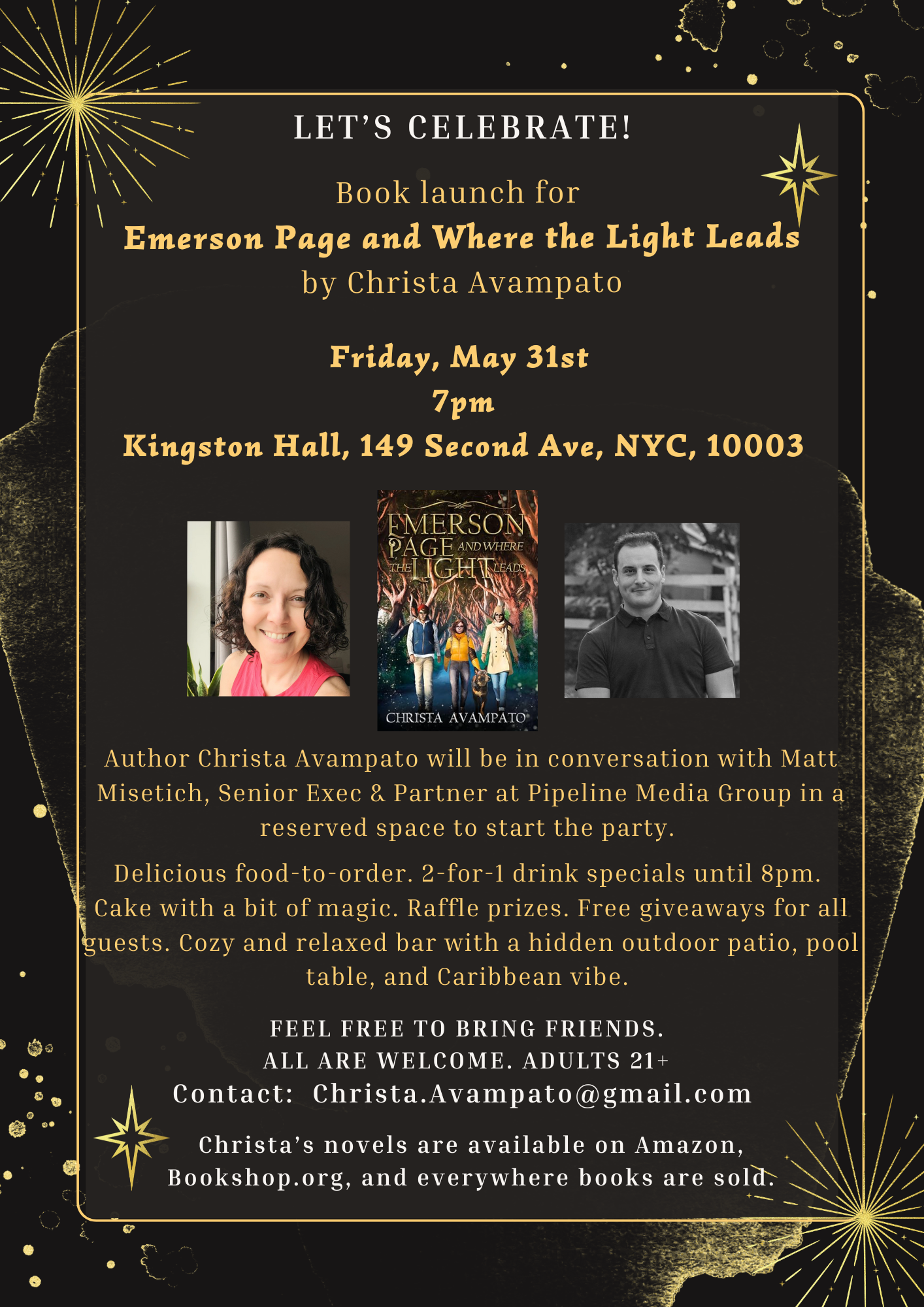
My book launch party is in 1 week on Friday, May 31st at 7pm

I can’t believe it’s almost here! On Friday, May 31st, at 7pm I’m hosting my first ever book launch party for my novel, Emerson Page and Where the Light Leads.

Date: Friday, May 31, 2024
Place: Kingston Hall, 149 Second Ave, New York, NY 10003 (East Village, a few blocks from Union Square)
Time: 7pm – 9pm
Cost: Free
Open to: Everyone 21 years and older is welcome!
RSVP: https://www.eventbrite.com/e/free-book-launch-party-emerson-page-and-where-the-light-leads-tickets-899217332247 or https://www.facebook.com/events/924022856051128/

Details: To start the party, I’ll be in conversation with Matt Misetich, Senior Executive and Partner at Pipeline Media Group. We’ll talk about the creative process of being a writer, the publishing industry, and transforming books to film. There will be delicious food-to-order, 2-for-1 drink specials until 8pm, cake with a bit of magic, raffle prizes, and free giveaways for all guests. Then enjoy the cozy and relaxed bar with a hidden outdoor patio, pool table, and Caribbean vibe.

The launch of this book has been wonderful, and I’m so excited to celebrate with everyone. I hope you’ll join us!

creativity

Take the risk and make something new

My Emerson Page books surrounded by good vibes from my favorite flowers, Kin Euphorics, and Homesick

This post is about the fear of criticism we all face whenever we do something new, and why it’s worth taking that risk.

Thanks to kind and generous readers, my second Emerson Page novel made her way into the world this week and became an Amazon # 1 new release. To say I’m grateful, honored, and filled with joy is a massive understatement. I toasted my courageous and creative girl and sent a wish out into the universe: “I want to keep telling stories that help people feel less alone”.

On Monday when I was doing all the final prep for Tuesday’s book launch, I had the TV on. Drew Barrymore was interviewing Bella Hadid on The Drew Barrymore Show. They talked about the bravery it takes to create something and put it into the world.

This conversation is exactly the one I needed at that moment. It’s scary to build something with your whole heart for years and then brace yourself for the response. The only thing scarier is not creating at all. 

Their conversation reminded me of the beautiful quote in the movie Ratatouille. The character Anton Ego has a monologue about the creative process and criticism, and it’s one of the truest things I’ve ever heard:

“In many ways, the work of a critic is easy. We risk very little yet enjoy a position over those who offer up their work and themselves to our judgment. We thrive on negative criticism, which is fun to write and to read. But the bitter truth we critics must face, is that in the grand scheme of things, the average piece of junk is probably more meaningful than our criticism designating it so. But there are times when a critic truly risks something, and that is in the discovery and defense of the *new*. The world is often unkind to new talent, new creations. The new needs friends…Not everyone can become a great artist; but a great artist *can* come from *anywhere*.” 

If in the pit of your stomach there’s both a fire to create and a fear of what people will think of what you’ve made, please know everyone who’s ever made anything has been right where you are. Take the risk. Someone somewhere needs exactly what you have to offer. As the great Maya Angelou said, “Life loves to be taken by the lapel and told: ‘I’m with you kid. Let’s go.’” It’s time to get going. Make the thing that’s in your heart, send it out, and see what happens.

creativity

My novel, Emerson Page and Where the Light Leads, is an official selection at the 2024 New Media Film Festival

https://emersonpagebook.wordpress.com/shop/

Closing out the week on a high! I just found out that my upcoming novel, Emerson Page and Where the Light Leads, is an official selection for the 2024 New Media Film Festival in Los Angeles in June. One of my big goals for Emerson is to have her story made into a film or series so bumps like this within the film industry mean a lot. I’m grateful for this honor and I’m hoping I can get to LA for the festival in June.

On Coverfly, a platform that curates film, book, and media awards, my book is ranked in the top 34% of over 135,000 projects in all genres and formats, and top 19% of books and manuscripts.

Thank you to everyone who continues to champion Emerson and support me in my creative work. Your encouragement means everything to us.

On May 14th, the book will be available everywhere books and eBooks are sold. Pre-orders can be placed now on Amazon, Bookshop, and Barnes & Noble. The first book in the series, Emerson Page and Where the Light Enters, is available now in paperback and as an eBook everywhere books are sold.

creativity

Why we create art—inspired by the words of Scottish actor, Robbie Coltrane

Photo by Allison Batley on Unsplash

“50 years on, my children’s children will sit down to watch these [Harry Potter] films. Sadly, I won’t be here. But Hagrid will.” -Robbie Coltrane, Scottish actor

This is the most true thing I’ve ever read about art and the motivation of artists. It’s our chance to be immortal, to get down stories and put them out into the world. They will be here long after we’re gone. Someone will see them or read them or hear them and a part of us will be there. Our energy, our hopes, our dreams, our fears, our disappointments, our joy.

It will mean something to someone across space and time who we never had the honor to meet on this plane. And maybe they will feel less alone.

They will find in our art someone like them, someone who validates everything they’re feeling, someone who makes them feel seen and heard, who helps them see that they matter. Art is the gift that never stops giving. It becomes our home, in the truest sense of the word, the place where we will always belong.

This week we lost Robbie Coltrane, the actor who immortalized Hagrid, a character who is dear to so many of us. His memory lives on in his work and his art.

creativity

JoyProject podcast: The Joy of Old Time Radio Shows with Zachary Lennon-Simon

The Joy of Old Time Radio Show with Zachary Lennon-Simon

Travel back in time with JoyProject as we delve into the world of Old Time Radio Shows, a form of entertainment from the 1920s to the 1960s that had families and friends gathered around the radio to tune into their favorite mysteries, drama, and comedies. Zachary Lennon-Simon, a comedian and storyteller in Brooklyn, New York, is our guide through this delightful and light-hearted audio-forward history for the latest episode of the JoyProject podcast—The Joy of Old Time Radio Shows.

At the end of the podcast, I share something that brought me joy this week related to the episode. I found a bunch of free online resources where you can tune into all kinds of old time radio shows with just a few taps on your computer or phone. I also share my two favorite apps where you can access thousands of free audiobooks through your local public library.

Topics discussed in this episode:
– How Zach discovered old time radio shows as a kid and rediscovered them after college
– Zach’s favorite shows and where to find them today
– The differences between old time radio shows, audiobooks, and narrative podcasts, and some good ones to check out
– The importance of sound design in old time radio
– Stars who made old time radio popular

Links to resources:
– Zach on Instagram – @lennonhyphensimon
– Zach on Twitter – @zachlennonsimon
– Zach’s short film, frantic delicate summer – https://vimeo.com/63383000
– Christa on Twitter – @christanyc
– Christa on Instagram – @christarosenyc
– Christa’s website – ChristaAvampato.com
– Old Time Radio Archive – https://www.youtube.com/c/OldTimeRadioArchive
– Old Time Radio Shows – https://www.youtube.com/c/OldTimeRadioShowsOnline
– MakeUsOf article – https://www.makeuseof.com/listen-old-time-radio-shows-online/
– Internet Archive – https://archive.org
– Relic Radio – https://www.relicradio.com/otr/
– RockIt Radio – https://rokitradio.com/
– Internet Radio – https://www.internet-radio.com/search/?radio=old+time+radio
– Pumpkin FM – https://pumpkinfm.com/
– RUSC – https://www.rusc.com/
– Libby App for free audiobooks – https://libbyapp.com/
– Cloud Library for free audiobooks – https://www.yourcloudlibrary.com/

A little bit about Zach:
Zach Lennon-Simon is a filmmaker and storyteller who was born & raised in Brooklyn, NY. He has told stories for many different shows such as Kvetching & Kvelling, Everything is Bad, Beaver Helmet, and The Teacher’s Lounge. In his spare time, he tries his best to sing both parts of Judy & Babs’ “Get Happy/Happy Days Are Here Again” medley. 

creativity

Write every day: How to write your first screenplay

It’s done! I wrote a full first draft of my first feature-length screenplay in preparation for the ScreenCraft April summit in Chicago. It feels amazing to have done this. Now it goes away for a few weeks before editing begins.

Here are some thing I learned about screenwriting during this process:

1.) The months of research, reading, storyboarding, visualization, and treatment writing were incredibly helpful. More so than any other kind of writing, the planning and organization of a screenplay is critical. It makes the actual writing easier, clearer, cleaner, and faster.

2.) I wrote the first draft of my screenplay in two days, and not because the story poured out of me. It absolutely didn’t! It was the months of pre-work, that was actual work, that made all the difference.

3.) Dialogue is the main vehicle in live-action screenwriting. The look and feel of the live-action film is the director’s domain. The story and dialogue, not the visual rendering, is the domain of the writer, and the screenplay respects and reflects that.

4.) I watched Aaron Sorkin’s excellent Masterclass on screenwriting. He said that most of screenwriting is not writing at all, and that jumping in to writing too soon can complicate a screenplay in problematic ways. I had to fight the urge to jump into writing. I had to force myself to do all the upfront work before I put down a single word. I’m grateful for his advice, and though it was difficult to follow it was absolutely worth it. You can free write for a novel, short story, or journalism piece. Screenplays need a plan.

Have you written a screenplay? What did you learn in that writing process?