creativity

Beyond Extraction: How Janine Benyus Reveals Natureโ€™s Universal Patterns for a Thriving Future


In a recent episode of The Common Good from the Garrison Institute, science writer and Biomimicry Institute co-founder Janine Benyus joined host Jonathan F.P. Rose for an illuminating conversation. The topic was profound yet elegantly simple: uncovering โ€œnatureโ€™s universalsโ€โ€Šโ€”โ€Šthe deep, time-tested design patterns that silently guide all living systems, and how we can apply them to the human world.

Benyus, the pioneer behind the biomimicry movement, anchors her work on a single, powerful biological truth: Life creates conditions conducive to life.

This isnโ€™t a romantic notion; itโ€™s a design principle. Over billions of years, successful natural systemsโ€Šโ€”โ€Šfrom the vastness of a forest canopy to the complexity of a coral reefโ€Šโ€”โ€Šhave learned to thrive not through competition and extraction, but through cooperation, self-organization, and elegant networked intelligence. These are the strategies that generate abundance without consuming the system that supports them. When we look at nature, we are looking at a master class in sustainability, efficiency, and resilience.

The Blueprint for Human Innovation

The conversation moved beyond mere observation to practical application, identifying core natural principles that can and must guide human industry and ethics. Two standout concepts for redesigning our civilization are:

  1. Right-Sizing: In nature, nothing is over-engineered. Organisms do what is necessary, but no more, often using modularity and local resources to solve problems. Benyus challenges us to abandon the modern human impulse for massive, centralized, and often brittle systems. Instead, we should mimic natureโ€™s local, tailored, and efficient solutions.
  2. Distributed Abundance: Natureโ€™s design is fundamentally anti-monopoly. Resources and solutions are distributedโ€Šโ€”โ€Šsunlight, nutrients, and water flow through a network, ensuring that the health of the whole system supports the success of individual parts. Applying this principle to economic and social systems means designing for local self-sufficiency and ensuring resources are abundant and regenerative for all, rather than concentrated at the top.

A Call for Biological Literacy

Ultimately, the episode serves as a powerful call to re-embrace our own biological literacy. For too long, Benyus contends, Western culture has viewed the worldโ€Šโ€”โ€Šand our place in itโ€Šโ€”โ€Šas a collection of separate parts to be managed and exploited. This mindset has dictated our industrial processes, our economic models, and even our spiritual disconnection from the living planet.

The discussion highlights that re-embracing these universal patterns is not just about engineering better products; itโ€™s about reshaping our culture and spirituality. By learning from lifeโ€™s inherent genius, we move toward a worldview where we recognize the world as a single, living, interdependent whole. The greatest innovation of the next century will be applying natureโ€™s wisdom to create human systems that are as beautiful, cooperative, and conducive to life as a thriving ecosystem.


Iโ€™d love to hear your thoughts on how we can all embrace natureโ€™s principles to live our best lives and also care for the planet. What do you think?

creativity

How to stay focused in this mad, mad world

Photo by John Cameron on Unsplash

Please donโ€™t get distracted by claims about Greenland, the Panama Canal, the Gulf of Mexico, and all the madness that is sure to arrive in the weeks, months, and years ahead.

Focus on what needs our attention and support right now: climate issues leading to the devastating fires in Los Angeles (which may be the worst theyโ€™ve had in over 30 years), the bitter deadly cold sweeping across the U.S., and the increase in bird flu and Norovirus; social media walking back fact-checking and calling it a win for users knowing it will lead to even more rampant misinformation and conspiracy theories; further restrictions on access to healthcare; continued intense geopolitical wars and unrest all over the world; the ever-growing gap in wealth that has serious consequences, especially for the most vulnerable. There are many more I could add to that list; Iโ€™m sure you can add to that list, too.

So how can you keep your focus on what matters most and what you can actually do? Donโ€™t get it twisted. Take care of yourself and your community, preserve your mental health and energy, and do what you can do where you are with what you have. Our collective priority needs to be caring about each other and this planet.

creativity

Monument Valley 3, a video game I worked on, is now on Netflix

Monument Valley 3 – https://go.ustwo.games/mv3

Monument Valley 3, a gorgeous video game with heart, is now out in the world on Netflix. I’m honored to be a Climate Expert for the game. I wrote about it as part of my Master’s program in Sustainability Leadership at the the University of Cambridge. Goethe said, โ€œIn the end we retain from our studies only that which we practically apply.โ€ I’m grateful that my applied learnings from Cambridge now have the potential to reach the 3 billion people around the world who play video games.

Of course I’m most proud of the exceptional group of talented people who made Monument Valley 3, especially the Game Director and my dear friend, Jennifer Estaris, whom I love and admire so much. May this game inspire all of us to care for each other, our communities, and this beautiful planet we share.

Please download, play, rate, review, and share Monument Valley 3, and let me know what you think! To play, click this link on your mobile device: https://go.ustwo.games/mv3

creativity

Reduce stress with Fall scenes and relaxing music

Image by Relaxing Jazz Corner

If you’re stressed, I’ve got something for you. I made this YouTube playlist of cozy Fall scenes with relaxing music: https://www.youtube.com/playlist?list=PLF8SWzj5Blq3uG2Zgig6jI4lOhefMF5VG

Crawl into one that looks inviting. Take a few deep breaths. Relax your face, neck, and shoulders. These scenes and this music are easy on all the senses. Even a few minutes of conscious relaxation will do wonders for your mind, body, and spirit. After some rest, you’ll bring a whole new perspective to your to-do list.

You’re doing the best you can. It’s okay to rest for a bit. Take care of you so you can take care of others.

Images from https://www.youtube.com/playlist?list=PLF8SWzj5Blq3uG2Zgig6jI4lOhefMF5VG

creativity

Digitally connecting everyone everywhere all at once: the Digital Doughnut Model

2024 United Nations Summit of the Future. Photo by Christa Avampato.

This weekend I attended the 2024 United Nations Summit of the Future as part of the 2024 United Nations General Assembly programming and Climate Week NYC. The event had three key tracks: digital technology, peace, and sustainable development and finance for sustainable development. The programs, speaker bios, and session recordings are all publicly available to anyone who would like to view them at the links above. 

At the summit, I had the good fortune of sitting next to Neal McCarthy, Associate Director of Digital Programs at Oxfam America. I asked him what work heโ€™s most excited about. He told me about the Digital Doughnut model, an excellent example of researchers and practitioners collaborating and building upon one anotherโ€™s work to create a better world. The irony isnโ€™t lost on me that my most valuable insight from a summit about digital technology came from sitting next to and talking to someone in-person. 

During my Masters in Sustainability Leadership at University of Cambridge / CISL, I studied Kate Raeworthโ€™s Doughnut Economics, which she first developed while at Oxfam. Because Iโ€™ve worked in digital technology for over a decade, I was excited to hear from Neal how the Digital Doughnut combines sustainable development and digital technology. When I got home from the summit, I read about the model. Below I share an abbreviated explanation of its structure and insights. 

Digital Doughnut Model
Kate Raeworth developed the theory of Doughnut Economics. The outer ring of the doughnut consists of the ecological ceiling (maintain balance in the natural world that supports life). The inner ring of the doughnut consists of the social foundation (the minimum standards that we need to live a healthy life). The sweet spot, the doughnut itself, exists in the space between the rings where our societal needs are met, and natureโ€™s boundaries are respected. 

Developed by Hannah Smith and Alistair Alexander, the Digital Doughnut is an emerging idea, applying the Doughnut Economics model to the digital technology industry. The Digital Doughnut explores 3 key areas: 12 social foundations (based on the UNโ€™s 17 Sustainable Development Goals), 9 ecological ceilings (planetary boundaries developed by the Stockholm Institute), and 7 ways to transform our thinking and imagination (also developed by Kate Raeworth).

In their 2022 pilot workshops, Hannah and Alistair worked with digital technology professionals to:

  • explore a broad definition of sustainability;
  • look deeper into the root causes of what is going wrong and how the digital technology industry has been culpable in eroding sustainability;
  • imagine a better future for the industry and actions that the digital technology industry can take to create that better future for all.ย 

The Doughnut Flower
The workshop discussions and insights led to the creation of The Digital Tech Industry Doughnut Flower. It shows which social foundations and ecological ceilings were most related to the digital tech industry. 

The diagram helps us see all social foundation dimensions were relevant to the attendees, especially income and work, networks, peace and justice, and social equity. Education, energy, gender equality, health and political voice were also prominent. Food, housing and water were discussed but not to the same degree as the others.

Of the ecological ceilings, not surprisingly, climate change was a very strong topic of discussion amongst the ecological boundaries. Air pollution and land conversion were the next dimensions to receive the most attention. Biodiversity loss, freshwater withdrawals and chemical pollution were discussed to some degree in most of the workshops. Ozone depletion, ocean acidification and nitrogen/phosphorus loading were barely discussed at all, and attendees generally did not see much or any connection between these boundaries and the impacts of digital tech.

Discussion themes
Three main themes were brought up in the workshops. These theme were woven throughout all of the discussions. 

  • Issues around gender/ethnicity, especially pay inequality and exclusion. differentials of pay, but also exclusion were major concerns of participants. These issues were clearly seen by many attendees as essentialโ€Šโ€”โ€Šand centralโ€Šโ€”โ€Što any meaningful discussion on sustainability.
  • Work culture was a theme, with โ€œtoxicโ€ tech culture referred to repeatedly, as well as exploitation and overlong work hours.
  • Quality of life issues, and in particular our unhealthy relationship to technology that drive addiction to tech and disinformation.

Solutions
The workshops then moved to discuss possible solutions. These solutions showcase four solutions of how the digital tech industry can mitigate its challenges and contribute to a more sustainable world. 

  • Stop the relentless consumption/depletion of resourcesโ€Šโ€”โ€Šattention-based revenue is driving the wrong behaviors.
  • Pointlessโ€Šโ€”โ€Šand endlessโ€Šโ€”โ€Šgrowth is getting us nowhereโ€Šโ€”โ€Šthe exponential growth bubble needs to burst.
  • Build things that last and can be reusedโ€Šโ€”โ€Šthe strategy of planned obsolescence only serves shareholders and not society.
  • Detoxify tech cultureโ€Šโ€”โ€Šreplace with fairness, inclusion and better ways of working.

Open-source resources for all to use
Hannah and Alistair have generously shared an enormous amount of information on this idea and the resources for these pilot workshops on the website https://doingthedoughnut.tech/. They welcome anyone to use all of these resources to run a similar workshop. All they ask is that the materials be attributed to Doing the Doughnut Tech Creative Commons BY-SA 4.0.

Whatโ€™s next
Reading through their website, Iโ€™m considering how the Doughnut Economics model could be applied to the strategy and operations of any organization in any industry that seeks to make sustainability its foundation. In my own work at Double or Nothing Media, Iโ€™m developing a proof of concept for a new company focused on rewilding and in the research phase of developing a food waste mitigation tech platform. How might you use the Doughnut in your work? Iโ€™d love to hear your thoughts in the comments. 

creativity

Kamala Harris official Facebook pages organizing voters and volunteers

Harris for New York

As part of my communications work to help Kamala and Tim win in November, Iโ€™m so happy to be a moderator for the Facebook group Harris for New York. Every state has its own group and these are official groups run by Kamalaโ€™s and Timโ€™s campaign. (Youโ€™ll also see me posting on Harris for Pennsylvania and Harris for Georgia.) I was a moderator for Pantsuit Nation in 2016. Iโ€™m using everything I learned then to help Tim and Kamala win. 

These pages are places to build community, get organized with others in your state, share information, and volunteer the time, talents, and resources you have to win this election. To find your state group, go to the search bar and type in โ€œHarris for [state]โ€. The logo will look like the one belowโ€Šโ€”โ€Ša blue background with white text that says โ€œHarris for [state]โ€. 

You join a stateโ€™s page based on where you live, work, went to school, or another important tie to it. Every request to join and every post in every state Facebook group is reviewed by moderators like me. 

While we combat misinformation and disinformation, the vast majority of the posts by moderators and members are positive, uplifting, and focus on Kamala and Timโ€™s stance on all the issues. These groups are also where we share official posts with information directly from the campaign. Also, they are places of JOY!

Weโ€™ve got 74 days until election day. Letโ€™s make every day count. We have no time to waste.

creativity

Iโ€™m a guest on the nature podcast, Unearthing Wild Wonders

A few months ago, I met Nicky Jenner, a gardener, conservationist, and nature lover who lives in Devon in the southeast of the U.K. Though Iโ€™ve only known her a short while, the moment we met I knew she was a kindred spirit. 

She told me she was starting a podcast called Unearthing Wild Wonders about the wisdom and wonder of nature, and how we bring about positive change in our deeply troubled world. I was honored when she asked if Iโ€™d be a guest and I immediately accepted. Our episode, Nature inspiredโ€Šโ€”โ€Šhome, healing, and biomimicry with Christa Avampatoโ€Š, is out now. Unearthing Wild Wonders is beautiful, uplifting, and hopeful, and each episode leaves me newly inspired to continue my work to protect the planet. Also, Nickyโ€™s voice immediately puts me at ease. 

In our conversation, Nicky and I talk about how the challenges Iโ€™ve faced in my life and with my health ignited my passion and commitment to make a difference for all beings on our precious planet. We talk about biomimicry and how the most unlikely species have inspired phenomenal innovations that we now use in our daily lives. We chat about the many languages we need to speak to bridge the divide between science, conservation, business, and finance.

I talk about my University of Cambridge dissertation that uses storytelling to connect climate entrepreneurs developing nature-based solutions with family offices looking for new investment opportunities that deliver a financial return and have a higher purpose.

I also share stories about my journey to overcome cancer, and how learning to heal my own body helped better prepare me to heal the planet. One of them Iโ€™m sharing publicly for the first timeโ€Šโ€”โ€Šhow lying in a hospital bed seriously ill from chemotherapy helped me realize the immensity of the plastic waste problem and made me even more determined to do something about it.

Iโ€™m so grateful to Nicky for having me on the podcast. Our conversation happened just days after the passing of my sweet soul dog, Phineas, one of the worst losses of my life. Talking to Nicky helped me begin to heal and honor him. I’m so grateful for that. Let us know what you think of the episode.

Iโ€™m excited for the day when Iโ€™ll get to Devon, give her a hug, and walk through her garden with her. Nicky has a wonderful website and newsletter at https://www.hawksdawn.co.uk/ that I highly recommend. You can also find her on Instagram @nickyjenner_hawksdown posting gorgeous pictures of nature along with inspiring quotes and stories.

creativity

How to overcome stage fright

Can I tell you a secret? Hosting events makes me so nervous. Iโ€™m forever worried no one will be there, or that people wonโ€™t enjoy the event or show, or that something, anything, everything will go terribly wrong. As a writer, Iโ€™m used to rejection and harsh critiques. It stings (of course!), though I can bear that privately. The second I do something in-person, in publicโ€Šโ€”โ€Šproducing or hosting a live show or having a public event like my NYC book launch party tonightโ€Šโ€”โ€Šthe butterflies in my stomach arrive in full force!

What gets me through the butterflies and helps me process my fear is that I love being with people. It brings me so much joy to create in-person events to inspire and uplift them. So, I take a deep breath and let that joy grow bigger and brighter than my fear. I place all my energy and focus on creating something special for my guests. Itโ€™s not about me. Itโ€™s about everyone else in the room. My book launch party tonight is about bringing people together to talk about creativity in all its wondrous forms. I hope you can join usโ€Šโ€”โ€ŠIโ€™d love to see you there!

creativity

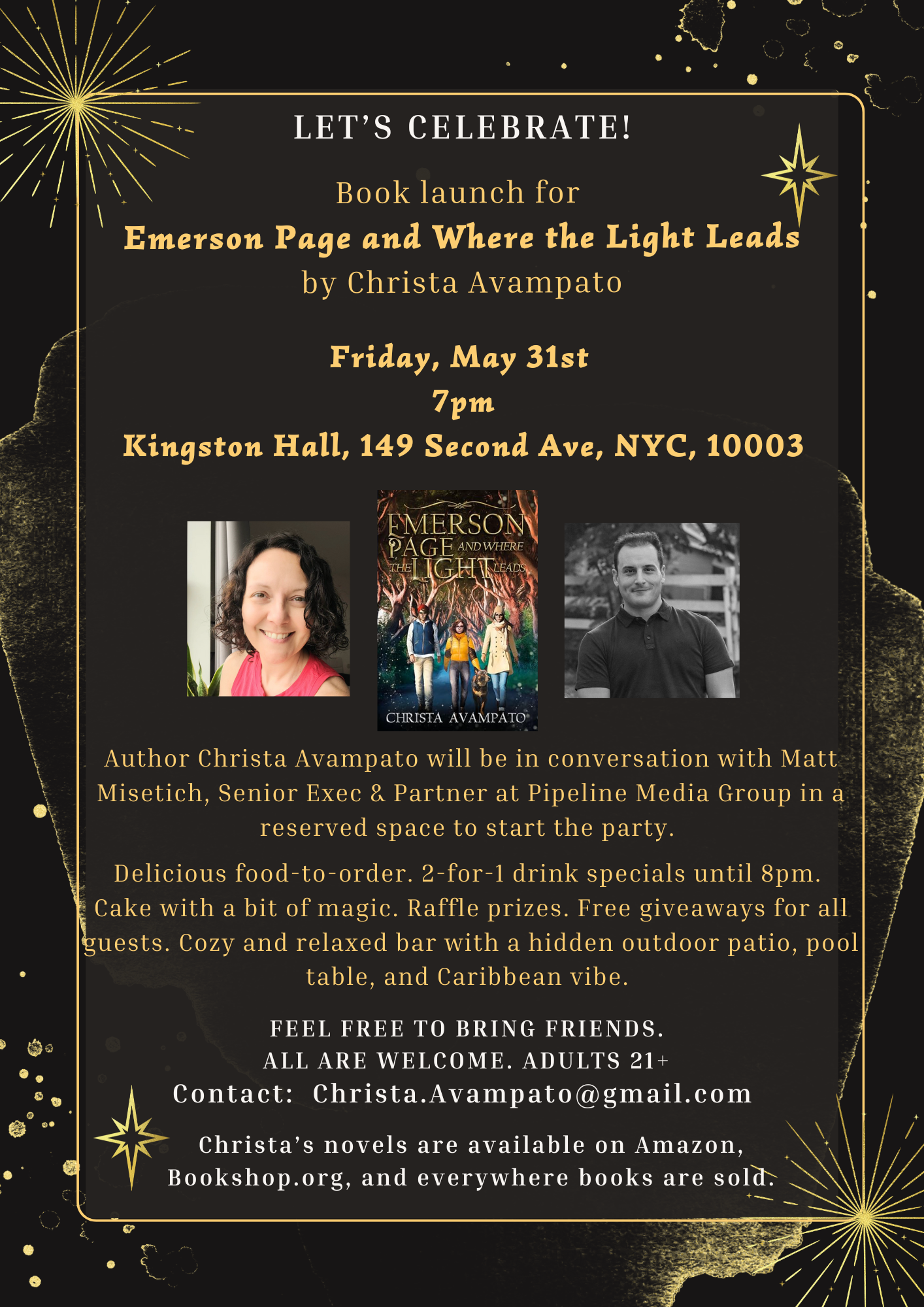
My book launch party is in 1 week on Friday, May 31st at 7pm

I can’t believe it’s almost here! On Friday, May 31st, at 7pm I’m hosting my first ever book launch party for my novel, Emerson Page and Where the Light Leads.

Date:ย Friday, May 31, 2024
Place:ย Kingston Hall, 149 Second Ave, New York, NY 10003 (East Village, a few blocks from Union Square)
Time:ย 7pm โ€“ 9pm
Cost:ย Free
Open to:ย Everyone 21 years and older is welcome!
RSVP: https://www.eventbrite.com/e/free-book-launch-party-emerson-page-and-where-the-light-leads-tickets-899217332247 or https://www.facebook.com/events/924022856051128/

Details:ย To start the party, I’ll be in conversation with Matt Misetich, Senior Executive and Partner at Pipeline Media Group. We’ll talk about the creative process of being a writer, the publishing industry, and transforming books to film. There will be delicious food-to-order, 2-for-1 drink specials until 8pm, cake with a bit of magic, raffle prizes, and free giveaways for all guests. Then enjoy the cozy and relaxed bar with a hidden outdoor patio, pool table, and Caribbean vibe.

The launch of this book has been wonderful, and I’m so excited to celebrate with everyone. I hope you’ll join us!

creativity

Doom and gloom climate stories harm the climate movement

Photo by Steven Weeks on Unsplash

Before you share one more post on social media about climate doom and gloom, please take a deep breath. And then, please post something else. Anything else.

The goal of sharing climate change stories is to drive actions that will halt and reverse climate change to protect the planet and human well-being. While doom and gloom stories such as alarming statistics (of which there are many, sadly!) drive more sharing, clicks, comments, and engagement on social media than any other type of climate story, the largest research study on the topic recently found they drive the least amount of climate action and do almost nothing to change climate change beliefs or support climate change policies. They actually backfire, even causing people concerned about climate change to take significantly less action than they otherwise would.

How could this be? Doesn’t instilling fear for the survival of our species cause so much alarm that of course we’d change our ways? That is a logical, rational assumption. For many years, this was the prevailing wisdom. If you just show people how much damage climate change can do, they’ll change their behaviors and habits to protect themselves and the people they love. This is why we see country leaders, the Secretary-General of the United Nations, leaders at environment nonprofits, and climate activists all over the world sounding the alarm. This is also why so many of us have posted about the climate emergency so often. It’s also why we aren’t seeing enough action taken at a fast enough rate. These stories depressed and demotivated people right into paralysis.

But if that’s the case, then why is there so engagement on climate stories? The clicks, likes, shares, and comments are through the roof. If there’s so much engagement, why is there not enough action? Being engaged on social media or with mass media isn’t the same as taking action in the real world. These stories have absolutely raised the consciousness around climate change, but they haven’t successfully moved people to physically do something about it. Fear-based messaging is somewhat effective at driving one-time actions. However, most climate action requires behavior, habit, and systems change, not one-time actions so the fear-based climate messages don’t give us the long-term and repeated actions we need.

So, what messages can we share that will drive climate action? That is an excellent question. Research points us to a few options that motivate climate action:

  1. Scientific consensus coupled with a clear call-to-action
    Sharing the science of climate change, and that the vast majority of scientists agree on it, is critical. However, just providing the science isn’t enough. We also need to give people specific, actions to take. And all the better if we can give them a mix of one-time actions (such as voting) and remind them to take habitual actions (such as buying only the amount of goods we need to reduce waste). And we have to make them as simple as possible to get broad-based engagement.
  2. Appeal to ethics and morality with a clear call-to-action
    Most people like to see themselves as having strong ethics and values. We want to protect our neighbors. We want to take care of our communities. We want to be healthy and happy, and we want people we love to be healthy and happy, too. Taking care of the planet is a way to take care of ourselves and others, and appealing to our collective nurturing nature makes a difference. And again, give people a clear call-to-action to help them do this.

There are other theories about what may work that need further study. There is a hole in the research about which messages will move people from engagement to action. We desperately need more research on this, so we tell the stories that motivate the actions we need to protect ourselves and all species with whom we share this planet. My master’s dissertation has a few additional findings that I’m excited to share soon, and I’m thinking of continuing this line of research and work because it’s so critical to protecting the health of the planet.