Bee pollinating a dahlia. Photo by Christa Avampato.
As someone who’s inspired by ancient wisdom and modern technology, I have a crush on Ubees. They’re a New York City-based agri-tech startup whose state-of-the-art technology enables remote, real-time monitoring of the health of beehives, the pollination status of the field, and the local weather information. With bee populations under threat, Ubees technology is vital to preserve crop health and yield.
The company is an incredible example of how nature-based solutions and modern technology can support one another to create transformative change. Their technology benefits the bees and the surrounding crops, farmers, and environments. By repopulating and supporting the health of bees, Ubees helps farms boost their resilience and diversify their revenues through regenerative agriculture.
In addition to their connected hives, Ubees is also launching new consumer products. In collaboration with the coffee company Nespresso, they have developed Coffee Blossom Honey and Coffee Blossom Honey Syrup. Launched in August 2024, these products are available in New York City and Walnut Creek, California Nespresso boutiques.
Nespresso Colombian coffee farm using agroforestry. Photo from Nespresso.
As I sip my morning coffee, I am grateful for trees. What do trees have to do with our coffee? In Colombia, everything. Trees are changing Colombian coffee, and the planet, for the better.
Arabica coffee grows at altitudes between 1,500 and 2,000 feet, on the sides of steep mountains. Colombian farmers have to consider ways to decrease soil erosion and increase biodiversity to pollinate their coffee crops. Collaborating with Nespresso, Cornell Lab of Ornithology, and PUR, they are rewilding their land and everyone is benefitting.
At Climate Week NYC, Andrew Nobrega at PUR, Julie Reneau at Nespresso, and Viviana Ruiz-Gutierrez at Cornell Lab of Ornithology reviewed their research, actions, and inspiring outcomes. Below, the picture on the left is a coffee monoculture in Colombia just south of Bogotá, meaning it only has coffee planted. The picture on the right shows agroforestry and regenerative agriculture— same amount of land, same amount of coffee planted, and filled in with other tree and plant species.
Nespresso presentation at 2024 Climate Week NYC. Photo by Christa Avampato.
In less than a decade, biodiversity above and below ground has increased between 10% and 20%. Farmers have diversified their income streams with additional crops, improved soil quality and water resources, decreased soil erosion, increased land resilience to storms and other climatic events, and sequestered carbon. Most importantly to the farmers, they have improved the quality of their coffee.
Coffee was never meant to be a monoculture. It’s a forest plant that thrives in shade, which is exactly the optimal environment that agroforestry and regenerative agriculture practices provide. For more information on these programs at Nespresso, visit https://www.sustainability.nespresso.com/regenerative-agriculture.
In the past few years, the U.S. has sought to push forward on wind. However, that’s coincided with cost surges, supply chain challenges, high interest rates, permit delays, and opposition from wildlife organizations, local residents, and fishing groups who feel there hasn’t been enough project vetting to ensure safety. Wind’s worries intensified this summer when a 300-foot-long wind turbine blade made by GE Verona collapsed on a wind farm off the coast of Massachusetts. Given the state of our planet and the extensive need for energy transition to clean, affordable electricity, our planet can’t afford to wait.
To get U.S. wind on track, we need to employ what I call the 4 considerations of problem-solving in today’s warming world: creativity, collaboration, connection, and climate.
Creativity With surging costs, scare resources in the supply chain, and safety issues of today’s wind turbines, we need to redesign them with materials that are abundant, affordable, and durable. Sounds like a job for recycled plastics to me. Vestas, a manufacturer of wind turbines, agrees. There are many factors to consider in turbine design and what they’re working on right now might not be the right solution. However, it’s this kind of redesign thinking that’s needed given the numerous challenges.
Collaboration Launching a large-scale offshore wind farm is an all-hands-on-deck project. Government (local, state, and federal), finance, design, engineering, marine science, wildlife advocates, and local communities have to rally around it and pool their talents and efforts. Right now, many of these parties are fighting one another and it’s sinking the projects. If we lose the momentum of this moment to the tired us-versus-them paradigm, we may lose the opportunity to make this energy transition before the worst outcomes of climate change find their way to us.
Connection While China has many operating wind farms, ~16% of its wind power has historically gone unused, costing ~$1.2 billion. This is mostly due to a lack of connections to the grid. The energy doesn’t do anyone any good if it can’t reach them when and where they need it. Like the design of the turbines, we may also need to rethink how we connect new wind projects to the grid.
With all these challenges for offshore wind, I wondered if it was worth it. Should we abandon the wind effort and focus solely on other forms of clean energy such as solar? As I listened to energy experts at Climate Week NYC, it became clear that the U.S. needs offshore wind as part of the energy supply mix. Wind is one of the least expensive and most efficient sources of power. Without offshore wind, the winds themselves may disappear altogether. That’s a scenario none of us can afford.
At the summit, I had the good fortune of sitting next to Neal McCarthy, Associate Director of Digital Programs at Oxfam America. I asked him what work he’s most excited about. He told me about the Digital Doughnut model, an excellent example of researchers and practitioners collaborating and building upon one another’s work to create a better world. The irony isn’t lost on me that my most valuable insight from a summit about digital technology came from sitting next to and talking to someone in-person.
Digital Doughnut Model Kate Raeworth developed the theory of Doughnut Economics. The outer ring of the doughnut consists of the ecological ceiling (maintain balance in the natural world that supports life). The inner ring of the doughnut consists of the social foundation (the minimum standards that we need to live a healthy life). The sweet spot, the doughnut itself, exists in the space between the rings where our societal needs are met, and nature’s boundaries are respected.
In their 2022 pilot workshops, Hannah and Alistair worked with digital technology professionals to:
explore a broad definition of sustainability;
look deeper into the root causes of what is going wrong and how the digital technology industry has been culpable in eroding sustainability;
imagine a better future for the industry and actions that the digital technology industry can take to create that better future for all.
The Doughnut Flower The workshop discussions and insights led to the creation of The Digital Tech Industry Doughnut Flower. It shows which social foundations and ecological ceilings were most related to the digital tech industry.
Discussion themes Three main themes were brought up in the workshops. These theme were woven throughout all of the discussions.
Issues around gender/ethnicity, especially pay inequality and exclusion. differentials of pay, but also exclusion were major concerns of participants. These issues were clearly seen by many attendees as essential — and central — to any meaningful discussion on sustainability.
Work culture was a theme, with “toxic” tech culture referred to repeatedly, as well as exploitation and overlong work hours.
Quality of life issues, and in particular our unhealthy relationship to technology that drive addiction to tech and disinformation.
Solutions The workshops then moved to discuss possible solutions. These solutions showcase four solutions of how the digital tech industry can mitigate its challenges and contribute to a more sustainable world.
Stop the relentless consumption/depletion of resources — attention-based revenue is driving the wrong behaviors.
Pointless — and endless — growth is getting us nowhere — the exponential growth bubble needs to burst.
Build things that last and can be reused — the strategy of planned obsolescence only serves shareholders and not society.
Detoxify tech culture — replace with fairness, inclusion and better ways of working.
What’s next Reading through their website, I’m considering how the Doughnut Economics model could be applied to the strategy and operations of any organization in any industry that seeks to make sustainability its foundation. In my own work at Double or Nothing Media, I’m developing a proof of concept for a new company focused on rewilding and in the research phase of developing a food waste mitigation tech platform. How might you use the Doughnut in your work? I’d love to hear your thoughts in the comments.
700 million people have no electricity. 3.1 billion people don’t have enough. Could changing that change everything?
Rajiv J. Shah, President of the Rockefeller Foundation and author of “Big Bets: How Large-Scale Change Really Happens”, published a New York Times opinion essay this week that makes the case for clean electrification as THE driver to end poverty, reduce violence, and drastically improve well-being including health, nutrition, jobs, and education, not to mention how it would provide us with cleaner water, air, soil, and crops.
I appreciate the holistic nature of the 17 Strategic Development Goals (SDGs). I also agree with Shah that we have to rethink how we’re approaching them by solving the few (or perhaps the one, as Shah suggests) underlying challenge(s) common across all the SDGs. The bureaucracy and complexity of 17 sets of solutions to meet 17 goals is enough to make anyone’s head spin, and it could very well be slowing our progress toward achieving any of them by 2030. These 17 goals may define symptoms, with the underlying disease being lack of clean electricity.
If Shah is right, and clean electrification is the root challenge of all these goals, how might that change financial investment and policy? How might our climate actions and climate storytelling shift if our one united goal was to provide every person with clean electricity by 2030? What would it take to get there?
Me and Phinny in the parking lot of the shelter. This was our first of many photos together. Taken by my Mom. I so wish we could take one today.
September 18th will forever be my favorite day of the year. Today is my dog Phinny’s 15th birthday and 14th Gotcha Day. My first without him as he once was. His first over the rainbow bridge. In his honor, I made donations to Animal Care Centers of New York City to help homeless pets in our city and to White Whiskers Senior Dog Sanctuary near Buffalo, New York to help homeless senior dogs with medical issues.
14 years ago today I took a train to a shelter in Harriman, New York to rescue a dachshund that New York Dachshund Rescue told me about. I had been talking to them for a few months about rescuing an adult black and tan male dachshund because I’d heard adult dogs who are black are less likely to get adopted than others. (This is actually not true though at the time it was a persistent online story.) They told me there was a little guy who matched my description in a very underfunded shelter. Even if I wasn’t sure if I was ready to adopt, if I could just go get him they’d help me find him a permanent home. I agreed. They didn’t even have a picture to send me much less any information about him other than his breed, sex, and color. His name was Beasley.
As I walked from the train station to the shelter, I was nervous. Was I ready to have a dog on my own in New York City? I had a demanding job. I’d never had a dog whom I was solely responsible for. I had a small apartment with not-so-pleasant neighbors. There were a million reasons to not get a dog and only one reason to get one — I really wanted a dog.
To calm down, I reminded myself that I had only committed to getting him out of this very underfunded shelter and fostering him. If it didn’t work out, we would find him a good home and I would have helped him on his journey. I walked into the lobby and said to the woman at the desk, “I’m here to get Beasley.” She sighed, and went into the back.
Less than a minute later, a little black and tan wire-haired dachshund wiggled out into the lobby. That was it. Love at first sight. This was my dog. I picked him up and he happily gave me a smooch as if to say, “I’m so glad you found me. Let’s go!”
“You want him?” the woman asked.
“I’ll definitely take him,” I said.
“200 dollars. Cash or check.”
I wrote a check for $200. She handed me an envelope with some health papers and we stepped out into the world together. Me and my dog, Phineas. We never looked back. I miss you every day, bud. Happy birthday. Happy Gotcha Day. Thank you for being my boy all these years.
Image created by Christa Avampato using Canva Magic Media
When you think about ways to improve the health of human babies, you may not immediately think of helping bats stay healthy. You should. The journal Science published a shocking paper this month linking a rise in human infant mortality to a declining bat population.
Plagued by an outbreak of the deadly white-nose syndrome, a fungal disease that kills bats, North American bat populations are dropping. This means there are fewer bats to eat insects that infest crops. That’s caused farmers to use more chemical insecticide. This insecticide leaches into crops, land, and water. This toxin has increased infant mortality. It’s also lowered crop yields, decreasing farmers’ crop revenue and the availability of fresh fruits and vegetables.
This is just the latest study to show how the health of ecosystems is directly linked to human health and the economy. As much as I’d love for municipalities and companies to care about the planet because we depend on nature for our survival, as climate communicators and nature advocates we often have to make the economic business case to drive change. Studies like the one in Science linking bats and infant mortality provide a solid example of how to quantify the cost and value of biodiversity and ecosystem health.
I often hear the media vilify animals like bats without recognizing the vital role they play in our lives and in nature. If we can’t get people to care about bats because they are sentient beings and a part of nature, maybe now we can get people to care about them because they affect babies, the food supply, and our economy. If that’s the argument that works, it’s the argument I’ll make, backed up with research-based science and facts.
Me on the Stairway to Heaven in the Pochuck Valley
I’m a big fan of ReWild Yourself, an online community inspiring nature connection. This month, they have a campaign called the Month of Meaning, encouraging their community members to connect with nature on a deep, meaningful level. It’s one of the five pathways they use as a means to help people connection with nature: meaning, compassion, beauty, the senses, and emotion.
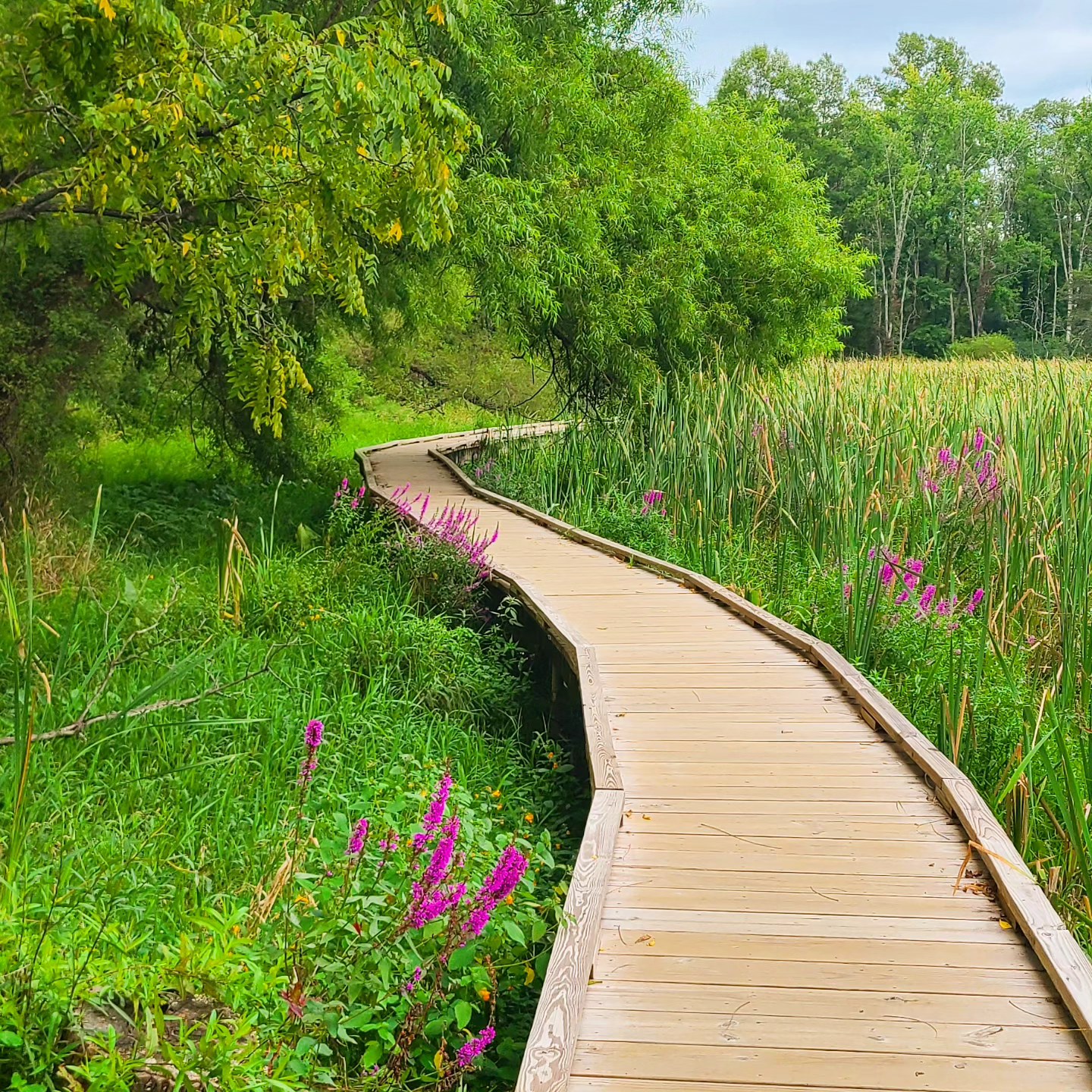
Their website has free resources that are both fun and beautiful. They’re all open source so you’re free to use them any way you’d like, for yourself or within your community. There’s also a nature art challenge which has my collage artist brain spinning with possibilities. I kicked off the month hiking the Stairway to Heaven in New Jersey’s Pochuck Valley, part of the Appalachian Trail, with a good friend. A difficult 7-mile climb, the views make all the effort worthwhile and then we were rewarded with a walk through the flats, a preserved and protected wetland. There, the connection to nature runs deep.
September has always been a meaningful month for me. Forever a student, I love back to school time. Fall is my favorite season, so this always feels like my new year, a fresh start, the next chapter. It’s no wonder my Alive Day is September 5th when I survived an apartment building fire 15 years ago. It’s also the Gotcha Day (birthday) of my beloved rescue dog, Phineas, on September 18th. This will be my first without him physically on this plane after his passing in January of this year. He would be 15 this month.
While the meaning of, well, everything, is always top of mind for me, this month I’m going to especially focus on what nature means to me. I’ll be sharing my art, writing, reflections, hopes for the future, and actions that preserve, protect, and propagate the natural world we all have, share, and depend on every day. ReWilding ourselves and our planet has never been more important than it is now.
Today marks 15 years since my NYC apartment building caught fire and I was almost trapped inside. My Alive Day started my difficult journey through one of the darkest times of mental health in my life. It also brought me Phineas as an emotional support dog and it made me a writer. I learned the difficult lesson that “someday” is today because today is all we have. On that journey, I learned how and why to really live. Emerson Page, the protagonist in my novels, was born from that pain. Her story saved me. Stories can save us all.
Forever grateful for my therapist and guide, Brian McCormack, and the many friends who showed up as angels on the path. And of course to Phinny and Emerson. Cheers to all of life’s chapters.
Something fascinating and fantastic is happening with campaign communications in 2024 and it warms my story loving heart. In the past, voters have rallied around their political party, social issues, geography, and demographics such as age, race, religion, and ethnicity. This year we’re seeing people rally around their interests, passions, and affinities in support of Kamala Harris and Tim Walz. From comedy and food to pets and music, there is a group for all of us. These groups and their respective Zoom events are using trusted messengers — people with whom we share a common bond and who make us feel safe—to relate to voters on a personal level.
This week I went to two online incredible online events: Swifties for Kamala organized by Taylor Swift fans and Cooking for Kamala organized by professional celebrity chefs. (They were both recorded so you can watch them at the links below.) Swifties raised over $144,000 and the chefs raised over $225,000 from event attendees. They got people registered to vote, helped people check their voter registration, talked about issues related to their interests (in these cases, corporate monopolies like Ticketmaster and food security, respectively), provided resources for people to volunteer on the campaign to knock on doors, send postcards, make phone calls, combat disinformation and misinformation, and most importantly activate their friends, family members, and communities to turn out the vote this November.
Collectively, all these affinity events and efforts are also doing the important work of reminding all of us that politics is about people and policies. It’s personal. It’s about who we are and who we want to be. It’s about how we live together in community, in harmony. It’s about the world we’re building for ourselves and future generations. While disagreements will inevitably happen, politics can only be effective if it’s about unity and open, clear communications. These affinity events are putting the heart back into government, and they’re giving us hope.
Some media outlets have said joy is not a strategy. These events show joy is not only a strategy; it’s also a way of being and doing. And it’s working.





 Christa Avampato