creativity

Books are magic

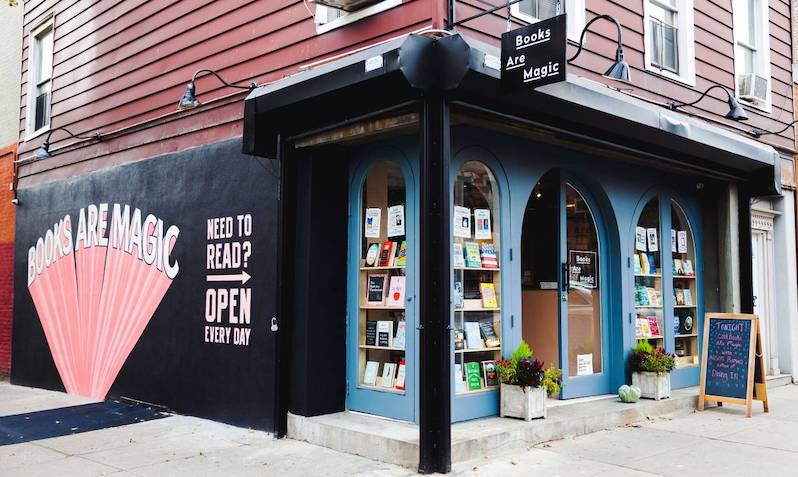
One of my favorite bookstores, Books are Magic, in Brooklyn, NY. Photo by bookstore.

“Books are a uniquely portable magic.” ~Stephen King

My dog, Phin, and I were enjoying the gorgeous Fall weather on our tree-lined block in Brooklyn, the sweet scent of dried leaves in the air. He’s an old man now – 14 last month – and he doesn’t move as well as he used to.

A young girl was walking toward us, her nose deep in a book—A Wrinkle in Time. I picked up Phin from his sunny spot in the middle of the sidewalk so he wouldn’t be in her way. Her mother walked a few paces behind her and saw me move Phin of her daughter’s way. The girl passed us without taking any notice.

“I’m so sorry,” her mother aid to me. “When she’s reading she’s in another world.”

I smiled. “No apologies needed. I’m the same way,” I said.

That’s the magic of fiction. As a reader and author, books have carried me away to fantastical places. The characters have become my friends and traveling companions. Their adventures are as real to me as my own in this physical world. 

When I finally look up from reading or writing, I’ve lost all track of time. After having been on a book’s journey, my own world looks and feels different. I feel different. Books change us, and our perspective.

Books are sense-making devices. When I don’t know how I feel about something, I read and write. In those acts, things become a little bit clearer. 26 letters arranged in countless ways to create portals across time and space, conveying emotions, sharing thoughts and experiences, connecting us to each other, attempting to make meaning of the messiness of life. There is no more magical invention than a book.

creativity

Cultivating our roots in difficult times

I ran the few blocks to Prospect Park for my morning run. On the way, I passed one of my neighbors who was sitting in a chair in her front yard. She had her eyes closed, face up to the sun, with her bare feet sinking into the ground.

“Morning, Marta,” I said.

“Hi dear,” she replied. “Just feeling my roots.”

As I ran through the park taking in all the reds, golds, and oranges of the leaves, I thought about Marta’s comment. We all have roots — where we live, where we work, in the communities and with the people whom we spend time with. It made me think about the value of connections, and how those connections form a kind of life journey and path as we carve our way in the world. It reminded me how strong roots take time to cultivate, how that work is mostly hidden from sight, and may appear like we aren’t making any progress.

But the progress of building our roots may be the most important progress we make because everything else we are and do comes from them. It’s our roots that sustain us, as people and professionals. They are what remains when everything else falls away. They help us grow, transform, and heal. They help us weather the tough times and flourish when the light returns. And it does always return, eventually.

The world is a difficult place right now in so many ways. Perhaps as difficult a place as we’ve ever seen. I’m finding hope in fostering my roots, in deepening my relationships, and rededicating myself to my community, in my city, in my work, and in all the places where I find points of connection. I hope that you are able to find this, too.

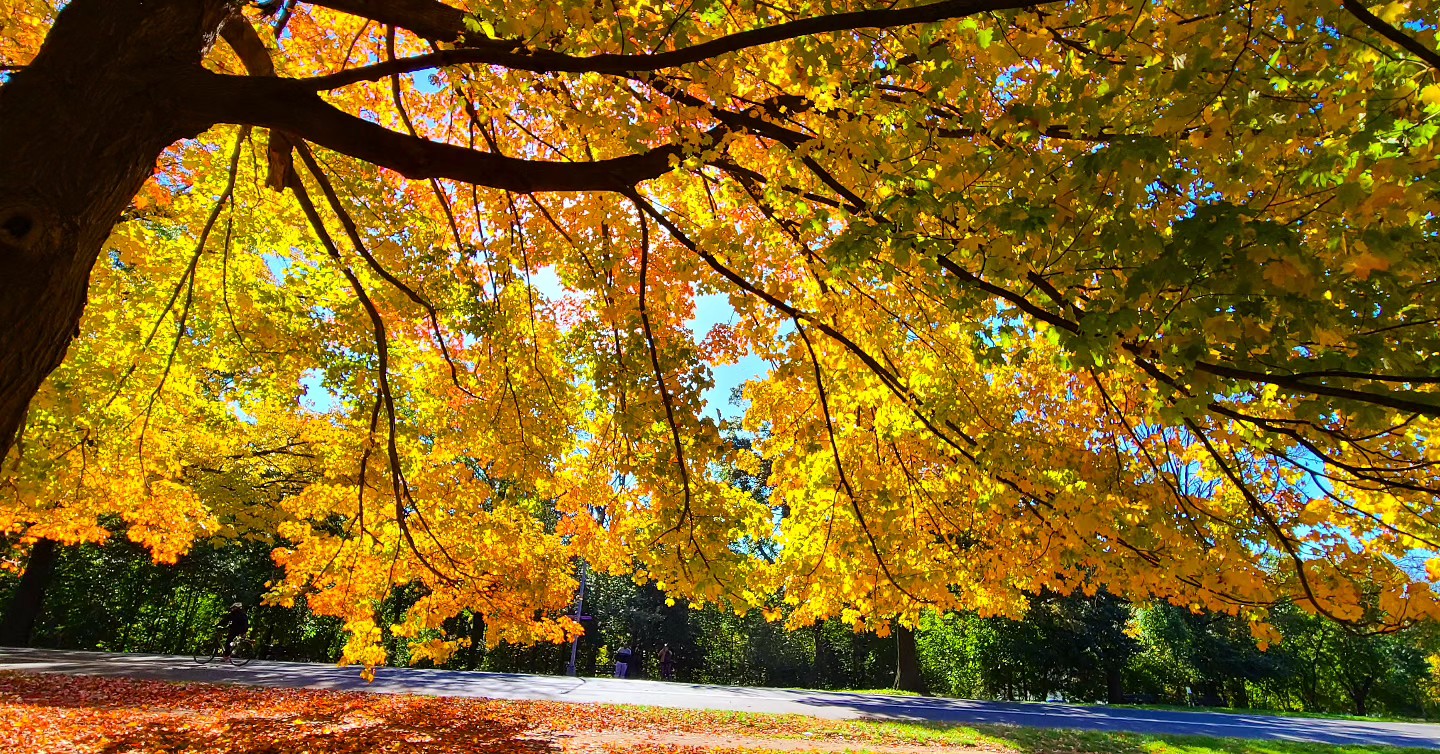
Photos of Prospect Park, Brooklyn. Taken by Christa Avampato on October 25, 2023.

creativity

Tell me something good, in this broken world

Photo by Jon Tyson on Unsplash

“Tell me something good.” That’s what one of my neighbors said to me when I saw her outside yesterday when we were walking our dogs. I completely understood why she needed good news right now.

Although this is a very different situation and it’s happening on a geopolitical scale with impacts on many millions of people, I felt the same way my neighbor feels when I went through cancer treatment. A friend of mine sent me an email back then that said he had tried to message me many times but just had no idea what to say. He felt that everything he could say was inadequate considering what I was going through. I said to him exactly what my neighbor said to me. “Tell me something good.” He felt awful talking about anything good because he thought it would make me feel worse about my situation. It did just the opposite for me. His good news lifted me up.

Even in times of mourning and the deepest sorrow, we need light. We need stories. We need moments of joy to give us a boost so that we can keep going. It doesn’t mean that we care any less or that we don’t understand the seriousness of what’s happening. Joy is an act of resistance. Joy is fuel. Joy is how we sustain our courage.

When we don’t know what to say, it’s okay to just be present and listen. So often what people need is not an answer but an ear and a shoulder. And if you have it within you, tell them something good. That may be exactly what they need to hear right now.

creativity

Trees show us how to survive in difficult times

Photo of Prospect Park by Christa Avampato

“I just want to live life all the way through. That is all.” ~Nan Shepherd

On my morning run in Prospect Park, I caught my first glimpse of autumn, my favorite season, one of catch and release, color and darkness, change and preservation, our two halves becoming whole. Trees changing and losing their leaves have so much to teach us about how we live and work. Biomimicry in action.

Deciduous trees let go of their leaves to survive the winter and live to see the next spring: it conserves energy and water, and allows wind to blow through the branches, putting less strain on the tree during winter storms.

In this next season of life, what will you do and what will you let go of so you can arrive in the next season rested and ready when the light and warmth return?

I am taking a little time every day to read place-based books about nature and landscape by people like Nan Shepherd and Robert Macfarlane who go out into the natural world and take it all in.

I am letting go of always thinking 10 ten steps ahead. Some amount of planning is necessary, but sometimes I get so caught up in the future that I don’t fully appreciate and learn from the now. So I’m going to make a conscious effort to love and be exactly where I am each day.

What about you? What will you do? What will you let go of?

creativity

Is peace ever impossible?

Photo of Brooklyn sunset taken by Christa Avampato

In the last days of his presidency, Bill Clinton called PLO Chairman Yasser Arafat. “You are a great man,” said Arafat. “I am not a great man. I am a failure, and you made me one,” Clinton replied. I don’t know if Arafat can bear all of the blame but he was a key player in the region’s failure. Never quite endorsing nor denouncing anyone or anything, he failed his people and neighbors by holding to the messy, non-committal middle.

After Arafat shook hands with Israeli Prime Minister Yitzhak Rabin on the White House lawn, Hamas’s (then called Change and Reform) rage exploded into violence. They narrowly won the 2006 election with 44.45% of the vote. Fatah, the next closest party and founded by Arafat, won 41.43%. The remaining 5 parties collectively won 12.3%. It wasn’t a runaway victory. A majority of Palestinians didn’t want Hamas.

2006 was the last time Palestinians voted. With 50% of Gazans under 18 today, they had no say in 2006. We have no idea how they’d vote now.

We know Hamas wants Israel to invade Gaza. They’d love to publicize the casualties. It’ll be bloody, horrific hand-to-hand, door-to-door combat. Only fans of chaos win that kind of war.

This picture is the view from my Brooklyn apartment. I spend a lot of time at this window, looking out across Ditmas Park, Kensington, Borough Park, Midwood, Greenwood, Windsor Terrace, Bay Ridge, Sunset Park, Fort Hamilton, Dyker Heights, and Bath Beach. They’re some of the most diverse neighborhoods in the world. A mix of every religion, culture, and ethnicity. Many Jews. Many Muslims. All New Yorkers, and so far, peaceful.

I hope it’s not too late for peace. The world could give Palestinians an option other than Hamas with humanitarian aid and safe passage. The Arab world could denounce Hamas, come to the table, and stand for peace for all. If we leave Gazans with no food, water, medical care, or electricity, their desperation will grow exponentially. I’m afraid of where that leads.

Is peace ever impossible? Is a spirit of humanity ever completely snuffed out? Time will tell.

creativity

Climate communicators must become storymakers, not just storytellers

Photo by Camellia Yang on Unsplash

This piece by World Economic Forum posted by UN Biodiversity gets it right when it comes to climate communications. It starts with the important grim facts of biodiversity loss — human activity is destroying biodiversity faster than in the last 10 million years, over 1 million species face extinction, 80% of threatened species are impacted by our activity, and we’ve degraded 40% of the land. Then it pivots to 5 solutions that improve our lives, save nature, create 117 million jobs, and generate $3.015 trillion dollars by 2030:

1)Higher-density urban development to free up land for agriculture and nature — $665 billion; 3 million jobs

2)Architecture with nature, not just humans, at the core of the design to benefit us and other species — $935 billion; 38 million jobs

3)Utilities that effectively manage air, water, and solid waste pollution in cities — $670 billion; 42 million jobs

4)Nature-based solutions for infrastructure like wetlands, forests, and floodplains to manage the impacts of rain, wind, and storms — $160 billion; 4 million jobs

5)Incorporating nature such as wildlife corridors into infrastructure — $585 billion; 29 million jobs

Total: $3.105 trillion; 117 million jobs

Tell me another set of policies that produces that much revenue and that many jobs. There isn’t one. Line up the investors for this unicorn deal. Which politicians are turning down this set of policies with these societal benefits? Those who won’t be elected. This is the power of effective climate storytelling about solutions and their benefits. These are stories that change the world. Tell them. Make them.

As climate communicators, we can’t drop audiences off at the abyss and leave them there. We can’t just be storytellers; we must be storymakers and solutioneers if we want to be part of the web of humanity that weaves a healthier, more joyful, peaceful, and sustainable world into existence. This is a lot to ask of my inspiring and beloved climate communications colleagues who are already doing so much. But I’m asking us to do more because the world needs us now more than ever.

You wanted to be a writer, journalist, filmmaker, or video game creator. You hadn’t planned on becoming a product developer, systems designer, policy maker, and community organizer. That wasn’t the deal. I know. The deal changed. The world changed. We have to change.

There’s a Hopi proverb that says, “Those who tell the stories rule the world.” As the CEO of Pixar Animation Studios, Steve Jobs said “The most powerful person in the world is the storyteller. They set the vision, values, and agenda of an entire generation.”

This is the mantle we have to take up. We have to tell stories about solutions that clearly communicate their benefits. Then we lead our audiences into the trenches to collectively roll up our sleeves and get the work done using the empathy and compassion in our hands, hearts, minds, and spirits to build a better world for all beings.

creativity

Using design thinking to solve any challenge

Photo by UX Indonesia on Unsplash

Design thinking is an incredible mindset and tool kit whether you’re trying to solve world peace, save the planet, construct a curriculum or framework, create a product, service, or system, or build and iterate on something to solve a common everyday problem. I’d love to do a session with you to show you how it works if you’ve never used it before.

Yesterday it was a joy to start to introduce design thinking to a colleague of mine. Seeing his eyes light up and the wheels of his mind turn made me a little jealous of him. I remember that exact feeling of being overwhelmed by entering a whole new world when Bob Giampietro, my boss at the time at Toys R Us, got me hooked on IDEO’s then-nascent design thinking philosophy.

Since then, I’ve used IDEO’s work constantly in my product development and design work. No matter what the challenge is, no matter the industry, and no matter the form factor of the outcome, I’ve found design thinking works. It’s especially good for complex collaborative projects when so many other methods fall short.

If you’re interested in learning more, please drop me a note at christa.avampato@gmail.com. I’d love to help you solve problems and make the world a better place for all beings.

creativity

Walking the path of peace

Photo by Levi Meir Clancy on Unsplash

Even though I’m not Jewish, I’ve spent the majority of my adult life in Jewish communities. Penn, where I went to undergrad, was 35% Jewish at the time. I attended my first Shabbat dinners there and learned about Jewish culture, traditions, and holidays.

New York theater, where I started my career, has a large Jewish community. I lived on the Upper West Side for many years, a neighborhood that is largely Jewish. Now I live in Ditmas Park, Brooklyn where there is a mix of just about every religion, culture, and language, including a large Jewish community and a large Muslim community who live side-by-side. Many of my dearest friends are Jewish and Muslim, and their pain now is palpable.

My friends Vince and Jane visited me last weekend. When we went out for our kosher pizza crawl and tasting, we found that nearly every shop was closed, in mourning. As I’ve gone for my run each day this week, I can see and feel the heavy weight of sadness here. Everyone is waiting for word about their loved ones and what will happen next in this horrible, dangerous war.

I have been in touch with my friends in Israel, and friends here whom I know have family there. Thankfully, they are all safe. And all of them are scared. Some are leaving the country. Some are determined to stay. Some are still trying to decide what to do. The heightened alert has also extended to NYC.

The footage from Israel and Gaza is difficult to watch this week but I have forced myself to do it to bear witness and to listen to their stories. I find myself crying with them, hurting with them, and fearing what’s to come.

I’m not an expert on the geopolitics there, nor on all of the history. But I do know that people whom mean a lot to me are there, and I’m afraid for their safety every day. I’m gutted for all of the families and friends who have lost someone and who have no idea where their loved ones are. I’m devastated for all of the children, the wounded, those whom we’ve lost, and the many who have lost who and what they hold dear.

I’m hoping for peace for everyone. Israel and Gaza have already been through so much, especially this last year. Now the devastation has escalated exponentially.

Yesterday, I found this photo by Levi Meir Clancy. It was taken last year at Netiv HaAsara facing the Gaza border. It has the words “Path to Peace” in Hebrew, Arabic, and English further along and the mural depicts a path with flowers, homes, and trees. Netiv HaAsara is a moshav (a cooperative agricultural community) in southern Israel. I hope we can all find our way to that path and walk together. There is so much healing needed.

creativity

Looking to Tom Friedman for guidance in Israel

Photo by Cole Keister on Unsplash

There are a few writers whom I count as my North Stars and Tom Friedman is at the top of the list. He has deeply immersed himself, physically and intellectually, in global geopolitics for more years than I’ve been alive. After the Hamas attacks in Israel, he contacted his North Stars in the region, Nahum Barnea, a veteran Yediot newspaper columnist, and Professor Victor Friedman (no relation), who teaches behavioral science at Jezreel Valley College in central Israel.

He wrote about his thoughts and theirs in his New York Times column on October 7th with a piece titled Israel’s Worst Day at War. He followed up that piece with another on October 10th titled Israel Has Never Needed to Be Smarter Than in This Moment.

These two unlocked links are well worth reading and contemplating. He addresses the heavy weight of history, Netanyahu’s divisive politics, and what the U.S., Israel, and countries like Saudi Arabia must do now to prevent the whole of human society from being thrown into violent chaos.

I hope Friedman has a direct line to the offices of Biden, Netanyahu, Israel’s opposition leader Benny Gantz, and MBS. His knowledge, perspective, and counsel is crucial right now as the world holds its breath.

We will see if the unity government in Israel is a real shift in Netanyahu’s psyche and not just a symbolic gesture. War can create otherwise unlikely allies. Time will tell in short-order whether we collectively descend into darkness or rise into the light. I continue to root for our better angels, and for peace.

creativity

The book Storyworthy by Matthew Dicks is a masterpiece about storytelling

The book Storyworthy: Engage, Teach, Persuade, and Change Your Life through the Power of Storytelling by Matthew Dicks is to storytelling what The Elements of Style by Strunk & White is to writing. Reading it immediately improves our craft because the advice is approachable and applicable. For every audience about any topic in any medium, every page of Storyworthy shows us how and why to tell stories, including the behind-the-scenes processes that make stories memorable and vehicles that can change hearts, minds, and behaviors.

When I first picked up Storyworthy, I didn’t expect much. I’ve read dozens of books on storytelling and many of them offer similar advice. When one of my best friends recommended Storyworthy, I was skeptical. However, my friend is a law professor who teaches writing and argument construction, and she is an exceptional storyteller whom I’ve worked with on storytelling shows. With her recommendation, I figured I could spend a few minutes flipping through it. My dissertation at University of Cambridge is centered around storytelling so if nothing else, I figured maybe I’d pick up one or two pointers that might be useful. 

By the time I got to page 2 of the preface, I was completely hooked even though Matt hadn’t yet given a scrap of advice on storytelling. His honesty is what got me. He opens the book with the first time he ever contemplated telling a story live on stage. He’s deeply conflicted about it. He has so much respect for the art form and he’s completely terrified of being judged. The stakes are high. His nervousness becomes my nervousness. I’ve felt that sick feeling in the pit of my stomach. I feel it every time I tell a story or do any kind of presentation in front of an audience. Terrified, he just goes for it. He takes his shot, and decides if his name gets picked he’ll just tell a story scared. He’s my kind of guy. I love risk-takers. I root for them. 

The book unfolds chapter after chapter with advice, exercises, and samples of Matt’s stories. These aren’t platitudes like “people love an underdog” or “start at the end and work backwards” that I’ve read in other storytelling how-to books multiple times. Both of those ideas are generally true and helpful but Matt goes so much further than that kind of advice. 

He explains exactly why and how he chooses his beginnings, endings, and the arc that connects them. He talks about pacing and timing, content and structure, word selection, story strategy, and storytelling devices to grab and hang onto an audience’s attention. Storyworthy is a playbook and it works for every story by every storyteller. It’s a compass, map, flashlight, and go-bag for everyone who has something to say that someone else needs to hear. It’s for all of us.

At one point, a friend of Matt’s whom I know and have told stories for, grabs his arm and tells him that he absolutely can’t tell anyone his secrets (or hers!) about how to create and tell a story. He laughs, ignores her, and thankfully we have Storyworthy. He’s given us the tools he has and uses every day. 

This might sound counterintuitive. Shouldn’t he keep some of this to himself so he can continue to make money from workshops, consulting, writing, and shows? Shouldn’t he hold back just a little? He’s the real trick: by telling his secrets I can’t wait to take a class with him to show him how I’m using these tools and to get his feedback so I can level up even further. 

Actually, I have to take a class with him. Here’s why: Matt is a lifelong learner. He wrote Storyworthy five years ago. I bet he’s got even more tools, tips, and advice to share now, especially after the pandemic. And I want to know all of them. 

My dissertation about storytelling involves interviewing storytelling experts. I want to interview Matt. My friend who recommended Storyworthy to me said he probably won’t agree to an interview. He’s busy. A man-in-demand. I wrote him an email anyway. Even if he said no or never responded, at least he’d know how much his book means to me and how much it’s helped me become a better storyteller and a better human. 

I’m a big believer in the idea that unexpressed gratitude is a horrible waste of a resource. Imagine what kind of world we’d have if people just said thank you more often.

So I go to Matt’s website. I navigate to his online contact form and put the advice in his book to work to craft my pitch. I was honest to the point of gushing about the book. All of it true. I gave some hints about my life. I told him about my dissertation’s research question and why it’s so important to me. I closed it by saying that this kind of request from someone he doesn’t know may feel a bit out of left field. It may not be of any interest to him, and if that’s the case that’s okay. Again I tell him that if all this message does is explain how much I appreciate the time and effort he took to write Storyworthy, then that’s what matters the most.

I click “submit form” and close my laptop. I take my dog outside for walk. I worry about my dissertation. I have to interview 30 — 40 experts. People are busy. What if they all say no? What if no one wants to talk to me? I better come up with a plan B just in case the worst happens. I should start that plan today because I have no idea how I’m going to explain this to Cambridge and keep my dignity. 

I go back up to my apartment and open my email. A note from Matt. “Well this is the second fastest rejection I’ve ever gotten,” I think. The first was from a literary agent I queried a few years ago when I was shopping my first novel. The response from the agent came back less than a minute after I sent it, and it had just one word. “No.” I should dig it out from my email archive and send it into the Guinness World Records. Fastest rejection ever—what a record to hold. 

I take a deep breath and open up Matt’s message. He says he appreciated my kind words about the book and he’s glad it helped me. Well, at least it’s a nice rejection, I think. 

Then he writes if we can make the timing work, he’d be happy to be interviewed. Hand to heart, I danced around my apartment. We figured out a date in short order and it’s in the calendar. I’ve got a few months to prepare for this interview, and I can’t wait for everything I’ll learn during it. Saying thanks really is an under-rated way to build a connection.