Me on the Stairway to Heaven in the Pochuck Valley
I’m a big fan of ReWild Yourself, an online community inspiring nature connection. This month, they have a campaign called the Month of Meaning, encouraging their community members to connect with nature on a deep, meaningful level. It’s one of the five pathways they use as a means to help people connection with nature: meaning, compassion, beauty, the senses, and emotion.
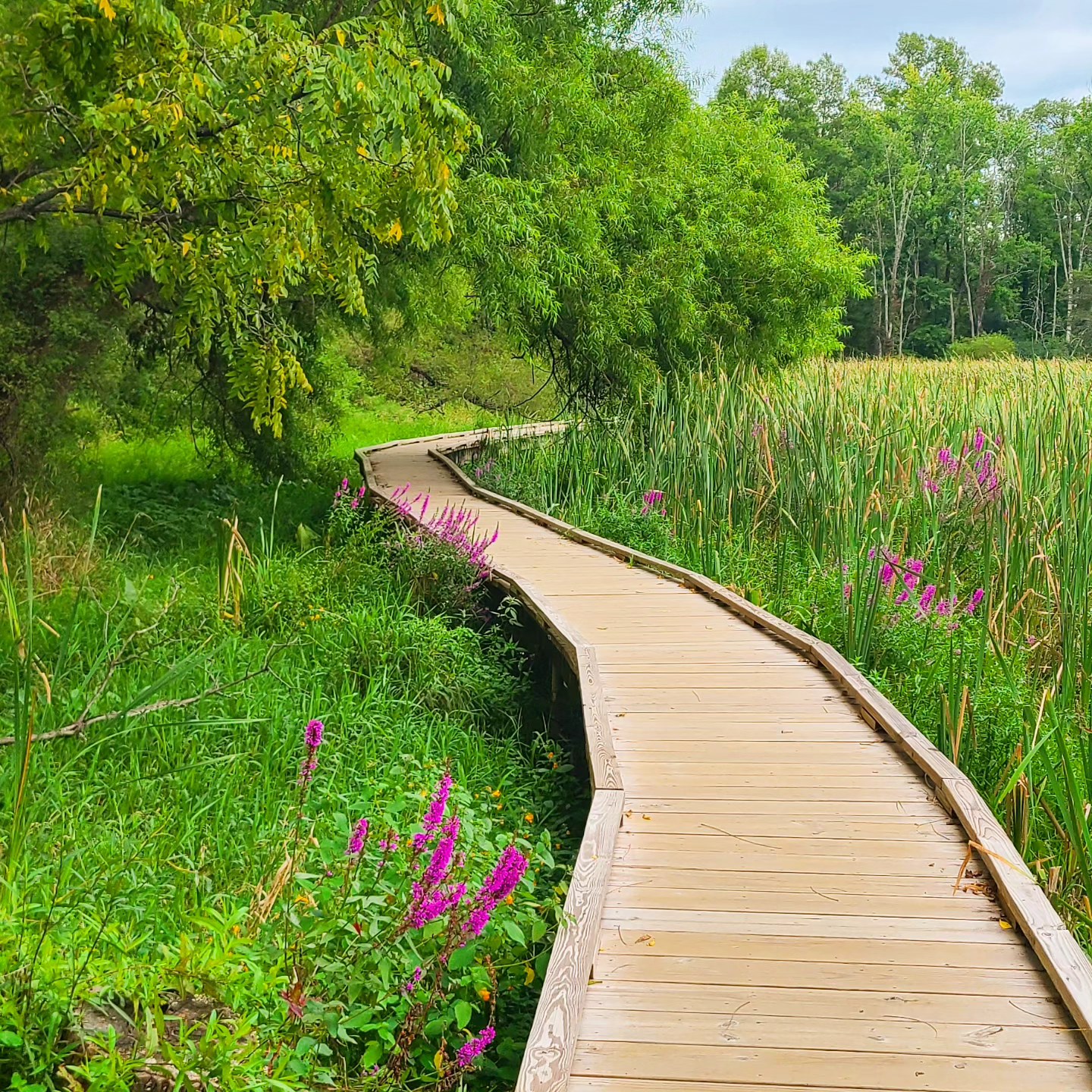
Their website has free resources that are both fun and beautiful. They’re all open source so you’re free to use them any way you’d like, for yourself or within your community. There’s also a nature art challenge which has my collage artist brain spinning with possibilities. I kicked off the month hiking the Stairway to Heaven in New Jersey’s Pochuck Valley, part of the Appalachian Trail, with a good friend. A difficult 7-mile climb, the views make all the effort worthwhile and then we were rewarded with a walk through the flats, a preserved and protected wetland. There, the connection to nature runs deep.
September has always been a meaningful month for me. Forever a student, I love back to school time. Fall is my favorite season, so this always feels like my new year, a fresh start, the next chapter. It’s no wonder my Alive Day is September 5th when I survived an apartment building fire 15 years ago. It’s also the Gotcha Day (birthday) of my beloved rescue dog, Phineas, on September 18th. This will be my first without him physically on this plane after his passing in January of this year. He would be 15 this month.
While the meaning of, well, everything, is always top of mind for me, this month I’m going to especially focus on what nature means to me. I’ll be sharing my art, writing, reflections, hopes for the future, and actions that preserve, protect, and propagate the natural world we all have, share, and depend on every day. ReWilding ourselves and our planet has never been more important than it is now.
Minnesota Governor Tim Walz has spent the better part of the last decade instituting climate policies that make economic sense and help all Minnesota residents live healthier, happier lives. Let’s dive into what he’s done in Minnesota and how this could help the entire country.
1.) Minnesota is a clean energy leader
Like many states, Minnesota was long powered by coal. Today, 50% of the state’s power comes from wind, solar, and nuclear power, thanks to Walz. It’s one of the fastest transitioning states in the country. In 2023, he signed the Minnesota Clean Energy Bill into law, ensuring Minnesota is fossil fuel-free by 2040. (If you want to see how all U.S. states stack up with their energy sources, check out this cool interactive created by Nadja Popovich.)
2.) Minnesota is a climate policy leader
On Walz’s watch in 2022, Minnesota launched the Climate Action Framework. This plan is preparing the state for climate change impacts, taking immediate and near-term actions to make the state “carbon-neutral, resilient, and equitable.” To-date, this plan has prompted the Minnesota Legislature to approve over 40 climate initiatives across industries including energy, health, agriculture, construction, and transportation.
3.) Minnesota policies connect everyday local concerns with climate solutions
Walz’s simple, straightforward, optimistic, and solution-oriented communication style unites people, makes them feel hopeful, and connects the challenges they face with policy solutions that will directly solve those challenges. This makes him wildly popular with constituents across the political spectrum. People trust him because he’s helping them. This has helped turn Minnesota into a climate action powerhouse. Using his playbook, we could do this for the entire country.
The Greenhouse Gas Reduction Fund is a powerful climate finance policy in the U.S. that hasn’t gotten enough attention. It effectively leverages blended finance, creating an effective model for future policies. Here’s the deal:
With the U.S. Environmental Protection Agency (EPA), Vice President Kamala Harris announced a $20 billion investment in climate and clean energy projects: three under the $14 billion National Clean Investment Fund and five under the $6 billion Clean Communities Investment Accelerator. They will create a national clean financing network for clean energy and climate solutions across sectors, ensuring communities have access to the capital they need to participate in and benefit from a cleaner, more sustainable economy.
Together, the eight selected projects will deliver on the three objectives of the Greenhouse Gas Reduction Fund: reducing climate and air pollution; delivering benefits to communities, especially low-income and disadvantaged communities; and mobilizing financing and private capital. As part of this collective effort, selected applicants have committed to the following:
Fund projects across sectors that will reduce or avoid greenhouse gas emissions
These projects fund net-zero buildings, zero-emissions transportation, distributed energy generation and storage, and the decarbonization of agriculture and heavy industry.
Reach communities in all 50 states, the 6 U.S. territories, and Tribal Lands, with a particular focus on low-income and disadvantaged communities
$14 billion funds low-income and disadvantaged communities that need it most, ensuring that program benefits flow to the communities most in need and advance the President’s Justice40 Initiative
Over $4 billion to rural and energy communities
Nearly $1.5 billion to Tribal communities
Mobilize private capital at an almost 7:1 ratioover the next seven years, with every dollar in grant funds leveraged for almost seven dollars in private funds
This is a significant point because a sustainable world requires private investment. This means $20 billion in U.S. government funding activates an additional $130 billion in private capital from banks, asset managers, and individual investors for a total of $150 billion. (This is known as “blended finance” — investments from different sources are combined to achieve a common goal.)
Fund community lenders and partners who are already working in communities across the country to deliver investments quickly
1,000 community lenders are lending in low-income and disadvantaged communities, including Community Development Financial Institutions (including Community Development Loan Funds, Community Development Banks, Community Development Credit Unions, and Community Development Venture Capital Funds); low-income credit unions, and green banks.
Hundreds of thousands of good-paying, high-quality jobs, especially in low-income and disadvantaged communities
Create hundreds of thousands of good-paying, high-quality jobs, supported by a number of local, regional, and national labor union jobs
Vice President Harris has spent her career standing up for people and the planet. She’s not resting on her laurels. She’s moving us forward toward a healthy, sustainable world for all. The Greenhouse Gas Reduction Fund is a cornerstone of a set of policies that create economic opportunities while protecting the planet we share.
Metalplant co-founders Laura Wasserson, Eric Matzner and Sahit Muja with the Albanian farming team. Image: Metalplant
Plants like sunflowers are viable nature-based solutions that remove heavy metal from polluted soil through the scientific process of phytoremediation. The term is a combination of the Greek phyto (plant) and Latin remedium (restoring balance). Simply, brilliantly, and quickly, the plants take up the heavy metal in large quantities and store them in their fatty tissues. This causes no harm to the sunflowers, nor to the land. They also thrive in hot, dry climates. What a wonder for a world wracked by pollution and climate change impacts.
Now imagine taking this incredible adaptation even further. What if we extracted the metals from the plants and use these metals in our technology so we didn’t need to mine for them?
I worried about the impact of the rock dust on the soil and the life within that soil. Thankfully, enhanced rock weathering is a regenerative practice, using mycorrhiza and other fungi fostered by the roots of the plants absorbing the metal from the soil.
Curious and want to learn more? Metalplant would love to hear from you. Get in touch with them at https://metalplant.com/contact/.
It is written. It is submitted. In the wee hours of Monday morning, I submitted my dissertation to the University of Cambridge. I’m proud of it. Every cell in my body is passionate about the topic and I think it can help to make this world a better place.
There are many people who helped make this dissertation what it is. The anonymous marking criteria precluded me from thanking them by name in the acknowledgements of the dissertation so I’ll thank them here.
My advisor Dr Candice Howarth provided support and encouragement from the start.
Louise Drake was enthusiastic about my topic from the point I submitted my proposal and provided early materials that helped me on my journey.
My first year tutor Angus Morrison-saunders sharpened my writing and research skills to make the writing of this research project possible.
The staff at Cambridge Institute for Sustainability Leadership (CISL) always warmly welcomed us in Cambridge, answered our many questions with kindness and grace, and created the space to make this phenomenal experience possible. There is so much work that happens behind the scenes and the staff is to be commended for all they do.
My close community of friends and relatives cheered me on throughout this two-year adventure and provided support for my studies in so many ways.
Many people graciously and generously gave their time so I could interview them for this dissertation. Your insights and perspectives made this research possible. Thank you for your honesty, candor, and enthusiasm for the work.
I love being a part of Cohort 13 and I’m inspired every day by all my wonderful classmates and friends. You taught me so much, not only about sustainability but also about life. I’m a better person for knowing you. Thank you for everything.
While we all now wait for our grades and the confirmation of our graduation celebration in 2025, I’m filled with gratitude and love for two fantastic years. Onward now to save the planet.
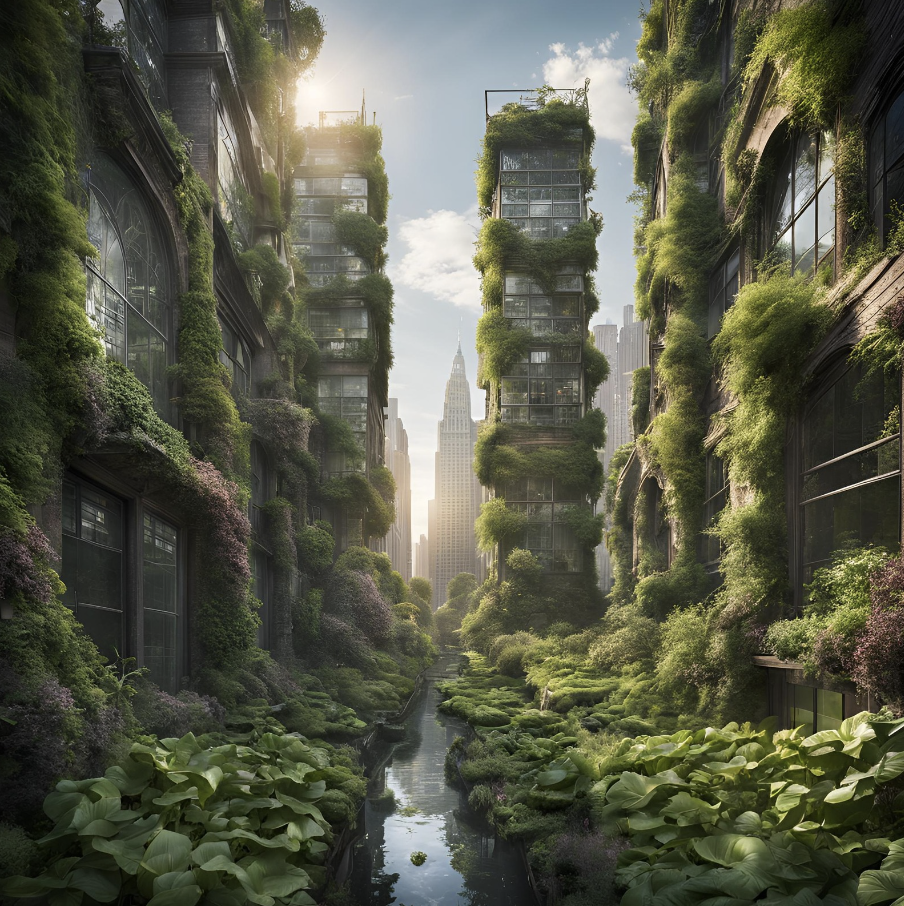
While on vacation I wrote my first full piece of ecofiction for a climate fiction writing competition. It’s a short story (5,000 words) that provides a slice of life in New York City in the year 2200, and grew out of the research I did for my University of Cambridge dissertation.
It’s told through the eyes of a journalist walking his dog who by chance meets the 90-year-old former mayor who galvanized the rebuilding of NYC after it was destroyed by floods caused by climate change. Biomimicry figures prominently in it. I tried to incorporate humor, heart, and redemption alongside the heartbreak, loss, and destruction. Ultimately, it’s a story about leadership, community, and vision.
No matter the outcome of the competition, I enjoyed writing it and plan to do more with these characters and in this genre. The predominant channels and messages we’re using for climate storytelling now are not generating the scale and speed of the changes we need. Fiction can play a bigger role is painting the picture of what a world transformed can look like, what it will take to get there, and how we might work together to make it so. The fandoms around fiction can be a unifying force for good, which is exactly what we need, now more than ever.
(I created the images below with AI, inspired by the story I wrote.)
A few months ago, I met Nicky Jenner, a gardener, conservationist, and nature lover who lives in Devon in the southeast of the U.K. Though I’ve only known her a short while, the moment we met I knew she was a kindred spirit.
She told me she was starting a podcast called Unearthing Wild Wonders about the wisdom and wonder of nature, and how we bring about positive change in our deeply troubled world. I was honored when she asked if I’d be a guest and I immediately accepted. Our episode, Nature inspired — home, healing, and biomimicry with Christa Avampato , is out now. Unearthing Wild Wonders is beautiful, uplifting, and hopeful, and each episode leaves me newly inspired to continue my work to protect the planet. Also, Nicky’s voice immediately puts me at ease.
In our conversation, Nicky and I talk about how the challenges I’ve faced in my life and with my health ignited my passion and commitment to make a difference for all beings on our precious planet. We talk about biomimicry and how the most unlikely species have inspired phenomenal innovations that we now use in our daily lives. We chat about the many languages we need to speak to bridge the divide between science, conservation, business, and finance.
I talk about my University of Cambridge dissertation that uses storytelling to connect climate entrepreneurs developing nature-based solutions with family offices looking for new investment opportunities that deliver a financial return and have a higher purpose.
I also share stories about my journey to overcome cancer, and how learning to heal my own body helped better prepare me to heal the planet. One of them I’m sharing publicly for the first time — how lying in a hospital bed seriously ill from chemotherapy helped me realize the immensity of the plastic waste problem and made me even more determined to do something about it.
I’m so grateful to Nicky for having me on the podcast. Our conversation happened just days after the passing of my sweet soul dog, Phineas, one of the worst losses of my life. Talking to Nicky helped me begin to heal and honor him. I’m so grateful for that. Let us know what you think of the episode.
I’m excited for the day when I’ll get to Devon, give her a hug, and walk through her garden with her. Nicky has a wonderful website and newsletter at https://www.hawksdawn.co.uk/ that I highly recommend. You can also find her on Instagram @nickyjenner_hawksdown posting gorgeous pictures of nature along with inspiring quotes and stories.
5 trees, actually, and in my kitchen. Two weeks ago, I planted 12 trees at their most vulnerable stage – grafts from existing trees sent to me by the Arbor Day Foundation that looked like nothing more than twigs. They’re in a planter in my Brooklyn kitchen. Of the 12, 5 now have tiny leaves: 2 Eastern Redbuds, 2 Washington Hawthorns, 1 White Flowering Dogwoods. This is thrilling because most trees at this stage rarely survive, and I’ve never planted trees in this stage before.
I’m very interested in learning more about tree propagation as the impacts of climate change grow more urgent every day. I’m thinking about a few tree-centered startups to pursue after I finish my Masters in Sustainability Leadership at University of Cambridge in two months. Growing these beauties counts as research! Nature’s wisdom is boundless, and I’m so happy to be her forever student.
Before you share one more post on social media about climate doom and gloom, please take a deep breath. And then, please post something else. Anything else.
The goal of sharing climate change stories is to drive actions that will halt and reverse climate change to protect the planet and human well-being. While doom and gloom stories such as alarming statistics (of which there are many, sadly!) drive more sharing, clicks, comments, and engagement on social media than any other type of climate story, the largest research study on the topic recently found they drive the least amount of climate action and do almost nothing to change climate change beliefs or support climate change policies. They actually backfire, even causing people concerned about climate change to take significantly less action than they otherwise would.
How could this be? Doesn’t instilling fear for the survival of our species cause so much alarm that of course we’d change our ways? That is a logical, rational assumption. For many years, this was the prevailing wisdom. If you just show people how much damage climate change can do, they’ll change their behaviors and habits to protect themselves and the people they love. This is why we see country leaders, the Secretary-General of the United Nations, leaders at environment nonprofits, and climate activists all over the world sounding the alarm. This is also why so many of us have posted about the climate emergency so often. It’s also why we aren’t seeing enough action taken at a fast enough rate. These stories depressed and demotivated people right into paralysis.
But if that’s the case, then why is there so engagement on climate stories? The clicks, likes, shares, and comments are through the roof. If there’s so much engagement, why is there not enough action? Being engaged on social media or with mass media isn’t the same as taking action in the real world. These stories have absolutely raised the consciousness around climate change, but they haven’t successfully moved people to physically do something about it. Fear-based messaging is somewhat effective at driving one-time actions. However, most climate action requires behavior, habit, and systems change, not one-time actions so the fear-based climate messages don’t give us the long-term and repeated actions we need.
So, what messages can we share that will drive climate action? That is an excellent question. Research points us to a few options that motivate climate action:
Scientific consensus coupled with a clear call-to-action Sharing the science of climate change, and that the vast majority of scientists agree on it, is critical. However, just providing the science isn’t enough. We also need to give people specific, actions to take. And all the better if we can give them a mix of one-time actions (such as voting) and remind them to take habitual actions (such as buying only the amount of goods we need to reduce waste). And we have to make them as simple as possible to get broad-based engagement.
Appeal to ethics and morality with a clear call-to-action Most people like to see themselves as having strong ethics and values. We want to protect our neighbors. We want to take care of our communities. We want to be healthy and happy, and we want people we love to be healthy and happy, too. Taking care of the planet is a way to take care of ourselves and others, and appealing to our collective nurturing nature makes a difference. And again, give people a clear call-to-action to help them do this.
There are other theories about what may work that need further study. There is a hole in the research about which messages will move people from engagement to action. We desperately need more research on this, so we tell the stories that motivate the actions we need to protect ourselves and all species with whom we share this planet. My master’s dissertation has a few additional findings that I’m excited to share soon, and I’m thinking of continuing this line of research and work because it’s so critical to protecting the health of the planet.
Last month, a study on conservation actions, including protected areas and management, showed they effectively halt and reverse biodiversity loss, and reducing climate change impacts. Over the weekend, CBS aired an interview with Pope Francis, the first he’s granted to a major U.S. television network. About climate change he told Norah O’Donnell, “Unfortunately, we have gotten to a point of no return.” What’s unfortunate is Norah O’Donnell didn’t explain the science that this is not true. We are not at a point of no return with climate change. We need to do more and faster, and there is hope.
I understand it’s probably intimidating to challenge the Pope during an interview on national television. However, what he says is taken as truth by millions of people. If he pointed to the many success cases we have, this would inspire the increase in climate action we need. People need to know they can and do have the opportunity right now to make a difference. We have to spread this message far and wide because time is running out. This next decade could turn the tide one way or the other, and we have the chance to be part of the solution.
The International Union for Conservation of Nature (IUCN) is the global authority on the status of the natural world and the measures needed to safeguard it. It’s documented that 44,000 species are at risk of extinction. If these extinctions happen, ecosystems will collapse and billions of people will struggle to have enough food, clean water, livelihoods such as fishing, homes, and cultural preservation, to name just a few of the severe impacts.
The world’s forests store approximately 861 gigatonnes of carbon, equivalent to nearly a century’s worth of current annual fossil fuel emissions. Tropical rainforests store 50 percent of that. These forests are not just the trees – they’re a whole ecosystem including the fungi, soil, insects, and predators. “When there are pieces of that biodiversity missing, the carbon cycle is incomplete or much less efficient than it would be otherwise,” said Christopher Jordan, Re:wild Latin America director. Storing carbon and keeping it out of the atmosphere needs all parts of the forest. It needs biodiversity. The wild, not human-invented technology, is the most effective solution to the interconnected climate, biodiversity, and human well-being crises.
This is what I wish the Pope had said about climate change because it’s true: There is hope. We have the solutions. Now, we need the will and humility to listen to nature and let her lead for our own sake and hers. We are all interconnected. We need each other.







 Christa Avampato