While there is a lot of fanfare on International Women’s Day and much to celebrate if we look at the (very) long arc of history, gender inequities all over the world are vast and sadly, growing. In recent years, women’s gains have been reversed with actions like the repeal of Roe v. Wade in the U.S. and the outsized negative impacts of the pandemic on women such as loss of healthcare, education, and employment opportunities, increased hunger, and skyrocketing gender-based violence.
Equal pay for equal work is still a distant dream: On average, U.S. women earn 16% less than men who do the same job, making 84 cents for every dollar earned by a man. Women of color in rural areas are paid 44% less than rural white, non-Hispanic men doing the same job, making just 56 cents for every dollar. And let’s not forget women are expected, and sometimes required and forced, to do the lion’s share or totality of work to care for children and a home at great sacrifice to their own personal wellbeing and aspirations.
To truly realize equity and equality of women, we must uplift them in real, tangible, actionable ways. So today, on this International Women’s Day, do this: listen to, encourage, and offer assistance by every means you have to help a woman in your life fulfill a dream they have, whether it’s a personal or professional endeavor. And then tomorrow and tomorrow and tomorrow do the same. A world of more and better opportunity for women is a better world for all people and all beings.
Commit to not only celebrating International Women’s Day but making every day a day we move women closer to equity and equality in every way in business, government, and society. Women have more than earned seats at every table everywhere. Build a longer table. Add more chairs. Listen. Respond. Activate. Repeat. Again and again and again. For as long as it takes. Women are worthy.
Photo of Brooklyn sunset taken by Christa Avampato
In the last days of his presidency, Bill Clinton called PLO Chairman Yasser Arafat. “You are a great man,” said Arafat. “I am not a great man. I am a failure, and you made me one,” Clinton replied. I don’t know if Arafat can bear all of the blame but he was a key player in the region’s failure. Never quite endorsing nor denouncing anyone or anything, he failed his people and neighbors by holding to the messy, non-committal middle.
After Arafat shook hands with Israeli Prime Minister Yitzhak Rabin on the White House lawn, Hamas’s (then called Change and Reform) rage exploded into violence. They narrowly won the 2006 election with 44.45% of the vote. Fatah, the next closest party and founded by Arafat, won 41.43%. The remaining 5 parties collectively won 12.3%. It wasn’t a runaway victory. A majority of Palestinians didn’t want Hamas.
2006 was the last time Palestinians voted. With 50% of Gazans under 18 today, they had no say in 2006. We have no idea how they’d vote now.
We know Hamas wants Israel to invade Gaza. They’d love to publicize the casualties. It’ll be bloody, horrific hand-to-hand, door-to-door combat. Only fans of chaos win that kind of war.
This picture is the view from my Brooklyn apartment. I spend a lot of time at this window, looking out across Ditmas Park, Kensington, Borough Park, Midwood, Greenwood, Windsor Terrace, Bay Ridge, Sunset Park, Fort Hamilton, Dyker Heights, and Bath Beach. They’re some of the most diverse neighborhoods in the world. A mix of every religion, culture, and ethnicity. Many Jews. Many Muslims. All New Yorkers, and so far, peaceful.
I hope it’s not too late for peace. The world could give Palestinians an option other than Hamas with humanitarian aid and safe passage. The Arab world could denounce Hamas, come to the table, and stand for peace for all. If we leave Gazans with no food, water, medical care, or electricity, their desperation will grow exponentially. I’m afraid of where that leads.
Is peace ever impossible? Is a spirit of humanity ever completely snuffed out? Time will tell.
1)Higher-density urban development to free up land for agriculture and nature — $665 billion; 3 million jobs
2)Architecture with nature, not just humans, at the core of the design to benefit us and other species — $935 billion; 38 million jobs
3)Utilities that effectively manage air, water, and solid waste pollution in cities — $670 billion; 42 million jobs
4)Nature-based solutions for infrastructure like wetlands, forests, and floodplains to manage the impacts of rain, wind, and storms — $160 billion; 4 million jobs
5)Incorporating nature such as wildlife corridors into infrastructure — $585 billion; 29 million jobs
Total: $3.105 trillion; 117 million jobs
Tell me another set of policies that produces that much revenue and that many jobs. There isn’t one. Line up the investors for this unicorn deal. Which politicians are turning down this set of policies with these societal benefits? Those who won’t be elected. This is the power of effective climate storytelling about solutions and their benefits. These are stories that change the world. Tell them. Make them.
As climate communicators, we can’t drop audiences off at the abyss and leave them there. We can’t just be storytellers; we must be storymakers and solutioneers if we want to be part of the web of humanity that weaves a healthier, more joyful, peaceful, and sustainable world into existence. This is a lot to ask of my inspiring and beloved climate communications colleagues who are already doing so much. But I’m asking us to do more because the world needs us now more than ever.
You wanted to be a writer, journalist, filmmaker, or video game creator. You hadn’t planned on becoming a product developer, systems designer, policy maker, and community organizer. That wasn’t the deal. I know. The deal changed. The world changed. We have to change.
There’s a Hopi proverb that says, “Those who tell the stories rule the world.” As the CEO of Pixar Animation Studios, Steve Jobs said “The most powerful person in the world is the storyteller. They set the vision, values, and agenda of an entire generation.”
This is the mantle we have to take up. We have to tell stories about solutions that clearly communicate their benefits. Then we lead our audiences into the trenches to collectively roll up our sleeves and get the work done using the empathy and compassion in our hands, hearts, minds, and spirits to build a better world for all beings.
“If I don’t work, I don’t eat so I have to be out here, even when there’s a flood.” This was a quote from a NYC delivery worker on the news during the September 29th, 2023 flash floods. His electric bike failed in the knee-deep water. He was pushing it against the current to deliver food.
NYC now has the largest income gap of any large city in the country — the top 20% make 53 times more than the bottom 20%. We’re failing our people with no social safety net, no protection from climate hardship, and few pathways out of their circumstances. City workers often live in temporary shelter and public housing because they don’t earn enough to make rent but residency is often required for their jobs.
This city is run by service workers. They are the lifeblood that keeps the city moving. Failing them will cause the city to crumble.
We also have the migrant crisis. Right now at the U.S.-Mexico border, the city is distributing these fliers:
I cried reading it. This has been the city of dreams for decades. Now it is the city of dreams only for those who are already of means. That cannot continue.
New York is a city of immigrants. It always has been. They enrich and enliven the social and economic fabric on which this city’s creativity thrives. Without them, we lose who we are and what we stand for.
The economics and business side of my brain spends the bulk of my waking hours thinking about how to support New Yorkers, present and future. How do we boost the economy and provide opportunity to everyone who wants to be a New Yorker? How do we rebuild this city, not just for the privileged few but for all the huddled masses yearning to be free so that everyone wins together?
The historian and storyteller side of my brain always sifts the sands of the past to see what I can find and use. As the late great John Lewis, who was at one time a New Yorker and is one of my greatest inspirations, often said, “We must make a way out of no way.”
That’s just a start of how NYC can work with nature so that everyone is cared for. There are dozens of other solutions that are relatively low-cost, efficient, and proven to clean the air, water, and land—benefits that benefit every resident, visitor, and commuter.
This doesn’t have to be a concrete jungle. It can be a green, verdant, healthy, thriving place for all beings who want to be New Yorkers. It’s going to take a massive mobilization, and the relentless pursuit to match needs with resources to transform our challenges into opportunities. We have to do this work, and we have to do it now while we still have time. I’m tired of a dirty, flooded, and unequal New York. Aren’t you? I love this city. I love New Yorkers. And I want us to do better. We have to do better, and we can—together.
“Go further than you think you can, or should. Push that boundary of what you could do into the uncomfortable zone because that’s where you know change is happening.” ~ Mathias Gredal Nørvig, CEO of SYBO
Because 1/3 of the world population plays games, games need to be a tool for every organization working in sustainability. If you’re interested in learning more about that, please get in touch! I’d love to share ideas of how you can get started! I also encourage anyone and everyone to look into Playing 4 The Planet, the UN’s inspiring games initiative with resources and data for every size of organization.
The summit was filled with incredible presentations about what’s already been done with games, projects that are underway, and the mountain of work ahead. There is one idea that I can’t shake, one perspective that completely changed my point-of-view about my work and my place in the world. It was from Mathias Gredal Nørvig, CEO of gaming company Sybo. He talked about how his company is pushing the boundaries in their communications and storytelling so far that there was a bit of backlash from their community. Rather than seeing this as a mistake or misstep, he saw this as a victory to be celebrated, a milestone that showcases progress. On this border, he saw evolution, change, and a provocative call-to-action. He closed his talk by saying he hopes all of us will have the courage to go further than we think we can, and to push our companies to do the same.
Over the next few weeks and months, I’m going to think about what that boundary is for me and how I can push past it to create breakthrough change. How can I extend myself beyond what I think I’m capable of doing? How can I take a bigger risk, step outside of my comfort zone to do something extraordinary that I’m not certain I can accomplish? How can I dare greatly?
I don’t know the answers to any of those questions right now, but I’m excited and eager to find them and share them. I hope you’ll join me in that quest to rise higher, to go further and faster together. The future of our planet, and all species with whom we share it, depends on it.
I spent my first year at University of Cambridge researching and writing about the role of video games to encourage climate action. I was fortunate to collaborate with the incredible team at ustwo Games on this work, especially Jennifer Estaris who is a shining star in the games for good space. They are a group of passionate, talented, and deeply committed people. Through our work, I realized that video games can and will play a part in building a healthier, more joyful, safer, and more sustainable world.
Games are for everyone. They unify people across cultures, continents, and every demographic designation. Their stories are timely and timeless. They allow us to reconcile with our past, make sense of our present, and simulate our future with a high degree of accuracy and an abundance of empathy. They help us not only to imagine a better and brighter future, but also create the roadmap to get there. Games can do what so many other tools can’t: they can transcend politics, cross the chasm of experience, and help establish common ground. They are a map, a compass, and a guidebook to the very highest calling of humanity—to be humane to all beings.
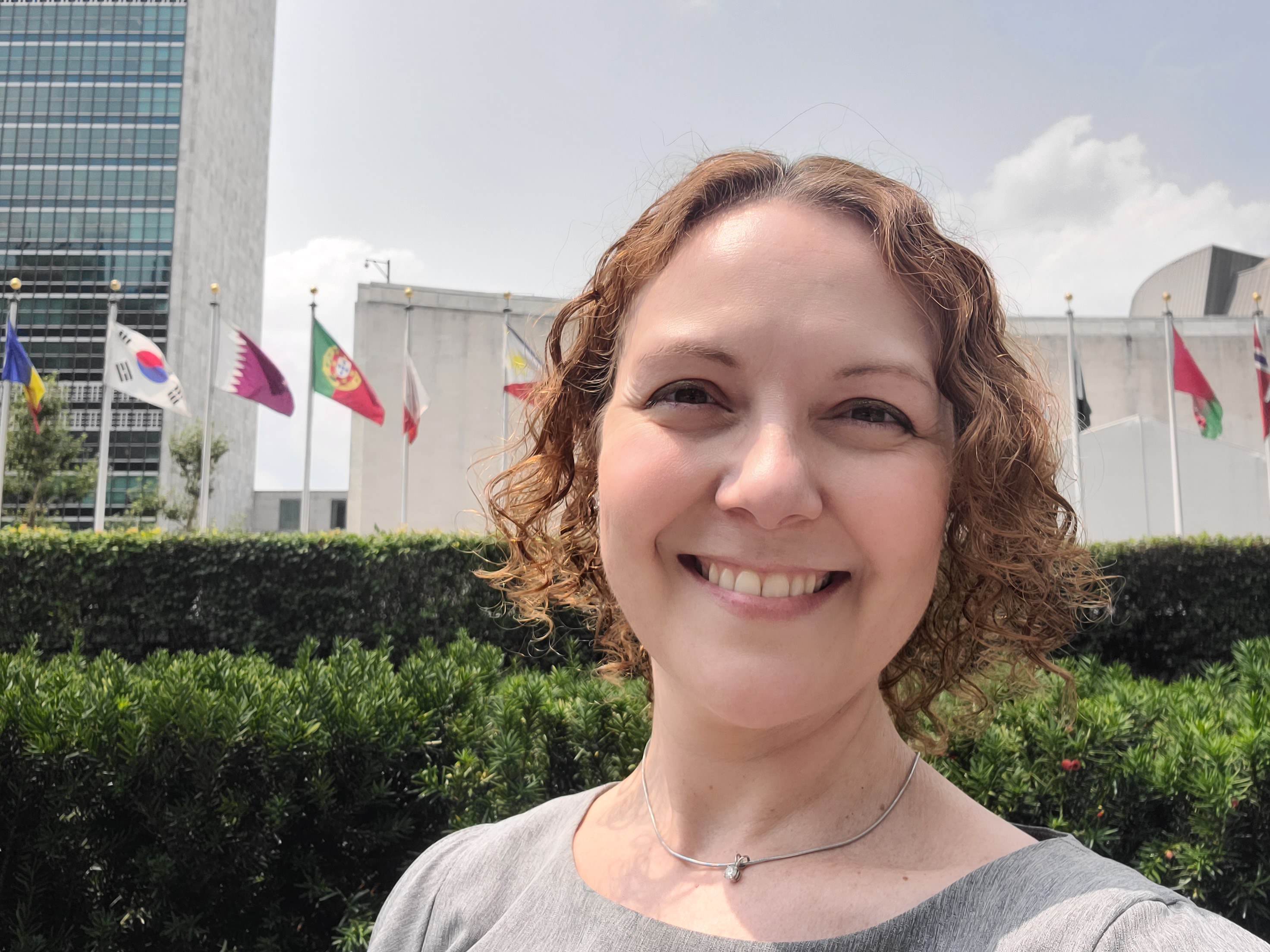
Today I’m at the United Nations for the inaugural Games and SDG (Sustainable Development Goals) Summit at the UN Headquarters, the kick-off to the 20th Games for Change Festival. I’m honored to be invited with industry professionals, government officials, and sustainable development experts, and look forward to all of the incredible conversations, ideas, and ambitions that will flow through each and every person in the room. Together, we’re building the path to higher ground, and I can’t wait to see what we find.
The new NASA global data set combines historical measurements with data from climate simulations using the best available computer models to provide forecasts of how global temperature (shown here) and precipitation might change up to the year 2100 under different greenhouse gas emissions scenarios. Credits: NASA
Over the weekend, I read a disturbing article that quoted a potential presidential candidate who wrote, “We will keep fighting until we put a stop to ESG once and for all!”
ESG stands for Environmental, Social, and Governance and is a set of investment standards for a company’s behaviors. In other words, it’s a set of standards that takes more than profit into account. It was coined by the United Nations in 2005. Originially, the acronym was GES because they believed Governance was the most important of the three. They weren’t wrong then. They aren’t wrong now. They just didn’t know at the time the dire state of our environment in 2023.
The quote above is so incredibly dangerous because if the United States completely gives up on the environment now, catastrophe is certain. Even if we went to net zero today, there’s still no way to keep global warming below 2 degrees Celsius. Above 2 degrees, we will see more intensified storms, extreme heatwaves, dangerous flooding, drought, and fire conditions, crop failures, sea level rise, deathly disease increases, and massive loss of biodiversity in flora and fauna.
To be fair, many parts of the world are already seeing impacts. Whole towns such as Newtok, Alaska moved to avoid climate impacts. Tuvalu, the Pacific island country of 12,000 people halfway between Hawaii and Australia, announced at COP27 its plans to become the world’s first digital country in hopes to preserve its history and heritage. 40% of its capital district is underwater during high tide. Eventually, it will be completely lost to rising seas. The Colorado River, Lake Mead, the Great Salt Lake, and the Mississippi River are rapidly shrinking.
But, climate has always changed. It’s changed many times before in the history of the planet. So why does this chapter of climate change matter? The last time CO2 was as high as it is now was 3 million years ago. Modern humans didn’t exist then. The rapid rate change of CO2 we’ve seen in the last 100 years because of human activity, particularly the burning of fossil fuels, has never happened before in the history of the planet. And it’s that rate that is the key point.
Yes, the planet can adjust to changes. But it can’t adjust this much this quickly. If you lost $1 a month in income, you could adjust and manage for a certain amount of time. If you lost $100 a month, that would require a much bigger adjustment in your budget. If you lost $1000 a month, that would require an enormous adjustment and you may find yourself in serious trouble with basic needs because of that rate of change. The planet is under this same type of pressure.
So why bother doing anything? If we’re on the deck of the climate Titanic, should we just play on? No. Not by a long shot. For every fraction of a degree we can curtail warming, we will see impacts lessened, human lives saved, and species protected from extinction. It’s going to be a difficult ride toward a fully sustainable world, and if we commit to protecting each other, we will eventually get there. It will be painful, expensive, and massively inconvenient to say the least, but not impossible for humans to survive. But life will look different, very different, for centuries.
None of us will be here to see a fully sustainable world, but we all have a responsibility to future generations. Consider how much better off we’d be today if 100 years ago strong governance cared about the environment as much as they cared about money during the Industrial Revolution. Our world would be healthier, cleaner, happier, and more peaceful. It could be that way for future generations if we, and our governments, do the difficult work now of restoring and regenerating the health of our planet. That could be our legacy. We could be known as the generation who saved human life, and the lives of the species with whom we share this planet. Imagine that. That’s our collective goal.
No matter on which side of the aisle you sit, can we all agree that health and happiness are what we all want? Don’t we want clean air, water, and soil? Plentiful healthy food and fresh water? Can we start to talk about ESG not as this divisive, political policy as framed in the quote above but as a means of kindness, care, and concern for all? If that’s woke, then please let’s not allow ourselves to turn a blind eye and go back to sleep. Our survival depends upon our eyes and hearts being wide open.
My friend, Ashley, in NYC. Photo by Christa Avampato.
Yesterday we witnessed a horrific historic moment in the U.S. A majority of the SCOTUS decided guns and zygotes have more rights than women.
We lose 68,000 women every year to abortions that have been forced underground for those who have no access to safe clinics and hospitals.
My friend, Ashley, dressed as a handmaid for the protests at Washington Square Park and Union Square here in New York City. People were amused. They shouldn’t be. This is not a joke. This is not a drill.
Thousands of people flooded New York City’s streets to demand justice for women. My friend Kelly and I were both proud and devastated to stand shoulder-to-shoulder with our neighbors.
We are now at the point of revolution. We must be. This attack on women cannot stand. Not now. Not ever. We will be as relentless as those who mean to send us back into the shadows.
This is not the end. This is The Rising.
Scenes from the New York City protests on June 24, 2022. All photos taken by Christa Avampato.
I’m so excited to share that I reached one of my big writing goals for 2019: I wrote and published two pieces about biomimicry for a science publication. I’m so grateful to The Biomimicry Institute for reaching out to me and asking me to write for them. My two pieces about biomimicry’s pivotal role in the Green New Deal (a set of policies to protect the health of our planet) and the Blue New Deal (a subset of Green New Deal policies that focuses on the health of our oceans) are now live. You can read them at the links below. I’d love to know what you think!
Yesterday I took the best trip to the grocery store I’ve ever taken because I had the opportunity to buy groceries for Keith Polite, a man impacted by the government shutdown. He’s been a security guard at one of the Smithsonian museums here in New York City for 4 years, and the museum is closed until the government reopens. Because he’s a contractor, he won’t receive any back pay. I heard about his story through the local CBS broadcast, and decided I had to help. Another viewer also helped and was able to meet with Keith about a possible job opportunity. I’m really hoping that works out for him.
I hope this one small act inspires all of us to help one another during this difficult time. There’s so much we can do right where we are for the people around us. We’re all walking each other home. Here’s the news piece that ran about Keith if you’d like to see it:







 Christa Avampato