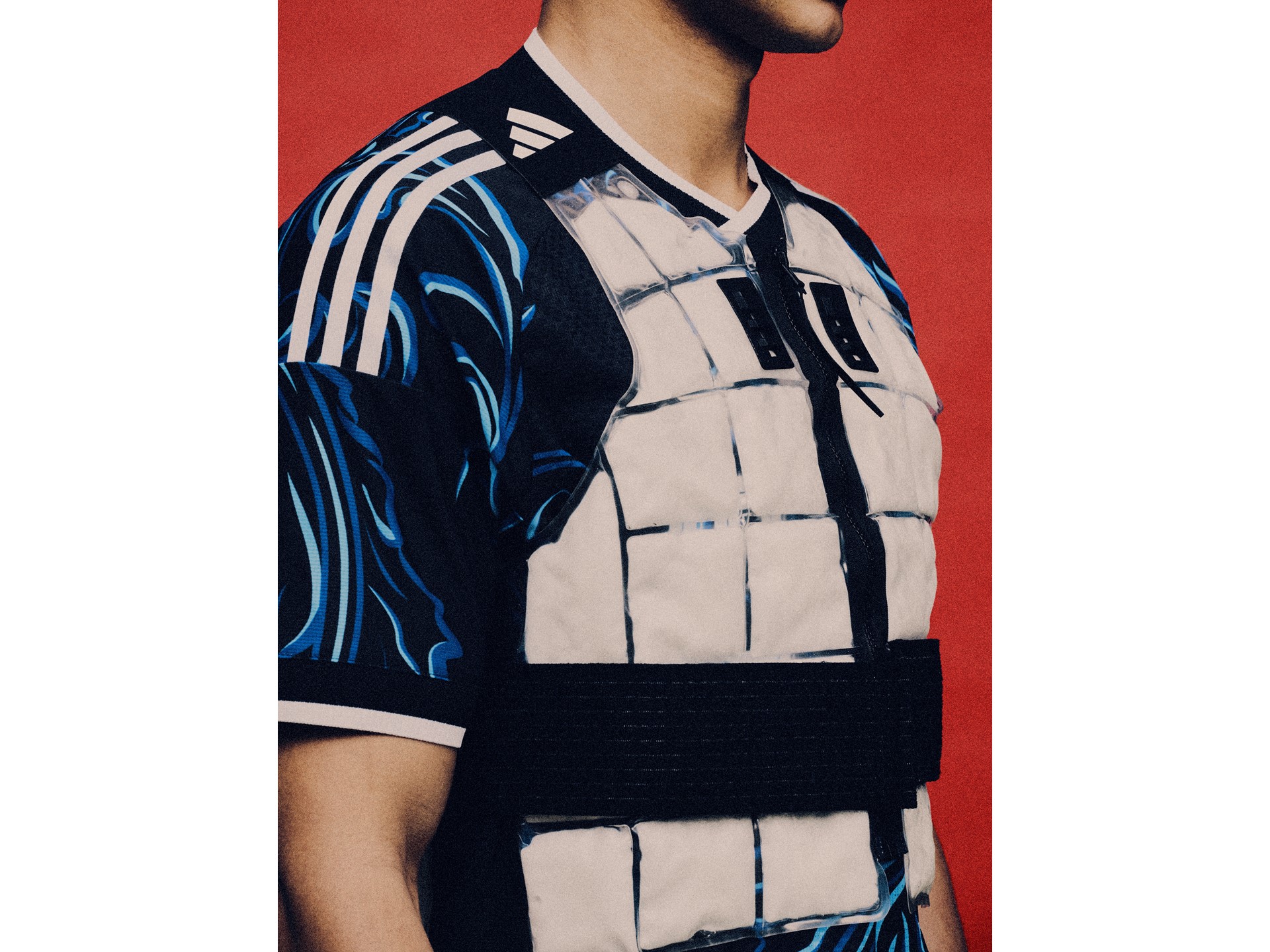
If you’ve been following the World Cup matches over the last few weeks, you’ve witnessed some of the most intense athleticism on the planet. To win, teams aren’t just strategizing against their opponents—they’re actively managing nature’s wrath. A brutal summer heatwave has blanketed the host cities, pushing the physical limits of human performance to a dangerous breaking point.
To keep players from overheating, teams turned to outer space engineering. As reported by The Athletic, players are donning specialized cooling vests and silver space jackets during warm-ups and half-time breaks, using materials originally designed to keep astronauts safe in hostile conditions.
It’s a brilliant feat of adaptation. As we watch multi-million-dollar athletes use aerospace technology to perform at the top of their game, it begs the question: will all of us eventually need this kind of adaptation to survive on a warming planet?
The Illusion of the Tech Fix
There’s a dangerous comfort in high-tech climate solutions. When we see space-age cooling gear or air-conditioned stadium hubs, it’s easy to fall into the trap of believing that human ingenuity will always engineer a way out of a crisis. We tell ourselves that as the planet warms, we’ll just adapt our way through it.
But this World Cup is exposing the deep inequality of technological adaptation. We can build specialized, high-conductive cooling gear for elite athletes, but we can’t wrap a space jacket around the construction workers building the stadiums, the transit staff moving the crowds, and the local communities whose power grids are strained to the limit by the surrounding infrastructure. In my own Brooklyn neighborhood, ConEd has to reduce everyone’s voltage to avoid a blackout for several days. If you aren’t a million-dollar-athlete (and I’m certainly not!), then you’re asked to adapt in a way where you give up something that provides comfort. In many parts of the world, air conditioning doesn’t exist at all. What becomes of them when the heatwaves are the summer norm, not an anomaly for a few days?
When Adaptation Hits a Hard Wall
This is the exact tension at the heart of our ongoing climate choice. Adaptations like cooling vests are vital for immediate safety, but they are a backstop for a privileged few, not a solution. When open-air stadiums face temperatures that FIFA deems unsafe for play, we aren’t looking at a management challenge—we’re looking at a systemic failure that’s much bigger than FIFA.
If we rely entirely on tech patches to shield us from a changing climate, we’re choosing a path of continuous, exhausting defense. Real progress happens when the friction of these extreme events forces us to move past temporary fixes and start investing in systemic mitigation—greening our local grids with renewables, restructuring our public spaces with natural shade from trees and vegetation, and designing infrastructure that works within the planet’s boundaries rather than trying to out-engineer them. We’ll never beat nature in the long game. We can’t burn down (or overheat) our home and expect to be able to live in it. That goes for our built homes as well as the planet we share with every other living being.
The Togetherhood Takeaway
Resilience means recognizing the difference between a temporary shield and long-term safety.
- Audit Your Local Shields: Think about the adaptations you rely on during a heatwave: your home’s AC, the food and drink you consume, neighborhood cooling centers (our public libraries in New York stayed open despite the 4th of July holiday to give people a cool place to go), the clothing you wear, etc. Are these available and sustainable for your entire community over the next decade, or are they temporary fixes? What will you do if summer temps over 100 degrees become the norm, when heatwaves are simply just how summer goes?
- Look for the Living Infrastructure, and Advocate for its Expansion: Tech is great, but nature is often a more effective, efficient, and less expensive cooling mechanism. Support local initiatives that plant urban tree canopies, install green roofs, and create public shade structures that cool entire neighborhoods and cities, not just individuals.
- Advocate for the Whole Team: True community agency means ensuring that climate protections apply to everyone, not just you and your household. When local labor advocates push for mandatory heat-safety standards for outdoor workers, back them up. Survival and comfort shouldn’t require elite status.
We can’t out-engineer a warming planet with silver jackets alone (though they are arguably cool in more ways than one!) Our collective and individual future depends on our willingness to cool the planet we all share.