television, writer, writing

Step 354: Matthew Weiner, Creator of Mad Men, Gets Nostalgic at 92Y

“I spent my entire complaining that no one ever listens to me and now look what happened. I can’t believe I’ve gotten to have this experience. I say this at every talk I ever give and no one ever prints it: Thank you, thank you, thank you so much for caring this story.” ~ Matthew Weiner, Creator of Mad Men, at the 92Y on Thursday, December 16th

I went to the 92Y on Thursday night to hear Matthew Weiner speak. I’m an enormous Mad Men fan because I love the intensity of the writing and how true he is to the time period. I left the talk loving Matthew Weiner as an inspirational writer who believed so much in the power of good content and in his Mad Men concept. He used the pilot script for years as a writing sample, his calling card, to get writing jobs. When he began to seriously shop it around after finishing his time as a writer for The Sopranos, HBO turned it down.

Weiner talked a lot about nostalgia, “the pain from an old wound”, and its place in the lives of the characters and fans. “In the 1960’s, being an intellectual was in style,” he said. “Advertising used to be a dead-end, a haven for creative people with lofty aspirations.” Now advertising, in its traditional sense, has fallen out of favor as viral and social media mechanisms have become more effective and efficient. The men of Madison Avenue must shake their heads and wonder how their world changed to drastically. “I’m writing a story that everyone knows the ending to,” Weiner stated. “It’s really a recipe for disaster.” And still, we watch. The power of nostalgia, of the desire to know and understand a time so different from ours and yet not that far into our past.

The concept of “The Other” also dominated quite a bit of airtime at 92Y. Weiner is fascinated by the concept of a foreigner, an outsider, someone who doesn’t belong. These Others are the truth-sayers, the mirrors for the rest of us who try so hard to push away any story that doesn’t fit our own narrative. The Other, in life and in good storytelling, has the ability to expose injustice and get at the reality underneath> They foreshadow what’s to come, just around the corner, no matter how much we deny the impending events. So long as The Other stands with us, we are forced to face the music, to recognize that life as we know it will never be the same. The Others are what cause heroes to rise up and villains to fall, eventually.

I loved Weiner’s raw honesty on stage. he was fully and unapologetically himself, neuroses and all on display. He didn’t put on airs. He didn’t try to be someone he’s not. He didn’t hide or dodge a single question or comment. His emotions and responses were authentic and genuine. Success seems to have had little effect on him except to shock and surprise him. He’s at once enormously proud of the work and pinching himself to make sure this is all real. He’s the kind of writer that should serve as an inspiration for anyone trying to make it in the world with this demanding craft. “If you push stories away, they’ll destroy you.” Better to tell the tales we have as fairly as possible, take whatever praise or lashings they garner, and keep going. It’s the only way to both persevere into our futures and preserve the pasts we come from.

goals, meditation, writing, yoga

Step 324: Find New Pathways

“I like to think of meditation methods as portals, entry points into the spaciousness that underlies the mind.” ~ Swami Durgananda (Sally Kempton)

As I prepare my plans for 2011, I’m focusing a lot of my energy on the how, or in other words, the doors to my dreams as opposed to the dreams themselves. This passage by Swami Durgananda made me look at my goals in a new way. There are a lot of paths to a dream, and I’m not sure that the path is as critical as I’ve made it out to be.

The analogy of meditation is helpful to me. When I first started meditating as part of my yoga teacher training, I was so focused on the process. Do I leave my eyes open or do I close them? Do I sit, lie down, or walk? Can I listen to music? Should I do pranayama first? After a few months, I found what worked for me – I sit in a comfortable seat, I close my eyes, bring my hands to heart center, and count my breaths. I stopped trying to memorize complex processes because I realized my focus was just to relax and release.

My goal with my yoga classes isn’t to pack the house and make money; it’s to show people what an incredible effect yoga can have on their lives. I don’t write for money or to get tons of clicks, page views, and comments. I write to share my experiences and inspire other people to live fully, and even if I do that for just one person, that’s enough for me. My life isn’t about doing more good in this world than everyone else; it’s about doing as much good as I can possibly do with the resources I have.

When we’re facing roadblocks along our path, it’s easy to get hung up on breaking through. Swami Durgananda has some advice for us on this front: “In approaching the Self, it helps to have a doorway we can comfortably walk through, rather than having to break through the wall of thoughts separating us from our inner space.” It’s not the goal that’s the problem; it’s the approach. Where we begin has very little do with where we end up; what matters more is that we keep trying. So when one road to a dream seems too difficult, there’s no need to let it die on the vine. Just look for another way forward.

The image above can be found here.

writing

I’m featured today on ZENyc

My friend, Amanda, write ZENyc, a blog that’s both beautiful and helpful to New Yorkers looking for a little more peace in their hectic lives. This morning I have a post featured on ZENyc about the joys of being a beginner. Check it out here.

career, work, writing

Step 296: 3 Things to Keep in Mind for Your Year-end Performance Review

“Let your manners speak, your deeds prove, and your delivery impress.” ~ Yogi Tea

Cue the music! “It’s about that time of, time of the year again…” Nope, not the holidays just yet. Performance reviews, one of my work requirements that I dread the most. I always fantasize about not following the company format but instead writing some pithy essay about why I don’t think performance reviews work. I was completing my self-evaluation on Friday, and in a moment of frustration at how long it was taking, I went to make a cup of tea.

The quote above was on the tag of my teabag. Yoga has taught me that the world often hands us the teaching we need exactly when we need it. I needed to hear this message today. I went back to my computer with a little bit of renewed energy. Maybe I don’t need to see these reviews as arduous and pointless. It is an opportunity to reflect on the year nearly behind us and to look ahead at how I’d like 2011 to take shape.

Given my recent introspective mood, it’s fitting to have this task on my to-do list now. Clearly, if the world is handing it to me, along with a bit of encouragement and advice via my tea, I must need what it has to teach me.

learning, mentor, teaching, writing

Step 289: 5 Ways to Effectively Use Our Windows of Wisdom

?What If! Innovation is one of my favorite innovation firms. They have a resource they use to get at key insights called “WOWs”, short for “Windows of Wisdom”. Everyone has them. Pieces of experience, knowledge, and expertise that give us special insights into how things work, or how they should work. They help us build empathy and compassion for specific circumstances. Being a parent, having a pet, living in a certain city, how we commute to work, what we do all day to earn a living, what we read, watch on TV, and hobbies we take up in our free time. It all matters – who we are is largely determined by how and with whom we spend our time.

Never underestimate WOWs, yours or anyone else’s. Insight is an elusive, odd beast that shows up in the strangest ways at the strangest times. Our WOWs are handy little assets to always keep in our back pockets. They help us recognize opportunities, and can be used for the greater good. Be generous with them – share what you know.

Here are 5 ways to put your WOWs to work:

1.) Crowding sourcing databases. A quick Google search will provide a myriad of agencies that now list crowd sourcing as an expertise and they need communities of people to be their experts. Their business depends on it. So get out there, join some of them, get compensated (in a variety of ways), and put your experience to work.

2.) Mentor or teach. Young people need our stories and example, now more than ever. Mentoring and teaching is the ultimate gift we can give because it involves generously sharing our own history. Check out sites like Takepart.com or Volunteermatch.org to find mentoring opportunities near you.

3.) Write. Writing in any form is helpful to connect us to others, to inspire, and to learn. Blog, comment on blogs, write a column or an op-ed, get involved in online communities of people with common interests. Put your thoughts out there generously and you’ll be surprised by the goodness you get in return.

4.) Create partnerships. Think of networking as finding like-minded partners. Write letters to people you admire – that’s how I wrote my column for Examiner that ultimately became my e-book, Hope in Progress. Online communities and Twitter are other great places to find potential partners who are as passionate as you are about your interests.

5.) Start a side business. Your key insights can be leveraged creatively to generate extra income. My interest in yoga led me to pursue my 200-hour RYT training and my creation of Compass Yoga. My interest in the art of writing led to my freelance writing work. Your hobbies can help you do well and do good at the same time when you share them with the world.

How have you put your experience to work for you?

creativity, determination, inspiration, writing, yoga

Step 283: Meeting Inspiration

“When inspiration does not come to go me, I go halfway to meet it.” ~ Sigmund Freud

Twyla Tharp quotes Freud in her book The Creative Habit. I read this book about two years ago and worked through the exercises faithfully. I flipped through it again last weekend, reading about my creative journey through the eyes of my 32-year old self.

Two years ago, I wanted to find more outlets for my writing. That’s happened to an even greater extent than I imagined, though not by accident, or hoping for that good fortune to find me. I had to go out there, dig it up, and then persist, persist, persist. I had to risk rejection and all that comes with it in the hopes that there would be some breaks here and there.

I followed a lot of leads to a very dead end, and considered just throwing in the towel. “Maybe the world doesn’t need my voice,” I thought more times than I’ll ever admit. And then here and there I got a bit of encouragement, which helped me to keep trudging out there again for more inspiration and more leads. Creativity, writing, hope, inspiration – they are all more easily cultivated with practice.

This has been true of my yoga teaching as well. I tried lots of avenues to get regular gigs, but the work didn’t come pouring in as I had hoped. This was going to harder than I thought. Stubbornness can pay off. It keeps us reaching up, even when the world seems to be pushing us down. On occasion, good luck shows up on our doorstep, but more often it’s up to us to get out there and discover it. Recognizing luck in all its disguises requires preparedness. Eventually a few things broke and now I teach at NY Methodist Hospital and Columbia Law School, with a possible third regular gig on the way. (More info to come if that pans out.)

I used to think of inspiration as a thunderbolt that reaches me at my dining table in front of this laptop. Sometimes that does happen, but more often it’s sparked by something I’ve witnessed or done outside these safe haven walls of my home. Being out in the world more by walking Phineas, my pup, has helped me see the gifts that lie just around the corner, literally. So now when I find that inspiration just isn’t flowing, I don’t get frustrated. I just pick myself up out my my chair, and go get it.

choices, decision-making, literature, mentor, writer, writing

Step 236: Mentor: A Memoir

I went to The Half King (one of the last great New York literary bars) last night to hear the author Tom Grimes talk about his new book Mentor: A Memoir. The book discusses Grime’s relationship with Frank Conroy, his mentor and friend whom he met at the Iowa Writer’s Workshop when Grimes was a graduate student at Iowa. Grimes explained how the book came about from a magazine assignment gone wrong. An editor had asked him to write a piece on Conroy’s work and instead the piece morphed into an exploration of Grime’s mentor relationship with Conroy. While not what the magazine editor asked for, the editor encouraged him to keep going and 8 months later Grimes had a book he never intended to write.

Exceedingly gracious and humble, Grimes also read a passage from the book from his early writing career when he waited tables at a small restaurant in Key West, Florida. He had a several second encounter with Conroy when Conroy spoke on a panel about writing in Key West. Conroy brushed him aside as just another would-be writer wanting admission into Iowa. Because of his rude behavior, Grimes wrote him off until Conroy called him to offer admission and a scholarship to Iowa after Conroy read his application and sample manuscript.

Throughout the talk, Grimes offered advice and encouragement to the audience about publishing, the craft of writing, the struggles that every writer faces in finding their own voice. The advice that sticks with me the most is his most simple and straight-forward: don’t let other people talk you into giving up; only give up when you think you should. It’s good advice for anyone who’s doing something they’re passionate about – their art, a business idea, an education, a community project, even a relationship.

There will also be naysayers, and sometimes those naysayers will be people close to us who care about us and our future. They will tell us how to spend our time, what skills to work on, where to live, go to school, and whom to be with. Ultimately, the only opinion about our lives that really matters is ours because we’re the ones we have to wake up with everyday, no matter what. If you can’t live with yourself and your choices, then it really doesn’t matter if anyone else can. You only get one crack at being you – make sure it’s done on your terms.

The Half King has a great slate of events that happen every Monday night. Check out the schedule and sign up for their email at http://www.thehalfking.com/

writing

My Latest Piece in Technolawyer: A Former Attorney Finds His Calling as a Therapist

My latest piece for Technolawyer profiles Will Meyerhofer, an exceedingly good-hearted attorney turned therapist. I had a wonderful time interviewing him and it was almost as therapeutic as a session with my own coach, Brian. I think they may be spiritual twins. Check out the piece here.

The most intriguing part of Will’s therapy practice is that he operates on a total sliding scale. His clients tell him what they can pay, and that’s the rate they pay. It takes guts to operate a business model like that, particularly in these economic times. Dubbed “The People’s Therapist”, he’s changing the world, one mind, one life at a time. You can learn more about Will be visiting his website and blog.

Above is a picture of Will that he sent to me while he was on vacation in Vermont.

failure, rejection, writer, writing

Step 227: Rejection is a Part of the Writing Life

I used to keep a file of rejection letters from companies where I applied for jobs. I may have them buried in a sealed box somewhere on the top shelf of my closet. I hope so – some day I want to make sure to go back and read them. Most of them were probably right to reject me. And those rejections didn’t get me down; they just made me work harder and that probably warrants a thank you note to each of them.

As a freelance writer, rejection is part of the path. In the end, I know I’m a better writer for all of the rejections I’ve received (and there have been many.) There’s no getting away from the occasional (or common) ding. A few days ago I received the latest in a long line, though I must admit it did have some interesting insights and a compliment thrown in at the end. It is in response to a piece I wrote on my recent jury duty service where I believe that the defendant was a victim of racial profiling, landing him with an unjust prison sentence. What strikes me as sad about the rejection letter is that the injustice that I discussed in the essay would be considered commonplace (and therefore acceptable) by anyone, most of all an editor of a highly respected publication.

I will post the essay on this blog as tomorrow’s entry because I think it deserves as wide a reach of audience as I can get for it, not for my sake but for the sake of the defendant in the trial. In the mean time, here’s the magazine editor’s response to my submission.

“Christa,

Thanks for the submission. I’m afraid this isn’t a good fit for us, though. Certainly an injustice seems to have occurred, and it seems sensible to lament it. But as lamentable as it is, the story here feels too commonplace to support an essay. That our codes of law have areas of absurdity, and that minority citizens are more vulnerable than privileged ones, are widely recognized facts. The case of Mr. Bond illustrates those facts, but an essay must do more than that to be compelling — whether by means of a counter-intuitive twist, an eccentric voice, or some other mechanism that either delivers us to a destination that’s different than we might have expected, or gets us there by an unexpected route.

You write well and clearly, and I would be more than happy to consider other submissions from you. I just don’t think this is the one for us.

Cordially…”

schedule, time, writing

Step 188: Routines and Rituals

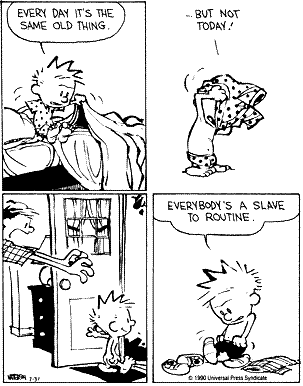
For most of my life, I have fought routine. I thought routine would make me boring. I thought routines were a waste of time and lacked creativity. That changed when I started writing every day about 3 years ago. I’ve liked writing stories since I was a little kid, but I never really made a routine out of it. I just wrote when the inspiration hit me.

Later in life, I realized that practice makes better. Even with natural talent, practice is a necessity for mastery. And I wanted to be a master writer, so I set myself on the path to writing every day no matter how tired or uninspired I felt. I went to the screen or the notebook, and recorded some thought. Like a physical muscle, my writing chops improved considerably. I look back at some of my early blog posts and laugh at how bad they were. I think this is healthy – laughter and the realization that practice does indeed help.

I noticed a marked change in my writing about two years ago. I could write more quickly and with greater clarity. My mind started making connections and developing deeper insights. My readership started growing too, because I was promoting my writing and also because my content improved considerably with daily practice. My writing routine crossed the line into ritual, becoming not a chore, but a pleasure I looked forward to. And writing made my life easier because it helped me make sense of even the most complicated, messy situations.

This morning on my way to work, I began to consider other routines that I could develop into rituals with more practice. I’ve started taking a nicer route to my office. I meditate every day. I do at least 10 minutes of yoga every day, even if that means just a few sun salutations or seated postures. I love to watch CBS Sunday morning with my coffee and the paper. I’m thinking of finally getting a dog in New York, and that care will develop a routine of its own.

Routine isn’t the boring, tired-out activity I once saw it as. It’s what gives our lives purpose and focus and very often, peace.

Do you have routines that have become rituals, or are you starting some new routines in your life? I’d love to hear about them!

I found the above cartoon here.