death, environment, family, home, love, nature

My Year of Hopefulness – Love is all around us

Yesterday my friend, Ken, called me with an incredible story that’s too good to keep to myself. Last Fall he lost his mom to a terminal respiratory disease that she had managed for a number of years. Ken was very close to his mom and he’s a rough go of it for the past 6 months. One of his friends gave him a gift certificate to a nearby greenhouse and nursery so he could buy a tree in honor of his mom to plant in his yard.

When Ken was a teenager, Evita had just opened on Broadway and the song “Don’t Cry for Me Argentina” was the mot popular song around. Ken’s mom used to crack herself up by changing up the words to “Don’t cry for me Sargent Tina…” She’d sing that all the time, making everyone around her laugh.

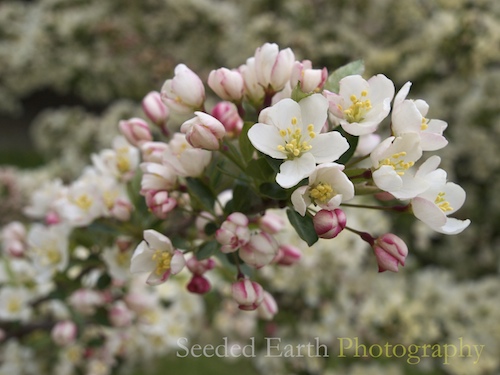
Ken was at the nursery yesterday with a friend, choosing a tree to honor his mom. They were specifically looking for a crabapple tree because of their beautiful flowers and found one they really liked. Variety: the Sargent Tina Crabapple. Maybe a coincidence…

Ken and his friend, Linda, get back to Ken’s house and plant the tree in the yard. They place the last shovelful of dirt around the tree and head back inside the house. Just as they get into the house, the song Hold Me Kiss Me Thrill Me was on the radio. That song was the only song Ken’s mother requested for her memorial service when she and Ken were choosing the music while his mom was in hospice. Coincidence, I think not…

Losing people is hard, though experiences like Ken’s remind me that we don’t ever lose the ones we love. They just cross over, and they’ll be there when we cross over, too. We’ll be with them again, and while it’s hard to accept that they don’t exist in the form in which we knew them and loved them, their love is still very much a part of our lives, always. Their love is truly all around us.

The photo above depicts the blossoms of a Sargent Tina Crabapple and is from http://farm3.static.flickr.com/2072/3534629428_bef4ba6e37.jpg?v=0.

entrepreneurship, environment, Examiner, green, New York City

NY Business Strategies Examiner.com: Interview with Gennaro Brooks-Church, Founder of Eco Brooklyn

As I was searching online for interesting Green entrepreneurs, I stumbled upon the site for Eco Brooklyn, a company devoted to educating and helping the New York community build greener co-ops and Brownstones. Eco Brooklyn is a social enterprise not just for its Green philosophy; they also make Green building education courses part of their core value proposition.

I had the opportunity to interview Gennaro Brooks-Church, founder of Eco Brooklyn. His inspirational story is one that illustrates that many times entrepreneurship chooses the entrepreneur rather than the other way around! In addition to the interview, there is also a slide show attached that shows Eco Brooklyn‘s work.

To read the full interview, please visit: http://www.examiner.com/examiner/x-2901-NY-Business-Strategies-Examiner~y2009m6d30-Interview-with-Gennaro-BrooksChurch-Founder-of-Eco-Brooklyn

business, career, economy, environment, nature

NY Business Strategies Examiner.com: A look at Adam Werbach’s book, Strategy for Sustainability

Adam Werbach wrote a short piece for this month’s issue of Fast Company. In the article he outlines nature’s ten simple rules for survival. They apply not only to nature, but companies as well. I’ve listed the principles below and added some commentary on how each applies to our day-to-day working lives, specifically focusing on entrepreneurship.

To read the full article, please visit: http://www.examiner.com/examiner/x-2901-NY-Business-Strategies-Examiner~y2009m6d30-Natures-10-simple-rules-for-survival–a-look-at-Adam-Werbachs-Strategy-for-Sustainability

choices, decision-making, environment, family, future, garden, nature, time

My Year of Hopefulness – Stay on Path

At the Brooklyn Botanic Garden yesterday, Mom and I kept seeing these small wooden signs that said simply “Please Stay on Path”. As we talked about my life and career, we considered what my path might be and how I can shape it to encompass all of my interests and passions. We thought about all the different ways that we get distracted, what causes us to lose focus, and how we can regain our bearings.

Staying on path at the garden is much easier than it is in life. It’s easy to lose direction, to veer off our course, some times without even realizing exactly how it happened. Some opportunity seemed like something we wanted to follow or we had an experience that made us consider a different way forward. Sometimes these side trips are life changing for the better and sometimes our interest in these new pursuit fades as quickly as it appeared.

And then there’s the question of flexibility. We get new information all of the time and we want to make sure that we have enough flexibility to incorporate the relevant info into our plans. Think of it like our bones. We want our bodies to be flexible, though the strength of our bone structure makes all of our activities possible. Without the rigidity of our bones, we’d never go anywhere! A life road map provides the same kind support.

I’ve found very often that I make much better life choices when I am running toward something and not away from something. It’s the difference between looking forward and looking back, and making choices depending upon which of these actions has more say in our decisions. I like a good balance of both. I want to be informed by my past and not ruled by it. I want to be hopeful and excited about my future without sacrificing the wonderful things about the present.

There’s nothing that says a path has to be a straight shot. Mom and I wound through the Brooklyn Botanic Garden, explored the different routes, and trusted in a healthy dose of meandering. Our map helped to make sure that we didn’t miss things we really wanted to see and that we headed only down roads that interested us. We had our priorities of what we wanted to see, things that would be fun if we had time, and things that we’d prefer to skip. And we took time to smell the flowers along the way. We enjoyed being surprised by things around the bend. We let our senses guide us on some adventures to things we had missed on the map. It’s a beautiful metaphor for how to live life.

business, environment, nature

My Year of Hopefulness – What Honeybees Teach Us About Business

In this current economy, the key is flexibility. Easier said than done, so I have gone looking for examples of successful work flexibility beyond the borders of business school books and analyst reports. My favorite find so far was in today’s New York Times in the Opinion column “The Wild Side” about evolutionary biology. The guest columnist, Leon Kreitzman, wrote “Let’s Hear it for the Bees”, about the remarkable career example that honeybees set for us.

The whole article is a fascinating read. Here are the key points I found most relative to business:

1.) Do the work that needs to be done. Honeybees have an amazing sense to know when a task needs attendance and when a task would be wasted effort. Their sense of efficiency and innate to ability to always make themselves useful is enviable.

2.) Different stages of life call for different types of work. While very young, honeybees care for eggs while older honeybees with be charged to forage for nectar and pollen. And if need be, they’ll flip back to tasks they have done before. It’s a good lesson in gathering knowledge from the ground up so that it can be called upon when necessary. They don’t get stuck seeing themselves in specific roles. Their jobs evolve as they gain experience.

3.) Communication and generosity are keys to a healthy hive. Honeybees are in constant communication with one another. Foragers let each other know where they’ve found strong supplies of nectar and pollen. They assist one another in a way that brings the saying “many hands make light work” to life. They don’t build fiefdoms or silos – they work for the benefit of the hive as a whole.

4.) Awareness of our surroundings and external circumstances inform the actions of our lives. Foraging bees only visit flowers when nectar and pollen counts are at their highest. They do this by synchronizing their internal clocks with a daily floral rhythms of flowers they’ve visited. This assures that their trips to the flowers are as beneficial as possible, and that they spend other times of their day on more useful activities.

We spend a lot of time buried in paper work at our desks. There is currently a lack of inspiration around the gray cubicles of America. I’ve been finding that I garner the most motivation by looking outside of business, into areas like science, health, and art. There are teachers and sources of education all around us if only we take the time to look and appreciate the knowledge they have to offer.

The above photo was taken by Kathy Keatley Garvey, University of California, Davis Department of Entomology

California, environment, hope, nature

My Year of Hopefulness – Monterey Bay Aquarium

I make a habit of visiting baseball parks and aquariums across the country. When I used to manage theatre tours, I would make a point of seeing as many stadiums and aquariums as I could in the different cities we traveled to. I have to say that Baltimore is tough to beat in both of those departments – I saw Shark Week at that aquarium and those hotdogs at Camden Yards are the best I’ve ever had.

Being in Northern California this weekend, I wanted to see the Monterey Bay Aquarium. I have heard about it since my fundraising days at Conservation International. Monterey – you’re no Baltimore or Atlanta, though I learned some fascinating things while I was there this morning. They had a few octopi that I were entrancing. Did you know that octopi change their color according to the color of the surface they are crawling or resting on? Incredible. In Boston, they had an octopus who was bored in his own tank, so he found a way to sneak out of his tank at night, when everyone had go home, and would make his way to the lobster, eat his fill, and then get back home before the first staff members arrive. They only way they caught him was by video camera.

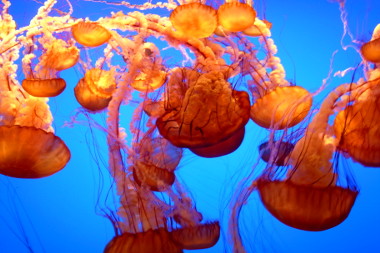
The jellyfish exhibit left me breathless. They had these gorgeous, bright orange jellyfish in front of a brilliant blue background. I could have stood there for hours to watch them float through their environment. It was a reminder to me that there are so many mysteries left in this world. There’s still so much more to explore, to see, and to know. We haven’t even scratched the surface – there are entire worlds underwater, canyons deeper and wider than the Grand Canyon, mountains taller than Everest. It is too much to fathom – we couldn’t possibly take it all in

70% of our planet is covered by water so if you ever feel life is too much for you to bear on dry land, I encourage you to go under the sea. Or at least get to your nearest aquarium. It will give you hope by showing you what’s possible.

The photo above can be found at: http://justinsomnia.org/images/monterey-aquarium-orange-jellyfish.jpg

books, environment, friendship, nature, yoga

My Year of Hopefulness – Winter Cocoons

My friend, Monika, was telling me about her recent spell of wanting to remain on her couch as much as possible. Though she likes the winter weather, this season she’s felt the need to hunker down and stay inside. I’ve been feeling the same way. It reminded of a story I like to read several times over the winter. It’s only one page, written by Nina Zolotow in Rodney Yee’s book, Yoga the Poetry of the Body.


Nina writes about her time in Ithaca, New York. Her neighbors had this incredible garden and the summer time lunches they would spread out in their backyard transported her to Tuscany. These lunches would always end with beautiful, fresh black figs from the neighbors’ garden. There was a massive fig tree in the middle the neighbors’ yard and she couldn’t understand how that tree would survive the rough upstate New York winters.

She finally got up the courage to ask her neighbor his secret. It’s very simple – after all the leaves have fallen, he severs the roots on one side of the tree, folds the flexible trunk down to the ground into a ditch he digs, and covers it with soil to rest, warm and safe, until Spring arrives. I think of this story all the time during the winter season.

Winter is a time of incubating, of resting and recouping, of letting ourselves get comfortable with peace. It’s a cycle. Monika’s cocooning really is a natural reaction, one we all should have. We burrow in to reflect on what’s happened to us in the more hectic Spring, Summer, and Fall. And we plan – for warmer days, for greeting friends when the sun comes out again, for reintroducing ourselves to the world when our surroundings take on that brilliant green hue again. 

For this next month or so of winter, I want to have that fig tree always in my mind. I want to imagine myself resting and regrouping, healing and soothing my tired soul, mind, and heart, gearing up for the best Spring of my life. 

The photo above can be found at here
art, environment, green, photographs, pictures

Picture of the Year


The Today Show recently ran a contest to determine the “picture of the year”. There were images of Obama, Michael Phelps, moving photos of conflicts around the world. But the theme that ultimately won out was nature. 3 of the top 5 photos chosen by viewers depicted acts of nature around the world, the top one being of a lightning storm over a volcano in Southern Chile. The photo is dramatic – so much so that you’d think it was doctored up or contrived. Rest assured, it is real and awe-inspiring. It was taken by photographer Carlos Gutierrez for the Patagonia Press. 


I think about the environment a lot, its beauty and power. I used to work for an environmental nonprofit and it is one of the main causes I donate to. I read extensively on the topic and am constantly working to lower my carbon footprint. I am certainly a green consumer and firmly believe that there are enormous public health implications if we do not do everything we can to protect our natural world. I am so pleased that Mr. Gutierrez’s photo won – it shows that I am not alone in being inspired by nature, not by a long-shot. Of all the photos that were taken in this historic year, nature reigned supreme in inspiring people around the world.
  
I hope 2009 will be the year when green energy and environmental conservation takes center stage – in this country as well as in other countries around the world. I hope we put policies and regulations in place that halt the rapid disappearance of species and habitat. I hope that more people will be willing to pay a bit more now for green products rather than pay dearly for the consequences of not protecting the environment in years to come. As a society, I’d like to see us protect and treasure life.

There is a song that John Denver sings on the Muppet Christmas album that is one of my favorites. It’s about a little tree named Alfie. At the end of the song, John communicates one small request from Alfie, and whenever I hear it I get a little bit choked up. It bears repeating. “You see life is a very special kind of thing. And not just for a chosen few, but for every living, breathing thing, not just me and you. So in your Christmas prayers this year, Alfie asked me if I’d ask you to say a prayer for the wind, and the water, and the wood, and those who live there, too.” That’s a request I’m very happy to fill. 

books, environment, nature, New York City

A Change of Scene Without Moving

I am in the midst of reading the book Wild Nights by Anne Matthews. It’s about the world of New York City that emerges between dusk and dawn. Matthews isn’t talking about the party-hopping nightlife, but rather the natural world that emerges when the archipelago’s dominant species, people, largely take their leave. An underworld of song birds, wild animals like coyotes, bears, and deer emerge. 


I think of myself as a New York City expert – I know many of the neighborhoods like the back of my hand. I spend a lot of time walking around Manhattan Island, and unlike many Manhattan-ites I venture to the outer burroughs on a fairly regular basis. In such a small geography, I assumed I knew most of what’s out there in my city. This book is opening my eyes in a whole new way, and has me planning weekend outings to parts of the city I’ve never even heard of, much less seen. 

All this new discovery in this book has me thinking about how to change our scene without changing our location. How can we make our space brand new, even if we’ve been in that space for a long time. And the same can be said for the actual housing space we live in, our jobs, our relationships. It’s about developing a fresh set of eyes, a new perspective, finding new joy and gratitude in what’s been right in front of us all along. A pretty decent New Year’s resolution that we can all make, right 
animals, business, entrepreneurship, environment, nature, relationships, Seth Godin

Lessons from an albatross


Seth Godin wrote a post today on his blog that made me pause and re-consider some questions I’ve been thinking about recently. He talked about the patience of the albatross. It can often sit in the water or on land for days waiting for the right wind to carry it up, up, and away. It can fly for days or weeks, non-stop, with a resting heart rate. It’s an incredible lesson in biology, with many applications to our lives. 


Seth talks about Albatross businesses – those that favor a long, slow ramp-up with an eye toward longevity. He promotes patience as more than a virtue – it’s a method of survival. And this is a good lesson not only for business, particularly entrepreneurial ventures, but also anything that is worth our personal time. This can be a personal relationship, a friendship, a hobby. I am thinking about it in the context of my writing and career and I hope these thoughts will help you think about this principle in the context of your own life. 

My writing: I started this blog on a whim about a year and a half ago. My friend, Stephen, said he liked my writing and hoped I’d continue doing it. I knew nothing about social media at the time. He suggested a blog. I googled the words “create blog”, Blogger came up as the top search engine return (no surprise since Google owns Blogger), and I put up a few posts that were copies of the newspaper articles I had written over the course of a year. I didn’t know what else to write about so I’d just jot down funny or interesting things that would happen to me throughout the day. And pretty soon, I was cranking along with a decent body of work. Over 400 posts to date. Where am I going with my blog? Not quite sure yet – but goodness am I enjoying the writing and it’s become a hobby I hope to continue throughout my life. At my friend, Anne’s, suggestion I am consider turning some of the posts into a collection of essays for publication on a more public scale. Just like the albatross, I’m searching for the right air current to launch a project like that.

My career: I’m 32 and have spent the better part of 10 years intensely studying human behavior and product and service development. I’ve cobbled together this beautiful tapestry of experience with that experience I have found a many colorful characters that have become my greatest treasure. Their collective diversity is a reflection of the many twists and turns my life has taken. I review the expertise I’ve built and the successes I can point to and wonder what’s next? Where do I go from here? How do I know what current to look for?

Part of the albatross equation is knowing where you want the current to carry you so you can quickly identify it when it comes your way. Extending your wings is the easy part. The challenge, and ultimately the reward, comes when you have taken a 360 look around from wherever you are now and determined the direction you need to go. The albatross doesn’t concern itself with the length of trip, his wings will carry him as far as they need to. He cares only about the destination.