I tell wonder-filled stories about hope and healing
Author: Christa Avampato
The short of it:
Writer. Health, education, and art advocate. Theater and film producer. Visual artist. Product geek. Proud alumnae of the University of Pennsylvania (BA) and the Darden School of Business at the University of Virginia (MBA). Inspired by ancient wisdom & modern tech. Proliferator of goodness. Opener of doors. Friend to animals. Fan of creative work in all its wondrous forms. I use my business skills to create passion projects that build a better world. I’ve been called the happiest New Yorker, and I try hard to live up to that title every day.
The long of it:
My career has stretched across Capitol Hill, Broadway theatre, education, nonprofit fundraising, health and wellness, and Fortune 500 companies in retail, media, entertainment, technology, and financial services. I’ve been a product developer and product manager, theater manager, strategic consultant, marketer, voice over artist, , teacher, and fundraiser. I use my business and storytelling to support and sustain passion projects that build a better world. In every experience, I’ve used my sense of and respect for elegant design to develop meaningful products, services, programs, and events.
While building a business career, I also built a strong portfolio as a journalist, novelist, freelance writer, interviewer, presenter, and public speaker. My writing has appeared in The Washington Post, The Huffington Post, PBS.org, Boston.com, Royal Media Partners publications, and The Motley Fool on a wide range of topics including business, technology, science, health, education, culture, and lifestyle. I have also been an invited speaker at SXSW, Teach for America, Avon headquarters, Games for Change, NYU, Columbia University, Hunter College, and the Alzheimer’s Foundation of America. The first book in my young adult book series, Emerson Page and Where the Light Enters, was acquired by a publisher and launched in November 2017. I’m currently working on the second book in the series.
A recovering multi-tasker, I’m equally at home in front of my Mac, on my yoga mat, walking my rescue dog, Phineas, traveling with a purpose, or practicing the high-art of people watching. I also cut up small bits of paper and put them back together as a collage artist.
My company:
I’m bringing together all of my business and creative career paths as the Founder of Double or Nothing Media:
• I craft products, programs, and projects that make a difference;
• I build the business plans that make what I craft financially sustainable;
• I tell the stories that matter about the people, places, and products that inspire me.
Follow my adventures on Twitter at https://twitter.com/christanyc and Instagram at https://instagram.com/christarosenyc.
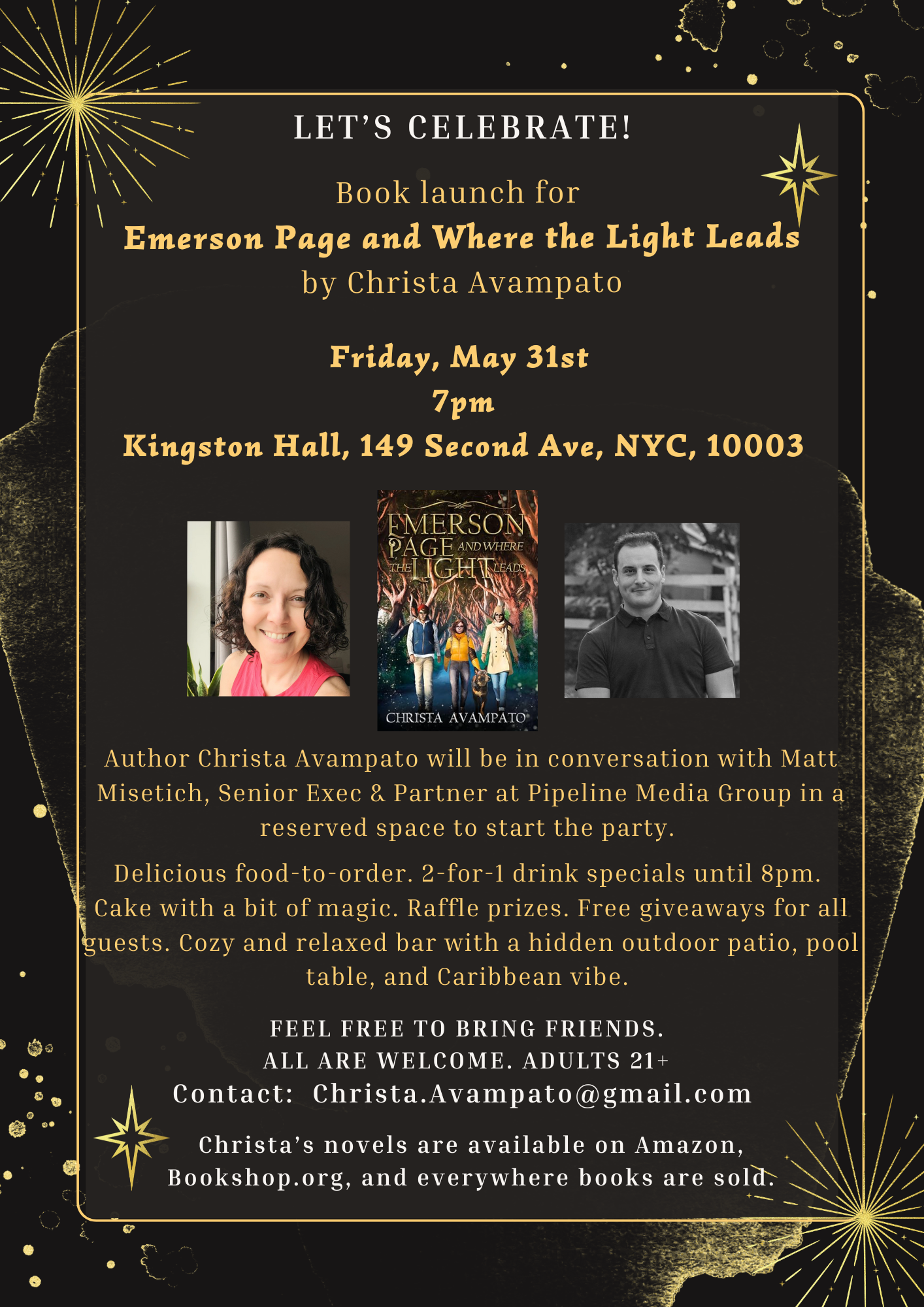
I can’t believe it’s almost here! On Friday, May 31st, at 7pm I’m hosting my first ever book launch party for my novel, Emerson Page and Where the Light Leads.
Details: To start the party, I’ll be in conversation with Matt Misetich, Senior Executive and Partner at Pipeline Media Group. We’ll talk about the creative process of being a writer, the publishing industry, and transforming books to film. There will be delicious food-to-order, 2-for-1 drink specials until 8pm, cake with a bit of magic, raffle prizes, and free giveaways for all guests. Then enjoy the cozy and relaxed bar with a hidden outdoor patio, pool table, and Caribbean vibe.
The launch of this book has been wonderful, and I’m so excited to celebrate with everyone. I hope you’ll join us!
Before you share one more post on social media about climate doom and gloom, please take a deep breath. And then, please post something else. Anything else.
The goal of sharing climate change stories is to drive actions that will halt and reverse climate change to protect the planet and human well-being. While doom and gloom stories such as alarming statistics (of which there are many, sadly!) drive more sharing, clicks, comments, and engagement on social media than any other type of climate story, the largest research study on the topic recently found they drive the least amount of climate action and do almost nothing to change climate change beliefs or support climate change policies. They actually backfire, even causing people concerned about climate change to take significantly less action than they otherwise would.
How could this be? Doesn’t instilling fear for the survival of our species cause so much alarm that of course we’d change our ways? That is a logical, rational assumption. For many years, this was the prevailing wisdom. If you just show people how much damage climate change can do, they’ll change their behaviors and habits to protect themselves and the people they love. This is why we see country leaders, the Secretary-General of the United Nations, leaders at environment nonprofits, and climate activists all over the world sounding the alarm. This is also why so many of us have posted about the climate emergency so often. It’s also why we aren’t seeing enough action taken at a fast enough rate. These stories depressed and demotivated people right into paralysis.
But if that’s the case, then why is there so engagement on climate stories? The clicks, likes, shares, and comments are through the roof. If there’s so much engagement, why is there not enough action? Being engaged on social media or with mass media isn’t the same as taking action in the real world. These stories have absolutely raised the consciousness around climate change, but they haven’t successfully moved people to physically do something about it. Fear-based messaging is somewhat effective at driving one-time actions. However, most climate action requires behavior, habit, and systems change, not one-time actions so the fear-based climate messages don’t give us the long-term and repeated actions we need.
So, what messages can we share that will drive climate action? That is an excellent question. Research points us to a few options that motivate climate action:
Scientific consensus coupled with a clear call-to-action Sharing the science of climate change, and that the vast majority of scientists agree on it, is critical. However, just providing the science isn’t enough. We also need to give people specific, actions to take. And all the better if we can give them a mix of one-time actions (such as voting) and remind them to take habitual actions (such as buying only the amount of goods we need to reduce waste). And we have to make them as simple as possible to get broad-based engagement.
Appeal to ethics and morality with a clear call-to-action Most people like to see themselves as having strong ethics and values. We want to protect our neighbors. We want to take care of our communities. We want to be healthy and happy, and we want people we love to be healthy and happy, too. Taking care of the planet is a way to take care of ourselves and others, and appealing to our collective nurturing nature makes a difference. And again, give people a clear call-to-action to help them do this.
There are other theories about what may work that need further study. There is a hole in the research about which messages will move people from engagement to action. We desperately need more research on this, so we tell the stories that motivate the actions we need to protect ourselves and all species with whom we share this planet. My master’s dissertation has a few additional findings that I’m excited to share soon, and I’m thinking of continuing this line of research and work because it’s so critical to protecting the health of the planet.
Last month, a study on conservation actions, including protected areas and management, showed they effectively halt and reverse biodiversity loss, and reducing climate change impacts. Over the weekend, CBS aired an interview with Pope Francis, the first he’s granted to a major U.S. television network. About climate change he told Norah O’Donnell, “Unfortunately, we have gotten to a point of no return.” What’s unfortunate is Norah O’Donnell didn’t explain the science that this is not true. We are not at a point of no return with climate change. We need to do more and faster, and there is hope.
I understand it’s probably intimidating to challenge the Pope during an interview on national television. However, what he says is taken as truth by millions of people. If he pointed to the many success cases we have, this would inspire the increase in climate action we need. People need to know they can and do have the opportunity right now to make a difference. We have to spread this message far and wide because time is running out. This next decade could turn the tide one way or the other, and we have the chance to be part of the solution.
The International Union for Conservation of Nature (IUCN) is the global authority on the status of the natural world and the measures needed to safeguard it. It’s documented that 44,000 species are at risk of extinction. If these extinctions happen, ecosystems will collapse and billions of people will struggle to have enough food, clean water, livelihoods such as fishing, homes, and cultural preservation, to name just a few of the severe impacts.
The world’s forests store approximately 861 gigatonnes of carbon, equivalent to nearly a century’s worth of current annual fossil fuel emissions. Tropical rainforests store 50 percent of that. These forests are not just the trees – they’re a whole ecosystem including the fungi, soil, insects, and predators. “When there are pieces of that biodiversity missing, the carbon cycle is incomplete or much less efficient than it would be otherwise,” said Christopher Jordan, Re:wild Latin America director. Storing carbon and keeping it out of the atmosphere needs all parts of the forest. It needs biodiversity. The wild, not human-invented technology, is the most effective solution to the interconnected climate, biodiversity, and human well-being crises.
This is what I wish the Pope had said about climate change because it’s true: There is hope. We have the solutions. Now, we need the will and humility to listen to nature and let her lead for our own sake and hers. We are all interconnected. We need each other.
Though I’m working on my dissertation for most of this weekend, I took a little time out to dream about my ancestral homeland thanks to Ben Tish’s gorgeous cookbook, Sicilia: A Love letter to the Food of Sicily. More than just recipes, Ben gives us a glimpse into the rich arid land, history, and the bustling society that is so prevalent on this island (and the many islands dotted along its coast). I particularly love his vivid descriptions of the food markets, each with its own unique spin on street food. I can’t wait to see and experience them myself.
Sicily’s history is dotted with many influences from many places and peoples. It’s not a melting pot, but rather an amalgam, a collage, with all the parts clearly visible and working together to create something none of them could do alone. Sicily isn’t one culture but many. Its food is its historical archive.
Arab and North African influences are some of the strongest we can find in Sicily’s cuisine, including both its ingredients and preparation. The Moors and the Islamic culture they brought are closely tied to Spain. However, they are just as prevalent, perhaps even more so, in Sicily. Pistachios and honey, oranges and lemons, saffron and pomegranates, sorbet and granite, couscous and sardines, almonds and pine nuts, raisins and fennel. If you love anything deep fried (and who doesn’t?), thank the Arabs who ruled Sicily in the 9th and 10th centuries for infusing that cooking preparation into Sicily and then on into the rest of Europe.
This island’s sprawling variety, so much packed into such a small amount of real estate, reminds me a lot of my home in New York. Here, Sicilian culture, along with hundreds of other cultures, can be seen and experienced all the time everywhere. Maybe my bloodline to Sicily is why I feel at home everywhere and with everyone–because my ancestors were diverse, people who came from all over to this plot of land that connects east and west, north and south, and celebrates its many influences.
6 years ago I was in Dublin, Ireland doing research for my second novel, Emerson Page and Where the Light Leads, that came out this week. There are a few key settings in the book in Dublin – the Brazen Head (Ireland’s oldest pub dating founded in 1198), Trinity Library (both the Long Room and the stunning Book of Kells), Temple Bar (a cobblestone street in Dublin filled with interesting characters), and St. Stephen’s Green (a park filled with nature and art where I spent a lot of time people watching and writing). Beyond Dublin, Newgrange, the Dark Hedges, and Giant’s Causeway also inspired scenes in the book that let me showcase the retellings of some of my favorite Celtics myths, legends, and folklore.
By a wonderful stroke of synchronicity, I was also in Dublin during the 2018 International Literature Festival Dublin. Neil Gaiman, one of my favorite authors who’s influenced my writing more than anyone, was the headliner. I grabbed a ticket. He talked about how Ireland inspired his comic, Sandman, and how he reimagined his favorite stories from Celtic mythology in his 2017 book, Norse Mythology. Now he felt even more like a kindred spirit to me!
Of all the beautiful advice he offered that evening, this quote is the one that affected me the most because it helped me give myself some grace as a writer:
“I’m not an outliner or someone who free writes. I’m more of a gardener. I plant seeds and I see what grows. I plant pumpkins and I expect a pumpkin. But if I get a tomato, I’ll figure out what to do with a tomato. That’s how I write. I love that magic moment when something happens on the page I’m writing that I didn’t know was going to happen. I get to be the first reader of my work, and it’s very exciting. And quite frankly that magic doesn’t happen often enough. A lot of writing is just laying brick.”
I’m a planner (probably because I grew up with a lot of instability). I like order and organization. I like to know what I’m doing and where I’m going, and I absolutely hate wasting time because I know what a precious and finite resource time is. I can’t imagine a world in which I completely let that go. However, Neil made me realize I could be a little less afraid and loosen the reins a bit.
As I walked back to my hotel in Dublin that night, I let myself entertain the idea that I don’t need the next bit figured out before I sit down to write every single time. I could be okay with planting seeds, seeing what grows, and figuring it out as I go. It was at least worth trying, and giving something a try is where everything begins.
In the 6 years since I heard Neil speak in Dublin, I’ve learned how to let more air into my writing and life. I’m still a planner, and I also plan to be delighted by surprise. There’s a time for hard and serious work, for laying bricks, and there’s also a time for fun and play. There’s room for the unexpected, for magic. My second Emerson Page novel that came out this week embodies that. I’m so grateful to Neil for helping me grow as a writer, and also as a person.
My Emerson Page books surrounded by good vibes from my favorite flowers, Kin Euphorics, and Homesick
This post is about the fear of criticism we all face whenever we do something new, and why it’s worth taking that risk.
Thanks to kind and generous readers, my second Emerson Page novel made her way into the world this week and became an Amazon # 1 new release. To say I’m grateful, honored, and filled with joy is a massive understatement. I toasted my courageous and creative girl and sent a wish out into the universe: “I want to keep telling stories that help people feel less alone”.
On Monday when I was doing all the final prep for Tuesday’s book launch, I had the TV on. Drew Barrymore was interviewing Bella Hadid on The Drew Barrymore Show. They talked about the bravery it takes to create something and put it into the world.
This conversation is exactly the one I needed at that moment. It’s scary to build something with your whole heart for years and then brace yourself for the response. The only thing scarier is not creating at all.
Their conversation reminded me of the beautiful quote in the movie Ratatouille. The character Anton Ego has a monologue about the creative process and criticism, and it’s one of the truest things I’ve ever heard:
“In many ways, the work of a critic is easy. We risk very little yet enjoy a position over those who offer up their work and themselves to our judgment. We thrive on negative criticism, which is fun to write and to read. But the bitter truth we critics must face, is that in the grand scheme of things, the average piece of junk is probably more meaningful than our criticism designating it so. But there are times when a critic truly risks something, and that is in the discovery and defense of the *new*. The world is often unkind to new talent, new creations. The new needs friends…Not everyone can become a great artist; but a great artist *can* come from *anywhere*.”
If in the pit of your stomach there’s both a fire to create and a fear of what people will think of what you’ve made, please know everyone who’s ever made anything has been right where you are. Take the risk. Someone somewhere needs exactly what you have to offer. As the great Maya Angelou said, “Life loves to be taken by the lapel and told: ‘I’m with you kid. Let’s go.’” It’s time to get going. Make the thing that’s in your heart, send it out, and see what happens.
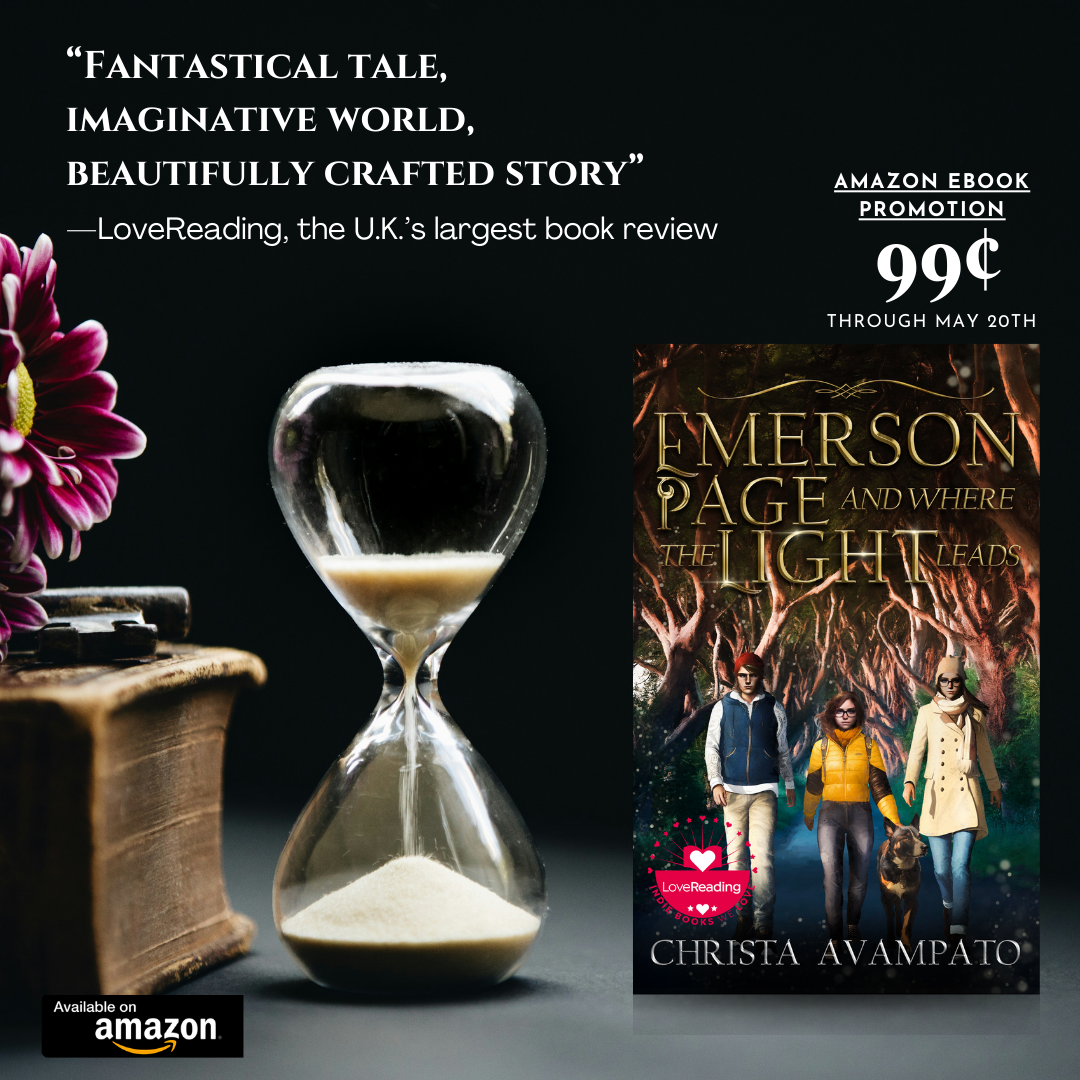
A special treat for eBook fans! To celebrate the launch of my second novel, Emerson Page and Where the Light Leads, and as a big thank you for helping the book hit #1 on Amazon on its first day, my publisher is running a special price promotion for the eBook on Amazon. It’s $0.99 now through May 20th — an 80% discount.
Synopsis: It’s New Year’s Eve in Times Square. Just as Emerson Page is about to celebrate the start of her 15th birthday, she comes face-to-face with a family friend-turned-traitor. They begin a dangerous race against time, both willing to give their lives for the lost treasure her mother died trying to protect: an ancient book authored by the Greek muses, Emerson’s ancestors, that contains the secrets to unlimited creativity. Its wisdom is both a powerful tool and a dangerous weapon.
To find the book, Emerson, her friends Skylar and Truman, and her service dog Friday, have to entrust their lives to a series of mythological creatures to usher them deep below the streets of Dublin, Ireland into the land of the faeries. There, they’ll have to convince the faeries to give them the book by exchanging it for a priceless gift of their own.
Can Emerson and her best friends finish the work her mother began and protect the power of human imagination forever, or will her enemy capture the book to boost his own power?
Two notes: Local bookstores and libraries can order the book with ISBN: 978-1-958901-80-9. The book is distributed by Ingram.
This is a photo of pure potential and a crazy dream. 12 tree saplings in their youngest and most vulnerable state: 3 eastern redbuds, 2 sargent crabapples, 2 washington hawthorns, 3 white flowering dogwoods, and 2 crapemyrtles. They all begin as a single twig with wispy roots.
The next time you’re looking at a fully grown tree, consider all the energy, effort, and time they took to transform themselves. If you’re thinking of doing something new or growing in a new direction, think of a tree. If they can grow from a fragile shoot into a towering figure who provides shade, clean air, food, and a home for so many species, who stands tall in the face of difficulty, then you can grow into who you want to be.
Over the next few months, I’ll be looking after these little ones in the hopes of giving them to my Brooklyn neighbors to plant in their yards when they’re a bit bigger and stronger. I’m sure there will be many lessons in this botanical endeavor. For now, these are the words they’re speaking to me: surround yourself with love and nourishment, and see how you flourish.
Water bears look like works of science fiction. The microscopic, 8-legged 1,300 species of water bears (tardigrades) are alive and well. Their remarkable abilities to survive and thrive in harsh conditions make them seem even more improbable. They’re one of the most resilient lifeforms that’s ever lived.
When I had 6 weeks of daily radiation to treat cancer, I thought a lot about the perseverance of water bears. The technicians would position me on the table, then close the heavy door behind them as they left the room to protect themselves from the radiation. Click. Through a small window, they’d watched me, alone, unmoving, exposed on a table with no protection from the radiation blasting my body. I imagined myself as a tardigrade, opening to the light and radiation, absorbing it to kill any microscopic cancer cells floating around my body. I would think of Rumi’s quote, “The wound is the place where the light enters you.”
By the end of week six, I had a painful burn the size of a baseball in the middle of my chest. “What would a tardigrade do with a burn like this?”, I wondered. They’d tend to what needed tending. So, that’s what I did. I changed dressings and applied the medication twice a day. I meditated on my wound, imagining it closing and healing. It was painful and frightening to have a wound like that, but like so much along my cancer journey, it passed. To my amazement and my doctors’, it healed in 2 weeks. Today it’s only a few freckles and the tattoo that marks the focus of the radiation beam, the place where the light entered me and healed me.
As we consider how to create a world resilient to climate change impacts, again I’m thinking of tardigrades. How can we withstand hardship, quickly and completely fixing what breaks? How can we endure? Nature-based solutions to our most dire challenges are found all around us if only we look, listen, and seek to understand. In a world where we constantly navigate change and manage difficulty, I want to be a tardigrade — repairing myself, my ecosystem, and all beings with whom I share it.





 Christa Avampato