Hooray! After a steep learning curve and months of agonizing over every word, photo, and design decision, my personal website is up and running. I created the website to drum-up freelance writing work and to grow my practice of helping small business effectively use new and emerging media to augment their marketing strategies. Launching my website today was the first step down the road to this new and exciting venture. The website links heavily to this blog and I will continue to maintain this blog with near-daily writing. I’d love your feedback on the website! http://www.christainnewyork.com
Category: writing
Writing from the heart, or at least from real life
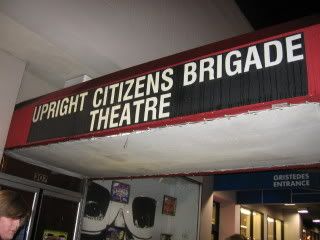
Week three of Sketch Comedy 101 at the Upright Citizens Brigade. Conversation between class members seemed easier. And then someone blurts out to our teacher, Charlie, “See, we’re talking.” This of course killed the whole good buzz that was happening. Luckily we got it back as the sketches again this week were very good.
This week’s assignment involved creating a character sketch. There are a lot of interesting folks in this world – so many that at some points in my life I’ve begun to wonder if those people are normal and I’m a bit left of center. Unfortunately, my memory was failing me badly this weekend. I couldn’t think of a single funny character to write about. Last week the other sketches were so good, and mine was certainly not, that I felt an intense pressure to write something hilarious. I wracked my brain for ideas, started to go down a path, and realized all roads were heading toward decidedly un-funny destinations. I was explaining the situation to my friend, Kelly, whom I was visiting in Buffalo over the July 4th weekend.
I threw out an idea of a Brain Storming Session Gone Wrong. I’m intrigued by how often that term is thrown around in some companies by senior management. I thought it might be funny to have a CEO who’s the least creative person on the planet running a session with his highly creative direct reports, and then shoot down all of their ideas in favor of his own lunatic suggestions. Kelly agreed that that could be a fun sketch, that it probably happens to people more often than not, and I could make a go of it.
So I did and it was funny. Very funny. So funny in fact that the man reading the CEO character was laughing too hard to get the lines out. This was a good sign for my writing and a vast improvement over last week. And then other people in the class were joining in with new ideas to heighten the comedy even more. Now I know why writers enjoy this form.
Here’s the learning: Take a cue from the very idea of brainstorming sessions and put every idea out there. I’ve suggested many ideas that fell flat once I put them out into the world. I’ve kept my suggestions to myself only to have someone else say the same exact idea and get a big laugh. And I’ve made some suggestions that don’t sound all that funny to me though once I get them out into the world, they go over well.
Comedy, more than any other art form I’ve experience, is a living, breathing entity. You know immediately whether or not it’s good because laughter, in the best possible case, is uncontrollable by our conscious minds. We have no idea if something is funny until we act it out for others and gauge their response. It requires that we ban together with other people to create something valuable; a good lesson to consider, with far deeper impact on our lives than just the act of writing sketch comedy.
Next week, we’re scheduled to present commercial parodies. With all of the good fodder out there on the airwaves now, the trouble will be deciding among dozens of choices which one will be most likely to get the biggest laughs.
Nothing Worse Than Silence
I started a Sketch Comedy Writing class knowing I’d be the least funny of the students. Part of my motivation was to meet writers, and I figured all of us could use a little more humor in our lives and in our writing. We write every week and then read our work out loud for everyone to hear.
My first piece was too short and not at all as funny as I had hoped it would be. I got a few polite smiles, and maybe one line that got a true laugh. Otherwise, it fell flat. To be fair, the class is relatively quiet – I’m assured by our instructor that ALL sketch writing classes are quiet. But if that’s the case then I’m having a hard time understanding why he brings that fact to our attention several times per class. Every other sketch piece was far funnier than mine.
Part of me just wanted to throw in the towel. And then I thought of my friend, Brooke, who has recently transitioned from stage acting to TV / film. She’s studied TV and film with conviction for nearly a year. And she goes to auditions not with the intention to book a job, but to improve, to feel that her investment of time in learning this new art form is worthwhile. Some people are naturally funny in that Saturday Night Live sort of way. I’m not — I’m going to have to work at it. And the good news is, well, I really have nowhere else to go but up.
I’m in the middle of preparing my next piece – a character sketch. Time to dig out the memories of all those weirdos I’ve had the privilege to meet…they’re finally coming in handy.
The hard work of simplicity
I have been working on a few projects that require one simple thing: simplicity. While we crave it, work for it, buy all kinds of books and gadgets that claim to be able to make our lives simple, simplicity often alludes us. Recently, I sat with a team member to craft a memo. She kept adding, and adding, and ADDING to it. Finally I said, “Stop. Turn away from the computer. Tell me what you want to say.” She could articulate her ideas well when speaking to me and the moment she sat at the computer, she hid behind an excess of words.
I found a quote later that day that gets at the very essence of good writing, and solid editing. “The ability to simplify means to eliminate the unnecessary so that the necessary may speak. ~ Hans Hofmann.” And that’s it in a nutshell – that is the motivation of every writer, and every editor, in one succinct sentence. To get to the diamond, you need to polish it, and that means removing the unnecessary layers.
It’s easy to understand why we think simplicity should be simple. It’s not – it’s an art that must be practiced. It can be painful. Simplicity is work. We are complex creatures – emotions, biases, past experience, and a deep need to be understood all stand in our way. The work of an editor is to clear the path. To soothe emotions and biases, while preserving and honoring history and the ability for us to influence and affect one another.
As a quick guide, I do the following four things when I feel simplicity getting away from me:
1.) I audibly articulate the nugget of truth I am trying to convey. And then I write it down verbatim. I start from there.
2.) I eliminate every word I can without losing the sentiment I want to convey. This can mean many different types of rework: from restructuring a sentence to finding a descriptive word that can speak for a number of smaller words.
3.) I step away from the writing, even just for a few minutes. Sometimes to get out of the hairball in our writing, we have to physically step away from it.
4.) I only write when I am crystal clear about my motivation for writing, the channel I am writing for (print, blog, brochure, presentation, etc.), and the audience I am trying to reach. This is the framework on which we hang every word.
Wishing you simplicity and good editing, in writing and in life!
Graphic above found at http://www.simpledorm.com/images/simple.gif
Live Bloggers on the Inside: the Iraq Hearings
Photographers, main stream media journalists, and videographers have a tough time getting into some spaces and collecting the information for their stories in real time. This past week, General Patraeus testified in front of Congress at the Iraq hearings. Though film crews could not immediately get the scoop into stations across the country, bloggers in the court room were getting the information out into the streets on cyberspace as the testimony unfolded. The Lede blog from the New York Times did a terrific job covering the conference. Check out the coverage of the Lede blog at http://thelede.blogs.nytimes.com/2008/04/08/watching-the-iraq-hearings-with-petraeus-and-crocker/#comment-380099
I am especially interested in this kind of coverage because of my experience in live blogging. This is just one poignant example of the power of immediate publishing. While newspaper and magazine articles, as well as newscasts, have some time to work through the material and polish it up,l live bloggers give the story and the feeling of the event as it’s happening. It’s the next best thing to a ringside seat at any event.
All of this leads me to believe that it’s possible that live bloggers are the go-to journalists and archivists of the future. Why wait for the nightly news, or for the morning paper, when you can virtually be at the event yourself? Even old world media is adopting what many companies in other industries have known all along: speed is life. And if the largest of the media institutions are to survive, live bloggers may be just the lifeline they need.
The occupational hazard of blogging and other creative outlets
This week, the New York Times ran a story on three prolific bloggers who, it is believed, blogged themselves to death. (http://www.nytimes.com/2008/04/06/technology/06sweat.html?pagewanted=1&_r=1&ref=media) The stress of the constant need to publish as quickly and as often as humanly possible caused them to fall into poor health. Several friends immediately sent me the article, knowing that I try as best as I can to publish daily on my own blog. I don’t always make it, though I am always on the look out for new content and new ideas.
I feel terrible for the families and friends of these writers, the oldest of which was only 60. It is always tragic to see anyone consumed by what they love. I read the article closely, several times, and there are a few things that on the surface I feel may have saved these people. I hope by sharing them with you that they may help other people who feel obsessed with their jobs for whatever reason.
I completely understand insomnia – I’ve suffered with it for most of my life. I understand anxiety about money – I grew up in a family with very little, and only recently have been able to breath a bit easier about my finances. There were a few huge things in my life that have made a difference in my level of anxiety – I consciously decide to not be a workaholic, and I practice yoga every day, no matter how short an amount of time.
When I worked in DC, some of my office mates would make fun of me because at 5:30, nearly every day, I was out the door. I would feel angry about their teasing sometime, though most of the time I let it go. My mom works herself to the bone. I mean to the absolute brink. It was painful for me, as a kid, to watch her. A year and a half ago, she was diagnosed with breast cancer, and from her recovery bed, she was on her computer. Some call this dedication. There’s no denying my mom is a dedicated woman; unfortunately, she is dedicated to a fault. A very large fault, that very easily could cost her, and her children, her life.
Even today, I will come in early, I will work on things at home at night, but I never, and I mean never, allow myself to fall into the habit of staying in the office past 5:30. On occasion, I get it – deadlines pop up, and an occasional late night is necessary. When I went looking for a job after business school, I was adamant about finding one that afforded me a life and time to live it. This is a conscious choice – I ALWAYS have more work, I could always be doing more. I choose to let it lie for the next day. I could very easily become a workaholic; it’s in my blood. I fight that temptation every step of the way, and I refuse to back down in the face of my impulse to work “just a little bit more”.
Yoga, quite honestly, saved my life. It helped me forgive a lot of sadness and disappointment. It helped me cope during times of extreme stress. It gave me the strength to get up, again and again, with an open heart. It is a discipline. After years of practice, I can sleep, in relative peace. And when I can, where I can, I am out in the world singing yoga’s praises, sharing my knowledge about it. Everyone needs a healthy release – yoga is mine.
Anything in the world can get the best of you – food, drugs, gambling, smoking, love, an obsessive hobby, and yes, work, no matter what field you’re in. You have more control over you than anyone in the word, whether you realize it or not. At every moment we have a choice. If we are doing something, anything, that harms us, it’s easier to blame someone else. Our boss, our romantic partner, our friends. The truth is others control us when we allow them to. Ultimately, our happiness, the very activities that compose our lives, are all choices. And choosing what to do among many options is the hardest, and most important, task we have. I consciously remind myself every morning that my time is the most valuable resource in the world, and I treat it accordingly.
It’s all in the edit
In recent days I’ve been building a presentation by committee. And it’s forced me to consider how to collect ideas from a wide audience, put them through a filter, a funnel, and then develop a unique, singular voice. If only I could draw, it would make a great visual: All the voice of the world at the top, been strained into a funnel with a neat, well-crafted set of ideas at the bottom.
I’m struggling with how to make the process less painful for all involved. It’s a struggle to edit. As a retail company, we are forced, constantly, into editing because the size of the box is finite. It’s true for newspapers, magazine, broadcasts, and museums. In some sense even for Google and Amazon.com – how much surfing is one person really willing to do on any one topic or product category – after a few pages of results, I’m done!
When I first moved to NYC, almost a decade ago, I worked for the Roundabout Theatre Company. Todd Haimes was then, and remains, the Artistic Director. And he’s brilliant. The best there is. In an interview, he was asked why he never directed shows. He answered, “I have no interest in directing shows. My passion lies in bringing talent together to get the work done.” He is a curator, an editor, of talent. He gathers, sifts, and funnels a multitude of great theatrical pieces and builds a season of shows each year that make a cohesive, powerful statement.
I thought about Todd as I worked on this presentation with a multitude of people voicing their opinions about what’s important. Deciding what matters and what doesn’t matter really is the hardest work on Earth, and the most important – through editing we define who we are, and what matters.
The photo above can be found at: http://www.blackwell-compass.com/render_image/fragments_home_editor_letter_image
A life in pictures
I’ve been impressed with The New Yorker’s Cartoonist of the month blog. February chronicled the journey of Michael Maslin as he made his way as a cartoonist. After pouring through his favorite publications, The New Yorker in particular, he would submit idea after idea and would be rejected continuously.
Writing for Life
“Writing is the only thing that, when I do it, I don’t feel I should be doing something else.”
—Gloria Steinem,American journalist
This quote warms my heart. Countless times I am in the process of doing something and thinking about doing 5 other things that maybe I should be doing instead. I used to believe that this was a neurotic impulse, that my multi-tasking has crossed over from a necessity of high productivity to a bonafide illness. Now I know that’s not true – it’s just that I preferred to be writing.
For some people a looming paper brings stress and discomfort. For me, it’s always generated a sense of calm and well-being. It makes me feel productive and alive. It makes me feel that “all of this” is worth it once I can put it into my writing or into a story. And it shows me the importance of doing something you love, and how that activity can rewire your behavior and thought patterns.
I’ve heard some people say that making a job out of doing what you love ruins that love. I disagree – I can’t imagine how anyone gets though the work day doing something they dislike or “don’t really mind” when all the while they’d prefer to be doing something else. What more in life could you ask for than to spend your time doing what you love best?
A Topic for Controversy
When a thing ceases to be a subject of controversy, it ceases to be a subject of interest.
~ William Hazlitt, English essayist and literary critic
Another milestone for this blog- my 200th post in less than 9 months. Not too bad. Constantly writing leads me to constantly think about topics of interest, and as a result of topics of controversy. At work, we always seem to be shoulder-deep in the later. And while it’s all well-intentioned, it can on occassion be tiresome. However, the controversy is necessary if we are to move forward.
I freely admit that I have a distinct reluctance to engage in controversy. Not that I have a problem with carving my own path, considering and re-considering emotional and complicated issues, or speaking my mind. On the contrary, I excel at all three of those things. What I have a tough time with is belaboring number after number with no consideration of the information contained within those numbers. I have little tolerance for the constant rehashing of the same material over and over again. I can’t stand constant controversy over a single topic. I am a firm believer in the “get on board this ship or find a new one” when it comes to the strategic direction of a company. And some times I get on board, and some times I bail. But I never get on board if I don’t fully believe that the ship is being steered by an able navigator. Once the controversy is settled, the real work of moving down the chosen path begins. A company can’t move forward while the seas of controversy rage.
This time of year there is plenty of controversy to go around – what to do about the economy, the next Presidential administration, our own foreign relations, the war in Iraq, our environment, and the list goes on. No matter what side of the fence we fall on with these issues, the interest and passion has yet to wane. And for that, I’m grateful. We don’t have the best answers yet. We have huge problems in this world, and we need the controversy and its companion, interest, to unearth the the best solutions. However, at some point soon, on many if not all of these topics, we will have to make a choice. As one co-worker said to me recently as we left a particularly heated meeting “it’s amazing how quickly something gets done when it absolutely has to get done.” At that point, the topic of controversy has to shift to resolution, as does the interest of those involved.