job, love, work, writing

Writing for Life

“Writing is the only thing that, when I do it, I don’t feel I should be doing something else.”
Gloria Steinem,American journalist

This quote warms my heart. Countless times I am in the process of doing something and thinking about doing 5 other things that maybe I should be doing instead. I used to believe that this was a neurotic impulse, that my multi-tasking has crossed over from a necessity of high productivity to a bonafide illness. Now I know that’s not true – it’s just that I preferred to be writing.

For some people a looming paper brings stress and discomfort. For me, it’s always generated a sense of calm and well-being. It makes me feel productive and alive. It makes me feel that “all of this” is worth it once I can put it into my writing or into a story. And it shows me the importance of doing something you love, and how that activity can rewire your behavior and thought patterns.

I’ve heard some people say that making a job out of doing what you love ruins that love. I disagree – I can’t imagine how anyone gets though the work day doing something they dislike or “don’t really mind” when all the while they’d prefer to be doing something else. What more in life could you ask for than to spend your time doing what you love best?

career, child, children, kids, Kidscreen Summit, retail, work

Kidscreen Summit Prep

I’m at home getting ready for the Kidscreen Summit, which begins tomorrow. Over 1330 companies in the field of youth entertainment will be represented and we will noodle through a number of issues to learn about new products, services, and ways of doing business. New technologies and entrepreneurs looking for a break will abound. I know I should be excited. Truthfully, I am terrified.

My fear stems from several things: 1.) my company has paid a fairly large amount of money to attend, and I am its sole representative at the Summit despite the fact that I’ve only been there for 7 months; 2.) as a result of #1, I feel a tremendous pressure to find something cool to bring back to validate the expense. This is not good – it’s kind of like working very hard only to get promoted or to make money. Wrong motivation = missed learnings and poor decisions; 3.) I’ve been in this field 7 months – seriously, what will I have to contribute in a conversation with people who have dedicated their entire lives to youth entertainment?

I hate fear; and I hate the feeling of stress it imbibes. I have to calm myself down. So let’s take these fears one at a time. 1.) though the money that was paid seems large to me, it’s within our budget, and for three days of learning that could give the company a competitive advantage, it’s a drop in the bucket. Check. 2.) There is cool stuff to be had – one only need to look at the agenda and list of exhibitors. I’ve have to be on another planet to miss all the cool stuff that will be available. 3.) I had this same fear when I started business school. In a finance class, what could I contribute coming from a nonprofit and theatre background in a room full of investment bankers. As it turns out, a lot. The beauty of tremendously complex fields, it turns out that no one has all the answers, regardless of how long they’ve worked in a field. Times change, and industries change with those times.

Okay, I feel a bit better. But what is really going to get me over my fear of this Summit – two things. First, I am pretty darn lucky to have a boss who believes in me enough to send me as a representative to this conference. Second, if wifi and an electric outlet are accessible, I’ll be live blogging from the Summit. It’s amazing how many fears can be dissipated if they can be formulated into a story. Check back tomorrow for the latest update….

career, corporation, creativity, work

What is good for the company?

I work a company that sells fun products and has a decidedly “unfun” corporate atmosphere. I am willing to toe-to-toe with anyone, and I mean anyone, who says otherwise. There is a completely lack of smiley-ness around the place. There’s so much grey and taupe that you begin to wonder whether or not color ever existed at all. When I come into work in the morning, I see employees marching toward the grey, 1970’s-architecture building with the same cadence of those in the movie Antz. It’s sad. Really sad….

I pride myself on having a colorful character – I’m also blunt and opinionated. Luckily, I work for someone who’s also blunt and opinionated and we’re starting to know enough to be dangerous. Dangerous as in we may be leading the Antz to some kind of colorful revolution. I am seeing signs of creativity and life pop up in unexpected places, and in fairly rebellious ways.

Our restrooms, like our offices, are grey and taupe. Today, I have found that several people must have gotten sick of no amenities in the restrooms and placed peach hand lotion in each one. On my way back to my office from the restroom, I passed by a cube that was in full view on the main drag with a very large banner that said in bold letters “What is good for the company?” The wheels of creativity and action are slowly, slowly beginning to turn. And then as I turned the corner of my desk, I saw people dancing, actually dancing, in their cubes. Finally, an outward expression of joy.

Organizations, particularly those with decades of history, have a tremendous amount of inertia. When at rest, they are difficult to shake into action. Luckily, once they are stirred up and in motion, they are tough to slow down. My hope is that by the time I leave the company, those wheels will be cranking full speed ahead. And hopefully, I will have been a part of a creative revolution. It will indeed be good for the company.

dreams, frog design, job, sleep, work

The road to creativity is paved with sleep

In recent weeks, the news has been covered with new scientific research on sleep and how we are not getting enough of it. We use our jobs, families, and personal interests as reasons to deny ourselves rest.

NPR recently ran a report on sleep. Though geniuses like da Vinci professed not to need more than several hours of sleep, what he didn’t mention was he didn’t need more than several hours of sleep at a time. In many ancient history and renaissance era books, writers often describe first and second sleep, each about 4 hours in length, with 1 to 3 hours of waking in between. This sandwiched time had a magical quality, often bringing to light a person’s most creative thinking. Sleeping, quite literally, is necessary for dreaming – it is a bridge to enlightenment and to the magic of innovative thinking.

This week on Frog Design’s blog, Tim Leberecht explores the possibility that we may not be as passionate about work as we purport to be. Maybe we’re just working scared….

To read Tim’s post, visit http://www.frogdesign.com/frogblog/are-you-a-passionate-worker.html

art, career, retail, work

The Vital Few

Today I participated in an off-site for work. There was a lot to focus on – we are facing an uphill battle, as are so many companies, in this tough economy that may soon get a lot tougher. It is easy to be distracted in this kind of environment; it is easy to get off-track, and even easier to let frustration rise to the top.

And as he often does, my boss stood up at the end of the day and asked if we might participate in a bit of an experiment. He wrote three poignant words on the wipe board. “The Vital Few”. Rather than putting together an enormous package of ideas, initiatives, possible developments, etc., could we hone our focus on the very few things that will move the needle, things we can all get behind and drive forward across all of our businesses?

In a sense, we need to remove the noise. We need to take a moment, breathe, hold hands, and promise to support one another on this journey with a common goal: to be great by doing the best we can each day for our guests. While this sounds easy, in our day-to-day tasks it is quite possible to get distracted, to take a Road to Abilene. The crisis du jour can cause us to do things against our better judgement.

So how do we find and focus on the vital few amidst so many other things competing for our attention. It’s about comparison. In a retail box, nothing sells like product. If we are to consider incorporating services, and I mean ANY services, they had better to prove to outperform product in the space they take up. By comparing services to products, we are able to discern what gets the space. The same can be done for new business concepts. If we have a new idea that we think will fly, great! And the next question: so if that new business concept comes in, what goes out?

What saves us are constraints. If as artists we were able to do whatever we wanted, then it’s likely we wouldn’t create our best work. We need to have constraints to think creatively, to have those break-through innovations. By forcing ourselves to find and nurture the vital few, we can be assured of discovering what truly matters and is worthy of our time and energy.

career, creativity, IDEO, job, work

A Room of My Own (sort of)

Two people at work have recently been promoted to a level that requires them to be seated closer to our company president. Both of these people have assistants that will be coming along with them so it was time for me to relinquish my front row seat watching how a company seeks to re-invent itself. Or so I thought.

Bob, my boss, is a mast-negotiator. He would never admit that; he is far too humble to ever toot his own horn. No matter – I’m happy to sing his praises as loudly and as often as I can. He deserves it. He hates the idea of ever being separated from his team at work and so he politely offered to have all three of us move to another area of the building. Nope, his boss wasn’t having that. Bob’s not going anywhere. So this week I moved across the hall with the third member of our team into a lovely office.

I hadn’t ever considered the possibility of getting an office at my company. I knew they were reserved for people at a much higher level than me. No one else thought it would be possible either. Bob took the two of us downstairs to the cafe this past week to have a coffee and celebrate our new digs. “Place profoundly effects progress,” he said. And he’s right – already I feel myself moving more swiftly in almost every area of my life and I think the space is the catalyst.

In addition to moving into a new space, Bob also encouraged us to make new name tags to hang outside our office. It had never occurred to me to replace the boring grey placard that stated my name, rank, and coded space. “Operations Support” was my job description according to the tag, despite the fact that I have nothing to do with operations. I’m not sure where they come up with this stuff. I couldn’t think of a less inspiring, or more inaccurate, job description if I tried.

A few weeks ago Bob sent me a job post from IDEO, a company we both greatly admire. I thought for sure this was the beginning of the end for me – I was being outplaced before I even hit the 6 month mark. In actuality, Bob was just trying to give me some structure and creative language to describe what it is we actually do in our very ambiguous jobs: we are nothing short of Human Factors Specialists. I proudly wrote that on my new office tag, and included a picture and poem by Brian Andreas, one of my favorite artists.

So what is a Human Factors Specialist you ask? It’s a fairly simple concept: we develop and foster opportunities to create joy through design. On IDEO’s website, they describe their human factors specialists as those who “apply their knowledge from psychology, anthropology, biomechanics, and related fields to enhance people’s experience through design. As interdisciplinary design team members, they employ a range of observational and empathic techniques to understand the issues people face. They use this knowledge to frame design opportunities and to create scenarios and “experiential prototypes” to explore, test, and refine opportunities in context.”

I don’t know that our HR folks will go for this fancy language, and that’s okay. While they may sequester me to a formal job description like “Operations Support”, I’m working hard to make make sure my imagination doesn’t fail me.

The above photo can be found at http://www.davlinswoods.com/Pictures/SPP0105.jpg

career, entrepreneurship, Robert Scoble, technology, work

What Robert Scoble has to say about entrepreneurship

I am a big Robert Scoble fan. One, I admire the road he paved for bloggers by fearlessly and honestly blogging about his life at Microsoft while an employee there. I also admire his ability to constantly stay true to himself.

He recently announced that he took a position with Fast Company to run their video network dedicated to business. The network launches on March 3rd. Prior to accepting this post, Scoble considered starting his own business. And decided against it for a number of reasons. In short, when he thoght about what he loved – blogging, interviewing people, and his family – none of those things lined up with what it takes to be an entrepreneur.

This gave me pause as I am now considering embarking on the road to my own company. Please understand that I am a huge advocate for small business and for those who want to go it on their own. I am an even bigger advocate for following your heart, doing what you love, and finding a career that allows you to soar on your strengths. For many, that does mean starting their own companies. Though for others, it means they need to find a company that provides them an opportunity to capitalize on what they do best.

Entrepreneurship isn’t for everyone, and I wonder if so many new businesses fail because some people who start them don’t realize all they are getting into. Scoble’s advice and insight merit a read for anyone starting a business. To read his full post on the subject, visit http://scobleizer.com/2008/01/16/why-were-going-to-fastcompanytv/.

business, career, work

The Power of Story

While powerpoint may be one of the main tools of MBAs and business schools, I have maintained a distinct dislike of the program and how it’s ruined the natural human ability of story telling. Executives and consultants hide behind them. It’s not a well-designed program, lack any kind of intuitive functionality, and for the most part provides a canvas for a lot of data, though no information.

I recently read a Harvard Business Review article about storytelling. Bronwyn Fryer interviewed screenwriting coach Robert McKee. McKee’s students have written, directed, and produced legions of popular movies such as Forest Gump and Monty Python. He is the basis for the main character of the movie Adaptation.

The article written my Fryer is both moving and insightful. While many leaders in business are intelligent and dilligent, they often lack the emotion, empathy, and concern to truly connect to those who work in their organizations and their customers. This is a problem that business schools and corporations should see as a crisis. Numbers and information are clouding our ability to interpret what we see and create meaningful solutions to today’s business woes. Is it any wonder we are heading for recession.

Corporate employees and customers need to be inspired, and they need to feel cared for and appreciated. As business people, we need to “get” our customers. And this takes far more than data and gant charts. It takes an ability and desire to truly walk in someone else’s shoes and live their lives. It requires a strong curiosity, a willingness to not only hear but listen to the concerns of others, and most importantly a craving for connection and simplicity.

Powerpoint can’t get us there. Storytelling can.

The images above can be found at http://www1.istockphoto.com/file_thumbview_approve/2819067/2/istockphoto_2819067_reading_story_book.jpg

art, career, guest blogger, job, Rob Lorey, social work, theatre, work

Career transitioning by guest blogger, Rob Lorey

In an effort to expand the depth of the topics I cover and to provide readers with new perspectives, I have decided to ask a few of my most interesting friends who inspire and enlighten me to appear as guest bloggers. The first one is my friend, Rob Lorey. I met Rob while we were on the Beauty and the Beast tour. He is an exceedingly talented performer and generous man who has now turned his talent toward a new career that is taking him in an entirely new direction. My love and thanks to Rob for sharing his story on this blog.

“I have been asked by my friend, Christa, to discuss career transitioning-which is interesting considering her own history. I have looked to her as a model when questioning my motives or planning. She has always seemed to me a person of keen intelligence and interests, who will throw herself into a given course with 110 percent dedication, yet readily change course with complete determination and little concern for popular perception. There. That’s my entry for the Christa Fan Club.

My own journey has been a bit lengthier- but very fruitful. I spent roughly twenty years in the entertainment industry- mostly stage work. This career took me all over. I’ve lived in several great cities, toured throughout the US and Canada, and spent time in Europe and Asia. By all accounts, I’ve been very lucky and reasonably successful.

But I find that a career in the Arts intensifies the perception that one has never quite “arrived”. No matter what successes you attain, you’re always looking to someone who has what you perceive as the better gig. It is very difficult to maintain a realistic sense of progress- and easy to become career obsessed. Add to that the very real dearth of work opportunities and the increasing talent pool you are competing with. It can be a bleak picture!

My own journey has allowed me the luxury of time for reflection. My last big tour gave me the opportunity to take stock and make some decisions about how I might want the rest of this ride to go. I will spare readers the nuts and bolts of this existential journey. Suffice it to say I decided that I needed to expand my capacity for work opportunities and life experiences. That’s what this move feels like- an extension of all that has come before it.

Currently, I’m pursuing a masters in Social Welfare- which is whooping my ass (back to a full time program after 25 years….ouch!) But it is incredibly interesting and engaging. I continue to perform- though not to the extent I was. It’s a necessary sacrifice for the big picture. I am not sure how I will choose to use all this once I have completed my degree. I know that whatever I do, I’ll be utilizing all aspects of myself, and all the work and life experience I have accumulated.

What a gift to be so energized and……expectant at this juncture! Goes to show you: every day is an opportunity to reinvent, to do better, to experience more!”

The above photo can be found at http://www.makinglemonade.com/Career%20Transition.jpg

creativity, innovation, invention, work

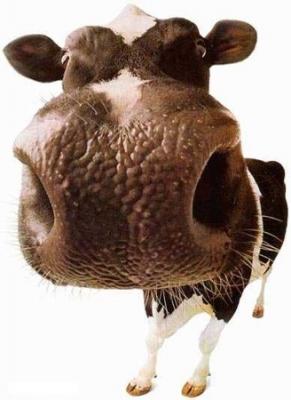
CEOs can learn a thing or two from cows – more from “Orbiting the Giant Hairball”

My friend, Dan, and I recently went to Maine to spend a weekend doing absolutely nothing of importance. It turns out that Maine is a great place for this kind of activity. I wish there were more Maines in the world. Dan is a master maestro of a delectable mix of jazz, big band, and lounge-y cabaret type music. I am not doing it justice with that description. It’s great stuff. He’s the only guy I know who’s ever run out of space on a giant iPod.

Dan brought his iPod as well as the iPod car kit so that while I drove he could entertain me spinning his fabulous mix. Being avid Sesame Street fans, he played me a set of tunes that included “Cookie at the Disco” and my personal favorite “Proud to be a Cow”. (You can read the lyrics through this link as well as download a “Proud to be a Cow” ringtone. http://www.lyricsdownload.com/sesame-street-proud-to-be-a-cow-lyrics.html. Build it and they will buy!) We should all be proud to be cows.

Today I was reading about those dreaded corporations and how they make it their job to drive every last ounce of creativity out of their enormous legion of exceedingly boring grey cubicles. This isn’t always true – it just happens to be more the norm than the exception. So imagine if dairy farmers judged their cows the same way that executive management judges their employees. Cows spend about 10% of their lives hooked up to milking machines in a barn. That’s the only time they actually produce something tangible. However, the other 90% of their lives they are performing magic turning grass into milk in some alchemic process that I do not even pretend to understand.

What would our dairy cases look like if those dairy farmers pressured those cows to “be more productive”? Impossible. Cows can’t make milk any faster than people can churn out creative ideas. Creativity is a strange alchemy as well. It needs time and patience to percolate. Corporations that think they can speed up creativity are as destined for success as a dairy farmer who thinks he can speed up milk making. If a farmer needs more milk in a shorter period of time, then he needs more cows. And if a corporation needs more creativity, then it needs more creative people.

The picture above can be found at http://www.blog.thesietch.org/wp-content/uploads/2007/02/zoom-cow.thumbnail.jpg