books, government, history, Obama, politics

A time for geniuses

Traditionally, grade A educations have been more prevalent in elite, affluent circles. But the tide may be turning on that trend – Obama could do for high-quality education what Target did for design. He could make it desired by, and possible for, all.


This past week I had lunch one day with a group of people I don’t know well. We were discussing the election and one of my lunch companions said, “Who would ever want to be President at a time like this?” This morning, I was watching Meet the Press. Doris Kearns Goodwin, Presidential historian and author of Team of Rivals, quoted Abigail Adams when asked about how Obama will govern with all of the problems he is facing. “These are times that a genius wants to live.” If only I had access to that quote during my lunch. 

And the same could be said of anyone who runs any kind of team, any kind of company. The challenge, the fun is rolling up our sleeves when things are messy and in disarray and setting them straight again. It’s in the churn that we find our new direction. Abigail Adams was right — this is a time that a genius wants to live. And I would add, it is also a time when a genius wants to lead. Thank goodness we had the sense and foresight to elect one.      

career, corporation, leader, leadership, New York Times, Obama, politics, Thomas Friedman

The value of and quest for alignment

I walked around all day today with a smile from ear to ear because this morning I woke up more hopeful about our future than ever before. The afterglow of the election was shining brightly on people’s faces everywhere I went – at work, on the subway, in the grocery store. Construction workers at ground zero, my co-workers, doormen of apartment buildings in my neighborhood. I’m getting emails from friends telling me how excited they are about our future. And that excitement is infectious. Obama will be the greatest President this nation has ever had. I believe. As Thomas Friedman said in his column today, “The Civil War is over. Let Reconstruction begin.”


The critical activity that lies before Obama, and us, now is one of alignment. I thought a lot about the difficulty of achieving this state, especially among parties, factions, and classes that are sometimes so disparate with competing interests and values. I’m working on a project at work that is nearly at completion and just when I think I have alignment, something threatens to derail us and I have to gently and firmly coax that detail back into line. It is amazing how much daily effort and time alignment costs; it is an endless pursuit. 

So how will Obama get to alignment and how will we help him get us there? I’ve found that focusing on the finish line and getting others to place their focus there is most helpful. Playing pool helps.

An old boyfriend of mine was a very good pool player, and he taught me how to play. When I first met him, I wasn’t very good. I always focused on my cue ball, not on the ball I was trying to hit. And without fail, I would miss my shot. What I needed to do was get my eyes in line with exactly where I needed to hit that prized ball to sink it, not on the ball right in front of me that I would hit with my cue stick. I needed to keep my eye on the prize in the distance- that ball that I couldn’t quite get to directly. My game dramatically improved. 

The same strategy that works for pool can work for alignment. Get everyone looking toward the same goal, the same prize. And then you will find that they are less concerned that their desired road must be taken to reach that destination. As the leader, you choose the road that’s leading the group to the common goal, and cast the players according to their strengths and curiosities. Alignment is possible, even in the most fragmented of circumstances, if we as leaders are committed to making that alignment priority number one, every day.     
election, hope, Obama, politics

O-ba-ma

“O-ba-ma”. That is the chant that is echoing down the streets of my neighborhood. People throwing back their heads in laughter. Cars beeping their horns in celebration. There is joy in the air. 

We have a long road ahead to rebuild this nation, to heal this world that has been plunged so deeply into despair. And while hope is not a strategy, it is certainly a tool, something that will build us up, something that will give us confidence to keep going, in spite of the tough times that lie ahead.
We banded together. And we did it. We stood up, we let our voices be heard, and we count.   
business, career, economy, finance, financing, investing, job, loans, personal finance, politics

Worried about the economy? Here are some quick answers to common questions

I was going to post about myself, my life, and my observations about the world around me today. However, I’m hearing so many people say that they don’t understand how this current economic crisis is going to hit them personally, that I wanted to do my part to try to get the word out about 4 common questions that many people have asked me over the past few weeks:


1.) “Do I need to pull my money out of my savings and checking accounts and put it in my mattress?”

No. Please don’t do that. If it gets stolen or you have some disaster like a house fire, you’ll lose it all. Also, as long as your money is in a bank that is FDIC-insured, your money is safe up to $100,000. If you have more than $100,000 with the same bank, then take out the balance above $100,000 and move it to an entirely different bank, not just into another account at the same bank. The $100,000 insurance is per depositor, not per account! Don’t know if your bank is FDIC-insured? Call them, stop into a branch, or visit their website.

2.) “I think I am going to stop investing in my retirement fund because the market is so bad. Is that a good idea.”

No. No, no, no, no! Please don’t do this. Please. Economies go in cycles. You need the compounding on your retirement savings to make retirement plans work. If you pull out your money or stop investing, you will lose the compounding factor you need. And you’ll pay hefty penalties on the withdrawal plus lock in the loss. What you can and absolutely need to do is make sure that your portfolio is balanced. Many retirement plans have a “set it and forget” plan. That’s what I have. You plug in the number of years you have until retirement, and the plan automatically calibrates different investments to get you to your retirement goals. Still unsure? Make an appointment with an advisor at the institution that manages your retirement accounts – it’s free and it’s their job to explain your options to you. And if you don’t know how to make an appointment with them, contact your HR department. 

3.) “This job market is so crazy that I’ve decided to get out of the job market. Is that a good idea?” 

AH!!!!!!!!!! No – no no no. Don’t do that. If you retire now, you essentially lock in all the loses your retirement fund has just been hit with because you begin to draw on those funds yo worked so hard to save. This is bad – really, really bad. You worked hard all these years, and you’re not getting the full benefit of that hard work. If you’re quitting your job with nothing else to go to, you need to reconsider immediately. And change your mind – do no leave your job without another place to go. There will likely be nothing for you to go to. Now, I do think you should be networking and watching out for new employment opportunities that sound interesting. Actually, I think you should ALWAYS do this, even if you are 100% in love with your job. You need to cover your bases and in this day and age, getting a job interview (and probably getting your dream job or even just your next job) has much more to do with who you know rather than what you know.   

4.) “I don’t think Wall Street zillionaires should get a bailout so I’m against the Government’s $700 billion plan.”

I don’t blame you for being confused on the bailout – I blame politicians who don’t understand economics (inexcusable) and make this a partisan issue (also inexcusable). This is not about bailing out Wall Street. I’m really upset with the person who coined this plan as a “bailout” – it’s not. This money will make the Federal Government a bank that will loan money to banks like Citi or Bank of America to make it easier for those banks to responsibly loan money to average consumers (you and me). There will be plenty of Government oversight to make sure that money is loaned responsibly. And when the market recovers, those banks will pay back the Government, who will pay back the tax payers.   

If we don’t have this plan, here’s what will happen:
Access to credit will plummet, making it hard for all Americans and all American businesses to have any access to credit. All free markets need access to credit to function properly. This los of access to credit is not good – you won’t be able to get car loans, schools loans, mortgages, or any other kind of consumer loan. Credit card companies will cut your limit. All businesses, whether it’s your local pizzeria or GE, will not be able to get the loans, short-term and long-term, big and small, that they have to have to do business and to get us the goods and services we need to survive. Bankruptcies and home foreclosures will skyrocket, and as a result, unemployment will also skyrocket. We’ll be in a downward spiral.

So here’s the choice: a) pay some more taxes now and get that money back in the fairly near-future so our economy can get going again. b) pay a whole lot more now with people losing their homes and companies going out of business, causing unemployment to rise rapidly, and pay even more later as we struggle to deal with the fall out. And we will ALL deal with the fall-out, especially those in lower and middle income brackets. The recovery from option b) will be slow and painful. a) will be less painful and shorter. I’m going with a). I don’t like that we’re in this situation, but here we are.

This might be the only idea that George Bush and I will agree on, and I took some convincing. I read A LOT about this, talked and listened to a lot of people very knowledgeable in finance. At this late date, the horse is out of the economic barn and the only way to corral him back inside and under control is through a rescue plan. There simply is no other better option.  

business, Business Week, clarity, creative, economy, government, money, New York Times, politics, simplicity, social work

The agony of confusion and the ecstasy of clarity

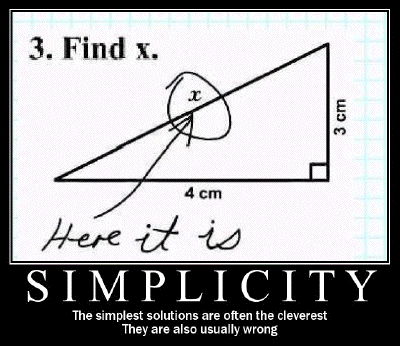
By nature, I’m a passionate person. There are a few subjects that really get me going – happiness, creativity, health and wellness, the environment, puppies. (Not necessarily in that order.) And simplicity – I’m big on that. If we all worked on making our world and our lives simpler, we would all be better off. In some circles complexity and confusion are celebrated, relished, even chased because it’s a mark that what those people in those circles are doing is “very important” if no one else can understand it. How ridiculous, not to mention wasteful – something we can no longer afford to be in our economic situation. 

I was shocked to hear the news today that the House didn’t pass the “bailout”. The Dow tumbled along with stock prices of major companies, and panic is spreading, slowly and quietly. It’s unsettling. Someone said to me today that she didn’t really ever understand the plan, and it’s too bad that it was never explained thoroughly and clearly to the American people. I almost see her point – I do think it was explained by major media outlets like Business Week and the New York Times. You just needed to have the patience to wade through the lengthy articles. And if you don’t understand something, ask around and get some help. Don’t just throw up your hands and say “forget it.” What really happened in the coverage is that no one made it simple to understand if you didn’t have a degree in economics or an MBA. 

Simplicity and clarity are absent in many areas of our lives: in meetings at work, in relationships, in the many contracts with very small print that govern our well-being, financially and health-wise. Companies spend a lot of time, effort, and money because of confusion in roles and responsibilities, objectives, and priorities. Simplicity saves a lot of heartache. And we get to simplicity by being real, honest, and straight-forward in our intentions and actions. 

Clarity builds trust and integrity; it makes people feel that they are a part of an effort because they understand it and can clearly articulate it. Being clear and concise is a sign of maturity – it’s the responsible thing to do regardless of circumstance. Confusion never pays in the long-run and only delays the inevitable. If only our government and financial markets understood that – maybe we’d find ourselves and our economy in much better shape. 
The image above can be found at http://ozguru.mu.nu/Photos/simplicity.gif
art, books, creativity, economy, education, jazz, music, New York City, politics, society

Moving to Higher Ground: How Jazz Can Change Your Life

I gave up my horn about 10 years ago because truth be told I wasn’t even mediocre, and even if I practiced for hours a day I’d never be great. I want to be a lot things, but I have no intention of getting in the habit of spending my time being mediocre. I love jazz, but I couldn’t play it. I just don’t have that ability. My creativity is in my writing. 


So for years now I have socked away all of the academic knowledge I built up around the music. (I studied it for a year in college and played in a few different bands.) People ask me if I miss playing, and truth be told I don’t. I never even think about it. Playing music doesn’t hold any kind of magic for me, but I still very much enjoy listening to it, and really what I enjoy is the history, all of the stories that come along with musicians. And there are plenty of stories to go around. 


My brother is a trumpet player and because he is 6 years older than me, I learned about Wynton Marsalis and the Marsalis family at a very young age. When I saw that Wynton would be at my local Barnes and Noble I decided to go hear some of his stories. He was so engaging and charming that I bought his book on sight, which I never do at author readings. And once I started reading Moving to High Ground: How Jazz Can Change Your Life, I couldn’t put it down. (And it helps that his co-author is the brilliant and well-spoken historian, Geoffrey Ward.)


For me the genius of this book is not to tell you about all the drugs that musicians have done, or all the women they’ve had or how down and out and poor they were. It talks about what the music has to teach us about living other aspects of our lives. How we treat each other. It teaches us about acceptance and nurturing and compassion. Wynton lays out the value is studying jazz not to be great, but to realize a certain aspect of humanity that comes through generosity.  Its is a living, breathing thing that connects the generations. It allows us to learn from generations of people who were long gone before we were every a twinkle in our parents’ eyes.  


Wynton goes on to talk about how we all hear something different in the music. He talks about arrogance and greed and the darker sides of our personalities that the music uncovers. But mostly he talks about how musicians with disparate styles can come together, should come together, to create something wholly different than they could ever make on their own. Nobody gets through this world alone in the same way that no jazz musician builds a career alone. Jazz is a way of capturing what it means to be out and about in this world. It’s a way of sharing that experience with others whom we will never meet but for whom our music could be a beacon of freedom if we are strong enough to tell our own stories, look them in the eye, and harvest the very best of what they have to teach us.


Wynton’s thoughts on community come at a particularly poignant time. Throughout the book I thought a lot of about the state of our world. How scary all these moving parts are – the economy, our national security, our political systems, health care, education. There is a lot to be afraid, maybe even more to be afraid of than at any other time in our history. What jazz, and musicians like Wynton teach us, is that the only way we can be safe is to let go of that fear with the confidence that those around us will support us. Their harmonies will carry us through. And if all else fails at least the swingin’ will give us enough encouragement to keep our chins up and the rest of us moving forward with grace.  

education, health, healthcare, innovation, politics

One Thing We Don’t Want to Change

Thomas Friedman wrote a brilliant article in the Times last week about innovation in the U.S. At the moment, we are the most innovative country in the world, though that is changing. Quickly. And though there are a lot of people in the press these days talking about change, few are talking about innovation, much less the need to foster that effort in our people. And it needs to be addressed, head on. Now. 


We are spending a lot of time talking about how to save manufacturing. The trouble is we can’t save manufacturing if we don’t save the innovative processes that dictate what to manufacture. And we can’t save the innovative process and its wonderful outcomes without seriously addressing education – and that includes K-12, college, and graduate school, the latter of which is nearly becoming a non-negotiable credential for those who want a modicum of job and financial security. In the case of K-12 education, the improvement child health and well-being is critical. And without K-12 education, we don’t have a prayer. 

Despite the fact that I have been a fan of Barack Obama since his entry into politics, I voted for Hilary Clinton in the primary. Many people ask me why when she seems so divisive and polarizing. One simple reason – I believed she would fix healthcare, which leads to better K-12 education which fosters innovation that supports our economy and global competitive advantage. Healthcare is a root cause to so many other problems we have in the U.S., and around the world. And if were going to talk about priorities and what to focus on first in this next Presidency, my wish would be that we make good health for every American a non-negotiable goal.       
election, hope, Obama, politics

What Obama means to me

I am one of those people that Barack Obama talks about all the time – I am frustrated and disheartened by politics. I feel let down by our government and its officials. I’ve long thought that there is nothing that any politician can do that would get me to believe again in our government. For me, business has been the answer. A free market economy can do much more for peace and prosperity than any government. Until now. 


Usually I don’t write about politics on this blog, though I think by my expressed beliefs and opinions it is obvious that I am a liberal. Until this year, I have never belonged to a political party and I have never made a political donation. After 8 years of watching us go down the wrong path in every area: education, healthcare, foreign relations, the economy, the environment, I couldn’t be an “NE” anymore and there’s no way I could ever be a Republican. 

So I became a Democrat and I voted for Hilary Clinton in support of a woman whom I very much believed would fix healthcare, an issue that I have grown increasingly passionate about since my mom was diagnosed with breast cancer nearly two years ago thanks to advanced technology that found the smallest of tumors and treated it effectively. 

I have always liked Barack Obama; I have read his books, and now that he is the nominee, I support his efforts whole-heartedly, with my money, with my writing, and with my time. After hearing his speeches, I cannot help but feel hopeful, and it has been so long since I felt that sense of hope in our government that I barely recognized it when it hit me.  

I believe that he is like the greatest of stage directors – honest, passionate, and unifying. He listens and speaks with conviction, not stating opinion as fact but making his case to bring seemingly disparate parties together. He’s decent and fair to the point that he softened the sharp edge I develop every time I hear the word “politics”. He makes me feel like we can and will be safe in this uncertain world. I feel his energy through the TV and in the people who support them. He may be our first President in a very long time who gets that leadership is about service, not ego. 

He has already moved mountains by motivating millions of people like me around the world to get interested again in our government and the people who run it. And if he can do that, imagine what he’ll be able to do as our Commander in Chief? To me, he is a rock star in every good sense of that word. He makes me proud and optimistic, and in this day and age that is exactly what we all need. 
Africa, environment, food, friendship, girl scounts, politics, sports, television, travel

10 little things

My friend, Julie, is in Tanzania for about 2 months. She’s on assignment with the Peace Corp and has started a blog to track her experienceshttp://turnyourhead.wordpress.com/


On one of her posts, she takes a cue from her blogging sister and lists 10 little known things about her that are interesting and unique. I love the idea so much that I’m stealing it. Thanks for the inspiration, Jules 🙂

1.) The first profession I ever had an interest in was paleontology because I loved dinosaurs.
2.) When I was little, I memorized every fact about Africa that I could get my hands on and my mother would patiently listen to me go on for hours – if only we had the internet then.
3.) I was a Girl Scout until I was 12.
4.) I learned how to swim when I was 30.
5.) This is the first year I have ever been registered with a political party. My mother gave me a voter registration form when I turned 18 and until this year have always been an Independent.
6.) There is a tractor crossing sign on the road I grew up on. 
7.) The two countries I must visit some time in my life are Rwanda, to see the mountain gorillas, and Cuba because of the movie For Love or Country.
8.) I hate talking on the phone – it’s my least favorite form of communication
9.) My favorite charitable cause is environmental protection
10.) Mary Lou Retton was my childhood idol  
and a bonus fact:
11.) My sister and I have two common obsessions: The Gilmore Girls (my baby niece is named after Lorelei Gilmore!) and Dunkin’ Donuts (which we affectionately refer to as “Dunks”)
career, family, news, politics, Tim Russert

Tim Russert

I read the news flash of Tim Russert’s passing with the same shock as others. “What?” I said out loud, despite the fact that I was alone in my apartment. I have previously written about my addiction to the news. I’ll give up chocolate and ice cream before I’ll give up the news. And Tim Russert has been a part of my news watching for as long as I can remember. 


I never met him, never even saw him in a rare celebrity sighting during my years in Washington, D.C., though I felt like I knew him very well. Whenever a primary or election or press conference was happening, I was eager to watch how he would crunch the numbers and determine a politician’s answers to his tough and fair questions. I believed every one of his predictions without hesitation, and  appreciated his honesty in the often less-than-honest industry of politics.


I am deeply effected by his passing for more reasons than just missing his political commentary. I admired him for how he relished his work with the gusto than many people reserve for their personal hobbies and interests. And it set me to thinking about what career I want to make my life’s work. What path do I take that I will love as much as Tim Russert loved his?  To find that path seems the best way to honor his contribution to our society. 


It’s seems unfair that he would be taken so suddenly, right before a holiday that celebrates one of his favorite roles, father, and on the eve of possibly the most historic election in our country’s history. We’ve relied on him for so long to steer us through the complexities of the political world and now we’ll need to navigate on our own.