creativity

5 ways to save money and waste less food on Thanksgiving

Photo by Megan Watson on Unsplash

Thanksgiving is 2 weeks from today and menu planning is in full swing. There are strategies you can put in place right now to save money and reduce food waste. These strategies will protect your finances and the natural world. Food prices today are 28% higher than they were in 2019 because of corporate price gouging, and the higher production costs and lower available supply caused by world events like the war in Ukraine.

These ReFED food waste stats about food waste from Thanksgiving Day shocked me:

  • ~316 million pounds of groceries worth $556 million will be wasted on Thanksgiving Day alone in 2024. If saved, this could provide 5 meals for each one of the 47.4 million Americans who are hungry.
  • It took 105 billion gallons of water to make all this wasted food — the equivalent of every American taking 18 showers
  • Over half of the food wasted on Thanksgiving comes from two items — turkey and milk. This is equivalent to 8.2 million whole turkeys. 
  • The greenhouse gas emissions from Thanksgiving food waste are 798,568 metric tons — equivalent to driving 190,000 gas-powered cars for an entire year.
  • When the Thanksgiving food waste decomposes in landfills, it will release 5,000 metric tons of methane gas (a potent and poisonous greenhouse gas)— equivalent to the electricity used by 26,000 homes for an entire year. 

Here are 5 ways you can reduce food waste, saving you money and protecting the health of the planet:

1.) Ask about your guests’ food preferences now
Make sure you know everyone’s dietary restrictions and allergies ahead of time. Build your menu around them so you don’t make any dishes that people can’t eat. 

2.) Make everyone’s favorites
While it’s always fun to try new recipes, when prepping for large group meals stick to everyone’s favorites that are likely to be eaten and likely to be taken home by guests as leftovers. Ask them for their favorite recipes or ask them to bring their favorite dish. Share the full menu ahead of time so everyone knows what to expect and so you can catch any dietary restrictions or allergies before the big day.  

3.) Use the free “Save the Food” Guestimator to make the right amount of food
This guestimator helps you estimate how much food you need to make for everyone at your table to be full and happy. It’s free to use, and customizable by number of guests, appetite level of each guest, how many leftover meals you want to have when dinner is done, and the food type (classic Thanksgiving dinner, vegetarian, or a bit of each). It accounts for the main dishes, sides, and dessert. Savethefood has additional great tools to reduce food waste including storage info for different foods, meal planning and prepping, and recipes.  

4.) Plan to give some leftovers to all of your guests to take home
Have lots of containers on-hand so everyone can take some leftovers home to enjoy or ask guests to bring containers with them. You could also ask them in advance which types of leftovers they’d like to take and how much they want to build into your planning with the guestimator tool above. 

5.) Clean out your fridge and freezer
Your fridge and freezer are great tools to save food waste and have food to enjoy in the days, weeks, and even months ahead! Frozen meals, when properly stored (see Savethefood’s storage tool for more info on that!), can last for months and will help you have a nutritious meal in minutes during the busy holiday season. 

All of these strategies and tools can be used for any food gathering you’re having at any time of year and will help you waste less food (and less money) all year long. Happy holidays!

creativity

How to get microplastics out of your body

0.5% of human brain weight today is from microplastics, according to the latest scientific research. It’s also collecting in human lungs, placentas, reproductive organs, livers, kidneys, knee and elbow joints, blood vessels and bone marrow. It contributes to cardiovascular disease, infertility, memory loss, and learning impairment.

These are frightening statistics, and there we can do something about it TODAY to protect ourselves and our families. Many of the answers are in our kitchens. An article in the New York Times interviewed 3 medical doctors and a research scientist about how to reduce our exposure.

1.) Eliminate plastic bottled water (and I’d add eliminate paper to-go cups because they have a plastic lining, especially for hot coffee). Instead, use metal, silicone, or glass to store your water.

2.) Have effective water filtration at home. Brita’s elite filter is a good choice.

3.) Don’t cook with utensils such as plastic spatulas or plastic mixing spoons. Use silicone, wood, or metal.

4.) Don’t store any food or drinks in plastic (especially if they are acidic or warm). Even if they come in plastic from the grocery store, take them out of the plastic when you get home and store in glass, metal, or silicone. Never leave food or drink in plastic exposed to heat (such as in a car).

5.) Don’t reuse packaged food containers you may have like those from butter, yogurt, etc. to store food. Put those right into the recycling bin.

6.) Don’t microwave plastic, no matter what the packaging says is okay.

7.) Hand wash plastic rather than running it through the dishwasher, and use cold water to wash it, no matter what the packaging says is okay.

8.) Replace your plastic cutting boards with wood or bamboo cutting boards.

9.) I would also add don’t eat with plastic utensils, plastic bowls or plates, or paper plates that have a plastic coating on them.

10.) Filter your air at home and vacuum regularly to remove microplastics that enter our home from the air and that we track in from outside.

It’s unfortunate that completely eliminating exposure to microplastics in our modern world is nearly impossible until we have safe, alternative materials to fossil fuel-based plastic. What we can do is limit our exposure as much as possible with these tips.


creativity

Falling in love with vegetables thanks to Hetty Lui McKinnon

Tenderheart: a cookbook about vegetables and unbreakable family bonds by Hetty Lui McKinnon

A number of years ago, I upgraded my diet to be plant-based. I still eat meat and animal products occasionally, but the bulk of my food comes from plants. I knew this change would be good for my health though I can’t say I was excited about it because I really didn’t know what to do with vegetables other than roast them. Enter the New York Times Cooking app, loaded with thousands of ways to turn vegetables into a feast. Some of my favorite vegetable-centric recipes are by James Beard Award winner Hetty Lui McKinnon whose inventive style and focus on easy preparation makes me feel like a gourmet cook even though I most certainly am not. Australian by birth and Chinese by heritage, she now lives in Brooklyn (as do I).

I recently read Hetty’s beautiful memoir cookbook, Tenderheart: a cookbook about vegetables and unbreakable family bonds. A love letter to both vegetables and her family’s role in stoking the fires of that love for her, Hetty gives us a glimpse into her past, present, and future, and celebrates her family history on every page. Organized by vegetable, the recipes include a snippet about why she loves each one, vegetable swaps and ingredient substitutions that can be made without compromising the flavor. I read cookbooks like they’re novels or biographies, so Hetty’s book is perfect for me. Give me a simple, healthy recipe and then tell me the story behind it. 

From cabbage carbonara(-ish) to chocolate eggplant brownies to the not your traditional Sunday roast to her Mum’s velvet potatoes, Hetty now has me dreaming about vegetables. Her recipes have also caused me to seek out vegetables I don’t normally buy because I never knew what to do with them. While vegetables can take a bit more coaxing than other foods, they can be made to be every bit as satisfying and craveable as any other food. 

Post-dissertation, I’m happy to be back in my kitchen more now than I’ve been able to be over the past two years. If you want to fall in love with vegetables, please join me in my sun filled apartment. With help from Hetty’s recipes (I’ve now ordered all of her cookbooks!), I’ll be happy to play matchmaker. 

creativity

Dreaming of Sicily through food

Sicilia: A Love Letter to the Food of Sicily. Photo by Christa Avampato.

Though I’m working on my dissertation for most of this weekend, I took a little time out to dream about my ancestral homeland thanks to Ben Tish’s gorgeous cookbook, Sicilia: A Love letter to the Food of Sicily. More than just recipes, Ben gives us a glimpse into the rich arid land, history, and the bustling society that is so prevalent on this island (and the many islands dotted along its coast). I particularly love his vivid descriptions of the food markets, each with its own unique spin on street food. I can’t wait to see and experience them myself.

Sicily’s history is dotted with many influences from many places and peoples. It’s not a melting pot, but rather an amalgam, a collage, with all the parts clearly visible and working together to create something none of them could do alone. Sicily isn’t one culture but many. Its food is its historical archive. 

Arab and North African influences are some of the strongest we can find in Sicily’s cuisine, including both its ingredients and preparation. The Moors and the Islamic culture they brought are closely tied to Spain. However, they are just as prevalent, perhaps even more so, in Sicily. Pistachios and honey, oranges and lemons, saffron and pomegranates, sorbet and granite, couscous and sardines, almonds and pine nuts, raisins and fennel. If you love anything deep fried (and who doesn’t?), thank the Arabs who ruled Sicily in the 9th and 10th centuries for infusing that cooking preparation into Sicily and then on into the rest of Europe. 

This island’s sprawling variety, so much packed into such a small amount of real estate, reminds me a lot of my home in New York. Here, Sicilian culture, along with hundreds of other cultures, can be seen and experienced all the time everywhere. Maybe my bloodline to Sicily is why I feel at home everywhere and with everyone–because my ancestors were diverse, people who came from all over to this plot of land that connects east and west, north and south, and celebrates its many influences.

creativity

In the pause: A love affair begins, and then I meet Roy Choi.

You never forget your first time. Picture this. The year is 2007. A young Italian woman makes her way to the lower east side of Manhattan onto a small, dark, and empty street. She meets a man who leads her through a flimsy, unmarked door into a small, steamy room. Immediately, she’s intoxicated by the wild activity, the joyful chattering, and the slurping.

And so began my love affair with ramen. That woman was me. The man was my friend, Michael. The door led to Minca, still my very favorite ramen I’ve ever had. The steam and wild activity came from the open kitchen, if you can even call it that. It really felt more like a giant stove with gargantuan metal pots of bubbling broth, and that was just fine with me. The slurping emanated from the giddy guests packed into a tiny dining area, and grateful just to have a place to take in the goodness from their piping hot bowls.

Since then, Michael and I have had many bowls of ramen together. He’s my ramen guru, alerting me to the latest and greatest on the art of ramen scene. He and his wonderful wife, Min, are two of my favorite dining companions. They’ve introduced me to all kinds of new foods, mostly Japanese, Korean, and Chinese, and I have happily taken it all in. I keep threatening to go visit them in China, and eventually I’m going to make good on that. I plan to eat my way through that country and enjoy every second of it!

I will admit that when Michael first asked if I wanted to go have ramen, I started laughing. “You mean those 25 cent packets of crunchy noodles with a salty flavor packet wrapped in cellophane?” I asked. Michael laughed. He said something akin to “you don’t know what you’re missing.” And he was right.

That bowl of ramen at Minca was heavenly. I was struck by the number of hours it takes just to prepare that rich and flavorful broth. I learned to appreciate the just right chewy bite of the noodles cooked perfectly to the second. And then there are all the toppings. I could go on and on, but I’d never do it justice with words. Ramen must be experienced to fully appreciate its value. To slurp it is to love it. It’s the most comforting of comfort foods.

I wrinkled by nose on Sunday when I read in the New York Times Cooking section about how to make the perfect bowl of instant ramen. “Instant ramen?” I croaked. Phineas looked over at me from his bed with an equally disapproving expression. “Look, it’s bone broth or nothing,” I said to him. He nodded approvingly and went back to snoozing. But, was I missing something? I mean, if Chef Roy Choi tells me how to make perfect instant ramen in the New York Times, then who am I to tell him he’s wrong without at least trying it?

I was at the grocery store yesterday to pick up a couple of items, and I passed by those sad-looking instant ramen packets. I picked one up, chuckled to myself the way one does when they think they know better, and put it back. Instant ramen. Ha! No way. I got to the checkout lane and at the last second doubled back. I just kept thinking about that instant ramen. Maybe it was worth a try. So I picked up the package again and decided to put Roy Choi to the test.

I’m gad I did. I used his simple recipe with a poached egg and butter. I further doctored mine using pepper jack cheese instead of American, a few dashes of hot sauce, soy sauce, and sesame oil, and topped it with a little thyme and tarragon. The result was something far different from the instant ramen I grabbed off the shelf of my grocery store. It was transformed into something delicious and satisfying that far exceeded my expectations. Not anything like Minca but certainly a fine lunch. And Phineas, my little sous chef, concurred so it must be true. Roy Choi, you win. I’m sorry I ever doubted you.

https://cooking.nytimes.com/recipes/1016583-perfect-instant-ramen


creativity

In the pause: Supporting refugee businesses

Entrepreneurial-minded friends, I read this story about Syrian refugees in Bay Ridge, Brooklyn who started an online bakery out of their small kitchen. If you are considering starting a business, I hope their bravery, resilience, and love for their work will inspire you and wipe away any sense of fear or doubt that you may have. That’s certainly what it did for me. I also just placed an order on their website at http://www.sweetrefuge.com. I feel that supporting their business is one of the best ways to help! I hope you’ll join me in supporting this new chapter in their lives.

creativity

In the pause: Baking bread as a holy act

screen-shot-2016-12-28-at-2-15-45-pm
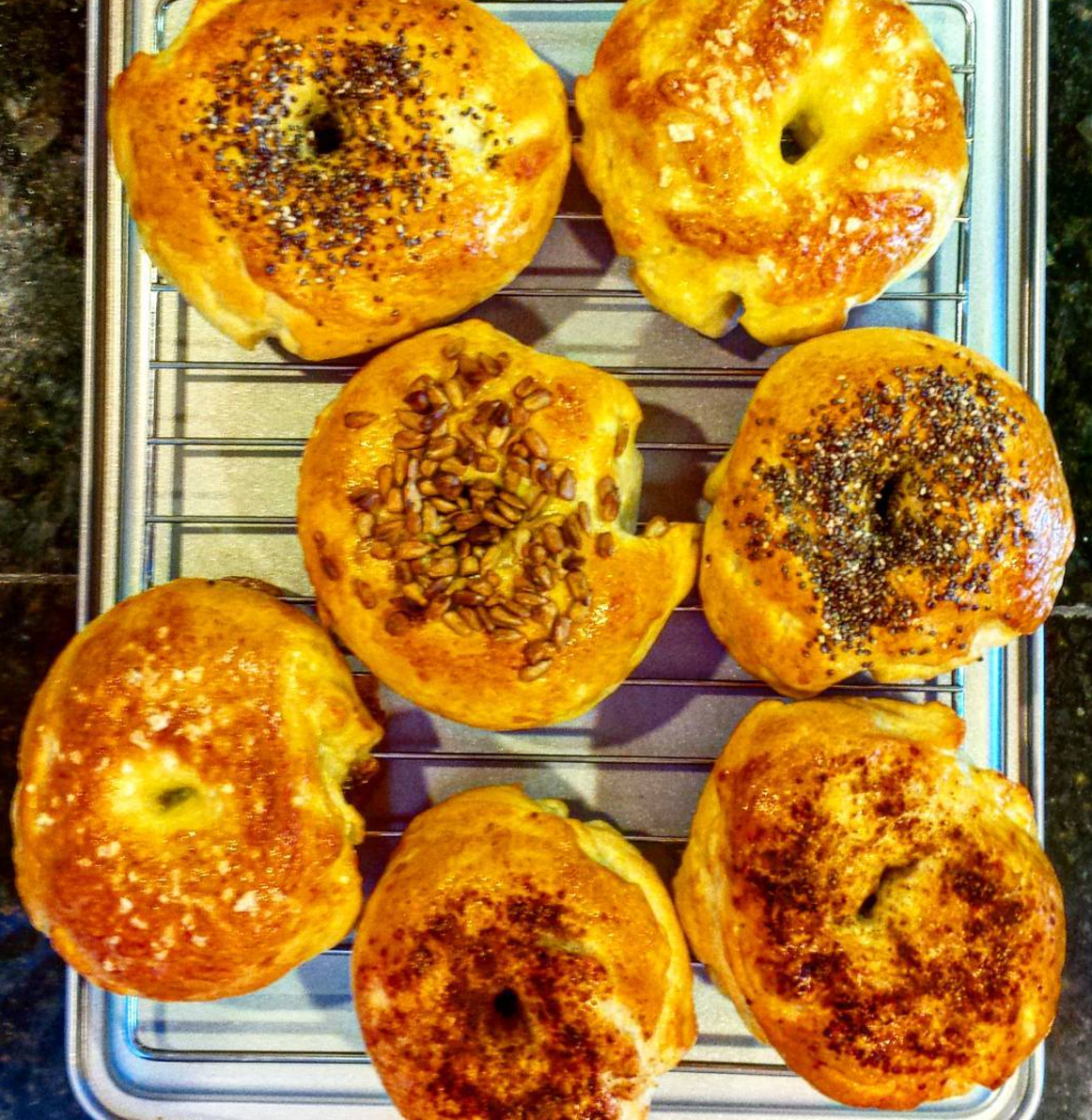
Homemade bagels from my kitchen. ~CRA

Tell bread to rise and it ignores you. It will rise of its own accord. You can’t make it rise faster. It often requires work, and lots of it. Baking bread is a contact sport, and you must give it your hands, arms, and heart. In all these ways, it is a holy act. It is an act of patience, belief, and faith.

Lately the only thing that makes me feel better is cooking and baking, and baking bread most of all. I can’t write or read or multi-task while I bake bread. It helps me to pause, be quiet, and reflect. It demands my mind, my hands, and my attention for a certain amount of time, and then it demands I leave it alone for a good long while.

So if you’re feeling lost or disillusioned or confused, even angry or sad or disappointed, I suggest stocking your cupboard with the magic combination of flour, salt, and yeast. Add some water, tuck it away for a while in a warm, cozy place, and magical things will begin to happen. It will rise. And you will rise with it.

creativity

Wonder: Breaking Bread with Chopped Champion and Executive Chef Demetrio Zavala

Ever wonder what it’s like to be a competitor on the Food Network show Chopped? Wonder no more. Today is my first installment of the “Behind the Scenes” segments for the Breaking Bread Podcast and I’m talking to Chef Demetrio Zavala, Executive Chef at DC’s Lincoln, Declaration, and Teddy and the Bull Bar. He became a Chopped Champion in October 2016. Chef Demetrio tells me what it’s like to be on Chopped. We talked about his love for his work, his business, his team, and most of all, his guests. I visited him at Lincoln to give you a full sense of the fun and festive atmosphere that he creates in all of his restaurants. Let’s listen in…