art, simplicity, values

My Year of Hopefulness – Jackson Pollack, Explained

I was in DC a few weekends ago and met up with a bunch of friends from business school. One member of the group who is more a classmate than a friend of mine criticized Jackson Pollock and his work, citing that even he could drip a bunch of paint on a canvas. (And this guy doesn’t have an artistic bone in his body!) At the time, I had no words to explain Jackson Pollock, and I was really upset by the guy’s criticism. I like Pollock’s work very much, though must confess I never understood it. I just love the patterns, colors, and textures of it.

As luck, and karma, would have it, today I found out why I love Jackson Pollock. If only I had read Matthew May’s book In Pursuit of Elegance before my DC trip! May explains the genius of Pollock’s work, thanks to the research of Richard Taylor, a physicist from Australia.

After studying Pollock’s work in connection to his physics research, Taylor recognized that Pollack built his paintings based upon fractals: “repetitive patterns nested within each other that remain the same at differing scales of magnification…[fractals] are simple rules…that create beautifully organized and highly complex designs [that are pleasing to the eye].” Trouble is Pollock died in 1956 and fractals weren’t discovered until 1975. Pollack lived and died ahead of his time, precisely 19 years ahead of his time.

I have been thinking about fractals all evening, their importance to physics, to Pollock, and to every day life. In a very real sense, our core values are fractals: repeating patterns that remain constant, even when examined up close. We don’t abandon them at our front door or in certain company. They stay with us and play themselves out in every area of our lives. From those simple values (aka, simple personal rules) – honesty, kindness, loyalty – we build complex, intricate relationships that form the very foundation from which all our life experiences grow. Fractals make art, and life, appealing to the eye, the mind, and the heart.

Lest we think that life is all about politics and facades and putting on airs – it is not. Life is about getting down to the simple matter of what matters to us. At the end of the day, what really counts? What do we want to be known for? What are the constants that underlie who we are, under all circumstances? It’s those things, those constant, consistent patterns, and their intersections that help us build beautiful lives.

The image above is of Blue Poles by Jackson Pollock. It recently sold for $40M.

Business Week, economy, job, multi-tasking, New York Times, simplicity

Growing by Shrinking

We’re in the midst of watching our economy contract. These are frightening times, uncertain times for many people. I was inspired by Nicholas Kristof’s column this week as he attempted to find a bright spot in all the gloom that is filling our news channels and our own minds. I was flipping through Business Week and saw an ad for IBM with the following headline in bold type: “Sometimes Growing Starts With Shrinking”. How can we connect Kristof’s ideas and the IBM ad? 

Aside from our economy, I have been thinking about examples of shrink leading to growth. The ipod – making our music libraries physically shrinking from 100’s or 1000’s of albums, tapes, and CDs into one powerful device helped Apple find new life. The same can be said of many electronics such as cell phones and computers. 
 
Let’s consider travel. There have been a myriad of articles that encourage travelers to select a few key cities for a vacation and take in all they have to offer rather than doing a whirlwind trip and only skimming the surface of many cities. It creates more powerful and lasting memories, not to mention providing for some relaxation – the whole purpose of many vacations. 
Another example that struck me was all of the research being done now on multi-tasking. By attempting to do many things at once, it turns out that we do all of them more poorly than we could if we focused on one at a time. I notice this all of the time at work as I’m trying to balance a whole host of projects and objectives. Some studies even show that a lack of focus caused by multi-tasking increases stress levels, worsening general health levels, and lowering IQs.    
Now consider our economy: Think about the benefit of shrinking our spending to increase our savings. Barry Schwartz talks about shrinking the number of options we consider as a means of being happier with the choices we make. And then one of my favorite mantras can bring an immeasurable amount of peace to your life: simplify, simplify, simplify.
All of this is meant to show that shrinking isn’t always bad and can even be good for us if we’re willing to put aside our belief that bigger and more always equals better. Sometimes doing and having less provides abundance in ways we never expected.   
business, Business Week, clarity, creative, economy, government, money, New York Times, politics, simplicity, social work

The agony of confusion and the ecstasy of clarity

By nature, I’m a passionate person. There are a few subjects that really get me going – happiness, creativity, health and wellness, the environment, puppies. (Not necessarily in that order.) And simplicity – I’m big on that. If we all worked on making our world and our lives simpler, we would all be better off. In some circles complexity and confusion are celebrated, relished, even chased because it’s a mark that what those people in those circles are doing is “very important” if no one else can understand it. How ridiculous, not to mention wasteful – something we can no longer afford to be in our economic situation. 

I was shocked to hear the news today that the House didn’t pass the “bailout”. The Dow tumbled along with stock prices of major companies, and panic is spreading, slowly and quietly. It’s unsettling. Someone said to me today that she didn’t really ever understand the plan, and it’s too bad that it was never explained thoroughly and clearly to the American people. I almost see her point – I do think it was explained by major media outlets like Business Week and the New York Times. You just needed to have the patience to wade through the lengthy articles. And if you don’t understand something, ask around and get some help. Don’t just throw up your hands and say “forget it.” What really happened in the coverage is that no one made it simple to understand if you didn’t have a degree in economics or an MBA. 

Simplicity and clarity are absent in many areas of our lives: in meetings at work, in relationships, in the many contracts with very small print that govern our well-being, financially and health-wise. Companies spend a lot of time, effort, and money because of confusion in roles and responsibilities, objectives, and priorities. Simplicity saves a lot of heartache. And we get to simplicity by being real, honest, and straight-forward in our intentions and actions. 

Clarity builds trust and integrity; it makes people feel that they are a part of an effort because they understand it and can clearly articulate it. Being clear and concise is a sign of maturity – it’s the responsible thing to do regardless of circumstance. Confusion never pays in the long-run and only delays the inevitable. If only our government and financial markets understood that – maybe we’d find ourselves and our economy in much better shape. 
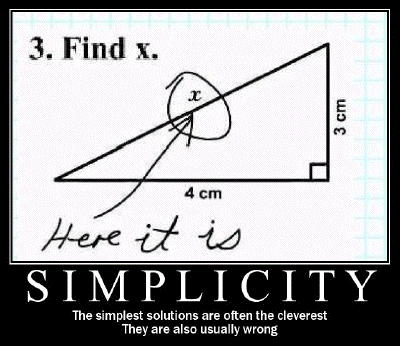
The image above can be found at http://ozguru.mu.nu/Photos/simplicity.gif
friendship, personality. relationships, Real Simple, relationships, simplicity, technology

iwantsandy.com

I think my mobile life is about to get more complicated. I have never had a Blackberry (or Crackberry as the case may be) before this job. It wasn’t essential to my other positions. Now with this new job, some work travel, and managing multiple cross-functional projects with tight deadlines and heavy execution components, I will need one. So here we go…


I was a little nervous because I was trying to figure out how I’d link my personal calendar and my work calendar if I have two devices. What a pain. And now I’m beginning to see that mobile applications are going to play a big role in our lives very soon. Who wants to be beholden to any single device? I want my schedule, documents, endless numbers of lists, etc. accessible 24 hours a day, wherever I am, from any device.

My friend, Ariel, constantly teases me about the fact that many times I can’t get right back to people when they leave me a message. If I take a week to return his casual phone call, I’m still hearing about it months later. Recently he joked “Christa, your social life is so active you need your own assistant.” I laughed. Sure I’ll get an assistant, as long as he or she works around my schedule, manages all of my life details with little effort on my part, and promises to never leave. Oh, and I’d like him or her to work for $0. “Ask and you shall receive,” my mother (Sandy) always says. And that’s when I met another Sandy that I think will quickly become indispensable. Real Simple Magazine introduced us. 

Sandy is a virtual assistant who emails and /or texts me any and all reminders that I set up simply by sending her an email to a special address. She has text recognition capabilities, handle calendars, to-dos, goals, contact lists. The only downside is you have to learn Sandy-eez. In order for everything to be logged correctly be Sandy – you have to speak her language and use her specific shorthand. That’s not so bad though – I mean, after all, she is keeping you completely organized for free and working 24/7 with a cheerful personality.

And the only other fix I might recommend – I’d love to be able to personalize my assistant and give him or her their own unique personality and look. Maybe that’s Sandy 2.0?   
China, economy, friendship, Olympics, simplicity

What no one tells us about China

Last night, my friend Allan and I had dinner at Barbuto, an Italian place in the West Village that I have been meaning to try for a year. Allan is going away for 6 months – off to Singapore for work. I’m a little jealous of Allan – part of me misses flying off to a new place every week. And then I remind myself that I should be careful what I wish for.


Allan is one of my dearest friends from business school. If you had to 5 people from your life who were cheering for you, you’d want Allan there. His loyalty to his friends is something to be admired. And his work ethic would leave any American student in disbelief. He got an MBA and a half out of Darden; he put the rest of us to shame. Usually Allan and I talk about books and work ad what every crazy little projects that are taking my time these days. But last night turned to the topic of romantic relationships. Allan is confused by women. I smiled. 

Allan explained to me that in China, things are not complicated. Love included. People live a simple and diligent life. In a planned economy, there isn’t all this choice that we have here in the U.S. Nothing is really all that trying. An absence of angst.

And now when I reflect back on those Olympics Games and those inspiring, creative beyond measure, ceremonies that preceded and closed them, I understand how they came to be so precise, so perfect. They were singularly focused, the entire nation. They are unencumbered by a multitude of choices and complications. 

Now, I’m not advocating for a planned economy. I’m saying that we have more to learn from the Chinese people than we ever imagined. Their creativity and their passion is built around simplicity. And the question I’m left with is I wonder if we, as Americans, could get out of our own and get focused. It might be out only hope out of so many problems that are plaguing us.  
simplicity, writer, writing

The hard work of simplicity

I have been working on a few projects that require one simple thing: simplicity. While we crave it, work for it, buy all kinds of books and gadgets that claim to be able to make our lives simple, simplicity often alludes us. Recently, I sat with a team member to craft a memo. She kept adding, and adding, and ADDING to it. Finally I said, “Stop. Turn away from the computer. Tell me what you want to say.” She could articulate her ideas well when speaking to me and the moment she sat at the computer, she hid behind an excess of words.

I found a quote later that day that gets at the very essence of good writing, and solid editing. “The ability to simplify means to eliminate the unnecessary so that the necessary may speak. ~ Hans Hofmann.” And that’s it in a nutshell – that is the motivation of every writer, and every editor, in one succinct sentence. To get to the diamond, you need to polish it, and that means removing the unnecessary layers.

It’s easy to understand why we think simplicity should be simple. It’s not – it’s an art that must be practiced. It can be painful. Simplicity is work. We are complex creatures – emotions, biases, past experience, and a deep need to be understood all stand in our way. The work of an editor is to clear the path. To soothe emotions and biases, while preserving and honoring history and the ability for us to influence and affect one another.

As a quick guide, I do the following four things when I feel simplicity getting away from me:

1.) I audibly articulate the nugget of truth I am trying to convey. And then I write it down verbatim. I start from there. 

2.) I eliminate every word I can without losing the sentiment I want to convey. This can mean many different types of rework: from restructuring a sentence to finding a descriptive word that can speak for a number of smaller words.

3.) I step away from the writing, even just for a few minutes. Sometimes to get out of the hairball in our writing, we have to physically step away from it. 

4.) I only write when I am crystal clear about my motivation for writing, the channel I am writing for (print, blog, brochure, presentation, etc.), and the audience I am trying to reach. This is the framework on which we hang every word.

Wishing you simplicity and good editing, in writing and in life!

Graphic above found at http://www.simpledorm.com/images/simple.gif