education, learning, teaching

Step 197: Teaching as Service

“Live each season as it passes; breathe the air, drink the drink, taste the fruit, and resign yourself to the influences of each.” ~ Henry David Thoreau

The syllabus for my LIM College class is coming together. We’ve worked through some required reading choices, made some structural decisions, and began the search for final project ideas that the students will work on in teams. I’m an exceptional student, and I’m learning fast that there is not a direct correlation between student skills and teaching skills. Previously, I thought there was a strong linkage. Teaching, unlike studying, takes us to the very edge of our learning every time. We can only teach what we truly know and embody.

I have a lot to learn about how a college operates, how staff and faculty work with one another, and how to make a mountain of information palatable and intriguing for college students. I have no doubt that I’ll get there – it’s just going to take loads of muscle power on my part.

As I left my meeting at LIM this morning, I thought about the correlations between teaching and leadership. I have always believed that being a leader is not telling people what to do – it’s about paving the way for others to spread their wings. It’s about providing resources, support, and a knowledgable, empathic ear. It’s about helping people be the very best they can be.

Teaching, as I see it now, is the same thing. Give students some knowledge, resources, and a structure that fosters their own creative thinking. And again, that empathic ear is as useful in the classroom as it is in the boardroom.

As a new adjunct faculty member, I’m a student as well. I’m learning how to craft a syllabus and then bring it to life. I’m learning about new teaching technologies as my class will be done half in the classroom and half online. From the other side of the table, I’m now crafting and analyzing grading systems, workloads, objectives, and then figuring how to map objectives and tie them into weekly lesson plans.

I’m a doer – the strategic thinking phase of a project, I will admit, is not my favorite. I want to roll up my sleeves and get to work. I need to tinker and test and try on these teaching shoes. I’m anxious to get into the classroom, meet the students, and begin.

On my way out from LIM this morning, I saw the Henry David Thoreau quote on their bulletin board and I took a deep breath. It’s okay, and actually a privilege, to be at the beginning. And the more time (within reason) we spend at the beginning, the better the end result will be. Every task, just like every fruit, has its season. Thank you for the reminder, Mr. Thoreau.

change, choices, education

Step 190: Structured Flexibility and Flexible Structure

“At the moment of commitment, the universe conspires to assist you.” ~ Goethe

This morning I had a terrific meeting with Dudley Blossom, the head of the Marketing Department at LIM College where I’m going to teach a class this Fall entitled “Guerilla, Viral, and Social Media Marketing.” We were tossing around ideas for the syllabus, getting it all down on paper. My first draft netted out at 6 pages, about 4 pages too long. To do that much editing, we needed to go back to the basics. Simplify, simplify, simplify.

This subject is so interesting because just when people think they’ve pegged the future of social media, there’s a beautiful disruption that takes content creators, consumers, and trend analysts in a new, never-seen-before direction. The way that the social media world exists today may be turned on its head by the time we wind up the semester in December. Still, we need to give students a sense of direction and give ourselves a way to change direction if the market warrants it.

What we need for this class is structured flexibility, or flexible structure. Social media, like yoga, like writing, like performance of any kind, needs to live in this in-between world. We have to be able to adapt on the fly. The more I think about my life and its directions, the more I see that I’ve been working on the skill of adaptation for many years, from so many different angles. A millieu of commitments made and commitments changed. As my friend, Amanda says, “You can choose 1 side or the other of an argument, but sitting on the fence is the weak position. And know that if convincing, contrary evidence is presented to you, you can change your position.”

I’m taking Amanda’s sage advice, and applying it to my syllabus for the LIM class and my life in general. Choices, and conviction behind those choices, do have a magic to them.

The image above can be found here.

education, social media

Step 175: My First College Teaching Gig This Fall at LIM College

In January, I spoke to my friend, Trevin, about my desire to teach in a college setting. At that point I was still considering a PhD program because I thought that would be the surest way to teach at a college. Trevin, now a college professor, in his infinite kindness offered to connect me to a friend and mentor of his at LIM (Laboratory Institute of Merchandising) College in New York. He thought his friend may be able to offer me some advice.

Trevin’s friend offered to take a look at my resume. He said at the time that there wasn’t a teaching position at LIM that matched my background though he’d keep my resume on file should anything come up. He mentioned that I may be a good fit for the Marketing Department so he’d keep an eye out for me. I thanked him profusely and archived the emails. Several months later, the head of the Marketing Department at LIM asked me if I’d come in to the school to meet him. He wanted to offer a class on social media in the Fall and thought I might be interested.

I went into the school, had my interview, and we talked about social media – where it might be going (anyone who says they know for certain where we’re heading is bluffing), how students could learn from the platforms available, and how brands can and should measure the results of social media campaigns. After a wonderful morning, I felt confident that this might have real potential, that I could actually teach in the subject area I’m most interested in without needing a PhD at all. We went back and forth on email over the following months, and then we seemed to reach a scheduling impasse. I thought the opportunity had died on the vine.

And then something really incredible happened. I sat down and really thought about how I’d feel in 5 years if I passed up this opportunity now, and no matter how I turned it over in my mind, I knew in my gut that turning down the opportunity was the wrong choice. (Brian’s proud of me for trusting my gut more often these days.) So I went back, worked out my scheduling conflicts, LIM compromised a bit on my behalf, and voila, problem solved. Compromise only results if we’re really honest about what’s most important to us.

This coming Fall I’ll joining LIM’s faculty as an adjunct professor, my first college teacher role (hopefully one of many). I will be teaching a class entitled Viral, Guerilla, and Social Media Marketing. (I can’t take any credit for the title, but I do love it!) The Marketing Chair and I are working out a cool curriculum, and are uber-excited to see how it all pans out. There’s magic in trusting our gut and going for what we want.

adventure, education, entrepreneurship

Step 161: Lateral Action

I went to college right out of high school at a prestigious university, finished in 4 years, completing classes in very practical subjects (economics and history, minor in psychology). I got an MBA in general management at another very prestigious university, worked my a** off, and then got a well-paying job right after graduation. By all accounts I architected my career to foster financial independence and my creative spirit, even if some of my decisions in real-time made some people scratch their heads. In the end, I did make the best choices. I was right to make the moves I made. Go me.

And then about a year and a half ago, the bottom fell out of the economy and I started to question what I was doing with my time post-MBA. All the old paradigms about education, career, and making a living crumbled. Then 9 months ago, my apartment building caught fire, I almost lost my life, I did lose almost all of my precious belongings I had worked so hard for, and I began to question everything. This staged questioning lead me to a door I never thought I’d choose again: entrepreneurship. Working for myself. And not just as a freelancer, but building my own company from the ground up – Compass Yoga.

I talked to entrepreneurs, interviewed them, wrote about them, read books, magazines, and blogs, and attended conferences. I built up enough knowledge that I knew I wanted to do this, that I’d be really disappointed with my life if I didn’t at least give it a whirl. And the further I’ve delved into the process, the more I realized that it would be very easy for me to make a bunch of really lousy mistakes because I don’t know what I don’t know. This is all new and I need some guidance, or at least some people around me who are in the same start-up boat.

Kismet set in and a post from Problogger showed up in my inbox on Tuesday about a guy named Brian Clark who pens Copyblogger. I hopped over to Copyblogger and liked what I saw. He was honest, straight-forward, and a very talented writer. He also seemed very genuine in his desire to help brand new or would-be entrepreneurs (i.e., me). He just co-launched an initiative called Lateral Action that will offer a 6-week online entrepreneurship course that offers “everything we would have wanted to know 10 years ago starting out.” His co-founders are a cartoonist and a poet. My kind of folks. Hmmm….I kept reading, skeptically.

Sounded like too much of a line, too much a cliché. And then he said something that opened my mind a bit more. “What is that type of information worth? Well, I personally made squat for about three years getting started. Making even a fraction of my current income back then would be worth a fairly substantial investment given that kind of return. Let me be clear. We’re not looking for just anyone with a credit card. Rather, we’re interested in working with motivated people who will take action with these methods.”

Okay, now I’m really listening. What sold me was that I sent an email to one of the co-founders and he responded within a few minutes. I told him about Compass Yoga and a bit about my professional background as a product developer. He told me why the class would be completely worthwhile for me and that one of his inspirations (and friend) is Jonathan Fields, the person who founded Sonic Yoga (where I just completed my yoga teacher training.)

All these pieces bundled together – the fact that I need some more guidance in starting MY business (not just any business), Brian’s authentic voice, Mark’s responsiveness, and the Jonathan Fields connection – made me realize that I stumbled upon something that is far more valuable than the small class fee. I just downloaded the first few modules, and I’m going to comb through them this weekend. I’ll let you know how it goes. This just may change my tune about online education.

Have you ever had an experience that caused you to change a long-held belief? If so, I’d love to hear about it!

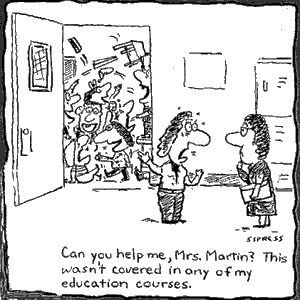
I don’t know who created the cartoon above, though if I had to place a bet, I’d say it was Tony Clark, the cartoonist who is a co-founder of Lateral Action. The cartoon is from their site and I think it’s hilarious (and true-to-life).

business, education, entrepreneurship, social change, social entrepreneurship

Step 144: Sparkseed Supports Social Innovators at American Universities

A few months ago, I featured Jerri Chou from All Day Buffet and Teju Ravilochan from the Unreasonable Institute. Jerri and Teju’s optimism in action inspired me to continue seeking out social entrepreneurs who believe that the greatest positive impact on society can be made when we create opportunities for people to use their personal passions to do well and do good at the same time.

I virtually met Mike Del Ponte as a result of my interviews with Jerri and Teju. He emailed me to educate me about his initiative, Sparkseed, which invests in American college students who aspire to be tomorrow’s social entrepreneurs. They have ideas to change the world, and Sparkseed helps them get there by providing a unique blend of services including pro-bono consulting, mentoring, and seed money.

I meet a lot of social entrepreneurs with inspiring stories. Mike’s ability to combine his business savvy with his passion for and personal experience with social entrepreneurship is a rare gift. “When I was at Yale I launched a social venture and soon found that I had to teach myself everything: how to form the corporation, how to recruit and manage a team, how to pitch to investors, etc…I had to reinvent the wheel and wasted a lot of time…I noticed that almost all student innovators run into the same problem…Sparkseed was established to give young social entrepreneurs everything they need to fulfill their potential as change agents.”

The Financial Times recently awarded Sparkseed with its prestigious Best Social Investment Strategy award. To date, Sparkseed has funded over 50 social enterprise projects from a wide variety of fields:

Elecar Inc.: Founded by Brown University student Andrew Antar, Elecar is working to provide the missing piece to the electric car puzzle. By developing residential charging station and an online payment system, Elecar is laying a cost-effective framework to facilitate the mass adoption of electric cars.

MaloTraders: Founded by Temple University student Mohamed Ali Niang, MaloTraders specializing in the processing, storing, and marketing of rice for small-scale farmers in Mali. By making local production more competitive on the international market, MaloTrade is working to alleviate poverty.

Paper Feet: Founded by University of Michigan student Jimmy Tomczak, Paper Feet makes the world’s thinnest and most flexible flip-flop out of recycled billboard vinyl. Every year, 10,000 tons of billboard vinyl ends up in landfills. Paper Feet is addressing this problem by rolling out a line of hip products all made from up-cycled waste.

Get involved and be inspired! Learn more about Sparkseed and its incredible stable of social entrepreneurs by visiting the organization’s website, joining the Facebook page, and following on Twitter.

children, education

Step 111: Everyone Needs Kids

“Adults are always asking little kids what they want to be when they grow up because they’re looking for ideas.” ~ Paula Poundstone

“When we approach children with the awareness that they are our teachers, we become more present ourselves.” ~ DailyOM

“Everyone needs a 14-year old,” my friend, Brian, said to me tonight at dinner. Kids and teenagers have their finger on the pulse of what’s cool, new, and will someday be widely accepted. We don’t give our little gurus enough credit. I’m convinced that a room full of teenagers has a whole lot more creative brainpower, and therefore potential to build something of value, than a room full of Fortune 500 executives.

Today at work we had our annual Bowl-a-thon to raise money for Junior Achievement, a nonprofit that helps professionals volunteer in public schools to teach financial literacy courses. We had a great time (even though it was made painfully clear that I’m just never going to be a good bowler), and I would have liked a small plug about the organization and their mission. Supporting education, and public education in particular, is crucial to our nation’s future. Without it, we might as well throw in the towel now.

This week I came across the quotes at the top of this page, and combined with my conversation with Brian and the bowl-a-thon, I was reminded how important it is to have kids in our lives. I’m not sure that I want to have children, but I’m so glad they’re a part of my life through my volunteer work and my family. We have so much to learn from them, and they need us to champion their rights. If kids aren’t a part of your life in any way, I highly encourage finding a way to spend time with them. Here are some ways that can help get you going:

1.) Volunteer. There are so many opportunities to teach a class, coach a sports team, or be a mentor. You can learn from them and they can learn from you. Check out TakePart Social Action Network, to find volunteer opportunities near you.

2.) It takes a village. Offer to spend time with the child of a family member or friend. Your friends and family can use the down time, and their kids will benefit from having you as a great adult role model in their lives.

3.) Check around the office. At work there may be a way to do some research about the youth demographic or work on a product or service whose primary users are kids. Being a part of the market research, or just having to put yourself into the mindset of a young consumer, can effect your entire view of the world.

4.) Read books meant for a young audience. When I’m in bookstores, I do a little spin through the young adult reader section and I always find a book I like. It’s become a huge market for book publishers (thank you, Harry Potter) so the content is very rich. If you can’t find a way to get real kids in your life, just reading the books they’re reading, watching the TV shows that intrigue them, or listening to music they like can give you enough of their perspective to start to expand your own horizons.

If you have kids in your life, I’d love to hear your stories about what these kids have taught you.

The image above is not my own. It can be found here.

education, teaching

Step 102: Teaching as Curation

I had dinner with my friend, Allan, on Saturday night. As we munched on the delicious Vietnamese food at one of my favorite restaurants in the neighborhood, I told Allan about my yoga teacher training (which I’m happy to report is now half-way finished!) and my continued interest in the field of education as a whole. “Do you think teaching is difficult?” Allan asked me. “Can’t you eventually just teach the material on auto-pilot?”

I thought about my teaching experience – teaching yoga at UVA, middle school economics for Junior Achievement in the South Bronx, high school business ethics for Junior Achievement in Lower Manhattan, and guest lecturing at Hunter College on the subject of social media and politics. I’ve never been able to, nor would I want to, go on auto-pilot. Going on auto-pilot isn’t teaching. It’s presenting, badly and blindly.

When I teach, I think of it as service. It’s not about me. It’s about the students. What do they need? How can I help them and what can I learn from them? Teaching is a curated dialogue, and it’s an act that needs commitment. Ever have a conversation with someone on auto-pilot? As soon as I see that auto-pilot light go on, I turn tail and run in the opposite direction. Students with teachers on auto-pilot should do the same. Presenting material is a breeze; doing it in a way that turns on a light for students and makes them see the world differently is a stunning event to witness and must be earned.

I’d love to hear your thoughts on amazing teachers who made a lasting impression on you and how they did it!

The image above is not my own. It can be found here.

anthropology, career, education

Step 71: Columbia Regrets to Inform You…

Several month ago I applied to a PhD program at Columbia’s Teachers College. I had found what I thought was a perfect program, Anthropology and Education, at just the right time. I carefully crafted my application, got my recommendation letters together, and took my GRE. Despite the rejection notice today, I know I put forward the strongest application I possibly could. And it’s okay that I didn’t get accepted – I guess that program is just not meant to be a part of my path right now.

I am very proud of the admissions essay I wrote and so I decided to share it below. The fact that Columbia will not immediately be a part of the journey that this essay lays out is not a terrible thing. I’ll find another way now to keep making progress toward bringing this dream to life — not only because I want to see it become a reality but more importantly because so many people in this country, in this world, need this solution:

“How did you learn to make stuff?” whispered Superior, one of my 7th grade Junior Achievement students at M.S. 223 in the South Bronx, when I described my career as a product developer.

“I made something once and it didn’t work so well so I just kept changing it until it did work well. A lot of trial and error and trial again,” I replied. “This process is called prototyping.”

He looked at me with a very serious expression. “I want to learn to make stuff, too.”

“And what kind of company do you want to work for?” I asked.

“My own. I don’t want to work for anyone else, ever,” he said.

Inspired by this conversation with Superior last year, I began to seriously consider a professional career in education. I was stunned by his interest in entrepreneurship at such a young age. I asked each student in the class what career they would like to have. 8 out of 10 wanted to have their own businesses where they made their own original products. These students were budding entrepreneurs, and I want to help them open their own businesses by providing them with a curriculum that teaches them the skills that will make them successful in their pursuits.

Our most successful lesson to date at M.S. 223 involved improvised skits to demonstrate the importance of insurance during emergency situations. The children came alive when asked to perform. I understood this feeling well because I made my career in professional theatre for 6 years. Additionally, the students quickly learned the complicated vocabulary and intrinsic value of insurance through their performances. The students were gifted storytellers. They showed me how all of my professional experiences could be brought to bear in a classroom setting. I found my home in the field of education at M.S. 223 thanks to those students.

As I headed for the subway that day last year, I felt a mix of emotions. I was tired from a long day and appreciative of what it takes to be a teacher in New York City public schools. I was happy to lend my time to a group of children who were eager to learn and in need of adult role models. I was frustrated with the holes in their curriculum and sad because I knew the dire living situations of these children.

Mostly, I felt responsible. I grew up below the poverty line so I understand the personal circumstances these children face every day. The odds of success are stacked against them just as they were stacked against me. Even though I grew up in a difficult socioeconomic situation, public education helped me to change my circumstances. I have a fervent desire to help other students the way that my family, teachers, and guidance counselors helped me to break the cycle of poverty by encouraging my natural creativity and love for learning. These children at M.S. 223, and the many other children around the world just like them, can better their own lives through hard work and commitment – I know that first hand. They can choose their better history so long as we build public education systems that provide opportunities for broad-based learning and success.

Design thinking, the discipline of using the creative problem-solving skills of a designer, is an ideal tool to re-imagine public education systems. While I have used design thinking as a product developer for almost a decade in a number of different industries, only recently have I begun to consider its application in social enterprise.

The development of education systems that tap into design is critical to our future. In corporations I meet many employees who feel downtrodden and powerless, unable to tap their personal creativity that can develop break-through innovation. They literally have to have their creativity and confidence rebuilt from the ground up because their education system and the companies where they work told them that people like accountants, computer programmers, and sales people are not the creative ones in an organization. Corporations cannot afford this kind of mindset in our new economy; to survive they need the creative engines of every employee.

Superior has more confidence in his creative abilities than most professional business people I know. We need education systems that reinforce creative confidence, not tear it down. It would be more effective to build a public education system that fosters creativity all the way through rather than trying to teach adult professionals how to be as creative as children. It is to this end that I plan to dedicate my career going forward.

Building public education systems based on design thinking will be my contribution to humanity. A doctoral degree from Columbia’s Teachers College in Anthropology and Education will be an asset for me as I pursue this dream. This program is the only doctoral program I am applying to because of its unique emphasis on a deep, disciplined understanding of culture as a critical component to building effective education systems. I am particularly enthusiastic about this program because it recognizes that educational environments can be found throughout a community and because of its history as a pioneer, a history that perfectly suits my plans to innovate in the field of education.

By conducting on-the-ground research and development in design thinking applied to public education, I can help many children across the globe to live happier, more productive lives. The concerns that our world faces are serious and many, and they demand that we muster every bit of our collective creativity to find solutions that bring about real, long-lasting change. When I consider how I can best lever up my abilities to do the most good in the world, my thoughts always return to the field of education because it is the lynchpin that makes transformative change possible. Education is our greatest hope for a better world and a brighter future.”

choices, education, time

Step 43: Traveling a Path Takes Time

“Yes there are two paths you can go by, but in the long run there’s still time to change the road you’re on.” ~ Led Zeppelin, “Stairway to Heaven”

This week has been filled with ups and downs of very high and very low proportions. On the very high side, I was offered and accepted a new position at my company, an assignment so fantastic that I’m going to tempt fate a bit and say it’s a dream assignment. A blank sheet of paper and lots of opportunity with a fantastic team.

The very tough decision to make was to not conduct Innovation Station, my after-school program about product development, with Citizen Schools. With all this newness hitting of the job and the program at exactly the same time, I was feeling a little overwhlemed and pulled in too many directions. Usually I just allow myself to be overwhelmed and go with it. I’m trying to be better about this. Something had to give and that something couldn’t be my sanity or my time with my friends and family. So I will have to find another way forward for Innovation Station.

I’ve been feeling badly about this decision, recognizing that I couldn’t have it all, at least not right now. And then this quote made me feel a bit better. We can always change the road we’re on; we don’t always recognize that. We sometimes forget that almost everything that happens in our lives in something we choose. If we really want to make something happen, we can find a new avenue for it.

Yes, we can find the right path, but traveling the path takes time and we don’t always progress in the manner or in the time frame that we’d like to. Sometimes, we have to slow down, for our own sake and for the sake of our calling. It’s a tough, powerful lesson to learn and I’m trying.

The image above is not my own. It can be found here.

education, innovation

Step 37: Go the Extra Bit

“We’re so close to greatness. I can feel it!” ~ Cliff, Citizen Schools Teaching Fellow working with Innovation Station

Last week at my training session for Citizen Schools, Cliff, the Teaching Fellow who will be with me every step of the way in the classroom, let this quote fly as we talked through ideas for the apprenticeship that begins next week. The apprenticeship, Innovation Station, is going to help students build their own prototypes and models of products and services that they would like to turn into businesses. On Tuesday, students at M.S. 45 will have the chance to attend an apprenticeship fair where I’ll be giving an elevator pitch on the subject of the apprenticeship and what we’ll do during the ten weeks that we’re together.

Originally, I thought I’d run a brainstorming session. Cliff looked at me, kindly, and said, “I think that’s going to get really out of control really fast. Let’s hold off on that idea. All the content is here – we know what the apprenticeship is about and the ultimate goal. We’re so close to greatness. I can feel it! We just have to figure out how to get and keep their attention.”

Cliff’s enthusiasm for the subject and for the kids helped me see that there was a better way forward. I could communicate the same content as originally planned, but there are so many other interactive avenues to get the kids interested than I first thought. Infomercials, celebrity examples, new uses for every day items, the element of the strange and unknown as a catalyst for curiosity. Cliff’s got a million tricks up his sleeves. More importantly, he believes in the idea as much as I do, and he can quickly get inside the minds of these kids. He knows what piques their interest.

What I needed was that extra push, that extra encouragement to knock down any perceived boundaries to what we could accomplish. As Cliff and I talked it out, we began to discover so many new ideas that we could barely keep track of them all on the paper. And the real beauty, is that the ideas were spontaneous. Neither of us had even considered them before sitting down to talk about the apprenticeship fair. Like little pings of inspiration, I could feel their magic falling down all around us.

We just needed to up our game a little – that’s what the prospect of a middle school student’s critique will do for us. It pushes us to go that extra bit. They don’t just want an apprenticeship that’s decent; they want one that makes them run to the session every week, one that makes them believe that they really do have hope for a brighter future and the ability to make it happen. They want greatness in action, and I mean to create that for them.

The image above is not my own. It can be found here.