business, corporation, ideas, innovation, leader, leadership

The Idea Guy

Some stories would be really funny if they weren’t so true. My friend, John, has successfully gotten his hefty graphic design projects out the door for the holiday season. He was right on-time and under-budget. We had coffee yesterday now that he’s successfully dug himself out from that pile of work. He was re-counting some of the sad and hilarious moments of the season and one of them really caught my attention. Well, actually one of the characters really caught my attention – his boss, Tom.


John largely does graphic design work for print. However, many of their clients are looking to them for web design work as well, specifically for social media. John doesn’t know much about this field so he had to dig in, learn the details, and then reconfigure his skills to get the job done. They had some big budget and time constraint decisions to make on some of his projects. He assembled the details in a clear presentation and then gave the decision options that were possible with the constraints they were under. After a 15-minute presentation, Tom cut in with some SWAG (Super Wild A*s Guess) ideas. Apparently, his company is fond of this SWAG idea to develop things like budgets, business cases, colorful PowerPoint presentations with smiley faces on them, etc. Poor John….

Professionally and tactfully, John explained why they really needed to choose from the options that he had presented. Tom stands up, and raising both of his hands to point at himself, says, “Tom, you’re not getting it. I’m the idea guy.” And gesturing to the rest of the team in the room says, “You guys need to make the ideas happen. I don’t care about the details.” Ouch. One of the team members actually rolled his eyes and plunked his forehead on the table. I feel another comedy sketch coming to me. And this would be a funny story, if it weren’t true. All we could was laugh as John was telling me this story. Otherwise, we’d have to cry. 

I love ideas; I can’t stand “idea people”. I’m not talking about people with ideas, innovators, product developers, etc. I’m talking about people who are full of hot air – lots of ideas with nothing to back them up. They have no ability to execute or even think about how it could be executed. And as a result, nothing gets done, the “make it happen” people leave, and innovation stalls. It’s a sad state of affairs. 

I have a simple piece of advice for companies that have people who refer to themselves as “idea people”. Get rid of them! Seriously. We all have ideas. All of us. The companies and people who win are also the ones who are movers and shakers, meaning they have ideas and they actually do something with them rather than just verbalizing them for their “minions” to do. These “idea people” are dangerous because they degrade others, as happened to my friend, John, and his team. By proclaiming themselves Lord of Ideas, they make everyone else feel small. If companies are going to get through these rocky times, teammates need to band together with a will to win. “Idea people” destroy the team dynamic, and that team dynamic is an asset that companies cannot afford to lose.  
business, career, corporation, job, youth

Is this the end of hierarchy?

With the current economy, the only case for hierarchy might be in the military. Have you ever wondered what a Senior Vice President General Manager Grand Pooba Chief of Everyone does? Me too. Who is making up titles this long and complicated? Companies too large to get out of their own way. 


The more I talk to my friends about their jobs, the more I hear the exact same frustrations continuously. “Not able to get anyone “of power” to listen to my ideas.” “Tired of feeling like I don’t count because I’m not a high enough rank.” “Why do 18 people need to approve every small decision we make?” “Why is everything SO SLOW here?”


There are many reasons for this commonality in their frustrations. It could be because many of my friends are on that cusp of being young though with enough years of experience under their belt to make bigger decisions than their titles “allow”. It could be that my friends are much smarter and more worldly than their bosses. It could that they’re all having a bad day – at the same time. 

The real reason I think they’re getting irritated is because the rules of the corporate game have changed and no one told their bosses, or their company CEOs for that matter. Seth Godin talks about industries as ecosystems, meaning they are dynamic. The rules change all the time, meaning corporate cultures need to change all the time. Adjustment, constant adjustment, is the name of the game. What worked for companies 10, 15, 20 years ago won’t work today. This is a brand new world. And it requires an intense curiosity and desire for growth that will keep today’s established companies relevant; without curiosity and growth they will be obsolete in the blink of an eye.

So what can big corporations do? Are they doomed? No – they just need to flatten out, especially at the top. A friend of mine recently attended a corporate training session and the trainer said that whenever they encounter a senior leader they need to look at their feet and let that leader run the whole conversation. I almost got sick. Who wants to work for an organization that not only doesn’t value youth, but does its best to make its young people feel insignificant? If corporations want to hang on to young people, they better learn to how to utilize their energy and ideas, quickly. Flatten out and give everyone at every level a chance to participate!

And for my friends who are frustrated with corporate rigidity? A few suggestions: think about branching out to try a new venture, maybe not for pay, but for peace of mind – for hope of what may pan out down the line. Offer your services to a start-up, or try something new like a language class that could have professional value in the future. It’s also powerful to gather the experience you can from where you are for however long you’re there. We all always have something to learn from whatever situation we’re in. Make sure to capture those learnings and take them with you when it’s time to give yourself a fresh start.      
business, entrepreneurship, health

Chance meetings you keep

Today I was feeling pretty badly. Sore throat, achy muscles, possibly a fever. But I had to go to work. I know I’m supposed to stay home when I’m sick. I couldn’t today – too much to do, no time to do it. Bad practice – yes. Avoidable – yes, if I had known I wouldn’t feel well and had brought my computer home. I didn’t. So I went in. 


And my sickness got worse throughout the day. My frustration and irritation was mounting.I hate being sick; I hate feeling sow and unproductive. Frankly, I just wanted to go home and crawl into bed. 

I had a meeting after work with an entrepreneur whom I greatly admire – Melanie Notkin who started savvyauntie.com. (If you haven’t checked out the site or signed up for the newsletter, I strongly encourage you to do so!) She wrote a post on her blog recently asking for interns. She wanted help, exactly the help that aligns with my experience and interests, to build her brand. I love social media; she loves social media and she needs someone to work on that part of her business. I almost cancelled our meeting, or at least postponed it. I didn’t feel well. I was tired. And frankly, I arrived home with a very bad attitude. How could I go talk to this bright-eyed entrepreneur with this dark cloud hanging over my head? I went any way – it’s rude to cancel last minute. And we were meeting at a Starbucks around the corner from my apartment. So I put on my best actor smile, decided to be in a good mood, and then was in a good mood. 

Thankfully I place a value on respect because I am thrilled that I didn’t cancel! I thought we’d meet for half an hour – we talked, non-stop for 2 and a half hours. By the end of our meeting I was on-board and excited about being an intern. An unpaid intern. Who would have thought? 
   
Turns out I was sick, though I had misdiagnosed the cause. I felt deflated all day today. With savvyauntie, Melanie explained what she needed, I explained what I was interested in, and we found a common ground. And wouldn’t you know it – my sore throat went away, my muscles ached less, and my bad attitude had evaporated. I feel more motivated for every area of my life. And I’m pretty jazzed about my new project. More to come… 

animals, business, entrepreneurship, environment, nature, relationships, Seth Godin

Lessons from an albatross


Seth Godin wrote a post today on his blog that made me pause and re-consider some questions I’ve been thinking about recently. He talked about the patience of the albatross. It can often sit in the water or on land for days waiting for the right wind to carry it up, up, and away. It can fly for days or weeks, non-stop, with a resting heart rate. It’s an incredible lesson in biology, with many applications to our lives. 


Seth talks about Albatross businesses – those that favor a long, slow ramp-up with an eye toward longevity. He promotes patience as more than a virtue – it’s a method of survival. And this is a good lesson not only for business, particularly entrepreneurial ventures, but also anything that is worth our personal time. This can be a personal relationship, a friendship, a hobby. I am thinking about it in the context of my writing and career and I hope these thoughts will help you think about this principle in the context of your own life. 

My writing: I started this blog on a whim about a year and a half ago. My friend, Stephen, said he liked my writing and hoped I’d continue doing it. I knew nothing about social media at the time. He suggested a blog. I googled the words “create blog”, Blogger came up as the top search engine return (no surprise since Google owns Blogger), and I put up a few posts that were copies of the newspaper articles I had written over the course of a year. I didn’t know what else to write about so I’d just jot down funny or interesting things that would happen to me throughout the day. And pretty soon, I was cranking along with a decent body of work. Over 400 posts to date. Where am I going with my blog? Not quite sure yet – but goodness am I enjoying the writing and it’s become a hobby I hope to continue throughout my life. At my friend, Anne’s, suggestion I am consider turning some of the posts into a collection of essays for publication on a more public scale. Just like the albatross, I’m searching for the right air current to launch a project like that.

My career: I’m 32 and have spent the better part of 10 years intensely studying human behavior and product and service development. I’ve cobbled together this beautiful tapestry of experience with that experience I have found a many colorful characters that have become my greatest treasure. Their collective diversity is a reflection of the many twists and turns my life has taken. I review the expertise I’ve built and the successes I can point to and wonder what’s next? Where do I go from here? How do I know what current to look for?

Part of the albatross equation is knowing where you want the current to carry you so you can quickly identify it when it comes your way. Extending your wings is the easy part. The challenge, and ultimately the reward, comes when you have taken a 360 look around from wherever you are now and determined the direction you need to go. The albatross doesn’t concern itself with the length of trip, his wings will carry him as far as they need to. He cares only about the destination. 

business, career, food, new product development, travel

Raisinets and apple juice

Sometimes my curiosity has hindered my life – just when I get going in one direction, any directions, I spot something else out of the corner of my eye and dart off to check it out. Some call this a lack of commitment or ADHD. I call it an uncontrollable commitment to learning. So match this up with my occasional insomnia and love of working very hard, and I get myself caught up in some very…interesting…adventures. 


This week, I launched a very large project which I will be advertising once it officially goes live and makes it past the test hurdles. I’ve been zig-zagging up and down the east coast this week, knocking down hurdles with my 2-ton bat. At one point, I made the mistake of calculating how many hours I had been awake: 39.5. Scary…but worth it in the end. 

I was in the Philly airport dining on a sumptuous dinner of Raisinets and apple juice. I was so exhausted that I could barely sit down – sounds counter-intuitive, though think of it as the jitters from too much adrenaline pumping through your system for too long. The thought of a full meal was making me a little queasy. So I opted for my beverage and candy of choice. Just enough to re-fuel and sending me packing off on another business trip, while I was only midway through my travels from the previous trip. 
  
Prior to my “Dinner of Warriors” as my friend, Stephen, called it, I just didn’t think I could do any more. I was so worn out and frustrated and disappointed. All I needed to do was take a deep breathe and re-evaluate. And that re-evaluation helped me take the long view. Did this suck a little bit right now, canceling all my personal plans for the week, eating candy for dinner, and living in the same clothes for several days as I got sent off in every which direction to keep the wheels on the bus that is my product launch? Sure. But I have a little secret – I kind of like the rush and the excitement of churn and the unknown. It’s when I feel most alive. And this tough economy, it’s not such a bad trait to have. And today when I advocated for the product to launch and received the green light, it was worth it. Well worth it. 

So now that I am back and cozy in my New York apartment, smiling and on my way out for a celebratory drink with my friend, Cindy, I know if need be, I’ll do it all over again. And my guess is that the need will indeed exist in the not-so-distant future. Next time, I’ll remember a change of clothes and a toothbrush. There may be a lot of Raisinets and apple juice in my future.   
business, care, career, economy, relationships, social work

Ask not what your company can do for you…

I was talking with a friend of mine from school today about, what else, the economy. We have big dreams – things to do, people to see, places to go. We were movin’ on up….until our economy tanked. Now we’re happy to just be employed. We talked about the morale in our respective offices. The morale of my team is going okay – his is not quite so good. I asked him how he felt about his future at the company and he gave me a wholly unexpected response. 


“In times like this, it’s better to think of what I can do for the company rather than think about what the company can do for me,” he said. “Who would you want to have around?: someone who’s always looking out for #1 or someone who’s looking out for everyone around him.” Good point.

In times like this when there is a lot of panic and anxiety, it’s only natural to think of ourselves and our own survival. As it turns out, the best way to survive is to look out for others, to connect with others, to support others in their pursuits. Think about it from another viewpoint – in tough times it would be easy for companies to just focus on their own survival. The truly innovative companies are finding their salvation in premium customer service – if they take care of customers now, when times are tough, those customers will remember them when the good times start to roll again. And they will roll again, no matter how bad it is now. Taking the long-view is critical to success years down the road. You’ve got to be willing to hang in there for the long haul. It’s no accident that the first for letters of “career” spell “care.” And that’s what businesses need right – people who honestly, deeply care about the present and the future. 

It’s like friendship, it’s like love. Tom Stoppard said, “It’s easy to love someone at their best. Love is loving someone at their worst.” When we’re down and out, we find out who really cares about us because those are the ones that stick around and help us pick up the pieces. It’s true in relationships and it’s true for businesses, too. Both need tending and nurturing, now more than ever.      
business, career, change, education, friendship, learning, work

How do you know when you’re done?

For the first time on this blog, I am writing from my Blackberry. Now that the full internet is always in my pocket, I have no excuse for not writing everday on this blog. The formatting may not be pretty, but I hope to keep the wit and insight constant despite this very tiny keyboard. Luckily I have tiny fingers. What I would really love is a peripheral full-size foldable keyboard that plugs right into my Blackberry. Maybe I need to contact the innovation head honcho at Blackberry and make that request.Now onto the topic of the day: knowing when you’re done.

With all of the demands placed on employees at work these days, it’s easy to understand how they are staying at work longer, physically and or virtually. In this economy, endless preparation is the name of the game for many. However, similar to student exam preparation, there is a point of diminishing returns. It’s similar to that old pithy line of “How can I ever miss you if you never go away?” Too much of a good thing is, well, no longer a good thing. This is true of almost everything in life, work included.

But with employees being pushed by managers in so many ways, how are we supposed to know when to call it quits? We could always do more, so how do we judge that fine line where more is less?

My dear friend, Ben, is a successful defense attorney. And because his expertise is criminal defense, he must be 100% prepared for every argument that could get thrown his way by the prosecution. Despite the fact that we recite the principle “innocent until proven guilty”, we rarely live it. I mean did anyone for a single moment believe that the “masterminds” at Bear Stearns were innocent before tried? I certainly didn’t, though I am a self-admitted hopeful cynic.

Ben has a very cool barometer of knowing when he’s done prepping for a case. It’s so good I considered stealing it as my own original thought for a very brief moment. Then I remembered I would be stealing from a highly-educated, best in class attorney who’s truly one of the most brilliant people I have ever met. Despite his humility and generosity, stealing IP from him seems unwise. And on occassion he reads this blog, so I would surely be caught. So please consider him fully-credited for this idea: prepare until your nervousness gives way to bordem. That’s the point at which all of your best thinking and lightbulb moments are exhausted.

So for today here is my own version of Letterman’s top 10 list – the top signs that I’m bored (aka – how I know when I’m just over it all):
10.) I begin to think about when I’m going to eat next
9.) I begin making multiple to-do lists in my head that have nothing to do with what’s in front of me
8.) I start humming audibly
7.) I start looking at my watch every 30 seconds
6.) I start thinking about how spot-on Tina Fey’s impression of Sarah Palin is
5.) I begin to wonder about the opportunity cost of doing what’s in front of me rather than doing something more “fun”
4.) I feel a nap coming on (even though I have chronic insomnia)
3.) Watching cartoons seems like a better use of my time
2.) Thinking I’d rather clean my bathroom than do the work in front of me.
1.) I realize I haven’t been paying attention to anything that the person in front of me has said for the past 10 minutes.

business, education, innovation, writing

Where to place our efforts

While in business school, I participated in the Innovation Challenge – a program that asks teams of business school students all over the world to solves a set of business challenges put forward by a handful of sponsor organizations. This year I was invited to be a judge in the competition and just completed the first round of judging. 


Someday, when I am old and wise (or at least old), I’d like to teach a class at a business school for one very simple reason. While I think our business schools may be teaching the fundamentals of how to value a bond and manage a P&L, they aren’t teaching a skill that is so crucial to success that many assumed it was an ability that everyone has – being able to write clearly and concisely. This afternoon, I would have settled for written proposals for the Innovation Challenge that were at least free of typos, used correct grammar, and exhibited a grasp of basic English vocabulary. 

Of the 11 proposals I was asked to judge, 2 of them were well-done. The ideas and solutions put forward by 2 teams were innovative and creative with sound success metrics and a long-term vision. Beyond those feats, they were also well-written. The other 9 were awful. Truly awful. Forget about the solutions not being feasible or short-sighted. Several were so badly written that I could barely read them. Those 9 badly-written proposals have nothing to do with talent or education level. It has everything to do with care and concern, or lack thereof. 2 teams put together the best case they possibly could. 9 of them slapped together some sentences in record time and handed it in.  

I considered writing a long set of notes for each team, and then I considered that that wouldn’t be fair to the 2 teams that put in so much of their own effort. So I wrote a paragraph for the 9 who didn’t care about the project, and saved my lengthy responses and comments for those 2 teams who got their act together.

After I completed my evaluations, I thought about my work experience and my own business school education. No matter what company or set of circumstances are in place, there are always a few people in the pack who shine because they are concerned about the quality of their work and how their work reflects on them. As business leaders, or teachers or judges of a case competition, our role is not to dwell on the ones who don’t put in the time or care or concern. That is a road to nowhere. It’s important to place the emphasis on the ones who want to do well and will take the time to put together the best they have to offer. That best won’t always be perfect – sometimes it won’t even be any good. I’m happy to spend time helping those who want to help themselves rather than spending it on people who don’t even care enough to run the spell check on their writing before they hand it in. 
business, career, economy, finance, financing, investing, job, loans, personal finance, politics

Worried about the economy? Here are some quick answers to common questions

I was going to post about myself, my life, and my observations about the world around me today. However, I’m hearing so many people say that they don’t understand how this current economic crisis is going to hit them personally, that I wanted to do my part to try to get the word out about 4 common questions that many people have asked me over the past few weeks:


1.) “Do I need to pull my money out of my savings and checking accounts and put it in my mattress?”

No. Please don’t do that. If it gets stolen or you have some disaster like a house fire, you’ll lose it all. Also, as long as your money is in a bank that is FDIC-insured, your money is safe up to $100,000. If you have more than $100,000 with the same bank, then take out the balance above $100,000 and move it to an entirely different bank, not just into another account at the same bank. The $100,000 insurance is per depositor, not per account! Don’t know if your bank is FDIC-insured? Call them, stop into a branch, or visit their website.

2.) “I think I am going to stop investing in my retirement fund because the market is so bad. Is that a good idea.”

No. No, no, no, no! Please don’t do this. Please. Economies go in cycles. You need the compounding on your retirement savings to make retirement plans work. If you pull out your money or stop investing, you will lose the compounding factor you need. And you’ll pay hefty penalties on the withdrawal plus lock in the loss. What you can and absolutely need to do is make sure that your portfolio is balanced. Many retirement plans have a “set it and forget” plan. That’s what I have. You plug in the number of years you have until retirement, and the plan automatically calibrates different investments to get you to your retirement goals. Still unsure? Make an appointment with an advisor at the institution that manages your retirement accounts – it’s free and it’s their job to explain your options to you. And if you don’t know how to make an appointment with them, contact your HR department. 

3.) “This job market is so crazy that I’ve decided to get out of the job market. Is that a good idea?” 

AH!!!!!!!!!! No – no no no. Don’t do that. If you retire now, you essentially lock in all the loses your retirement fund has just been hit with because you begin to draw on those funds yo worked so hard to save. This is bad – really, really bad. You worked hard all these years, and you’re not getting the full benefit of that hard work. If you’re quitting your job with nothing else to go to, you need to reconsider immediately. And change your mind – do no leave your job without another place to go. There will likely be nothing for you to go to. Now, I do think you should be networking and watching out for new employment opportunities that sound interesting. Actually, I think you should ALWAYS do this, even if you are 100% in love with your job. You need to cover your bases and in this day and age, getting a job interview (and probably getting your dream job or even just your next job) has much more to do with who you know rather than what you know.   

4.) “I don’t think Wall Street zillionaires should get a bailout so I’m against the Government’s $700 billion plan.”

I don’t blame you for being confused on the bailout – I blame politicians who don’t understand economics (inexcusable) and make this a partisan issue (also inexcusable). This is not about bailing out Wall Street. I’m really upset with the person who coined this plan as a “bailout” – it’s not. This money will make the Federal Government a bank that will loan money to banks like Citi or Bank of America to make it easier for those banks to responsibly loan money to average consumers (you and me). There will be plenty of Government oversight to make sure that money is loaned responsibly. And when the market recovers, those banks will pay back the Government, who will pay back the tax payers.   

If we don’t have this plan, here’s what will happen:
Access to credit will plummet, making it hard for all Americans and all American businesses to have any access to credit. All free markets need access to credit to function properly. This los of access to credit is not good – you won’t be able to get car loans, schools loans, mortgages, or any other kind of consumer loan. Credit card companies will cut your limit. All businesses, whether it’s your local pizzeria or GE, will not be able to get the loans, short-term and long-term, big and small, that they have to have to do business and to get us the goods and services we need to survive. Bankruptcies and home foreclosures will skyrocket, and as a result, unemployment will also skyrocket. We’ll be in a downward spiral.

So here’s the choice: a) pay some more taxes now and get that money back in the fairly near-future so our economy can get going again. b) pay a whole lot more now with people losing their homes and companies going out of business, causing unemployment to rise rapidly, and pay even more later as we struggle to deal with the fall out. And we will ALL deal with the fall-out, especially those in lower and middle income brackets. The recovery from option b) will be slow and painful. a) will be less painful and shorter. I’m going with a). I don’t like that we’re in this situation, but here we are.

This might be the only idea that George Bush and I will agree on, and I took some convincing. I read A LOT about this, talked and listened to a lot of people very knowledgeable in finance. At this late date, the horse is out of the economic barn and the only way to corral him back inside and under control is through a rescue plan. There simply is no other better option.  

business, Business Week, clarity, creative, economy, government, money, New York Times, politics, simplicity, social work

The agony of confusion and the ecstasy of clarity

By nature, I’m a passionate person. There are a few subjects that really get me going – happiness, creativity, health and wellness, the environment, puppies. (Not necessarily in that order.) And simplicity – I’m big on that. If we all worked on making our world and our lives simpler, we would all be better off. In some circles complexity and confusion are celebrated, relished, even chased because it’s a mark that what those people in those circles are doing is “very important” if no one else can understand it. How ridiculous, not to mention wasteful – something we can no longer afford to be in our economic situation. 

I was shocked to hear the news today that the House didn’t pass the “bailout”. The Dow tumbled along with stock prices of major companies, and panic is spreading, slowly and quietly. It’s unsettling. Someone said to me today that she didn’t really ever understand the plan, and it’s too bad that it was never explained thoroughly and clearly to the American people. I almost see her point – I do think it was explained by major media outlets like Business Week and the New York Times. You just needed to have the patience to wade through the lengthy articles. And if you don’t understand something, ask around and get some help. Don’t just throw up your hands and say “forget it.” What really happened in the coverage is that no one made it simple to understand if you didn’t have a degree in economics or an MBA. 

Simplicity and clarity are absent in many areas of our lives: in meetings at work, in relationships, in the many contracts with very small print that govern our well-being, financially and health-wise. Companies spend a lot of time, effort, and money because of confusion in roles and responsibilities, objectives, and priorities. Simplicity saves a lot of heartache. And we get to simplicity by being real, honest, and straight-forward in our intentions and actions. 

Clarity builds trust and integrity; it makes people feel that they are a part of an effort because they understand it and can clearly articulate it. Being clear and concise is a sign of maturity – it’s the responsible thing to do regardless of circumstance. Confusion never pays in the long-run and only delays the inevitable. If only our government and financial markets understood that – maybe we’d find ourselves and our economy in much better shape. 
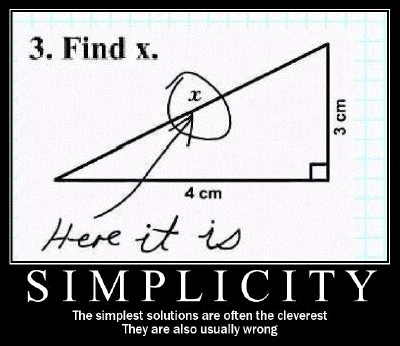
The image above can be found at http://ozguru.mu.nu/Photos/simplicity.gif