Life

My Year of Hopefulness – Rugby Girl

I went out with my friend, Allan, last night. He’s just returned to the States from 6 month assignment in Singapore. While in Singapore, he stopped over in Australia where he picked up a gift for me: a beautiful canvas bag with geometric designs and kangaroos in black, red, and yellow. And a t-shirt that says simply on the front: Rubgy Girl. I laughed out loud at the t-shirt, because it’s true. I’ll be wearing it with pride.

I don’t play the sport of rugby; I live its principles. My friend, Alex, has told me, “Christa, you’re the kind of person who is so nice and generous with such a good heart, but if someone crosses you or someone you love, you have no problem checking that person.” It’s totally true.

I’ve had to learn to be appropriately tough. My tolerance for whining is very low and my admiration of taking action in support of beliefs is high. I learned early on that I had to stand up for myself because I could never 100% count on someone else standing up for me. And I take it on as a personal responsibility to lend a voice to those who cannot or are fearful to stand up for themselves. In my family, if you didn’t speak up with confidence, your concern didn’t get heard. Hard lessons to learn as a child, and ones I am incredibly grateful for as an adult.

business, Business Week, entrepreneurship, hope, Jack Welch

My Year of Hopefulness – Jack and Suzy Welch

I never thought I’d say that Jack and Suzy Welch give me hope. Sound business advice. Straight talk about tough issues. A dissenting opinion. Yes, yes, and yes. But hope? Pure, empathic hope? Yep. Believe it.

In their recent BusinessWeek column, Jack and Suzy Welch not only gave me hope, but they made me tear up. They talk about the entrepreneurs all over this country who are about to emerge as the bright shining light to lead us into economic recovery. “Those kids (the ones at colleges inventing businesses right this moment) and their ideas are the future of business, if we just hang on tight…you can be sure, too, that legions of people out there aren’t frightened by the economy. They’re called entrepreneurs. And challenges don’t make them surrender; they make them fierce.”

If ever there was a rallying cry, a mantra to hang on to in this economic mess that seems to get worse by the day, this is it! And if you, as an entrepreneur (or an aspiring entrepreneur), still had any doubt about whether or not entrepreneurs should really consider starting a business in this climate, isn’t a vote of confidence from Jack and Suzy Welch just about the best vote you could find? They don’t say things to be nice or supportive or upbeat. They say them because they believe them whole-heartedly.

I love this article so much that it is currently hanging up by my desk. So when I sit down to do research, to consider where my career might, could, should go, and to write about entrepreneurs, I’m reminded that Mr. and Mrs. Welch are on our side. And with support like that, it seems we’ve run out of excuses to not take our careers in our own hands. In their very simple language, Jack and Suzy Welch have not only given us their support, they’ve put all their cards on the table and told us that the world needs us – we are the people we’ve been waiting for to lead us out of these dark days and into a better world of business. It is not just an opportunity for us, it is a responsibility. The world needs us. Be fierce.

justice, movie, social change

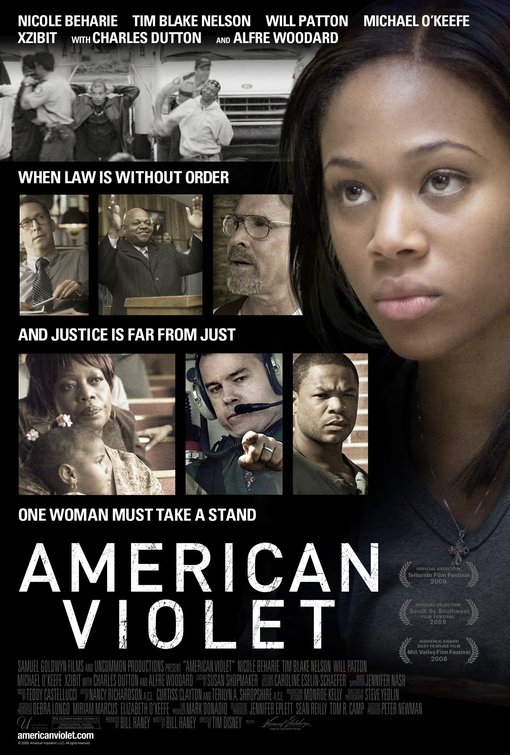
My Year of Hopefulness – American Violet

Tonight, I went to the New York screening of American Violet, a movie about an ACLU case in Texas against a District Attorney for racial profiling in drug cases. I was skeptical about the movie. I was worried about it being preachy and over-dramatic, though my friend, Richard, invited me, and I wanted to support him and his organization. And I couldn’t have been more wrong. The movie is stunning.

This movie showcases activism at its best. A young woman takes on the case as the lead plaintiff with the encouragement from the ACLU to stand up for her community, her neighbors, and her family. Wrongfully convicted of selling drugs in a school zone, she endures great pain and difficulty in the name of what’s right. She displays so much courage that had a I not known it was based on a true story, I would have believed it was invented in Hollywood.

A complete surprise, the woman whom the story is based on was there in the audience and spoke after the movie. Her eloquence and grace in the face of such trying circumstances is so inspiring that I left wondering how on Earth I could ever complain about anything in my life. While many people have given their lives to stand up for justice, the main character of American Violet didn’t have a choice. Injustice was her life, and the life of those all around her. If she wanted to live free, truly free, and move forward she had to stand up. She had no choice but to fight.

American Violet is a testament to the power of story-telling and narrative, the ability to connect people across miles and circumstances, despite age, race, culture or gender. Stories, and their telling and retelling, build empathy and strength. Films about social issues have the ability to entertain and inform; they build community. And to solves problems as large as the issues of racism and substance abuse and incarceration, we need community.

As I walked back to my apartment, I was reminded of Anne LaMott‘s book Bird by Bird, my favorite book about writing and story telling. At one point in the book, Anne talks about the writing classes she teaches in the Bay Area. And her one piece of advice to her students that I always think about revolves around courage in writing. If you have the courage to live through a tough situation and free yourself, then have the courage to write it down and share it with others because in telling your story, you just might help set someone else free. I can’t imagine a more beautiful example of that principle than American Violet. Opens in theatres everywhere April 17th.

health, healthcare, philanthropy, sports

My Year of Hopefulness – Row for Hope

At 25 years old, Paul Ridley is the youngest American to row across the Atlantic Ocean alone. It took him 88 days and he rowed almost 3,000 miles. Paul and his sister, Joy, started an organization called Row for Hope in 2001 in honor of their mother who passed away from cancer. Row for Hope is a fundraising organization for cancer research.

In the CNN article I read about the journey, the line that stood out for me was when Paul how he decided to put this effort together with his sister. “I was a rower at Colgate University. I love the sport. I’m not a scientist, but I can row,” he said. Paul looked at what abilities he had, what contribution he wanted to make, and found a way to put the two together.

In addition to raising money for cancer research and awareness of the disease, Paul and Joy also want to encourage other athletes to take up efforts similar to Paul’s Atlantic Ocean crossing. Even better news – he may just inspire all of us by showing that we can take what we love doing, no matter what it is, and use it improve the world around us in any way we can think of. A social enterprise mash-up in the making.

art, education, music, New York

My Year of Hopefulness – The Music Prodigy Down the Street

Last night my friend Richard and I stopped in to a piano competition at Symphony Space, a performing arts organization that has an incredible slate of programming. I’d never been to a piano competition and wasn’t sure if I’d like it but it was only $5 so I figured it was worth at least checking out. Little did I know that just down the street there were several virtuoso piano players offering up a concert for a next-to-nothing ticket price.

All over the country, these piano competitions are happening any given night of the week. Performers are young and yet undiscovered musicians who have gone to conservatory and now enter as many competition as they can in an effort to boost the potential of their careers. They dedicate their lives to their art. And so few of them ever make it despite the immense talent within each of them. And to get by they work at The Gap or as temps in high rise office buildings. Think of the incredible artistic ability of temp staffs buried in the gray cubicles of New York’s law firms and financial institutions.

So where is the hope in this? Hundreds, maybe even thousands, of young, talented musicians will never be discovered, never receive any acclaim, never achieve their dream of making their living through music. Or can they?

I emailed a friend of mine who works at Teach for America. A handful of corps members teach art or music in public schools. So look at the gap: a huge numbers of schools suffer from a complete lack of music and art education programs and a huge number of people in this world want to earn their living from music. I understand that most of these students want to earn their living from performance though wouldn’t they prefer to have a teaching job rather than taking phone messages and selling mass-market clothing until their time in the spotlight arrives?

It seems to me that this is a gap waiting to be filled. I know that funding for art and music is tough to come by but with all this talent in the world and all the students who want and need an arts education, we can’t let funding stand in the way. You can bet that I’m going to be looking into this further. There’s too much kismet to let this challenge continue unanswered.

art, history, music, opera

My Year of Hopefulness – Honor: The Voice at Carnegie Hall

Last week, I had the pleasure of watching the final performance of Honor: The Voice at Carnegie Hall. Curated by Jessye Norman, the show featured 6 young opera singers, 4 pianists, and an evening of traditional opera pieces, spirituals, and pop/Broadway numbers. The festival exists to “celebrate the African America cultural legacy”.

The set up was simple and elegant – a grand piano, a pianist, and a singer on a bare, shining stage. No microphones. The talent radiating from the stage was so pure and overwhelming that I had to physically prevent my mouth from hanging open. The power and emotion of the music in those voices on the Perelman Stage filled the Stern Auditorium and then some.

My friend, Chris, who runs the international education program at the Weill Music Institute at Carnegie Hall, explained to me that this festival exceeded all expectations. The audience was much more multi-cultural than usual and the sales were impressive. On a Monday night, the auditorium was packed and as I looked around, I could see every race, every age range, and an even mix of men and women. That festival brought together a community of diversity rarely seen at most New York institutions. Inclusive and diverse, it was representative of our city’s population – in other words, exactly what an audience should be.

And you might wonder what on Earth a white girl like me from a small rural town in upstate New York is doing at a place that celebrates the African American cultural legacy. I wondered, too. I love the music that was presented and the diversity of my city, though do I really belong here? Do I have the right to celebrate and honor a legacy that is not mine? Was I welcome?

According to Jessye Norman, the answers are yes, yes, and yes, because this legacy actually is my legacy. It is every American’s legacy. In her signature, elegant manner, I had the great fortune to hear Ms. Norman speak about the festival and its importance, not just to African Americans, but to all of us. If we live in America, then the history of African Americans is our history and we have not only the right but the obligation to pay tribute to it. The feeling of inclusion, respect, and admiration in that auditorium was undeniable. I am honored to have had the opportunity to bear witness to the performance and to the inspiration it provided for all of us within its reach.

At the end of the performance, the audience cheered and applauded with great energy and Ms. Norman looked on with pride. Her performers, however, would not let it go at that. They brought her to the center of the stage, applauding, hugging, and kissing her. You could see and feel their gratitute to this great talent standing before all of us. Through my loud applause, I hope she knows that I am grateful to her, too.

apple, books, business, economy, government, politics

My Year of Hopefulness – The Age of the Unthinkable

In 1997, Apple launched a campaign with one simple message “Think Different”. 12 years ago it was inconceivable how necessary to our survival those two words would be in 2009. Joshua Cooper Ramo, an analyst and former Foreign Editor of Time, takes this Apple campaign slogan and sprints with it, full speed ahead, to help us understand where we are and what we’ll need to do to pull ourselves together. His new book, The Age of the Unthinkable: Why the New Global Order Constantly Surprises Us and What to Do About It, is a beacon for those who have been looking for straight-talk about our current economic crisis and how you and I, everyday people, can move forward.


Ramo pulls from historical examples to show how people in the midst of a situation leading to their demise never saw it coming. Gorbachev is an eloquent example. He opened up the U.S.S.R. a bit at a time, and then the momentum of change was so strong, so pronounced, that Gorbachev had no choice but to let go of the reigns he had gripped tight for so long. Is the state of our economy, and the CEOs who have long prospered under the old rules of our financial system, any different?

In this dark situation it can be hard to see any cause for hope. Ramo suggests that while this might be the darkest moment in our world’s financial history, it is also the moment of greatest possibility. We have the opportunity to wipe away every preconceived notion we have about how we do business, how we live life, how we create, how we inspire, how we dream. 

“Ahead of us is the invigorating possibility of discovery and reinvention.” With that simple sentence, Ramo encourages us to question every assumption about ‘how it must be done’. The days of cookie-cutter policy, politics, and business are over. If we are going to craft a new, brighter future, it will take all of our courage to challenge ourselves, our families, neighbors, co-workers, and leaders. It is time to toss aside common assumptions in favor of grander, more creative, and courageous plans and actions. 

Never before has it been so possible to create a world that we want to live in. It’s as if we have a blank canvas staring at us, daring us, to invent something extraordinary. The only question now is do we have the confidence to build something from nothing. Can we take up the paint brush and with wide, vibrant strokes imagine a new future and commit to bringing it to life?  
career, Examiner, technology

NY Business Strategies Examiner: UpMo, an on-line tool to rev up your career

With the tough economy, a lot of companies are curbing their career development and continuing education programs. Everyone’s busy schedules grow busier everyday as they’re asked by their senior leaders to do more in every area with less of every resource. But you can’t allow your career, no matter track you’re on, to be brought to a halt. So who can help you help yourself? Meet UpMo


For the full article, please click here. 
Junior Achievement, New York City

My Year of Hopefulness – Enjoy the View

Junior Achievement visited my company this week as part of a job shadow day. I volunteered to be part of the welcoming committee, greeting the students at our auditorium on the 26th floor. I was escorting the first group when they stopped short at our picture windows that look out over New York Harbor. Even though the day was overcast, the view was still breathe-taking. Governor’s Island, the Statue of Liberty, the promenade, and Colgate Clock. 


I remember the first time I went to the auditorium myself almost 8 months ago and I had that same feeling of awe, watching life go on down below as if no one could observe it. It changes perspective to climb up above the bustling harbor and watch the world go by. We are a very small part of this much larger world. I was overwhelmed by how beautiful New York is, and how peaceful it looked from that vantage point. 

Somehow looking out I was able to feel that perhaps the situation of our country will be improved with the latest proposals from D.C. Maybe we will come out of this, burned a little bit, but not to an irreparable degree. And honestly, I think we need a little burning to keep us from being too comfortable, to keep us honest, and to keep us striving. We are no doubt in the midst of a vast correction. I cannot imagine that New York City, nor our country-at-large, will ever be the same. We will be better, stronger, more creative, more open-minded, and of richer character than we ever have been before. 
education, Ethics, Junior Achievement

My Year of Hopefulness – Find Another Way

After last week’s class on ethics topics in newspapers, I was getting back to the curriculum. Or at least I thought I was. Some of the students felt badly about not bringing in a story the week before. One student in particular, Starling, loves to talk. He loves raising his hand and de-railing conversations with wacky questions. On occasion I ask him to please make his questions relevant to the topic at hand. He loves questions that start with “What if…” Most of the time, I take his questions and we run with them because I’ve found that they lead somewhere that helps the class laugh a little while we explore this very serious topic of Ethics.

Today, Starling came into class with a topic he really wanted to talk about: Chris Brown and Rihanna. Given that the news converge and messaging to teenagers on this topics has been atrocious, I took full-advantage of getting to discuss this topic openly with teenagers. The entire class could lay out every detail of the case. What was startling is that almost everyone, male and female, looked at the case from Chris Brown’s POV. No one really considered Rihanna beyond being an object of Chris Brown’s actions. They hadn’t considered how they’d feel or what they’d do if they were Rihanna. She went back to him, her choice. She loves him. He “took her back.” What else could there be to consider?

We had 5 minutes remaining in the class after laying out all of the details and a lot more that could be said. I had only one chance, very brief, to communicate the message that I wanted them to hear, at least once, from an adult. “Did you hear Oprah’s comments on the situation?” Blank stares. “She said, “Love doesn’t hurt. And if someone hits someone once, they will hit them again.” It is never okay to hit anyone unless you are physically protecting yourself. Ever. Violence is not a solution, and it has no place in personal relationships. Ever.”

“Even if she was yelling at him in the car about how he was cheating on her?” Starling asked. “Even if he told her she needed to shut up or he’d punch her?”

“Yes, Starling. Even then.” I said.

He looked at me, with a mix of suspicion and confusion. And I realized that at least for one student, I got through to him to suggest that there is a different way out of conflict than violence.