I tell wonder-filled stories about hope and healing
Author: Christa Avampato
The short of it:
Writer. Health, education, and art advocate. Theater and film producer. Visual artist. Product geek. Proud alumnae of the University of Pennsylvania (BA) and the Darden School of Business at the University of Virginia (MBA). Inspired by ancient wisdom & modern tech. Proliferator of goodness. Opener of doors. Friend to animals. Fan of creative work in all its wondrous forms. I use my business skills to create passion projects that build a better world. I’ve been called the happiest New Yorker, and I try hard to live up to that title every day.
The long of it:
My career has stretched across Capitol Hill, Broadway theatre, education, nonprofit fundraising, health and wellness, and Fortune 500 companies in retail, media, entertainment, technology, and financial services. I’ve been a product developer and product manager, theater manager, strategic consultant, marketer, voice over artist, , teacher, and fundraiser. I use my business and storytelling to support and sustain passion projects that build a better world. In every experience, I’ve used my sense of and respect for elegant design to develop meaningful products, services, programs, and events.
While building a business career, I also built a strong portfolio as a journalist, novelist, freelance writer, interviewer, presenter, and public speaker. My writing has appeared in The Washington Post, The Huffington Post, PBS.org, Boston.com, Royal Media Partners publications, and The Motley Fool on a wide range of topics including business, technology, science, health, education, culture, and lifestyle. I have also been an invited speaker at SXSW, Teach for America, Avon headquarters, Games for Change, NYU, Columbia University, Hunter College, and the Alzheimer’s Foundation of America. The first book in my young adult book series, Emerson Page and Where the Light Enters, was acquired by a publisher and launched in November 2017. I’m currently working on the second book in the series.
A recovering multi-tasker, I’m equally at home in front of my Mac, on my yoga mat, walking my rescue dog, Phineas, traveling with a purpose, or practicing the high-art of people watching. I also cut up small bits of paper and put them back together as a collage artist.
My company:
I’m bringing together all of my business and creative career paths as the Founder of Double or Nothing Media:
• I craft products, programs, and projects that make a difference;
• I build the business plans that make what I craft financially sustainable;
• I tell the stories that matter about the people, places, and products that inspire me.
Follow my adventures on Twitter at https://twitter.com/christanyc and Instagram at https://instagram.com/christarosenyc.
Legend has it that Michelangelo conducted autopsies to heighten his understanding, and thus his art, of the human body. Fiction writers must also conduct autopsies, though their subjects are stories. Compelling, intricate, luscious stories.
I’m reading and watching a lot of fiction as I prepare to write Where the Light Enters during National Novel Writing Month. As I read and watch, I sketch the story. At the end of every scene, I answer these questions:
Whose POV is represented?
What happens?
What did I learn about the characters and the story?
What were the interesting turns of phrase and images?
What did I learn about the characters through their actions?
How did it end?
What questions am I asking that move me to keep reading and watching?
At the end, I answer these questions:
What was the story about?
What happened?
Who’s story is it?
Do I care and if so, why?
What questions remain?
Did I get what was promised at the beginning of the story? And what was it?
This exercise is immensely valuable and fun.Like Indiana Jones, an archeologist who digs in the dirt for buried treasure, I’m discovering the bone structure, value, and meaning of the words that comprise page-turning books.
What have your learned about writing from reading?
I’ve met people who had every advantage and others who began life with less than nothing. Some of them are successful and happy; some aren’t. Talent and intelligence helps. Being organized, hard-working, and determined have incredible merits.
However, only one personality trait stands above all others as a universally common predictor of success and happiness: resourcefulness. The ability to take however much (or little, as the case my be) and squeeze every last drop of value out of it is what matters most. Every successful and happy person I know is also resourceful.
Opportunity is everywhere. It doesn’t come to those who wait, nor does it come to people who work their asses off. Opportunity, and its fruits, belong to people who see, recognize, seize, and mold it for all it’s worth. Turn over every rock and make the most of everything you find. Be resourceful.
“It is the neglect of timely repair that makes rebuilding necessary.” ~Richard Whately
Whether it’s a project, your career, a relationship, or the leaky kitchen faucet, fix what needs fixing now. The problem will not go away on its own. Like a pebble in the bottom of your shoe, it will get increasingly more uncomfortable with time. It will irritate you, aggravate you, and make its presence known until you do something. Figure out what’s broken and address it head on. You can fix everything that needs fixing so don’t back down. Take a deep breath. Have faith. You can do hard things.
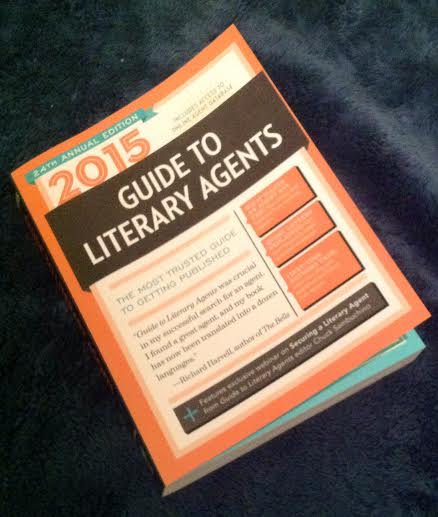
Yesterday my hot-off-the-presses copy of Chuck Sambuchino’s 2015 Guide to Literary Agents arrived on my doorstep. I quickly sliced open the box and cracked it open. As I prepare to write Where the Light Enters for National Novel Writing Month, a portion of that planning involves marketing the book and learning as much as I can about the agent and book publishing world. This is completely new territory for me, and this book is one of my main sources of research, advice, and guidance. If you’re taking a serious step into the writing world, I highly recommend the book. In an hour, I learned more information from it than I’ve learned in months of doing my own piecemeal research. It’s that good. Let’s do this!
Stargazing was one of my favorite activities when I was a kid. I looked at the stars for hours and they carried me away into my imagination. Were there creatures up there, out there, looking at Earth the same way I looked at the stars and planets? Did they know things I didn’t know? Did they have magic powers that I could only dream of? Maybe. Definitely.
In New York City there are hardly any stars. The city has too much ambient light and that light hides the stars from us. They’re up there of course, but New Yorkers can’t see them, or at least can’t see them very well. Here in Florida, they’re out there in brilliant abundance every night. They carry me away exactly like they did when I was a child. They remind me that I am only one very small speck in an enormous universe that is awash with secrets, truths, and discoveries yet to be made.
The sight of the stars in Florida keeps me reaching, and for that I’m grateful.
The only essential for a good trip, an adventure that sticks with you long after it’s over, is happiness. Pack it in abundance. Seek it out, in all the people you meet, places you go, and things you do. Be a joy seeker and a smile junkie, and give both away, as much as you can possibly muster. What you’ll find is that you won’t feel spent. Instead, you’ll feel more fulfilled than you ever thought possible.
“Don’t compare your beginning to someone else’s middle.” ~ Jon Acuff
When we start something new, or even think about starting something new, we look at experts who are doing what we want to do. While they can be a wonderful source of knowledge and advice, we can’t directly compare ourselves to them. They’ve put in their practice time. We’ve only just begun.
Don’t let someone else’s success cause you to question your potential. At some point everyone, everywhere, started at zero. Just get started.
I’m one week into my Florida residency and I thought I’d share the good, the bad, and the in-between with you:
The good
– I get to see my nieces all the time. We actually share part of the house with our rooms clustered together, and Phin in particular loves all of the attention he gets here.
– My sister and brother-in-law have been gracious hosts for me while I sort out life here. They redid their guest room for me and my closet is almost as big as one of the rooms I rented in my last apartment.
– For most of the day, I have the house all to myself so that time’s been incredibly productive for me. I had a flurry of writing work that I wasn’t expect last week so I felt very grateful to have the space in my life to get it done.
– Cost of living is so much lower here, it’s laughable. I’m still in sticker shock after my many years of New York City prices for everything.
– I’m so close to nature here. The sunrises, sunsets, and wildlife are beautiful. My family lives in a rural area of Central Florida (that is surprisingly close to Orlando) so I have plenty of opportunities to get back to the land.
– It’s been over 10 years since I lived in Central Florida and Orlando in particular has changed a lot. In the coming weeks, I’m looking forward to exploring it.
The bad
– The heat is intense. As someone who loves seasons, particularly the Fall, I knew this would be tough for me. Unfortunately, Florida doesn’t get those gorgeous Fall colors that I love so much. However, Fall weather will eventually arrive here and it lasts longer here since Florida doesn’t really have a winter and Fall in the Northeast ends in the blink of an eye. (And this morning, it was a brisk 57 degrees. I couldn’t be happier about it!)
– I don’t yet have a routine. I love order and organization, of my time and my belongings. Just after a move, everything always feels out of whack for a time and I’m looking forward to getting that sorted out soon.
– I miss my New York friends. While many of my close friends live nowhere near New York, and I do have wonderful friends in Florida, I miss being able to stroll down the street or hop on the subway to hang with them. I’m hoping many of them will come to Florida to visit, and making plans to see my Florida friends should also help ease that sting.
– Because I’ve spent most of my adult life living in New York, I’m used to heading underground, jumping on the subway, and magically emerging exactly where I want to be, or taking my marathon walks all over Manhattan. Here, I have to learn how to get around by car and I have a fairly underdeveloped sense of direction. Thank goodness for GPS!
The in-between
– We drive everywhere. I love public transportation, though once I get my own car, find a neighborhood that has some walkability (where I’m hoping to buy a house or condo of my own for the first time!), and get my patterns down, I think I’ll find a way to make this work for me. I am looking forward to taking my first ride on the Sunrail, the very beginnings of Central Florida’s public transportation system. It’s incredibly limited but I’m hoping in time that it will expand.
– Having never lived with kids before, I’m still getting used to the early school day routine. I have had to shift my schedule as we’re up really early (5:30am). However, this is also a time change I’ve been wanting to make. I like to be up early and in bed early so I’m looking forward to this adjustment in my sleep rhythms.
Change of any kind is always challenging and even welcome change takes some getting used to. I’ll be sure to update you as I navigate through this latest life shift.
My niece, Lorelei, had a choice for her after dinner treat: a cookie or playing on my iPad with an app that helps her write stories. She chose to write stories. “Stories are good for me and sugar is bad for me so I’m choosing stories.” A girl after my own heart (not that I have anything against cookies!) Some people may bemoan technology and kids’ obsession with it. I celebrate it. For my nieces, it opens up whole worlds for them and enables them, at a very young age, to tell their own stories. Kid, if you have a story you need to tell, you can use my iPad anytime you want.
Nigerian writer Chimamanda’s wise and powerful TED Talk
I am so thrilled to let you know that I was asked by TED Weekends to write a response to a TED Talk about the art and power storytelling for The Huffington Post. Click here to view the story on the Huffington Post. The text of my article is below. Huge thanks to Amanda Hirsch, who brilliantly edited my piece for The Huffington Post.
Our Story is Our Choice
We cannot leave it to others to write our stories for us; we all have the right, and the responsibility, to write. This was my main takeaway from Nigerian writer Chimamanda’s wise and powerful TED Talk, which argues beautifully the ways that stories shape our world. What we think, we become, and stories are the canvas on which we paint our thoughts.
Our story is our choice, and we need to tell it.
I grew up in a farm community before it was cool and in fashion. “Farm to table” wasn’t a choice, it was a way of life – and it wasn’t glamorous. By global standards, we were not poor, but by American standards, we were.
I worked hard in school for as long as I can remember, and with the help of grant money and federal financial aid, I was able to attend the University of Pennsylvania – where my freshman tuition far exceeded my mother’s annual income.
I remember meeting one of my hall mates at our freshman picnic. He asked me if I was a Franklin Scholar, which I’d later learn was a program at Penn for incoming freshmen that were expected to be the highest achievers in the class, based upon their admissions applications. In other words, they were the cream of the crop. I asked how I would know if I was part of the program. His curt reply (“If you don’t know,, then you aren’t”) made me feel unworthy in a place where I already felt completely out of place due to my socioeconomic level. He never spoke to me again, and when I passed him in the hallway, he looked the other way every time. Encounters like this made me feel out of my league at Penn from day one. The truth is that when you grow up without enough you think you aren’t enough, period.
Financial resources weren’t the only ones that were scarce in my childhood My father was a severe man. I have exactly two happy memories of him from the 16 years I knew him. That’s one story of my childhood, and if I’m honest, it’s the dominant one. Chimamanda speaks about the need for balance, a blending of many stories from many perspectives about a single person or place. The truth is in the mix, not in the loudest voice. If I think long and hard enough, I have other childhood stories: making mud pies with my sister, digging holes in our backyard in pursuit of dinosaur fossils, and climbing trees with the wind in our hair and our dogs barking down below.
If my father did nothing else that was good for me, he inspired my love of travel, not because he traveled but because he gave me access to other worlds. He read the Sunday New York Times, every scrap of it, every week. He completed every crossword puzzle in ink without a mistake. He read so intensely that he wasn’t aware of anything else happening around him. When he was finished with it, I would sneak away with sections of it, and my favorite was the travel section. Every summer, they put together a special magazine section that advertised vacations to faraway lands. Having never left the Eastern seaboard of the U.S. for the first 18 years of my life, I constantly ordered away for travel catalogs. I would call the 1-800 numbers in the Times travel section and a few days later, I’d get a stack of the brochures in the mail, addressed to me. I’d run to the mailbox and pour over them the moment they arrived. I kept them neatly organized and stacked under my bed, and when times got very difficult at home, I’d retreat to my travel brochures and dream about a someday when I would live a better life somewhere far away.
If my childhood had been blissful, if my father had been more interested in raising me than in reading the New York Times, and again, if I had been enough of something to hold his attention, then I might have never found my love for travel, for dreaming, and yes, for stories. And that, too, is part of my childhood story just as much as his neglect and disinterest.
Going back to my experience at Penn – fortunately, feeling inadequate wasn’t the only story from my college years. Once I found theater, I made Penn my home. That extracurricular activity ignited what would become a professional career in Broadway theater management and my lifelong involvement with storytelling in many and varied forms. Now I’m a full-time writer. Last year I wrote my first play, Sing After Storms, which debuted at the 2014 Thespis Theater Festival in New York City. It’s based on an event from my childhood that has haunted me for the better part of three decades — and it’s an example of how writing has helped me make sense of my story, and make it my own.
By heritage, we are all storytellers. If we trace our roots back far enough into the past, we will all find a direct and unbreakable link to the campfire, and to the storytellers who used that campfire as a stage to explain, illuminate, inspire, grieve for, and laugh with their communities. Stories are our voices and we all have a voice. Storytelling is as much a human right as breathing, eating, and deciding how, with whom, and on what we spend our time. As Chimamanda so eloquently and truthfully states, “Stories are a kind of paradise” — and they’re ours for the taking.