medical, medicine, OLED, technology

The Consumer Electronics Show: The "Eyes" May Not Have It

I’ve been given a project by my boss to track what’s happening at CES (the Consumer Electronics Show) in Las Vegas. The trick is I need to track it from my office in New Jersey. Thanks to publications like Wired, CNET, USA Today, Business Week, and the plethora of bloggers at the show, the tough part isn’t getting the information – it’s sifting through all of it. I’m not complaining in the least; I am a master sifter. And this project feels much more like play than work- my gratitude for this terrific job has now reached an all-time high!

I came across a post on Amazon Current’s blog regarding Sony’s OLED TV, one of the hottest products at the show. http://www.amazon.com/gp/blog/post/PLNK30ULMBBBDWULY Among their many features, these TVs feature “super deep black” levels. Pictures pop with a vibrancy never before seen in a TV. This started my nerd wheels going – can our own eyes even experience “super deep black” on their own?

After a few hours of looking far and wide on numerous medical sites, I couldn’t find any evidence of whether or not this color contrast is something we can naturally experience without the aid of technology. (I did discover that the human eyeball weighs approximately 28 grams, can discern between 500 shades of grey, and that sailors once thought that wearing a gold earring would improve their eyesight!) It’s possible that the answer to my question is out there living on some website I have yet to discover. It’s also possible that these advanced technologies are helping us experience the world “out there” from the comfort of our own couches in a way that we could not see it on our own.

career, creativity, cubicle, job, office space, social work

Improving officespace: death to cubicles

How the color taupe ever made its way into U.S. offices I will never know. I am so sick of this color I could scream. My friend, Alex, and I talk about this regularly. Humans love and crave color; so how did corporations miss that? There is nothing inspiring about taupe and if I can’t be inspired then I can’t work.

I’ve been thinking about the subject a lot lately as I am in the process of moving into a new space at work. Originally, the facilities people were trying to figure out how to cube it up as I am sharing the office with another person. I fought my urge to roll my eyes and gag. Cube up this beautiful office? What??

If I had my way I’d paint it some fabulous color, put down Tatami mats, create a “Beautiful Mind” wall, and leave that space as open as possible – no walls thank you. I’m getting my way, partially. No fabulous paint color (white is all that’s “allowed”), no Tatami mats. I am going to have a beautiful mind wall and though the space won’t be totally open, it will have bookcases and a credenza in a cherry finish as a “wall” as opposed to taupe cubicle walls. It’s a start.

The progress has been driven by my boss and to the members of the facilities team who took us downstairs into the depths of our corporate building to the warehouse where they hide the cool furniture. We’re hoping to have the place set up and be moved in by the end of the month. And here’s the kicker: the maintenance team is excited to do the project. It’s something new and different for them. Finally, a creative outlet for them! They hate the taupe, too.

I came across a post on the website http://www.coolhunter.net/ that addresses the problem of boring office space with outrageous ideas. And given the rut that corporate office design is stuck in, I think being outrageous may be the only way to wake us up from our cubicle-induced coma. Enjoy these wild officescape photos and I hope they inspire you to buck the taupe.

http://www.thecoolhunter.net/design/CREATIVE-WORK-ENVIRONMENTS—Do-you-work-in-one-/

art, museum, technology, theatre

A meeting of the minds: art and technology

I have been out of professional theatre management for quite some time now. I love going to shows, love reading about the industry. Every once in a while I get a twinge to go back to it, and then about 5 seconds later I have a moonstruck “snap out of it” moment. We idealize the past.

While I am not sure if I will ever return to the industry, I am passionate about propagating the arts. I read Michael Eisner’s book A Work in Progress about 6 months before I moved to New York City to begin my career in theatre. It is not an exaggeration to say that he very much influenced my decision to give it a shot and see what I could do in the industry. He has a quote in the front cover that to this day is one of my favorites, and it bears repeating. “What hope there is for us lies in our nascent arts, for if we are to be remembered as more than a mass of people who lived and fought wars and died, it is for our arts that we will be remembered. The fortunes wither, the kings depart. What survives are the creations of people who are makers and artificers of the spirit.”

I am now an outsider of the industry with some wonderful friends still very much inside. Over the past few months I have begun to wonder how on Earth the industry expects to survive without embracing technology beyond complicating lighting plots and set designs. With all of the competing interests for time that consumers now face and a shaky economy, the arts cannot expect to rely on local audiences and tourists to make up the whole of their subscriber base. The traditional subscriber model needs to be ripped to shreds and rebuilt. Why should Lincoln Center limit their viewers to only those who can get to NYC? Why not develop a subscriber base that spans the globe?

I’m talking about a technological platform that would film performances and museum exhibits in very high definition to be broadcast via subscription on the web to those who pay per log-in. I am already hearing the naysayers – “theatre is about being there”, “what about the live interaction that the actors need?”, “no technology can replace actually being there in person”. I agree with all of that. And the die-hard subscribers will, too. They will still come to performances and exhibits.

Let’s consider those who can’t get to the theatre or museum: why should art institutions leave that money on the table? Why shouldn’t all people everywhere be able to experience and appreciate art wherever it is? If we don’t do this, can we hope to hang on to young audiences who are so intrinsically linked to technology? And don’t our artists deserve to have the ability to reach audiences far and wide?

The other bonus that this kind of technology would offer is the ability for those who see the performances to interact with one another, to keep the artistic discussion going long after the curtain goes down. Not to mention the diversification of revenue – new subscribers and the increased ad money that could be made available to arts organizations to not only survive but to thrive.

I have a certain disdain for critics – how they kill works of art before the performers even get their arms around a piece. Why should the critics decide what shows stays open on Broadway and what closes? Why does this very select group of people get to determine the art we see and enjoy? Opening up the subscriber base and encouraging the conversation among patrons returns the power to the people it rightfully belongs to – the patrons.

The above images can be found at http://infocusmagazine.org/3.2/images/eng_beyond.gif

books, Mark Penn, society, technology

Social geeks

I love ethnographers. I appreciate their fervent desire to bucket people in an attempt to figure out the human race, though I must admit I have never been one to enjoy being in a box. My boss recently passed me the book, Microtrends by Mark Penn, an advisor to Hillary Clinton’s campaign.

When I tell people I work in the field of trend and innovation they assume that I must be checking out the latest “fads” and “fashions”. And I do check those things out, only to the extent that they reveal some underlying and unifying trends that may be emerging. Trends take the long-view, have a psycho-social implication, and signal major shifts in how a large group of people see themselves and their place in the world. This long-view is what holds my interest.

As I read through Microtrends, I discovered a few new interesting groups that I actually belong to, on my own terms. I’m a joiner (there in lying the paradox that while I love groups I hate formal classifications), and so this news of “my people” coming together has got me jazzed. First up, those of us who believe in being DIY doctors. I’ve previously blogged on my neurotic addiction to WebMD, mostly stemming from my preoccupation with health and wellness and the sense of worry etched in my DNA. Turns out that my years-long tracking of WebMD just meant that I was ahead of the trend curve. The tipping point for DIY medicine is approaching, thanks in part to our horrid health insurance system.

Another group I love and seek acceptance to: the Tech Fatales – women and girls who are not only interested in technology but seek to be the people who change and improve the systems and their applications. Finally, those of us who have long been hanging out on the edge contemplating how in the heck all of these technological advancements actually apply to us are not only figuring out that conundrum – we’re also finding new uses for the technologies to make them more applicable to us.

And the last group of note for me – the social geeks. How I love this! Finally a description in two words that does justice to my weirdo nature. I’m so nerdy that at times in my life it has been a source of embarrassment. I was one of those kids who embraced the word “why” with every fiber of my being. My library is my most precious material possession. I have a hard time parting with any of my books, even if I never intend to read them again. And the subject matters are so varied that I have a hard time placing any two books into a single category.

The flipside to my nerd nature is that I have often been correctly accused of being a social butterfly. I love making the rounds, meeting new people, and bringing people together. So imagine my delight when social networking came on the scene in a big way – it would be possible for me to connect with tons of people with all kinds of interests, spread across the globe, all from my cute and comfy apartment. Are you kidding me? Count me in!

Mark Penn points out that Myers-Briggs recently needed to alter their classifications. Previously people interested in technology had been placed in the “introvert” bucket. That’s changed – now people most interested and active in technology are also the most extroverted. Sorry Myers and Briggs: the social geeks will define their own characteristics in their own words.

The above photo can be found at http://www.cnet.co.uk/i/c/blg/websites_feature/1.jpg

family, sisters

Welcome to the World, Baby Girl

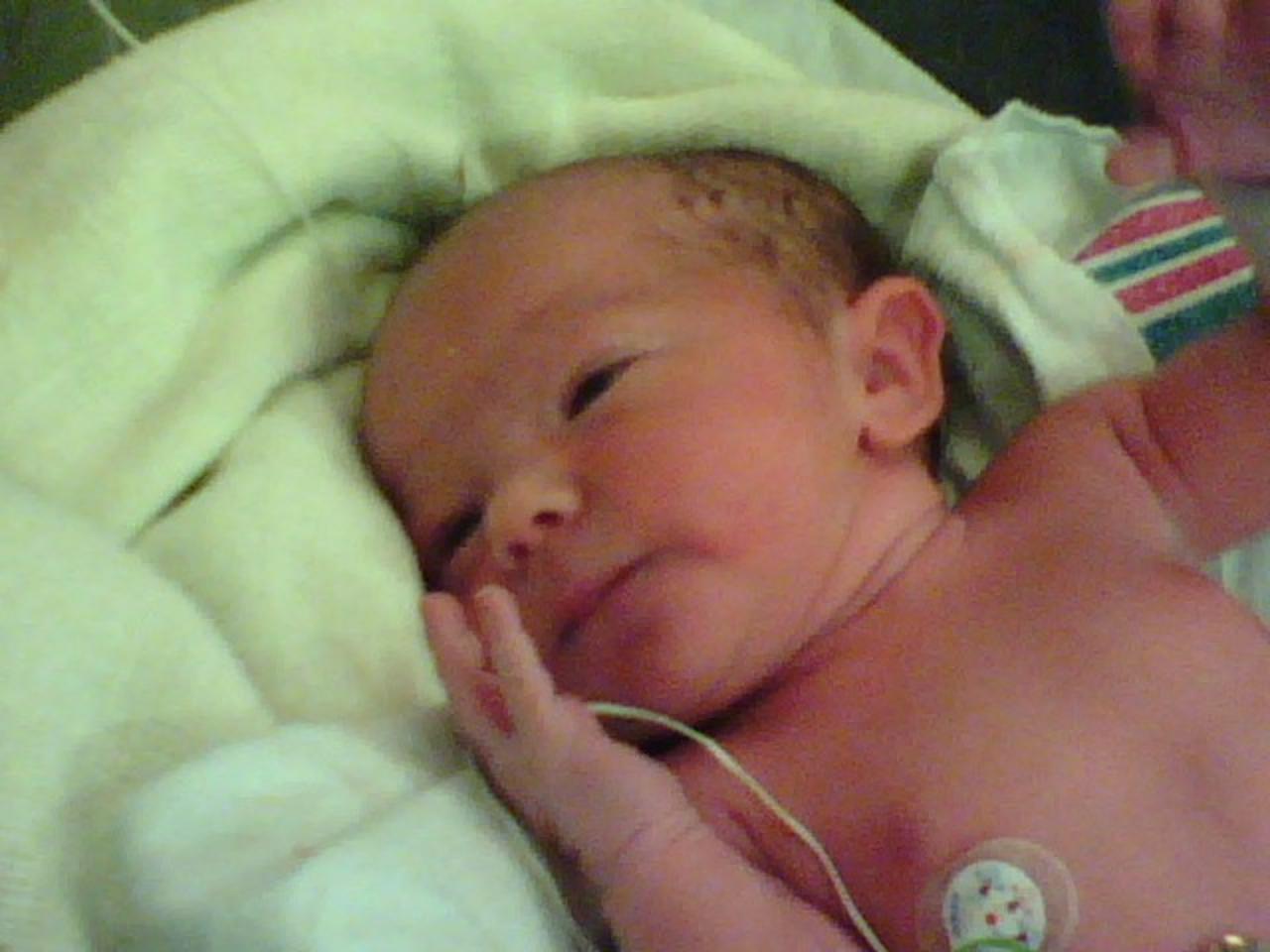
Yesterday we welcomed the newest addition to our family. My sister, Weez, and brother-in-law, Kyle, had their first child – a baby girl. Miss Lorelei arrived to us yesterday afternoon around 3:30pm at 6 pounds, 11 ounces, 19.5 inches long.

I have been an aunt twice before – my brother has two children, now 9 and 11. At first, I couldn’t explain why this time around is more exciting. Maybe because I am in a different phase of my life. Maybe it’s because there is this inexplicable link between sisters. Maybe it’s because I couldn’t stand my brother’s wife, and love my brother-in-law. Could be because Lorelei is named after mine and Weez’s favorite sitcom of all-time: The Gilmore Girls.

And then I thought some more about a comment a friend of mine made when I told her that my sister found out she was having a girl. “There is some instinct that takes over when a sister has a little girl. It’s as if she is your little girl, too.” You invite her into the sisterhood, you bring her into the fold. We welcome another strong warrior heart.

creativity, story, TED, women, writing

A Woman of Her Words

“What is truer than truth? The story.” ~ Jewish Proverb

TED recently posted Isabel Allende’s talk on passion. In a room full of scientists, technologists, and innovators, Allende talked about story telling, about women, and about the importance of having a warrior heart. She speaks bravely with humor, honesty, and grace about the state of women in the world, and the picture is bleak, though hopeful.

When the news reports talk about war casualties, 80% of the people they are talking about are women. The women of war have suffered unbelievable cruelty and horror. They have endured gruesomeness beyond measure, in the lands formerly their homes and in refugee camps. Once they are displaced by war they have hardly anywhere to go and hardly anything to take with them: women own 1% of the world’s assets though do 2/3 of the labor.

In the world of philanthropy to help the needy, again women lose. Even though they comprise 51% of humankind, women’s programs receive only $1 for every $20 that is donated to men’s programs.

After all of this sad news, you may wonder where in the world is that hope I mentioned in the opening paragraph. And here it is: the stories of women are haunting them so much that they cannot help but write them down. We are becoming an entire generation of story tellers. 35% of on-line teenage girls have created a blog, in contrast to only 20% of on-line boys who have done so. 57% of people in the news industry are women.

The trend of Tech Fatales is emerging: Women are more likely to use mobile phones, digital cameras, satellite radios, and DVD recorders. Why? Because to listen and tell stories, we must connect. We don’t just want to contribute and make this world better. We are striving to make it good.

Allende talks about a woman whom she met in a refuge camp named Rose Mopendo. After tragedy upon tragedy, Rose and her 9 children finally made it to the U.S. In Swahili, “Mopendo” means “great love”. And what we love most is the truth, and so we must love and propagate our stories.

So it is no wonder that we are writing history in our own hand. Allende goes on to say that “heart drives us and determines our fate. It matters more than training, more than luck. The world needs dissidents, mavericks, rebels, and outsiders.” If this world is to be a better place, it needs us to rise up, to question everything, to put ourselves out there as risk takers and rule benders. And then, please, write it all down. We can’t afford to have anyone forget the lives we have lived.

To see a podcast of Allenede’s talk, click this link: http://www.ted.com/talks/view/id/204
The picture above can be found at http://www.artinthepicture.com/artists/Georgia_Okeeffe/red_canna.jpeg

art, career, guest blogger, job, Rob Lorey, social work, theatre, work

Career transitioning by guest blogger, Rob Lorey

In an effort to expand the depth of the topics I cover and to provide readers with new perspectives, I have decided to ask a few of my most interesting friends who inspire and enlighten me to appear as guest bloggers. The first one is my friend, Rob Lorey. I met Rob while we were on the Beauty and the Beast tour. He is an exceedingly talented performer and generous man who has now turned his talent toward a new career that is taking him in an entirely new direction. My love and thanks to Rob for sharing his story on this blog.

“I have been asked by my friend, Christa, to discuss career transitioning-which is interesting considering her own history. I have looked to her as a model when questioning my motives or planning. She has always seemed to me a person of keen intelligence and interests, who will throw herself into a given course with 110 percent dedication, yet readily change course with complete determination and little concern for popular perception. There. That’s my entry for the Christa Fan Club.

My own journey has been a bit lengthier- but very fruitful. I spent roughly twenty years in the entertainment industry- mostly stage work. This career took me all over. I’ve lived in several great cities, toured throughout the US and Canada, and spent time in Europe and Asia. By all accounts, I’ve been very lucky and reasonably successful.

But I find that a career in the Arts intensifies the perception that one has never quite “arrived”. No matter what successes you attain, you’re always looking to someone who has what you perceive as the better gig. It is very difficult to maintain a realistic sense of progress- and easy to become career obsessed. Add to that the very real dearth of work opportunities and the increasing talent pool you are competing with. It can be a bleak picture!

My own journey has allowed me the luxury of time for reflection. My last big tour gave me the opportunity to take stock and make some decisions about how I might want the rest of this ride to go. I will spare readers the nuts and bolts of this existential journey. Suffice it to say I decided that I needed to expand my capacity for work opportunities and life experiences. That’s what this move feels like- an extension of all that has come before it.

Currently, I’m pursuing a masters in Social Welfare- which is whooping my ass (back to a full time program after 25 years….ouch!) But it is incredibly interesting and engaging. I continue to perform- though not to the extent I was. It’s a necessary sacrifice for the big picture. I am not sure how I will choose to use all this once I have completed my degree. I know that whatever I do, I’ll be utilizing all aspects of myself, and all the work and life experience I have accumulated.

What a gift to be so energized and……expectant at this juncture! Goes to show you: every day is an opportunity to reinvent, to do better, to experience more!”

The above photo can be found at http://www.makinglemonade.com/Career%20Transition.jpg

holiday, New Years Eve

Tradition!

While I practice traditions in so many areas of my lives, I find that as I get older I am more reluctant to make any new ones of my own. I adopt them from family and friends, and many of them relate back to my childhood. I think of their practice as a way to hold on to happy memories and people that have passed on. Traditions preserve history.

I came across a blog post by Andrea Leigh on the Amazon Daily Blog about the tradition of eating food in the shape of a ring to celebrate the New Year. It is believed by many cultures that this will bring good luck as it symbolizes “coming full circle”. The Dutch in their forever playful outlook on life feel that donut eating is the best way to “ring” in the New Year. What a marvelous way to take a tradition and personalize it. And who am I to argue? Boston Cream, anyone?

For Andrea Leigh’s post, visit http://www.aldenteblog.com/2008/01/happy-new-year.html

blog, blogging, writing

The Power of Blogging

I believe that writers in the blogosphere can change the world by changing the way that people see their own environments. Until very recently, some members of the general public saw blogs as a fad. Though I love blogging, I have to admit that I’ve had my doubts about their effectiveness. My doubt has been compounded by looking at statistic of how many new blogs and blog posts are created every day. The blogosphere has some population growth issues, and I am playing my part in that growth.

Today I read an article about the Saudi blogger who was recently arrested for writings on his blog. He has been held since December 10th because of political candidates he supports through his blog. His political views are not what interest me. What I find fascinating is that musings and opinions on a blog warranted the Saudi police to intervene.

Bloggers around the world should be rejoicing. If there was any fear that blogs were the red-headed stepchild of the writing world, that fear has been squashed. You can be sure that if you create it and update it regularly with passionate writing, they will read.

For the up-to-date news on the Saudi blogger and his impending release, please visit http://www.cnn.com/2008/WORLD/meast/01/02/saudi.blogger.jailed/.

celebration, happiness, holiday, New Years Eve, New York

Day 1

2008 was brought in with a wide smile on my face surrounded by fabulous friends. I have never hosted a New Year’s party before and my friend, Catherine, suggested that having one would be a good idea. Plus, she has a spacious apartment, a rarity in NYC, that would be a perfect spot to host one.

I invited a number of friends from different parts of my life, and many of them had never met before. Worlds colliding can be a nerve-wracking thing. To my delight, it was fabulous from beginning to end. People were striking up conversations right and left and I feel confident that the party could have gone on into the wee hours of the morning without a pause.

I was so thrilled with the turnout of so many amazing people in one room. And a bit sad, too. I have been wishing that I could afford a bigger apartment to have gatherings like this more often. And then my dear friend, Lisa, helped me open up my eyes a bit wider. We panned the room to take a look at the space that people were actually occupying as they enojyed the last few hours of 2007. It was roughly the size of my studio apartment. And when I came home I did some more analyzing…while my place may be small, there is ample room to sit and chat, and people at a party don’t spread out – they clump together to have conversations and to share laughs.

The wonderful gift that 2008 brought me, in addition to all of the great people I was surrounded by, was the idea that this type of gathering didn’t need to be a once-a-year event. I could have this kind of celebration much more often, even in my studio apartment. Happiness and laughter is like air – it just conforms to the space in which you allow it to be.

The image above can be found at http://www.backdrops.net/images/108%20Celebration%2010%20x%2010.JPG