Writers know where their characters will be on the last page of the book. That focus creates the flow of our characters’ actions and ups the ante when the many necessary conflicts and complications arise. Here’s the game of writing fiction: my character is on this side of the field and what she wants is on the other side. A million proverbial land mines lie in wait for her missteps. (And misstep she will!) She must learn to deftly navigate her way across the field to claim her prize. She needs to get help from others, build skills, and ditch her fears to fulfill her potential. By the time I type those two sweet words “The End”, she has to transform into the person who can traverse the risky landscape that stretches as far as her eyes can see in every direction. Writing fiction is an adventure.
I learned about Scrivener, a software package for writers, through National Novel Writing Month. As a sponsor of the event, Scrivener is offering a free extended trial for NaNoWriMo participants. Did you just groan? I did, at first. I’m usually wary of sponsor-offered trials, but the community around NaNoWriMo is so generous and supportive that I decided to at least give Scrivener a look. Apparently the snappy inventors of the software got inside my brain when I wasn’t looking and built me exactly what I’ve always wanted – writing software that makes me a better writer.
For writers of every feather I’ve shied away from other writing software packages because my writing varies widely: blog posts, essays, journalism, web copy, playwriting, nonfiction books, and now a novel. Many software options cover only one or two of these options. Scrivener works for all of them.
Organization I’m usually guilty of harboring numerous Word documents, Excel spreadsheets, photographs, scribbled notes on post-its and napkins, and a mess of links that resemble a giant blob of letters. I constantly worry that I’ll forget or miss a key lightbulb moment that I had somewhere along the way. Scrivener keeps even the most copious note takers organized and makes the mind numbing tasks of project management a joy.
Inspiration I’m not a terribly visual person by nature. I’m one of those oddball auditory learners. However, fiction pushes me to use my words to illustrate visuals. To help me in that process, I often pin photographs, sketches, graphs, and art onto several Pinterest boards that I consult during the writing process. I’m also a big believer in the power of inspirational quotes (and incidentally so is Emerson Page, the heroine in my current novel, Where the Light Enters.) Scrivener’s split screen option makes it possible for me to open a portion of my writing on one side of the screen and have images and virtual posts that I created on the other side. Scrivener makes these visuals a constant reminder and inspiration to me without hindering the act of writing.
Research incorporation Curious to the nth degree, the research aspect of writing gets me jazzed about a new project no matter what genre it takes. I love being an archaeologist of words and ideas. Scrivener helps me keep all of that research organized and on-hand with its research folders, easy-to-build research templates, bulletin board functionality, and synopsis creator.
Putting it all together God bless copyeditors. I adore them. I’m so glad there are people who love that work because it drives me bonkers. I also hate that my dislike for copyediting makes life for my copyeditors more difficult. The compiler feature of Scrivener helps lessen my copyediting guilt. With a few simple clicks, Scrivener assembles all the pieces of my manuscript into a cohesive whole in a variety of formats so at least the formatting is uniform and my copyeditors can focus on editing at the word level.
Support I hate to download software and then feel like I’m on my own to figure it out. Given all the work I’m doing to prepare for NaNoWriMo, I didn’t want software that would take weeks to learn nor a tool that would be clunky to use during the mad dash of the month-long event. Scrivener has a comprehensive set of informative and entertaining videos that show you its power to enhance your writing. The basic 10-minute video explains all of the key features any writer needs to dive into Scrivener. For those who want to use the more advanced features, there are short videos to explain each of those features. There’s even an interactive demo available to you at all times. Have specific question? Just email them. They got back to me in 24 hours with a detailed answer. Scrivener is a feature buffet: use as many or as few as you like and be a better writer for it.
Other goodies
Scrivener takes dictation and integrates with my audio recording software that I use for my voiceover work. This is perfect for getting true-to-life down on paper. Creating revisions in one document is a snap and the Scrivener dovetails well with Microsoft Word. Importing and exporting content is a snap with drag and drop. For fiction writers, it’s got a groovy name generator tool. Outliners (like me) rejoice – outline until your heart’s content with many layers of organized detail available as you build your story from the ground up.
I could go on, but just go see it for yourself. Invest 10 minutes to watch the intro video and you may discover your new perfect writing partner. I certainly did. Now if they could make my meals, do my laundry, and walk my dog during NaNoWriMo, that would be perfect!
If you’re participating in NaNoWriMo this year, may the force be with you and let’s connect to cheer each other to the finish line of writing 50,000 words in 30 days. You can find me on the NaNoWriMo platform as christanyc.
Ever wonder how dolphins sleep without drowning? So did I so I asked one of the biologists at Sea World. Dolphins (and whales) are unihemispheric: one half of their brain sleeps while the other half stays awake because they must actively decide to take every breath. This idea is mind-boggling to me. Imagine what we could do with that kind of brain! There is no such thing as impossible, not even if you live in water and breathe air.Sometimes to live a good life with the situation that presents itself, we have to do something insane that’s never been done before. When there’s a will to live, there’s a way. Nature is flipping amazing.
I’m researching and writing like a madwoman for National Novel Writing Month. Truthfully, all I need to do is begin and finish, in that order. 50,000 words in 30 days, roughly 1,800 words per day. There will be many round of revisions after November 30th; most of writing is rewriting. I don’t need any part of it to be perfect this first time around. I’m free to play, experiment, and explore. I have to remember that if I can breathe, then the story will breathe, too.
To write a compelling story, the characters must want something that matters to them in every scene. If that line isn’t art reflecting life, I don’t know what is. Why are any of us doing anything if we don’t know why we’re doing it? We wouldn’t follow (nor write) a story if the characters weren’t clear on their deepest desire, so why would we live our lives that way? Dorothy didn’t go to Oz because she thought it might be a nice walk. Alice didn’t traipse through Wonderland because she was bored. Characters go in search of something that’s meaningful. And so should we.
Ever feel like this? Don’t. Own who you are and who you aspire to be!
I spoke to two friends this week who just started their own companies. We chatted about how difficult it can be to feel authentic about new roles, especially if we create them ourselves. When I first started telling people I was a writer I felt like a goldfish with a shark fin strapped to my back.
As Yoda would say, “Own we must.” Know who you are, what you do, and why. Don’t flinch. You did a lot of work and put in a lot of time to make your own opportunities. Stand proud and say it loud: “I’m a (fill in the blank)”, and smile.
Every day the first decision you make is whether or not to rise. Is it worth getting up or should I just stay in bed and wait for something better? Physically, most of us must make the choice to rise. We have work to do, a family to tend to, or a dog that needs walking. But what about mentally and emotionally? Are we all in — heart, body, and soul — or do we plunk along just trying to get back to bed at some point later that night? Are we even aware of the choice we’re making?
Lately, I’ve been working with being more conscious and present. As a writer, this is hard because I live my real life and I live my writing life and those two worlds often live in different places even though I haven’t yet found a way to clone myself. The two exist side-by-side the moment I open my eyes in the morning and I have to choose: rise or don’t. Put your best foot forward even if it scares the hell out of you, or don’t.
Me? I’m going to decide to rise. Always. I’m all in.
When J.K. Rowling and Steve Jobs began, they had an insatiable desire to create with the few resources they had. Rowling wrote Harry Potter on an old typewriter as a single mother while receiving public assistance. Jobs grew up in a lower-middle-class family and spent his early adult years living in an apple-growing commune in Oregon. Then he returned to his parents’ home to tinker in their garage.
We have many more resources than they did. First, we have their example of what the human imagination can build. Second, we have more sophisticated technology and markets, at far lower costs of entry. Third, we have social networks that help us connect to one another and share our creations with the world.
Rowling and Jobs didn’t have any of those resources, but you can bet that if they did, they would have used them to the hilt. That’s exactly what we should do. Right now there’s someone who needs what you want to invent as much as we needed the inspirational creations of Rowling and Jobs. You have the resources to build it. Go!
Legend has it that Michelangelo conducted autopsies to heighten his understanding, and thus his art, of the human body. Fiction writers must also conduct autopsies, though their subjects are stories. Compelling, intricate, luscious stories.
I’m reading and watching a lot of fiction as I prepare to write Where the Light Enters during National Novel Writing Month. As I read and watch, I sketch the story. At the end of every scene, I answer these questions:
Whose POV is represented?
What happens?
What did I learn about the characters and the story?
What were the interesting turns of phrase and images?
What did I learn about the characters through their actions?
How did it end?
What questions am I asking that move me to keep reading and watching?
At the end, I answer these questions:
What was the story about?
What happened?
Who’s story is it?
Do I care and if so, why?
What questions remain?
Did I get what was promised at the beginning of the story? And what was it?
This exercise is immensely valuable and fun.Like Indiana Jones, an archeologist who digs in the dirt for buried treasure, I’m discovering the bone structure, value, and meaning of the words that comprise page-turning books.
What have your learned about writing from reading?
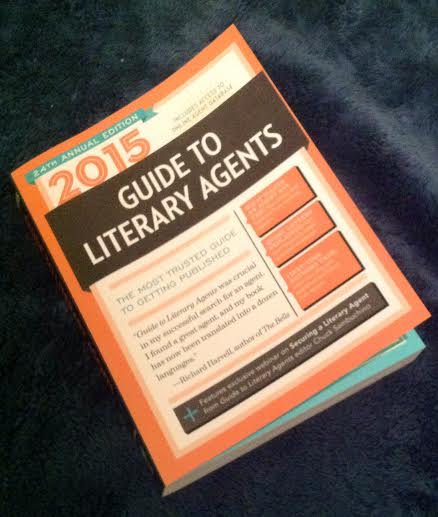
Yesterday my hot-off-the-presses copy of Chuck Sambuchino’s 2015 Guide to Literary Agents arrived on my doorstep. I quickly sliced open the box and cracked it open. As I prepare to write Where the Light Enters for National Novel Writing Month, a portion of that planning involves marketing the book and learning as much as I can about the agent and book publishing world. This is completely new territory for me, and this book is one of my main sources of research, advice, and guidance. If you’re taking a serious step into the writing world, I highly recommend the book. In an hour, I learned more information from it than I’ve learned in months of doing my own piecemeal research. It’s that good. Let’s do this!



 Christa Avampato