So many times we’re asked to shrink, to tempter our expectations, to conform, settle, and receive less than what we truly deserve. Yesterday, the Supreme Court changed that. Love won, and not just the “right” kind of love according to the definition of a shrinking minority, but ALL love for EVERYONE. That decision made my eyes tear and my heart open. The decision on gay marriage is proof that we have higher standards, for ourselves and our government. That we can do better than we’ve done in the past. That we can transform. That light, and love, will win as long as we continue to believe and continue to fight for every person’s dignity. Up with love!
I am bowled over by the support I have received since recording a Youtube video in response to Mitt Romney’s 47% comment. Many people wrote to me to share their own stories of success that began with receiving assistance from the government to better their lives. I am moved and inspired by their words and actions.
Fresh off the Social Good Summit and Clinton Global Initiative gatherings, I wanted to do something more to help people share their stories and to illustrate the humanity behind the 47% statistic. Too often numbers are tossed around without the context of the narrative that gives them meaning and purpose. Behind that 47% figure are people who are trying to make the very best of use of their time, energy, and talent. They need our help and encouragement. Let’s help them to have a voice in this conversation.
Visit The 47% Facebook page to lend your support with a Like and to share your own story of success, hope, and gratitude. Together, we can help government to realize the good it can do by investing in all of its people.
Upon the very strong advice of my friend and mentor, Richard, I bought a ticket to see the Metropolitan Opera’s final performance of Satyagraha (“truth force” in Sanskrit), an opera by Philip Glass that tells the story of Gandhi’s life in South Africa through the ancient Hindu text of the Bhagavad Gita. The Gita is also one of the primary teaching tools in yoga classes and in yoga teacher trainings. Yogis live by its lessons.
The visual representation and innovative use of puppetry in Satyagraha was stunning. The lighting and sound of Sanskrit (rarely heard today in this country, save for the occasional phrase in a yoga studio) set to music lit up all of my senses while also giving me a true sense of peace and resolve. I was in a very meditative state during the entire production. In the program, I learned that it took over 10 years of tireless effort by Philip Glass and his collaborators to complete.
The Gandhi we know who changed the world with his campaigns of nonviolent resistance against social injustice spent over 2 decades testing and refining his methods in South Africa after facing fierce personal discrimination. His movement began on an incredibly small-scale and remained small for years. It was his persistence and absolute confidence in his mission that brought him to prominence and influence.
Satyagraha was a particularly personal performance for me on a number of levels:
Yoga
I went on December 1st, the 19th anniversary of my father’s passing. The circumstances of his life and death have fueled my own yoga journey and the healing found along that journey spurred my desire to teach and to form Compass Yoga.
South Africa
While I was a graduate student at the Darden School, I went to South Africa as part of a cultural exchange class. For many years, I dreamed of going to Africa. As an elementary school student, I was fascinated by learning about the cultures there and somehow felt as though I oddly belonged in Africa even though I was very young and had never even left the East Coast of the US, much less traveled to Africa. For me, South Africa was a dream and I hope to return someday. Perhaps to even live there for some time.
India
In May, my friend, Rob, and I will be traveling to India on another long-overdue trip of a lifetime. India is the seat of so much philosophical history and the root of yoga. I expect it to be one of those places that changes me forever, how I see the world and how I see myself in this world.
Gandhi’s Lesson: Do or Don’t
Choosing to begin and undertake an auspicious project – whether it is a mission of social justice or an opera that chronicles the life of a towering historical figure through an ancient text in a language that few people understand – takes courage and faith. There are moments of grave doubt, fear, and anxiety for all people who choose to live a life of meaning and service to the greater good. What separates those from those who do and those who don’t is that those who do see something that bothers them, really bothers them, and decide that they have within themselves the ability, endurance, and dedication to generate great change.
It really is that simple – either we do or we don’t. We get the lives that we have the guts to begin and create.
“Sunlight is the best disinfectant.” ~ U.S. Supreme Court Justice Louis Brandeis
Last night I went with my friend, Sara, to a vigil for religious freedom and to commemorate the anniversary of 9/11. I had never seen the sky lights that are lit up to pay homage to the Towers, 2 giant beams that shoot up from the base of where the buildings once stood clear into the sky for as far as the eye can see. Hundreds of people gathered just one block away at Park and Church, holding candles, listening to speeches by religious leaders, and talking with friends. Just around the corner stood the site that will become the Islamic Community Center.
To be honest, the speeches weren’t moving, sometimes inaudible, and the traffic continued to run along Church Street throughout the vigil. What was moving was to hear the message, from the speakers and attendees beside us, that no neighborhood in this country should ever be off-limits to anyone. It sounds like such a simple idea and yet it has caused such controversy in New York and around the country. The argument “how could THOSE people be so insensitive?” has circulated around the Islamic Community Center in newspapers, TV broadcasts, and on the streets on U.S. cities. My response is THOSE people didn’t have anything to do with 9/11. Muslim lives were lost when those Towers fell, too; Muslims the world over are mourning today and everyday just like non-Muslims. If anything that ground on Vesey Street, and anywhere else in this world for that matter, belongs to the global community. We all have a right to be wherever it is we want to be.
What toppled those Towers so tragically 9 years ago today was not Islam or people living in Middle Eastern countries. It wasn’t hatred for Americans, nor was it anger in our foreign policies. What destroyed those Towers and continues to threaten world security is intolerance. By protesting the Islamic Community Center at 51 Park Place, intolerance grows and strengthens. Intolerance, the very idea that has caused our nation and particularly New York City, so much heartache is exactly what the protesters to the Islamic Community Center are propagating. It’s akin to poisoning ourselves with the very thing that others used to harm us.
It was encouraging to be among the group gathered for the vigil last night, sharing candle light and a common belief in true freedom for all people everywhere. I hope that the light we created there goes at least part of the way toward rooting out intolerance and burying it once and for all.
Today marks the 40th anniversary of Gay Pride. Last night, I went to the movies with my friends, Thomas and Richard, a couple who have been together for 24 years. After the movie, we walked over to the Christopher Street subway stop to head back uptown. Before getting on the subway, we went by the Stonewall Inn. Richard explained the history and significance of the Inn to me and how it served as the stage for the tipping point of the gay rights movement in what would become known as the Stonewall Riots.
We enjoyed watching the crowd in the neighborhood, and read the newspaper clippings and admired the replica of Judy Garland’s Wizard of Oz dress in the window of the Stonewall Inn. (Judy Garland, a hugely popular gay icon, died several days before the Stonewall Riots began and her funeral was held the day before the riots.) It’s important to bear witness, to remember how difficult and frightening a time was for people courageous enough to stand up for themselves. And while it’s easy to consider how far we still have to go on certain human rights issues such as gay marriage, it’s equally important to celebrate how much has been accomplished in the 40 years since Stonewall.
In New York State, we are on the cusp of legalizing gay marriage. If passed, we’d be the 7th state to legalize gay marriage. Gay marriage and the equal treatment of gay Americans is the civil rights issue of our time. I am certain that decades from now, we will look back on this period as one of embarrassment and shame. I cannot fathom how anyone would deny the basic rights of another human being based on their sexuality. Are the movements that led to equal treatment of women and ethnic minorities any different than what the gay community now faces? If two gay people want to get married, what bearing does that have on two straight people who are married? Who are we to stand in judgement of someone else’s lifestyle?
I hope the concept of denying gay marriage never makes sense to me. I hope to never understand why a portion of the straight population is so convinced that the gay population is ruining the sanctity of marriage. What I do hope happens is that the very politicians and their supporters who are fighting so hard against gay marriage, the same ones who are so quick and earnest to dismiss their own issues of infidelity, will find a way to see the world and the rights of all people through new eyes.
I hope that someday we will look at all people as equal, gender, sexual orientation, race, and religious beliefs aside. I hope that someday very soon, my gay friends are afforded the same right to union and happiness that my straight friends and I have. I hope that very soon the gay rights movement becomes something for history books – a time that we collectively look back on, and shakes our heads in wonder, asking “why did it take so long for simple justice?”
“My favorite place is my imagination.” ~ Jackie Pagan, featured narrator in Youth Producing Change
My friend, Linda, invited me to the Human Rights Watch film festival here in New York at Lincoln Center’s Walter Reade Theatre. We went to see Youth Producing Change, a documentary created from the stories of 10 young film makers on issues ranging from youth homelessness to HIV / AID to water conservation. The stories are deeply moving, and all the more remarkable because they were made by film makers under 18 years old, many from impoverished countries who belong to marginalized populations.
How often do we catch ourselves saying, “how can I make a difference?” or “what change can I really achieve in this complicated world?” We had the great privilege to have a question and answer session with the film makers after Youth Producing Change had its screening. The producers don’t ask themselves these questions. They have gone confidently in the direction of their dreams, believing now only that they can have an impact, but rather that it is their obligation and their duty to create change.
Most times, young people are told to respect their elders, to follow the lead of adults, to learn from their mentors. Sitting in the Walter Reade Theatre today, I found that these young adults have much more to teach us than we have to teach them. They have seen, heard, and experienced life in a way that is very difficult for most of us to even imagine; the vivid images and language of the documentary give us a frame of reference that is critical to build our empathy and compassion for the human experience. Thankfully, their stories are the stuff of movies now, and we should do our best to nurture, support, and encourage their drive, ambition, and courage to tell their stories.
At 40 years old, Harvey Milk sat in a gray New York City cubicle at a large insurance company. He wasn’t proud of a single one of his accomplishments. Luckily for all of us, Harvey Milk was not content to live out his days in an unremarkable fashion. He rose up, and he took us with him.
In the remarkable portrayal of the first openly gay elected official in the U.S., Sean Penn brought the story of Harvey Milk to a new generation of people, just as the tide of activism, volunteerism, and interest in politics was taking hold again in this country. Harvey Milk stands as a shining example of possibility realized, of personal accountability and responsibility, of the power of a single individual to unite a group of people for a common cause.
Harvey Milk’s story is especially important now as we consider and re-consider laws and propositions whose central issue is decency and respect and dignity. Someone’s sexual orientation, gender, cultural heritage, religion, race, and socioeconomic status too often determines the course of someone’s life in our country. And it must stop.
I’ve heard people say that every generation has its own societal ill that becomes central to its history, shaping the lives of its members going forward. Ours is very basic, very easy to articulate. Once and for all, are we going to support the notion that all humans should be treated humanely, regardless of circumstance? Will we finally make the statement “all people are created (and therefore treated) equal” a reality? If so, then all of Harvey Milk’s efforts, and the efforts of millions like him, will have all been worthwhile.
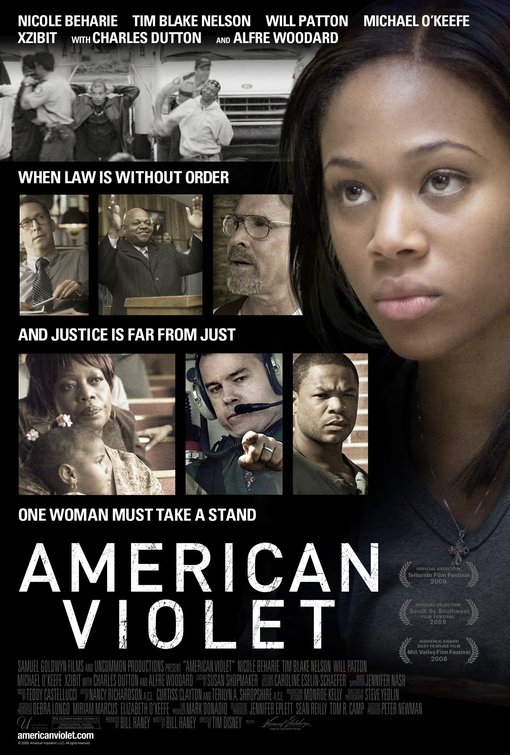
Tonight, I went to the New York screening of American Violet, a movie about an ACLU case in Texas against a District Attorney for racial profiling in drug cases. I was skeptical about the movie. I was worried about it being preachy and over-dramatic, though my friend, Richard, invited me, and I wanted to support him and his organization. And I couldn’t have been more wrong. The movie is stunning.
This movie showcases activism at its best. A young woman takes on the case as the lead plaintiff with the encouragement from the ACLU to stand up for her community, her neighbors, and her family. Wrongfully convicted of selling drugs in a school zone, she endures great pain and difficulty in the name of what’s right. She displays so much courage that had a I not known it was based on a true story, I would have believed it was invented in Hollywood.
A complete surprise, the woman whom the story is based on was there in the audience and spoke after the movie. Her eloquence and grace in the face of such trying circumstances is so inspiring that I left wondering how on Earth I could ever complain about anything in my life. While many people have given their lives to stand up for justice, the main character of American Violet didn’t have a choice. Injustice was her life, and the life of those all around her. If she wanted to live free, truly free, and move forward she had to stand up. She had no choice but to fight.
American Violet is a testament to the power of story-telling and narrative, the ability to connect people across miles and circumstances, despite age, race, culture or gender. Stories, and their telling and retelling, build empathy and strength. Films about social issues have the ability to entertain and inform; they build community. And to solves problems as large as the issues of racism and substance abuse and incarceration, we need community.
As I walked back to my apartment, I was reminded of Anne LaMott‘s book Bird by Bird, my favorite book about writing and story telling. At one point in the book, Anne talks about the writing classes she teaches in the Bay Area. And her one piece of advice to her students that I always think about revolves around courage in writing. If you have the courage to live through a tough situation and free yourself, then have the courage to write it down and share it with others because in telling your story, you just might help set someone else free. I can’t imagine a more beautiful example of that principle than American Violet. Opens in theatres everywhere April 17th.



 Christa Avampato