career, experience, work

Beginning: Learning from the Tiny Experiments of The Onion, Starbucks, and Chris Rock

On Friday, Brian and I talked about the idea of tiny experiments that get us ready for big leaps. I had been chiding myself a bit about all of the things I haven’t done yet in my 35 years of existence. This kind of topic always gives Brian a good chuckle.

A Realization Date
Last weekend I went on a date (nice guy, but not the right guy for me) and we got into talking about all of the work we’ve both been doing on our own personal projects. I tend to shy away from this type of topic on a first date because I know I am hyper-productive. Unfortunately, this guy kept asking questions and so I had to keep answering. Several times he articulated that he couldn’t believe how much I’ve done in the past two years. While I appreciate the compliment (?), I also know that I need to be with a guy who is in that same mode of productivity, who’s in this life to get as much joy from it as he possibly can. I need someone who inspires me and helps me grow.

The Mind Prepares
This date woke me up a bit and got me out of my tiny rut of being a bit down on myself as of late. I am a tough self-critic. Relentless. I expect a lot of myself. I’m a little annoyed that at 35 I haven’t made some bigger leaps in my professional life. Brian reminded me that I needed all these little pieces that I’ve been collecting over my career, that the step into full-blown entrepreneurship is a big, mind-shifting step and so our bodies and minds try to ease that transition as much as possible. It’s a step-wise process. “Inch by inch, it’s a cinch. Yard by yard, it’s hard.” Every role I’ve had has played it’s part, which might be why I’m being so darn picky about my next role. It’s got to fit in to the master plan, which is a new perspective for me to take.

So how do we cut ourselves some slack to take the small steps that prepare us for the big leaps? Author Peter Sims has some ideas. This Sunday’s Times ran an article by Sims on the “daring to stumble on the road to discovery”. Sims’s book “Little Bets: How Breakthrough Ideas Emerge from Small Discoveries” is a treasure trove of successful examples that illustrate how powerful it is to try, tinker, and try again based on experience. Starbucks, The Onion, and Chris Rock hold the same truth: try out a creative idea on a small beta scale, learn, and then go bigger.

Quiet Down
The article helped to quiet my inner critic. This is exactly the approach I’ve been taking with Compass Yoga. I offered by-donation classes – made a bit of money, grew as a teacher, no way to scale. I rented my own studio space for group classes – broke even financially, took a lot of marketing time, and brought me little satisfaction as a teacher. I attempted to partner with nonprofit organizations and grow a community of new teachers to offer free classes to their communities – no money, lots of administration, grew as a teacher and leader. None of these experiments were a waste, and ultimately they each gave me something that lead me to my latest experiment in mission and direction for Compass.

My message is this: take your time, figure out what you really want to do, and then give a small bet a-go. Hang your foot out over the edge and pay attention to how it feels. If that bet doesn’t work, place your foot back on solid ground, regroup, and try again with a new bet based on your learnings from the first bet. Get going, stumble, discover, learn, repeat. A winning formula.

experience, learning, teaching, yoga

Beginning: Why You Need to Know What You’re Doing

“If you know what you’re doing, you can do what you want.” ~ Moshe Feldenkrais

“Awareness is the first tool of change.” ~ Arturo Peal

Sometimes you can play the game of fake it ’til you make it. You can make it up as you go along, and hope that it all goes well. I’m not an enormous fan of winging it. My MO is to plan, plot, and prepare. In the past year, I have let go of some of that. I do feel a little more at ease taking life as it comes when there simply is no other option. Winging it is still a last resort for me.

Practice helps
I believe there is something really powerful about the art of practice. Through discipline we continuously improve and build an awareness that helps refine our skills. The goal of practice isn’t to be perfect; it’s to be the best version of ourselves at every moment. When we are aware we are always in a state of learning. It’s a virtuous cycle: the more aware we become, the more we learn, and the more we learn, the better we become in our chosen field.

Choose your direction
It’s that idea of our chosen field that came to find when Arturo shared Moshe Feldenkrais’s famous saying, and then added his own thoughts about awareness as the prime tool to generate change. It’s an especially relevant concept for teachers. Teaching is a performance, and yes, you absolutely need to roll with the punches. However, it’s much easier to roll with those punches if you know what you’re doing, at least in a broad sense if not specifically. When I was in business school at Darden, I could always tell who was a seasoned master case method teacher. Their delivery, commentary, and ability to steer the conversation without stifling the students’ creativity always impressed me. Their practice over many years made all the difference.

I consider all of the times in my life when I’ve been really frustrated, when I’m just not sure what to do next or how to get out of the rut I so much want to leave behind. There’s nothing that gets me down more than the feeling that I’m spinning my wheels to no avail. These moments find me most often when I just don’t know what I’m doing. This feeling attacks my confidence and sense of ease. If I can just take a deep breath, crank up my awareness, and recall when I’ve been in a similar situation before, I can begin to find my way one step at a time. My confidence builds, my ease returns, and I begin to do the work I want to do.

You can prepare to adapt
Preparation and improvisation don’t need to be mutually exclusive. I’m beginning to see that our ability to effectively prepare while also being able to handle unexpected change is the very best way of living. To take our lives in the direction we want them to go, we need to know which road to take even if we don’t know all the turns that will crop up along the way. Our preparation helps us choose the right road. Our ability to adapt helps us navigate the inevitable twists and turns.

creativity, experience, teaching, yoga

Beginning: If You’re Going to Experiment, You Need a Laboratory

From smashingapps.com

“Experimentation is an active science.” ~ Claude Bernard

The only way anyone can really learn to teach is to practice. No amount of book learning or observation (and I am an enormous fan of both practices!) can really prepare us to stand before a group of willing minds and bodies who want to learn what we know. We have to take our place at the helm of a class and give it a whirl, over and over and over again.

This is especially true when learning to teach yoga. The cadence, tone, and volume of our voices, how we tread the lines of observing our students, adjusting them verbally and physically, demonstrating, and giving them information about a posture’s benefits all take a good deal of practice. To practice we need a laboratory – a place where we can try experiment and play to gauge what works and what doesn’t. My laboratory for teaching is my free class at the New York Public Library on Wednesday nights at 6:00pm.

Tonight we started class with a few postures that I learned over the weekend at my therapeutic yoga training at Integral Yoga. These postures are more based in Traditional Chinese Medicine  than yoga, and asked if they’d be willing to give them a go so I could practice teaching them. Gracious as always, they were more than happy to give them a try to help me out. It was a great gift for me to practice receiving help, something that is sometimes difficult for me to request. I’m used to giving all the time; the students were more than happy to be able to give in return.

Labs gives us the chance to try what’s difficult for us, which is often exactly what we need to do, and it promotes the growth of the individual and the participating community. It also opened up the dialogue. The students felt more willing to ask question than they have in other classes. Rebecca, the head librarian at Bloomingdale who makes this class possible, walked me out after the class. “I have to miss next week’s class and I’m not happy about it. This one hour of class makes my whole week manageable.”

And that’s the benefit I didn’t know a lab could provide – the freedom it represents gives all of us permission to check our cares at the door and for a brief time just be.

experience, yoga

Beginning: Be Where You Are

“Progress is what you make of it.” ~ Matthew Sanford

While I was doing my yoga teacher training, a number of my training friends and I were frustrated with our progress. We were all searching for a greater sense of understanding of very complex ideas in our own practices. One of our instructors, Jeffrey, gave us some very sound advice that sticks with me every day: Enjoy the view, whatever it is, wherever you are. There is always something to see from every vantage point.

Every step we take, every experience we have, is unique. We will never have the chance to relive it exactly as it is in this moment. It’s a snapshot that we need to grab a hold of and appreciate for all that it has to offer us. There is so much learning and wisdom available at every moment. It is a reason for gratitude. Even the trying moments, perhaps especially the trying moments, are here for a reason.

I often wish life was easier. I wish it didn’t take so much difficulty for us to learn some lessons. But we are complex beings, and as a result create complex systems and circumstances. I try to take the long view as often as I can. I try to remember that everything I experience supports my own evolution and development. Whenever I feel my frustration rising, I try to remember that this moment, like every other moment, will pass. What will ultimately make a difference is what I do with each of these experiences going forward and that has everything to do with how I progress.

books, career, courage, encouragement, experience, leader, leadership

Beginning: You Have All the Power You Need

“New seed is faithful. It roots deepest in the places that are most empty…And so it came to be that over time this field, opened by burning – this field, fallow and waiting – drew just the right strangers, just the right seeds to itself. What is this faithful process of spirit & seed that touches empty ground and makes it rich again? Whatever we set our days to might be the least of what we do, if we do not understand that something is waiting for us to make ground for it, something that lingers near us, something that loves, something that waits for the right ground to be made so it can make its full presence known.” ~ Dr. Clarissa Pinkola Estes

I read Dr. Estes book Women Who Run with the Wolves many years ago. It remains a faithful guide all of these years later. Its pages are well-worn and yellowed. I regularly read its opening passage, particularly when I’m afraid and lonely. It’s stories quite literally began to shape the person I am today. They empowered me to realize that I can carve my own road toward a future of my design.

So it was with great excitement that I discovered that Dr. Estes had written another book, this one a novela entitled The Faithful Gardener: A Wise Tale About That Which Can Never Die. I read it in one sitting. Dr. Estes tells the tale of her Uncle who got to the end of his rope and wanted to take his power back. He set a field aflame as an invitation for new life to seed there.

In our lives, we collect clutter. Relationships that no longer serve. A job that no longer interests us. Commitments that no longer provide fulfillment. Slowly, drop by drop, our lives sometimes become something we never wanted them to be. This can leave us feeling paralyzed, regretful, and embarrassed.

This is exactly the myth that Dr. Estes dispels by sharing her Uncle’s story with us in The Faithful Gardner. One day last week, I arrived at a meditation class feeling powerless and through the meditation realized that the only one taking away my power was me. Dr. Estes explains this same principle in her book – we are all more powerful than we give ourselves credit for being.

This same idea reared its head over the weekend as I watched the documentary Stress: Portrait of a Killer. In several scientific studies, it has been found that if you perceive yourself at the bottom of the pecking order in life then your health and longevity are severely compromised. If you want to live a happy, healthier, longer life, it is critical that you find an outlet that allows you to feel in control of your own destiny. And that outlet doesn’t have to be your career or household. You could be the captain of your softball team, the leader of a charitable project, or a responsible dog owner. Somewhere in your life you need to have the opportunity to take the reigns, and if that’s not happening naturally in your life by some wonderful twist of fate, then you need to make it happen for yourself.

There’s no reason to play the victim. We all have the ability to build better lives, for ourselves and for those around us. You don’t need more schooling or experience or permission. It is yours for the taking. The only question is courage and confidence. Can you stand up and be counted? Will you make your voice heard? Can you release everything in your life that doesn’t benefit you for the sake of making room for something that truly matters? Your life literally depends on it.

experience, healthcare, learning

Beginning: Let New Experiences Be New

http://www.sevenof.com
“You can’t use a Western mind to understand Eastern philosophy. To really understand it, you have to change your mind.” ~ Dr. Nan Lu, OMD

Dr. Lu used this quote to close his talk about Traditional Chinese Medicine at the Integrative Healthcare Symposium earlier this month. It reminded me of how often we try to understand a new concept based upon our past learning. Of course, this is entirely logical. Our experience gives us a language and lens by which to process novel ideas. Though just because this pattern is logical, doesn’t mean it always serves. What’s perhaps more powerful, and yet more difficult to do as we get older, is to just take a learning as is without trying to compare it to what we already know.

This is how children learn. They’re little sponges. No prejudices, no judgements, no nagging voice in the back of their minds that is chattering away. They take a new lesson as just that – new and to be appreciated in its own right.

What if we could do that as new situations and experiences come into our lives? What if we could set aside that chattering, monkey mind, and just take in the new information for all the glory it has in its own right? If we could do that then I am confident that there isn’t a single challenge in all the challenges our world now faces that we wouldn’t be able to solve.

books, design, experience

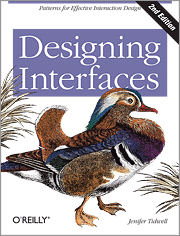
Beginning: Finding Beauty in Interactive Design and Life Thanks to Jenifer Tidwell’s Latest Book, Designing Interfaces

“Looking closer can make something beautiful.” ~ Cynthia Lord

As a customer experience designer I spend a lot of time thinking about aesthetics. I recently finished up an excellent book by O’Reilly Media on the topic – Designing Interfaces by Jenifer Tidwell. Yes, the book focuses on the design of interactive experiences – online and for mobile. Tidwell has used the idea of pattern finding as a basis for exploring interactive design. Patterns, a way to recognize the structure of past experiences and relate to new one, make us feel comfortable and secure. So it’s not surprising that we find beauty in them.

What Tidwell highlights so well in the book is the idea that patterns don’t just show up by accident, and they aren’t recognized accidentally either. Patterns need to be sought out, pursued, and practiced. Of course you can and should vary a pattern based upon the audience you’re targeting and the medium you’re using. However, a pattern, even if rough form, gives us a place to begin, a root to branch from, and eases the anxiety we feel at the start of a new project on a very blank canvas. Just beginning can be the very highest hurdle. Patterns give you a way over that hurdle so you can get to the fun stuff.

And this true whether you’re working on interactive design, painting a mural, or designing your life. While Tidwell wrote the book for software developers, web / mobile designers, and usability experts, the truth is that the interactive space highlighted in the book can be a metaphor for anything that can be designed, which is to say that it’s for everyone living, breathing, and creating. Patterns are where we start. According to Tidwell they have a 5-fold purpose:
1.) We learn from them.
2.) Teaching us what has worked and what has not worked, and why.
3.) They give us a design vocabulary that allows us to exchange thoughts and ideas with other folks like
us.
4.) Patterns serve as comps for projects we are currently engaged with.
5.) Patterns inspire us – and that’s true whether we’re trying to copy them or break them.

Interested to start seeing patterns in your own life? Here’s a fun exercise I like to do whenever the way forward on one of projects seem murky and I can’t find the beauty in what I’m currently doing. Hint: take Cynthia Lord’s advice and look closer:

1.) Think about a time when you felt blissful, when everything, literally everything, in your world fit perfectly in its place. Where were you, who were you with, and what were you doing?

2.) Think about a time when you felt totally disillusioned, disappointed, and frustrated. What are the events that lead up to that circumstance? How did you remedy the situation? How did it resolve?

Through the careful and honest assessment of these two exercises, you will see some patterns in your life that lead you in two polar opposite directions. And this little trip down memory lane can be scary for some people. Looking at our successes and failures and seeing how they came to be forces us to see how we play a hand in shaping our own life. Life doesn’t happen to us; we build it. That responsibility can feel empowering to some, and downright terrifying for others. If you’re in that latter group, take comfort that the patterns that emerge will provide you with a great understanding of how your life has come to be where it is now, at this very moment. And knowledge is power.

Still nervous? Here’s an example for each of the exercises from my own life to get you going:

1.) Last Fall, I was walking through Central Park by the Metropolitan Museum of Art. It was a warm, sunny Fall day, and Phineas and I were enjoying one of our marathon morning walks. (How I miss those days as the frigid winter wind now howls outside my window at this very moment.) There was nothing extraordinary about that moment, but just as the Met came into view, I felt this surge of joy rush through me and overflow.

Patterns: Walking my dog (and exercise in general) is very therapeutic for me. Our desire for happiness can be fulfilled in every moment, even when doing the simplest things. Happiness is always accessible to us as long as we remain aware.

2.) When I first started at my current company two and a half years ago, I was in a miserable work situation. I had the worst boss of my career, and faced some of the toughest projects I’ve ever done with very little support from her. Oh, and the economy was falling apart and there was a very real possibility that I would be laid off at the height of the recession. Those were scary, sad, anxiety-filled days.

Patterns: I rushed into taking that job, even though my gut told me this boss was not the right one for me. I didn’t ask much of my boss, even though I was frustrated with her lack of support and lack of engagement. Though outwardly confident, I was a nervous wreck inside, which caused my health to be compromised for far too long.

Just writing that out now did me a world of good. I’ve moved my life much more in the direction of my joyful experience and further away from circumstance that disappointed me. And this exercise spurred me to look for even more patterns from other experiences.

I think Jenifer Tidwell would be proud, and she should be honored that her book about interactive design can really serve an even higher benefit – it can help someone build a satisfying, fulfilling life.

This blog is part of the 2011 WordPress Post Every Day Challenge.

This blog is also available as a podcast on Cinch and iTunes.

change, experience, psychology

Beginning: This Year, Change Your Mind

Listen to a podcast of this post on Cinch.

On New Year’s Day I spent the morning happily curled up on my couch with Phineas (he was a little under the weather due to an allergy to all the rock salt they slather NYC sidewalks with), my computer on my lap, Anthony Bourdain on my TV traveling and eating his way through exotic lands, and a cup of Bengali Spice tea. I was having a perfect start to the new year.

I was flipping through the New York Times on my computer and came across an op-ed by Oliver Sacks, an author and scientist who was very influential during my undergrad years at Penn. The way he looked at cognitive psychology and its implications on culture and understanding the human condition, really struck a cord with me so I was thrilled to read about his latest ideas.

In the article, he talks about how New Year’s resolutions tend to be things like lose weight or go to the gym, wonderful resolutions that are good for the body. He asks us to consider making a resolution to grow and strength our minds, and suggests that one of the very best ways to do that is to try something new, which could mean brushing your teeth with your weaker hand, traveling to a new destination, or taking up a new instrument. Giving ourselves over to the beginner’s experiences does for our mind what working out does for our bodies. How wonderful since I just pledged to be a beginner for the entire year of 2011!

Here’s to stronger, more open mind in 2011. What new adventure are you taking up?

The gorgeous image above appeared with Dr. Sacks’s op-ed and was created by Valero Doval.

This blog is part of the 2011 WordPress Post Every Day Challenge.

choices, dogs, experience

Beginning: A Lesson Along the Snowy Path

Listen to a podcast of this post on Cinch.

Phineas and I took our first walk in the snow last week. He’s pretty psyched about snow and not at all psyched about slush and wet pavement. For some reason, the snow really agrees with him and because he’s only 6 inches at the shoulder, it wears him out, too. (Imagine how tired we’d be if we always had to walk in snow up to our waists!)

Over at Riverside Park, you can frequently find us frolicking in the meadows, hanging out with other dogs and dog owners, and taking in the view. We love that park, maybe even more than we love Central Park. Its slow pace, river-facing views, and arching trees make us happy in every season.

On our first snowy walk together, I chose the safe path, the one shoveled and cleared by others because I thought it would be easier for Phin. He, however, chose the snowy path because it was more fun. He dove right into that snow with wild abandon, made little snow angels (more appropriately snow dachshunds), and tossed the snow up in the air with his ample nose. It was glorious to watch him living so fully. And inspired me to do the same.

The heck with the well-traveled path. Like Phin in the snow, I want to carve my own. (And then after all that work, a nap is in order!)

The photos in this post are, respectively, Phin dashing around in the snow (tough to catch on camera – he’s a fast little guy!) and then coming home and promptly finding his blanket to settle in for his afternoon nap.

This blog is part of the 2011 WordPress Post Every Day Challenge.

experience, writing

Beginning: New Writing Intention for 2011

Listen to a podcast of this post on Cinch.

“We will open the book. Its pages are blank. We are going to put words on them ourselves. The book is called Opportunity and its first chapter is New Year’s Day.” ~ Edith Lovejoy Pierce

As I moved closer to my goal of Step 365 on my path to extraordinary living, I started to worry about what I would set as my writing intention for 2011. In 2009, I set out to write a post every day that discussed something that made me feel more hopeful. In 2010, I wrote a daily post that described one more step I was taking to live an extraordinary life. I learned so much in those 2 years, and it felt like a streak that would be tough to maintain in 2011.

And then my friend, Amanda, sent me a lovely email and asked me to write a guest post for her blog ZENyc, which focuses on how to maintain balance in the crazy place we know and love as New York City. Of course I said yes and I asked her if she had a specific topic she wanted me to address. She didn’t have anything particular in mind, just a post about how I stay sane in New York.

The mere suggestion of my sanity was very flattering. Sometimes I feel totally off-kilter but apparently I am holding it together well for a majority of the time. New York keeps us on our toes – we grow comfortable with being uncomfortable from time to time. You’ve gotta be a little nuts to live here, and a little more nuts to stay for a while. Thankfully, I’m a lot nuts – gratitude to my upbringing by a very bohemian mother and an austere, psychoanalyst father – so not only do I choose to stay in New York, but I also choose to call it home.

For Amanda’s guest post, I batted around the idea of writing about yoga, having a dog, my amazing friends, my writing, having a quiet home – all topics that I write about all the time. I wanted to do something really unique for Amanda, offer something up to her readers that would be new and helpful. I wrote, re-wrote, and tossed away a number of posts. None seemed quite right.

About the same time that Amanda asked me to write the guest post, one of my co-workers told me about his New Year’s Resolution to be open to new experiences. He said it worked well for him in 2010 and he was thinking of taking it up again in 2011. That sounded like a good idea to me, and inspired me to write a guest post for Amanda’s blog about the topic of beginning. It takes courage to try something new. To have a beginner’s mind seems to me to be the best way to stay balanced. If we’re always beginners, always learning, always energized, always bold and courageous, then it’s possible to achieve great things while keeping our humility. We don’t know what we don’t know, so as beginners we experiment and explore and try, and then try again without beating ourselves up or second-guessing ourselves.

Just writing that post on the beginner’s mind was invigorating, and it got me jazzed to head out into the world and try all sorts of new, cool things. It put more fun and laughter into my writing and my life. Calling myself a beginner, I was able to look at everything with new, fresh eyes. And before I knew it, I had my writing intention for 2011. (Thank you, Amanda!)

In 2011, you’ll find all of my beginnings recorded here. All of my bumbling, fumbling, and shenanigans as I try these new beginner shoes on for size will be exhibited daily for your reading pleasure. Sometimes it will be a story of some experience I had or person I met or place I went. It may just be a cartoon or a quote or a picture. I’ll write about my new business, Compass Yoga, and how it’s going. I hope you’ll come along for the ride with me, take in the sights and sounds of a new writing journey, and tell me about your new adventures, too.

Let’s get going – as an old Levi’s ad once said, “the frontier is all around us.” Our frontiers are waiting.

The image above cracks me up. I hope it makes you laugh, too. Find it here.

This blog is part of the 2011 WordPress Post Every Day Challenge.