books, career, economy, job, management, work

Trust and learning in a time of change

“But never forget … our mission is to recognize contraries for what they are: first of all as contraries, but then as opposite poles of a unity.” ~ Herman Hesse


There’s a lot of tension flying around companies at the moment. This holiday shopping season, and the financial results it generates for companies, will lead to some potentially scary decisions in January. If you feel everyone holding their breathe until the new year, you’re not alone. The pressure and fear is immense and wide-spread.


This morning, I read my Daily Good email that highlight a Harvard Business Review article about trust in a time of extreme mistrust, and leading change in a time of change – both incredibly difficult things to do and quite frankly two things that many managers are not good (although they don’t always know that but their team does.) For example, some managers think they’re change agents simply because they question everything. The fine line that separates change agents from managers who only ear what they want to hear is how they ask the question and what their end-goal is. A change agent wants to examine possibilities, dig in to the issue, and examine detail in an effort to fully understand the issue at hand so a collaborative solution can be found. They take a balanced approach. 

Managers who hear only what they want to hear, also ask a lot of questions but ignore any of the details of what they’re asking for. These are the “I don’t care what it takes, just make it happen” managers. They will steamroll over their people, squeeze change out them, and then sit back quite proud of themselves of how they’ve transformed the group. Unfortunately that transformation came at the group’s expense, not to their benefit. And if you have one of these managers, I am very sorry. Truly. I know where you’re coming from and so do most of my friends. You are in a no-win situation because there is no reasoning with that kind of manager. Your leader doesn’t have balance, and without balance that person cannot lead effectively, much less mentor you.  

So what can you do? Reach out, way out, in your organization. Extend the olive branch at every turn, whether the person is in your group or not. Take this time to expand your network – you’ll feel better meeting new people in your organization that may have nothing to do with your job now, but could in the future. You can find solace in partnership, strength in unity. And that solace and unity is what’s going to get you through this economic bust. 

The other thing you can do is focus on the learning, not the bad behavior your fearful manager is exhibiting. Bob, one of my former bosses, gave me this counsel and I think of it all the time. He would say that no matter what happened to him in his career, good or bad, he knew it was all good learning and it made him a better person and a better manager in the end. Take this time to think about how important it is to build trust with the people you work with and for, and go out and exhibit that trust while also relying on your skills and ingenuity that will help you persevere. It’s a tough road, I know, but at this point it may be the only way forward.   

career, corporation, economy, job

We’re going the wrong way! Who’s driving?

My friend, Jamie, was was telling me about a his sister’s job in retail. It’s an industry I’m passionate about and may return to someday. It’s the heart and soul of the 70% of our GDP created by consumer spending. They’re hurting, like so many industries, and in times of trouble companies need the most able navigator at the helm. The trouble, at least with Jamie’s sister’s company, is that everyone is playing a game of Pass-the-buck instead of Survivor. The answers to questions like “Who is our core customer?”, “How are they hurting right now?”, and “With our competencies how can we ease that hurt for them?” are critically important for companies that wish to come out the other side of this latest economic slide, or any economic slide for that matter. 


Jamie drew a metaphor that is so clear in my mind and it perfectly captured the situation with his sister. It’s as if everyone is in the back of the bus, facing the wrong way, and asking where we’re going. No one, no one is actually willing to grab the steering wheel and drive. That driver’s seat is a very dangerous place to be for sure, though sitting in the back, eyes covered, knowing no driver is up there steering is far worse. It’s a choice of the lesser of two evils, with advantages and disadvantages for each action. 

Let’s look at hat’s actually happening for Jamie’s sister – no one’s driving. A crash is practically unavoidable. A runaway car with no driver can only stay on the road for so long. The people in the back may feel that they have a better chance of survival if they hang out and wait for someone else to step up. That’s possible. Though the greater likelihood is that the whole operation goes down while everyone is wringing their hands. And the lead up to the crash is painful and anxiety-inducing. 

An alternative is that someone does take the helm, and the crash happens anyway. It would be a near certainty that the blame and guilt will fall to the driver, and that driver couldn’t hope to survive. But what if that driver can pull it off? At this point, it’s hard to imagine any industry coming out of this recession unscathed. With the right leadership, the wounds could be bumps and bruises instead of lost limbs and massive internal bleeding.

It’s a gamble – there are clear choices that need to be made now by every company. What’s not clear is the best way forward that causes the least number of casualties. Strong leadership that focuses on stakeholder needs now is best able to find a way up, over, or through. At this point, we have to ask ourselves a key question about that bus situation: If we had no intention or desire to drive, or at least take a shift at the wheel, then why did we get on the bus in the first place? It’s foolish and downright dangerous to leave an entire journey up to everyone else. 
Christmas, economy, holiday, retail, shopping

Leaving sales on the table

Two girls shot in a California Toys R Us; a temporary employee, likely someone who needed the extra money in this economy, trampled to death in a Wal-Mart. All this after a raucous crowd ripped the doors off of the hinges. I was saddened and shocked to read this news late last night, particularly because I spent last Black Friday working in a retail store. Is that $130 Blu-Ray player worth violence? Does anyone on my list need a Nintendo DS so badly that I should literally risk life and limb to get it at as deep a discount as possible?

We could say that people in general need to calm down when it comes to holiday shopping. Perhaps suggesting that they act like humans instead of wild animals on the hunt. Then I took a stroll through the Wednesday and Thanksgiving papers that were filled with circulars. I reconsidered all of the television and internet advertising I’ve seen in the past few weeks, compounded by the many newspaper articles that have trumpeted Black Friday sales as the only time of year when you can get a real deal. Is it any wonder that frenzy ensues?

I understand that retailers are hurting and need the business. I understand that our economy needs a boost from consumer spending this holiday season. The only thing that is going to prevent this kind of violence happening year after year on the day after Thanksgiving is pull-back by retailers. This Black Friday is a man-made holiday, and it needs a man-made solution. Drive more sales to on-line rather than in-store. Learn how to spread yours sales across a season rather than across the hours of 5am – 11am on one day. And for heaven’s sake order enough inventory to fulfill at least a majority of the demand. Work with the suppliers beforehand, long beforehand, and do a proper forecasting model. This scarcity as strategy model is obscene, and it’s literally killing people.

This season I’ll be staying away from stores for the majority of the holiday season, as much as possible. I might pop in at some lull periods just to soak up some ambiance. I’ll be doing my spending right here in front of my laptop. In my efforts to cultivate peace on Earth this holiday, it seems that our retailers are not the place to be.

career, economy, government, New York City, opportunity, politics, relationships, thankful, thanksgiving

Thankful

Now that the food and travel of Thanksgiving have passed, I’m spending the morning eating leftover pie, drinking coffee, leafing through retail sales circulars, and considering all the things I am thankful for. Friends and family go without saying. This has been quite a year to date so items are making the list that have rarely if ever been on the list before:

My job – despite the normal frustrations that come with every job, I am especially grateful for my current position because the day-to-day tasks and the big picture view get me up out of bed every morning. I’m learning this is a rare blessing.

A place to call home – my friend, Monika among many other people close to me, are quite shocked that I have lived at one physical address for longer than a year. That hasn’t happened since 1998. Ten years of moving at least once a year. Good grief. And now I am finally in a city that is comfortable and feels like home. I feel a sense of ownership and belonging that I haven’t found before in my life. The stability of that sends waves of peace into my life that I have not had before.

Interesting times at a young age – the economy, politics, social activism. We are living in unprecedented conditions and if we can push aside the sense of uncertainty that invades our lives regularly, it is truly a spectacular opportunity for learning. To have this privilege so early on in my life and career is a tremendous gift that will inform many decisions I will make in the year to come.

The opportunity that lies ahead – we may look out into the world at the moment and see a very bleak picture. Though hidden within the folds of that bleak cover, there are wrinkles and pockets of opportunity. Going forward, there will be incentives for us to start businesses, to become a society of savers rather than spenders, to take up the call to protect the environment, and to build better transportation systems in our cities that will benefit generations to come. The good times will roll again, though in different, and dare I say better, forms that before.

In business school, Frank Warnock was one of my economics professors. Frank developed his expertise in international capital flows as a Senior Economist in the International Finance Division at the Board of Governors of the Federal Reserve System in Washington, DC. And whenever we reviewed cases or economic situations that were troubling, he would always say, “You have to be hopeful. What’s the alternative?” Those words ring truer today than ever before. And for hope, and the people who remind me of its value, I am most thankful.

business, care, career, economy, relationships, social work

Ask not what your company can do for you…

I was talking with a friend of mine from school today about, what else, the economy. We have big dreams – things to do, people to see, places to go. We were movin’ on up….until our economy tanked. Now we’re happy to just be employed. We talked about the morale in our respective offices. The morale of my team is going okay – his is not quite so good. I asked him how he felt about his future at the company and he gave me a wholly unexpected response. 


“In times like this, it’s better to think of what I can do for the company rather than think about what the company can do for me,” he said. “Who would you want to have around?: someone who’s always looking out for #1 or someone who’s looking out for everyone around him.” Good point.

In times like this when there is a lot of panic and anxiety, it’s only natural to think of ourselves and our own survival. As it turns out, the best way to survive is to look out for others, to connect with others, to support others in their pursuits. Think about it from another viewpoint – in tough times it would be easy for companies to just focus on their own survival. The truly innovative companies are finding their salvation in premium customer service – if they take care of customers now, when times are tough, those customers will remember them when the good times start to roll again. And they will roll again, no matter how bad it is now. Taking the long-view is critical to success years down the road. You’ve got to be willing to hang in there for the long haul. It’s no accident that the first for letters of “career” spell “care.” And that’s what businesses need right – people who honestly, deeply care about the present and the future. 

It’s like friendship, it’s like love. Tom Stoppard said, “It’s easy to love someone at their best. Love is loving someone at their worst.” When we’re down and out, we find out who really cares about us because those are the ones that stick around and help us pick up the pieces. It’s true in relationships and it’s true for businesses, too. Both need tending and nurturing, now more than ever.      
career, economy, job

Quelling financial anxiety

This morning the New York Times ran a great article on quelling the financial anxiety that is running rampant in this country. They interviewed Margaret Wehrenberg, a clinical psychologist in Naperville, Ill., and co-author of “The Anxious Brain.” That’s the permanent state of my brain: anxious. What a perfect article for me to read. According to Dr. Wehrenberg, I’m using my anxiety wisely: to prepare for anything. There is power and empowerment in action. Use the anxiety as fuel to get going.  


When I graduated from business school, I didn’t have a signed job offer in-hand. I had turned down several because they weren’t the right fit, and in the Spring of 2007, it was okay to do that because to economy was cranking along at a good clip. You could even negotiate a job offer. How quickly times have changed! I have friends who would take anything reasonable at this point, including a significant cut in pay and title, just to be working in their chosen field.  

I got a great job offer in June of 2007 but not before I had completely run out of money. I had to take a cash advance on my American Express Card and incur a finance charge – the only time I have ever had that happen in my 12 years as a card member. I read two books by Suze Oreman and have followed her advice to the letter. Since then, I have been on a diligent savings plan. Tax refund? Banked. Sale of car? Banked. One day of wages per pay period? Banked. I have set up automated funding into into my savings account every month and have been working to save 8 months of very modest living expenses. I started these habits when times were good, and now that times are not-so-good, these habits are easing my anxiety-prone mind.

So I’m in my apartment this morning, waiting for CBS Sunday Morning to start, drinking tea, eating granola, and battening down the hatches, or at least planning to. I love my job and am very happy to have it. The job losses of so many of my friends is weighing on my mind, and to remedy that, I feel like I need to consider what life would be or could be like if I were in their shoes. We all need to do that in this economy. So here’s the plan:

Update the resume: keeping it fresh is something we should be doing all the time, regardless of the job market. It needs to be ready to go at a moment’s notice. Update it on Linked-In, and any other on-line source you feel is appropriate.

Get out there: networking is a continuous activity. It’s much easier to establish and refresh a network when you aren’t looking for something, and then the network is there to tap when you’re in need. Keep your name out there, and let your contacts know what you’re up to.

Get your would-be action items in order: I am a list maker. I love lists of any variety. I’m working on several this morning – key contacts, brands I am passionate about (more to come on that in a later post), and job sources.   

It’s rough out there and these are uncertain times. The best defense is one that is all-encompassing. We all want to feel safe and secure, and if this economy has taught us anything it’s that security is self-made. As Ani DiFranco sang, “Self preservation is a full-time occupation.”
Business Week, economy, job, multi-tasking, New York Times, simplicity

Growing by Shrinking

We’re in the midst of watching our economy contract. These are frightening times, uncertain times for many people. I was inspired by Nicholas Kristof’s column this week as he attempted to find a bright spot in all the gloom that is filling our news channels and our own minds. I was flipping through Business Week and saw an ad for IBM with the following headline in bold type: “Sometimes Growing Starts With Shrinking”. How can we connect Kristof’s ideas and the IBM ad? 

Aside from our economy, I have been thinking about examples of shrink leading to growth. The ipod – making our music libraries physically shrinking from 100’s or 1000’s of albums, tapes, and CDs into one powerful device helped Apple find new life. The same can be said of many electronics such as cell phones and computers. 
 
Let’s consider travel. There have been a myriad of articles that encourage travelers to select a few key cities for a vacation and take in all they have to offer rather than doing a whirlwind trip and only skimming the surface of many cities. It creates more powerful and lasting memories, not to mention providing for some relaxation – the whole purpose of many vacations. 
Another example that struck me was all of the research being done now on multi-tasking. By attempting to do many things at once, it turns out that we do all of them more poorly than we could if we focused on one at a time. I notice this all of the time at work as I’m trying to balance a whole host of projects and objectives. Some studies even show that a lack of focus caused by multi-tasking increases stress levels, worsening general health levels, and lowering IQs.    
Now consider our economy: Think about the benefit of shrinking our spending to increase our savings. Barry Schwartz talks about shrinking the number of options we consider as a means of being happier with the choices we make. And then one of my favorite mantras can bring an immeasurable amount of peace to your life: simplify, simplify, simplify.
All of this is meant to show that shrinking isn’t always bad and can even be good for us if we’re willing to put aside our belief that bigger and more always equals better. Sometimes doing and having less provides abundance in ways we never expected.   
calm, economy, meditation, stress, yoga

Getting quiet

I am a long-time subscriber to Yoga Journal. I read it cover to cover every month. One of my favorite sections is the 10 pose sequence that has a specific focus. This month, the focus is “Inviting Quiet”. What can I say? I like a challenge.


I am a talker, a chatty Cathy in some circumstances. On the Myers-Briggs test, a couple of things stand out as truly odd. I am OFF THE CHARTS on extroversion and ambiguity. Give me a situation that is mired in ambiguity and deals with boatloads of people, and I’m as happy as a mouse in a cheese shop. 

I like engaging with people about 95% of my waking hours. And then in the other 5%, I hide away from the world. It’s important to note that without that 5% of hiding away from all humanity, that other 95% of the time with them is far less enjoyable. So while this introspection is small in quantity, the quality is critical. Yoga generates this necessary high quality.

I think about this need for quiet, even in the loudest lives, as I make my way to work each morning. There is a very short walk from my office building to my subway line. It’s not pretty, but I use it to center myself at the start and end of my day. It’s my gateway between my working life and my personal life. It is especially important in this churning economy to spend some time getting quiet, calming down our nerves, and turning inward to remind ourselves of what’s important. Getting quiet, at least for a short time, may be our only avenue through the noise all around us.   
business, career, economy, finance, financing, investing, job, loans, personal finance, politics

Worried about the economy? Here are some quick answers to common questions

I was going to post about myself, my life, and my observations about the world around me today. However, I’m hearing so many people say that they don’t understand how this current economic crisis is going to hit them personally, that I wanted to do my part to try to get the word out about 4 common questions that many people have asked me over the past few weeks:


1.) “Do I need to pull my money out of my savings and checking accounts and put it in my mattress?”

No. Please don’t do that. If it gets stolen or you have some disaster like a house fire, you’ll lose it all. Also, as long as your money is in a bank that is FDIC-insured, your money is safe up to $100,000. If you have more than $100,000 with the same bank, then take out the balance above $100,000 and move it to an entirely different bank, not just into another account at the same bank. The $100,000 insurance is per depositor, not per account! Don’t know if your bank is FDIC-insured? Call them, stop into a branch, or visit their website.

2.) “I think I am going to stop investing in my retirement fund because the market is so bad. Is that a good idea.”

No. No, no, no, no! Please don’t do this. Please. Economies go in cycles. You need the compounding on your retirement savings to make retirement plans work. If you pull out your money or stop investing, you will lose the compounding factor you need. And you’ll pay hefty penalties on the withdrawal plus lock in the loss. What you can and absolutely need to do is make sure that your portfolio is balanced. Many retirement plans have a “set it and forget” plan. That’s what I have. You plug in the number of years you have until retirement, and the plan automatically calibrates different investments to get you to your retirement goals. Still unsure? Make an appointment with an advisor at the institution that manages your retirement accounts – it’s free and it’s their job to explain your options to you. And if you don’t know how to make an appointment with them, contact your HR department. 

3.) “This job market is so crazy that I’ve decided to get out of the job market. Is that a good idea?” 

AH!!!!!!!!!! No – no no no. Don’t do that. If you retire now, you essentially lock in all the loses your retirement fund has just been hit with because you begin to draw on those funds yo worked so hard to save. This is bad – really, really bad. You worked hard all these years, and you’re not getting the full benefit of that hard work. If you’re quitting your job with nothing else to go to, you need to reconsider immediately. And change your mind – do no leave your job without another place to go. There will likely be nothing for you to go to. Now, I do think you should be networking and watching out for new employment opportunities that sound interesting. Actually, I think you should ALWAYS do this, even if you are 100% in love with your job. You need to cover your bases and in this day and age, getting a job interview (and probably getting your dream job or even just your next job) has much more to do with who you know rather than what you know.   

4.) “I don’t think Wall Street zillionaires should get a bailout so I’m against the Government’s $700 billion plan.”

I don’t blame you for being confused on the bailout – I blame politicians who don’t understand economics (inexcusable) and make this a partisan issue (also inexcusable). This is not about bailing out Wall Street. I’m really upset with the person who coined this plan as a “bailout” – it’s not. This money will make the Federal Government a bank that will loan money to banks like Citi or Bank of America to make it easier for those banks to responsibly loan money to average consumers (you and me). There will be plenty of Government oversight to make sure that money is loaned responsibly. And when the market recovers, those banks will pay back the Government, who will pay back the tax payers.   

If we don’t have this plan, here’s what will happen:
Access to credit will plummet, making it hard for all Americans and all American businesses to have any access to credit. All free markets need access to credit to function properly. This los of access to credit is not good – you won’t be able to get car loans, schools loans, mortgages, or any other kind of consumer loan. Credit card companies will cut your limit. All businesses, whether it’s your local pizzeria or GE, will not be able to get the loans, short-term and long-term, big and small, that they have to have to do business and to get us the goods and services we need to survive. Bankruptcies and home foreclosures will skyrocket, and as a result, unemployment will also skyrocket. We’ll be in a downward spiral.

So here’s the choice: a) pay some more taxes now and get that money back in the fairly near-future so our economy can get going again. b) pay a whole lot more now with people losing their homes and companies going out of business, causing unemployment to rise rapidly, and pay even more later as we struggle to deal with the fall out. And we will ALL deal with the fall-out, especially those in lower and middle income brackets. The recovery from option b) will be slow and painful. a) will be less painful and shorter. I’m going with a). I don’t like that we’re in this situation, but here we are.

This might be the only idea that George Bush and I will agree on, and I took some convincing. I read A LOT about this, talked and listened to a lot of people very knowledgeable in finance. At this late date, the horse is out of the economic barn and the only way to corral him back inside and under control is through a rescue plan. There simply is no other better option.  

business, Business Week, clarity, creative, economy, government, money, New York Times, politics, simplicity, social work

The agony of confusion and the ecstasy of clarity

By nature, I’m a passionate person. There are a few subjects that really get me going – happiness, creativity, health and wellness, the environment, puppies. (Not necessarily in that order.) And simplicity – I’m big on that. If we all worked on making our world and our lives simpler, we would all be better off. In some circles complexity and confusion are celebrated, relished, even chased because it’s a mark that what those people in those circles are doing is “very important” if no one else can understand it. How ridiculous, not to mention wasteful – something we can no longer afford to be in our economic situation. 

I was shocked to hear the news today that the House didn’t pass the “bailout”. The Dow tumbled along with stock prices of major companies, and panic is spreading, slowly and quietly. It’s unsettling. Someone said to me today that she didn’t really ever understand the plan, and it’s too bad that it was never explained thoroughly and clearly to the American people. I almost see her point – I do think it was explained by major media outlets like Business Week and the New York Times. You just needed to have the patience to wade through the lengthy articles. And if you don’t understand something, ask around and get some help. Don’t just throw up your hands and say “forget it.” What really happened in the coverage is that no one made it simple to understand if you didn’t have a degree in economics or an MBA. 

Simplicity and clarity are absent in many areas of our lives: in meetings at work, in relationships, in the many contracts with very small print that govern our well-being, financially and health-wise. Companies spend a lot of time, effort, and money because of confusion in roles and responsibilities, objectives, and priorities. Simplicity saves a lot of heartache. And we get to simplicity by being real, honest, and straight-forward in our intentions and actions. 

Clarity builds trust and integrity; it makes people feel that they are a part of an effort because they understand it and can clearly articulate it. Being clear and concise is a sign of maturity – it’s the responsible thing to do regardless of circumstance. Confusion never pays in the long-run and only delays the inevitable. If only our government and financial markets understood that – maybe we’d find ourselves and our economy in much better shape. 
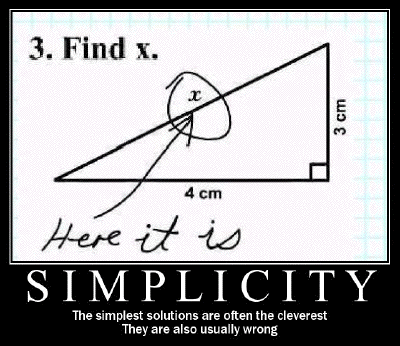
The image above can be found at http://ozguru.mu.nu/Photos/simplicity.gif