creative, creative process, creativity, productivity, time, work

Leap: A Balance of Work and Play Leads To Our Best Creations

From Pinterest

How many times have you churned your mind over and over to come up with a solution to a problem? And how many times have you found that taking your eye off of the proverbial ball, actually helps you to see the ball more clearly so you can hit it out of the park? This happens to me all the time. I read a lot of articles and books about the science behind creativity – it’s one of my favorite subjects to study – and from the research it appears to be true for many people.

So if we know that letting go of a problem will actually help us solve it, why do we hang on so tightly? Why do we have a problem relaxing and trusting in the process in which creativity works most effectively? It could be that we’re worried that while relaxation has helped us solve problems in the past, it will somehow fail us this time. It could also be that we are programmed in this society to believe that hard work equals self-worth. Without working hard, at every moment possible, will we somehow be less worthy?

I actually love to work hard. I love the feeling of accomplishment, of feeling like my effort matters. But here’s what I don’t love – the mania that comes from having a schedule that is so ridiculously packed that I have to remind myself to breathe. To balance this tug-of-war, I break projects apart into phases and give myself what I need in each phase to do my best work.

When I am working on the creative portion of a project, I give myself downtime to solve problems. I do trust the process of creativity, but I also give myself some guidelines. I get a few hours of downtime here and a few there, and I keep checking in with myself regularly to see if any new inspiration has arrived. When I am in the implementation phase and need to get something built, I really focus to give myself more structure and less downtime so I can do a lot of work while I’m in the groove.

Like anything, it comes back to needing balance – give both sides of your brain the opportunity to strut their stuff. They need different fuel because they do different types of work. If you’re taking too much downtime, or not giving yourself enough, try switching it up and see what happens. Creativity is all about experimentation.

books, creative, creative process, creativity, theatre, time

Leap: Learn to Love Your Constraints

From Pinterest

“You break out of the box by stepping into shackles.” ~ Jonah Lehrer, Imagine: How Creativity Works

It’s a bit of a morbid visual but Jonah Lehrer’s quote made me pay attention.

Have you ever had the thought that goes something like this: “If only I had (blank), my life would be so much easier?” I have this thought several times a day, and when it pops into my mind I stop, breathe, and keep going. I’m sure somewhere in that breath there is a silent prayer for help to someone somewhere. Most of the time I don’t get that (blank) that I wish for, but to quote the Rolling Stones, I do get what I need. And often what I need is constraints. (No shortage of those lying around!)

Jonah Lehrer, and many other creativity researchers, make the case for loving constraints. Some go so far as to ask us to feel grateful for them. Why? They light a fire under us. If we had all the time, money, and resources in the world, would we really use them wisely? There’s at least the slight possibility that we would squander them to some degree.

I’ve seen this happen in many large companies. We get used to big budgets and flexible launch dates. Too used to them and it’s ultimately a curse.

When I worked in theatre, we were constrained in almost every area, especially by the hard deadlines. If there was going to be an audience on Tuesday at 8:00pm, then there was no way we could launch late. It forced collaboration, cooperation, and dedication from all parties involved. In theatre, the good of the many always outweighs the good of the few or the one so the few or the one had better get on board or exit stage left. That might sound brutal, but the curtain rises. The show goes on because of constraints, not in spite of them.

Maybe you’re working on a project right now that has constraints you wish you didn’t have. Rather than resenting those shackles, take a moment to recognize what they give you rather than focusing on what they take away from you. Creative work is a series of trade-offs. We get something and we give something. It is a sacred exchange.

adventure, art, creative, creativity, education, health, healthcare

Leap: We All Have to Get High Somehow

My friend, Blair, posted this picture on her Facebook wall and it perfectly sums up how I feel about getting more creative outlets to more young people.

“Art is the only way to run away without leaving home.” ~ Twyla Tharp

We all want to be high. Once we feed the soul, once we know that feeling of being truly alive, we will crave it more and more often. The happy soul is a hungry beast, and eventually it will require your full attention.

It is heartbreaking to see someone, especially a young person, turn to chemical means for that high. My dad suffered with addiction for most of his life, and our family felt those effects in dramatic and tragic ways. What helped me come to terms with my father’s decisions was to feel that high – after running, yoga, writing, or creating a piece of art. It is a delicious feeling. My father didn’t have those outlets so he turned to other means. The same thing is happening with so many Americans today, particularly those still making their way through school.

We ask young people to say no to drugs, alcohol, and other habits that will eventually destroy their health, but we don’t do a sufficient job of recognizing the need to feel that high. We strip schools of art and music programs. We cut physical education. We prioritize testing over emotional and mental development. We’re creating a generation of very good test takers but we are doing a poor job of helping our young generations grow into healthy, happy, productive, and creative adults.

We need to do better. Is art the answer? For some, yes. Is physical activity the answer? For some, yes. Is a creative outlet of some kind that is supported, encouraged, and celebrated by society the answer. Yes, for all of us.

Africa, creative, litertaure, story

Beginning: We are Storytelling Creatures

“Human beings have two ears and only one tongue. Why is this? Probably so that we have to listen twice as much as we speak.” ~ Henning Mankell

I read Henning Mankell’s article in the Sunday Times on the edge of my seat. He is a brilliant Swedish author who has spent almost 25 years off and on living, working, and creating in Mozambique. In the article, Mankell explains how African storytelling and narratives are about to burst onto the world literary stage.I couldn’t be happier about this development!

I went to Africa for the first time in 2007 after decades of dreaming about it. Immediately, I felt at home in a place that should have felt incredibly foreign. It was as if I had been there before, many time before. It felt like comfortable. It must have been our mutual love affair with great stories that made it feel so familiar.

We have the opportunity now to listen and share stories across continents, over oceans, and through the decades. The stories we tell today will be preserved in some way for people to read hundreds of years from now long after we’ve crossed over to whatever is next. Whenever we feel most alone, most frightened, we can take comfort in the stories of others who have had similar experiences. Go to Google. You’ll find them there, just waiting for you – your people, all holding a seat of your to sit around the proverbial campfire and share.

Storytelling in an act and art as old as time. It began with the very first person and will end with the very last. Storytelling and listening are more innate, more human than anything else we do. And its craft is within all of us.

choices, creative, creative process, creativity, decision-making, design

Step 334: An Impossible Goal

Today I had lunch with General Counsel of the company I work for. I asked her how she fostered creativity among her team and she told an interesting anecdote. One of her teams manages a very large portfolio of patents, and while valuable they are very expensive to obtain and maintain. She challenged her team to devise a solution to cut the cost of the patent program in half, a ridiculously provocative goal (her words, not mine.) While she has a great deal of confidence in the talent of her team, she had serious doubts about being able to reach that goal.

So why did she do it? Why set a team up to “fail”? She wanted them to really get into the problem and find a new way of doing things. If she had set the goal at 10%, they probably could have made a few tweaks here and there, and met the goal. She wanted radical transformation and extreme creativity to come into play. To get at that, she needed to set the bar so high that it seemed out of reach. Even if they didn’t hit it, she was certain that they’d find a new way forward that would be beneficial.

And with the ingenuity of her team operating on all cylinders, they did find a new ways forward and they did hit that crazy goal of a 50% cost reduction. And as an added benefit, they also liked the new system much better because it was much easier to manage.

Impossible goals can be very valuable. They can push us to our edge and then some. They ask us to not tinker, but to go out to the wide open white space of our minds, into areas that we would likely never even approach because our logical minds would get in the way. If we make a goal far out of sight, it ceases to be a roadblock to our creativity. It can actually free us to do our very best work, to imagine a whole new world of possibilities.

art, creative, creativity, education, Google, kids

My Year of Hopefulness – Doodle 4 Google

Google put forward a competition, Doodle 4 Google, for kids K-12 to design the Google logo with the idea of expressing the theme “What I Wish for the World”. The Cooper-Hewitt Museum currently has the finalists of the competition on display. I went to see them today with my friend, Dan. I’m currently working on an after-school program for public school children and knew that this exhibit would help inform the program. After all, the idea is to discover the way kids would like the world to be.


Several themes cropped up frequently in the doodle: environmental conservation – everything from climate change to species protection to green energy. Even the importance of pets! Creativity, acceptance, and education were also prevalent in the doodles. And some were advocating specific causes such as a cure for breast cancer and an end to war.

As I walked the exhibit, I considered what I would wish for the world and how I might depict it to create my own Google Doodle. If I had one wish for the world, I’d want to see the desire to be helpful become the main goal of every person’s life. I like that being helpful is a specific goal that’s open to interpretation depending upon each individual’s talents and interests.

Being helpful could mean volunteering, going into a helpful profession such as medicine, or being a good listener. It can be done in small spurts or over an extended period of time. It usually doesn’t cost anything to be helpful outside of an individual’s time and energy. When one person helps another, both their lives are enriched. You can pay it forward, and every act of helpfulness triggers another similar act.

Best of all, helpfulness naturally causes other positive changes in the world that we need in abundance: more kindness, empathy, and generosity. By being helpful, we become useful and we have a hand in shaping the world to be a bit more the way we’d like it to be. In short, the fastest road to a more hopeful, brighter future may start with the extension of a single helping hand.

The images above was created by Sinceraty Alexander for the Doodle 4 Google conference. Sinceraty’s image was a New York State finalist.
business, Business Week, clarity, creative, economy, government, money, New York Times, politics, simplicity, social work

The agony of confusion and the ecstasy of clarity

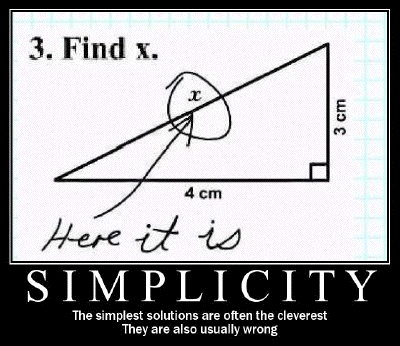
By nature, I’m a passionate person. There are a few subjects that really get me going – happiness, creativity, health and wellness, the environment, puppies. (Not necessarily in that order.) And simplicity – I’m big on that. If we all worked on making our world and our lives simpler, we would all be better off. In some circles complexity and confusion are celebrated, relished, even chased because it’s a mark that what those people in those circles are doing is “very important” if no one else can understand it. How ridiculous, not to mention wasteful – something we can no longer afford to be in our economic situation. 

I was shocked to hear the news today that the House didn’t pass the “bailout”. The Dow tumbled along with stock prices of major companies, and panic is spreading, slowly and quietly. It’s unsettling. Someone said to me today that she didn’t really ever understand the plan, and it’s too bad that it was never explained thoroughly and clearly to the American people. I almost see her point – I do think it was explained by major media outlets like Business Week and the New York Times. You just needed to have the patience to wade through the lengthy articles. And if you don’t understand something, ask around and get some help. Don’t just throw up your hands and say “forget it.” What really happened in the coverage is that no one made it simple to understand if you didn’t have a degree in economics or an MBA. 

Simplicity and clarity are absent in many areas of our lives: in meetings at work, in relationships, in the many contracts with very small print that govern our well-being, financially and health-wise. Companies spend a lot of time, effort, and money because of confusion in roles and responsibilities, objectives, and priorities. Simplicity saves a lot of heartache. And we get to simplicity by being real, honest, and straight-forward in our intentions and actions. 

Clarity builds trust and integrity; it makes people feel that they are a part of an effort because they understand it and can clearly articulate it. Being clear and concise is a sign of maturity – it’s the responsible thing to do regardless of circumstance. Confusion never pays in the long-run and only delays the inevitable. If only our government and financial markets understood that – maybe we’d find ourselves and our economy in much better shape. 
The image above can be found at http://ozguru.mu.nu/Photos/simplicity.gif
art, creative, creativity, education, health, medicine, music, philanthropy

Genius Awards – $500,000 "no strings attached"

How would you like a half a million bucks with no strings attached? All you need to do is be a genius, and by genius I mean someone who is “creative, original, and has potential to make important contributions in the future.” The John D. and Catherine T. MacArthur Foundation awards 25 people every year with their Genius Awards. The Genius Awards for 2008 have been announced and the variety of recipients is encouraging.


When I heard that they were awarded based on originality and creativity, I naturally assumed that the awards were primarily for artists. And many of the recipients are indeed artists from many different areas of the arts. But there’s also an urban farmer, a critical care physician, and an astronomer. This variety supports the sentiment that artistry and creativity can, should, and will be found in every discipline the world over. 

We are all creative, inspired people regardless of our title at work or the discipline in which we work. The trick is how to leverage that creativity for the greatest benefit of the world at large. In short how do we take our precious, common gift of idealism and make it extraordinary? Geniuses take what we all have – this innate ability to imagine things the way they could be – and they go global with it. Well worth a half million dollars for their priceless contributions to humanity. 
The image above can be found at http://www.wilywalnut.com/Genius-choice.jpg
art, creative, creativity, Cubby Bernstein, theatre

Cubby Bernstein is waiting for Tony

I can’t believe it – I am actually going to have to watch the Tony Awards this year. My friend, Trevin, who has every Tony show since the dawn of time on video in pristine condition, will be thrilled that I am finally joining him in watching the broadcast. Now the show is guaranteed at least two television viewers.


Despite the fact that I love theatre and used to make my living in company management for Broadway shows and national tours, I have never liked the Tony Awards. I blame that on the fact that there is rarely a surprise award and that the critics seem to run everything. It has none of the elegance found at the Oscars and none of the fun found at shows like the CMAs. And despite the fact that the industry is built around live entertainment, the staging is awful for a televised audience, through no fault of the Broadway companies that put so much effort into the performances. 


However, I am so enjoying the Cubby Bernstein webisodes at http://www.cubbybernstein.com that I am routing for Xanadu to deliver on its promise of “Yes it can”. And therefore, I need to watch to see what happens, and because I want to see what the Xanadu producers have in store for Tony night. 


There’s something decidedly unique and inspiring about a little show that the public and critics laughed at when first announced, and has now been open a year, coming from behind and taking the top prize. Instead of the usual Broadway materials, actors, and producers who win over and over again, more for their reputations built on achievement from shows gone by rather than their current work, it’s refreshing to see a whole new crew take on an industry that is in desperate need of reinvention.  


Just announced, Patti LuPone and Cynthia Nixon will give Cubby a hand on the latest YouTube webisodes to promote the show. See the full announcement at: http://www.playbill.com/news/article/118490.html. (Thanks to my friend Dan for sending this link to me.) Nathan Lane also recently made an appearance. My only regret is I didn’t get to purchase a Cub-cake to support the company, and I missed my chance to meet Cubby at the promo event. Even if the show doesn’t win the Tony, the producers have breathed life into the stale Broadway marketing business. And in that cause, Xanadu moved from “Yes it can” to “Yes it has”. Congratulations Cubby, you did it!

art, books, creative, creativity

The Creative Habit

I have started reading Twlya Tharp’s book, The Creative Habit. A celebrated choreographer, I am struck by her honesty and candor as she describes her deeply personal commitment to the art of dance while also revealing a very personal side of herself that she often protects from public opinion. 

The book reads like part memoir and part workbook. It’s useful for people who want to jumpstart their creative nature, and for those who are still searching for the activity that sparks their long-buried sense of creativity. Tharp has clearly done her homework on a number of celebrated artists, getting under the hood and finding out what makes them tick.

Tharp is also unafraid to deny some long held public “truths” about creativity. My favorite example is Mozart. While we honor him as a boy genius that basically came out of the womb composing symphonies, Tharp reveals that with his father’s strong guidance Mozart developed his natural talent for music through obsessive study and practice. His dedication to music was at the very least equal to his innate gift. So while we often tell ourselves that we can’t draw, or have two left feet, or can’t read music, in truth our creative ability in a discipline is largely a matter of choice. 

To be sure, we are all inclined toward certain disciplines. Tharp isn’t denying that. What she wants to emphasize is that creative mastery can only become just that through habitual practice and commitment.   

My friend, Dan, recently did some work with Bebe Neuwirth. She is a strong supporter of dance and dancers. In a recent speech, she recounted the many times she’s been approached by fans that have said to her, “I’d give anything to dance like you.” And every time this happens, she thinks, “Actually, dancers do give everything to dance like they do.” Tharp would agree, and she’d encourage all of us to find that creative pursuit that so inspires us that its practice is a welcome habit.