business, career, family, finance, friendship, nonprofit, Seth Godin

My Year of Hopefulness – A Matter of Compromise

Seth Godin wrote a great post this morning about compromise. In his usual style he started with the caveat, “If you sell crack to kindergarten students, no need to read this. Same thing if you donate all your belongings and income to the poorest and sickest in the slums and ghettos. The rest of us have compromised. We’re not profit-maximizing sociopaths, nor are we saints. We’re somewhere in between.”

The trouble is that the great majority of us are somewhere in between, though we haven’t thought much about where exactly our in between is, how we got there, and whether or not our in between is the right in between for us. To assess where we are and how we got there, we need to consider what our priorities are. That step will best inform our trade-off decisions, and those trade-off decisions set the stage for our optimal place in between.

My priorities:
1.) Time and energy for my friends and family
2.) Enough free time to write and have hobbies
3.) Financial independence that allows me to contribute to my savings, pay off my school loans, start a small side business, and live a good quality life in New York City

These priorities lead me to the following trade-offs:
1.) There are certain companies and careers that are all-consuming. Those are not the best places for me at this time in my life. I have to work at a place that appreciates balance.
2.) Because I have chosen to live in an expensive city and have a considerable amount of school loans, I have a certain minimum salary that I need to make. This salary requirements excludes certain careers and requires that I work full-time while I get my small side business started.

Where is my in between?
1.) When I first went to business school, I had the idea that I would immediately return to the nonprofit sector after graduation. As my school loans piled up and it became clear that I wanted to move to New York City for personal reasons, a return to the nonprofit sector grew very unlikely.
2.) Because I want to be part of a mission-based organization, I’ve found other ways to have a positive impact on my community: I volunteer regularly, went through a United Way training for future nonprofit board members, and donate to nonprofit organizations.

For my in between, I have certainly made trade-offs. While it might be my preference to work for a nonprofit full-time, there are a lot of benefits I’ve received in the for-profit sector that would not be possible at my level within a nonprofit. I have good balance between my personal and professional time. I have a generous vacation allowance, am getting good professional training, and great benefits. I’m also well-compensated which allows me to enjoy my life and help my family, two things that are very important to me.

One thing I didn’t count on while in graduate school is that many people are interested in doing well by doing good. The field of social entrepreneurship that combines the best of both the for-profit and nonprofit sectors has grown by leaps and bounds. So many people have made the trade-offs I’ve made, and a whole industry is springing up as a direct result of our common in between.

Considering these trade-offs that I’ve made brought a happy, unexpected consequence: it made me appreciate the choices I’ve made and it made me feel more empowered. In a time when we feel like so many facets of our lives are out of our control, this exercise can bring a sense of calm and purpose. The best part is that it can be done with a holistic approach to our lives, or we can focus on one specific area like career or relationships.

If we find that we aren’t happy with the result, it gives us a basis for an action plan to begin making some changes. While Seth Godin may have meant this exercise to be about compromise, it is also about happiness and accomplishment.

business, Examiner, technology, women

NY Business Strategies Examiner.com: Ursula Burns, CEO of Xerox

Something very historic happened recently in the world of business and the story did not get nearly enough press. Ursula Burns was named to become the CEO of Xerox on July 1, 2009. She is the first black woman to lead a large American corporation and the first woman of a large American company to succeed another woman (Anne Mulcahy.)

Several months ago, I heard Ursula Burns speak, and she so impressed me with her empathy, confidence, and fervent belief that we must support one another in the workplace. She is a remarkable example of someone who rose up to great heights through hard work and ambition. Only a few days after Barack Obama’s victory, she offered a perspective on adversity that has kept me looking up, even in these dark times.

For the full story, please visit:
http://www.examiner.com/examiner/x-2901-NY-Business-Strategies-Examiner~y2009m6d2-Ursula-Burns

The above image was taken and run by the Associated Press.

business, economy, friendship, harmony, leadership, stress, work

My Year of Hopefulness – Harmonious Work Environments

I love to talk and on occasion someone says something to me that’s so striking that I cannot let it pass without writing about it. A friend of mine recently had her supervisor tell her that she creates a work environment that is too harmonious. I was so stunned by this comment that all I could do was laugh. And once that laughter subsided, I found the very core of this comment to be highly disturbing.

The American workplace right now, particularly in large corporations, is a tough place to be every day. Layoff rounds seem never ending and are referred to with a dizzying array of synonyms: “right-sizing”, “restructuring”, “displacement”, “down-scaling”, and the list goes on. At the end of the day a lot of very talented, bright, dedicated high performers are losing their jobs. Morale is low and bad behaviors abound as a result of fear, angst, and disappointment.

Layer all of these bad sentiments into my friend’s situation. Despite the fact that morale is very low at her company and the environment there is like a pressure cooker these days, she has found a way to bring some sense of harmony to her team and her projects. And the feedback to her is she creates too much harmony?! If she were ineffective at her job and unable to get anything done, I could possibly understand the feedback though that is not at all the case. She’s one of the highest performers in her department, due in large part to her ability to create winning strategies that are widely supported by others.

By saying please and thank you, and recognizing the hard work of her team she is being criticized by her boss who is unable to create any kind of good will due to his bad attitude and propensity for bullying. With all the anxiety in the world, we should welcome the contributions of people who can restore a sense of order and calm, particularly in the workplace. In the case of harmony, there can’t be too much of a good thing.

business, career, entrepreneurship, fear, lonely

My Year of Hopefulness – Fear #7 of Entrepreneurship

“Starting my own business will be lonely.”

Some times I wake up in a cold sweat: I’m dreaming about being at my desk, starting at my computer’s blank screen with nothing to say. And no matter how hard I think about it, I have no words. I can’t think of a single thing to write down. That cursor blinks and grows larger and larger at the top of an empty Word document. The fears of a writer!

Starting a business elicits the same kind of fear. When push comes to shove, it’s us and our business on one side and the rest of the world on the other. We have to keep ourselves motivated to get up everyday, sit down with ourselves, and get to work. No one is giving us a to-do list or setting goals for us – it’s all up to us.

We live in a privileged time – reaching out, making connections, and finding support are just a few clicks away no matter where we are. Hop on Twitter or Facebook. Join any one of the thousands of smaller social networking sites on Ning. Meet-ups are around every corner. And these are just the beginning!

Experts, supporters, partners and customers are within arms reach thanks to all of these new and free communication tools, and they want to help us. Make them a vital and vibrant part of our business, and that fear of loneliness will be a thing of the past.

business, career, entrepreneurship, fear, mistakes

My Year of Hopefulness – Fear #6 of Entrepreneurship

“Everything that goes wrong will be my fault.”

Looking failure in the face is tough. When we go it alone, or even when we join a small company, there isn’t anywhere to hide. We have responsibility, lots of it, and we will invariable make mistakes. And then we will have to own up to those mistake, many times on our own.

When we are #1 and only on the workforce, we then need to admit mistakes and failures to ourselves – the toughest audience out there. And it’s painful, and sometimes embarrassing. We find it much easier to forgive others than to forgive ourselves. And no one holds mistakes over our heads like we do. That little voice will pop up from the back of our minds continuously to remind us of our failings and flailings. And it takes a lot of determination and effort to turn down the volume of that voice.

What we need to be mindful of is that there is a tremendous upside to responsibility. We can make changes that we feel are right and necessary. We can focus on ideas and tasks that we deem important and worthwhile. Our mistakes are ours, and our victories and wins are as well. It’s taking the good with the bad, the yin with the yang. No matter whether we work for someone else or we work for ourselves – responsibility inevitably will find us. We can run but we can’t hide.

If I’m going to make mistakes and own the outcomes, I’d much prefer that they be my own so that I can learn as much as possible from them. Mistakes are an investment and a sunk cost of doing business. We all make mistakes; the trick is to not make the same one twice and the best way to assure that is to make sure that I’m the one who made it and owned up to it.

The image above can be found at: http://imagecache.allposters.com/images/pic/QUOMAG/MX01~Mistakes-Esther-Dyson-Posters.jpg

business, career, entrepreneurship, fear, time

My Year of Hopefulness – Fear #5 of Entrepreneurship

“I don’t have enough time.”

Running a business, particularly as a side venture in addition to a day job, is time-consuming no question. There will be trade-offs. I’ve found that a good deal of organization and keeping initial goals small helps to temper this fear of not having enough time. Starting a business can be an overwhelming project, though breaking it down into small bite-sized action items makes the idea less daunting.

Here are some ideas to make the time management portion of your new business more manageable:

1.) Develop an action plan, a task list, and a timeline to stay on track with small goals

2.) Celebrate achievements small and large, especially at the very early stage of starting a business – developing the first draft of your business plan, meeting a contact that has the potential to be a partner, deciding on the name of your company, etc., launching your website. Every accomplishments is worth at least a little celebration.

3.) Get some help – could be an intern, a family member, a friend, or a potential business partner to give a few hours of their time. Sharing the load can take some of the pressure off.

4.) Fun organization tools abound at places like Target, Container Store, and Staples. Use them to keep you motivated in your quest for organization.

5.) Set a realistic time frame. There’s a lot of pressure in the world to move as fast as possible all the time. Running a business is a long-term commitment and slow, managed growth wins the race.

6.) Remember that the time will pass any way, regardless of how you spend it so why not invest in an idea that you have and see if you can make a go of it? The worst that can happen is that you’ll still have your day job, you will learn a lot about yourself and what you want out of your life, and you can always switch gears and work on a different idea if the first one doesn’t work out.

When I was in college, I was feeling overwhelmed by some paper or exam. One of my roommates gave me a very small two inch picture frame. To this day, it still sits on my desk to remind me that all I have to do at this very moment is enough work to fill that two inch frame. And once I finish with that first small task, I can move on to another. That two inch frame doesn’t reduce the amount of work I have – it just gives me a perspective that’s a little bit easier to deal with.

business, entrepreneurship, fear, friendship, ideation, intellectual property

My Year of Hopefulness – Fear #4 of Entrepreneurship

“Someone will steal my idea.”

Last night I went out with my friend, Steve, who is one of the greatest inspirations in my life. He’s one of the hardest working, most courageous business people I know. He’s my go-to guy when I have a new business idea and need advice. For a long time, he’s been encouraging me to start my own business. I was telling him about my business idea and asked him how he decided to communicate his business plan while also protecting his idea.

“Chances are, Christa, no one is going to think your idea is worth quitting their own job over. The idea that starts a business is 10% of the work and executing it is the other 90%. It’s very hard, if not impossible, to do that 90% alone.”

With that kind of perspective, the fear of someone stealing my idea seems completely irrational. In addition, consider that Apple was not the first MP3 maker, Zappo’ not the first on-line e-tailer to sell shoes, Google not the first search or email service. These companies redefined their playing field, largely by banking on delightful execution and maniacal focus on customers and employees. Their ideas were around long before they were ever created. They brought their own special mark to an idea; that special mark brought them success and is something that cannot be stolen.

business, career, entrepreneurship, failure

My Year of Hopefulness – Fear #3 of entrepreneurship

“I’ll fail.”

A hallmark fear for anyone starting anything new – whether it’s a business, a new job, getting a degree, starting a relationship, moving to a new city. Every time that we adopt a change in our lives, we open ourselves up to the risk of failure. The flip side of that possible failure is a tremendous upside for growth, learning, and improvement of our current situation.

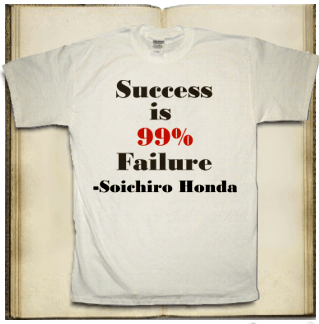
Failure has a very negative connotation in our culture, and it’s often unwarranted. Failure means to discover what doesn’t work. Knowing what doesn’t work puts us one step closer to knowing what does work. And once we know what doesn’t work, we can correct it and move forward. Peter Skillman of Palm is famous for advocating for early failure. Try something. If it doesn’t work, switch gears, and take another run at it.

Whenever I am afraid of failing, I consider what I would have to do to completely protect myself from it. And the answer is often that I would end up not doing anything. That’s no way to live. Our time on this Earth is too brief, too precious, to stand still for every long. Life is about experience, and with every new experience comes the risk of failure.

Like death and taxes, failure is a part of life. It can be a wonderful teacher if we cast in that role in our lives. Whether it changes our lives for better or worse is largely up to us – it all depends on what we do with the lessons it teaches us. Do we use them as valuable information or do we take them on like a yolk, a source of discouragement and despair? How we look at and use failure says a lot about how we live our lives.

business, career, entertainment, technology

Examiner.com: An interview about entrepreneurship with David Priemer of Rypple

A few months ago I came across an article on Rypple, a company that builds on-line collaboration tools. I was very impressed with the simplicity and elegance of their mission and interface. They identified that there was a hole in the market for a tool that could help people identify where and how they can improve their job performance. For those who are pro-active, believe in the process of continuous improvement, and dread performance review time, this tool is a godsend! For the full interview, click here.

business, career, children, entrepreneurship, fear, rejection

My Year of Hopefulness – Fear #2 of entrepreneurship

“No one will want the product or service my business produces.”

This is the #2 fear of entrepreneurship for me, the second in a series that I’m doing after being inspired by Gary Novosel, Founder of The Food Medic. In our interview, he gave a piece of advice that really resonated with me: if you’re afraid of starting your business, write all your fears down, and then put them aside. So here we go, fear #2 – no one will want what I’m trying to sell.

Isn’t that the age old story of rejection – people won’t like me, I won’t be good enough, or, the worst – I won’t be relevant. What I say and think and do will not matter and no one will care. Ouch – painful ideas and thoughts that we work very hard to suppress, and yet at least at one moment of weakness in our lives, we’ve all felt them.

One of the fun things of starting a business and making a product or service is continuous improvement. The enemy of good is perfection – so don’t wait perfection to get the idea out the door. If you do, that product will never see the light of day. You’ll tweak and tweak and tweak, until someone else beats you to the punch and puts together a similar idea.

And what’s the very worst that can happen? People won’t by what we make, we’ll get feedback, change the product, and try again. Not so bad, right? Or maybe it’s just not reaching the right audience, or a wide enough audience. Or maybe it’s an idea that just needs time in order to b adopted by the market.

I was thinking about this fear all day today, wondering how I’d write this post and put it in perspective. As I rounded the corner toward my apartment this evening, a bunch of little kids ran up to me to drag me to their lemonade / cookie stand. For $0.10 I could get my choice of a cookie or a glass of lemonade, or for $0.20 I could get both. These kids did not have one bit of fear telling me about their business and the cost of the goods they were selling. I envied them.

I walked toward my apartment, happily eating my chocolate chip cookie, and honestly, it was the best cookie I’ve ever had. Entrepreneurship is alive and well among kids, so couldn’t we just model our own behavior after their fearlessness? It’s at least worth a try.