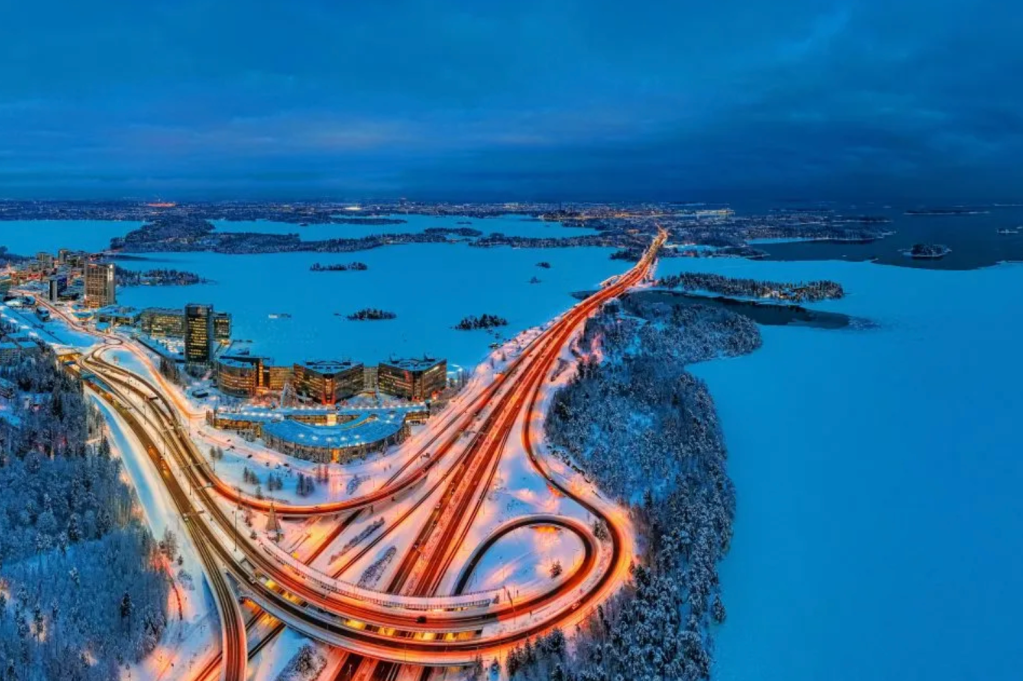
Microsoft’s new data centers in Finland are designed to operate with 100 percent emission-free energy and will supply heat for the cities of Espoo and Kauniainen. Photo by Trellis.
This summer I went to Finland and this lesson has stuck with me: Finnish citizens don’t see themselves as apart from nature but as a part of nature. This is evident in how they eat, how they build their infrastructure, and now also how they heat their homes during their long winters.
We often talk about the enormous energy cost of digitalization—the vast server farms that consume electricity and generate a tremendous amount of waste heat. This is a core challenge of the AI era.
But what if that heat wasn’t a liability? What if it was a valuable, free community resource?
I went to Finland this summerIn Finland, cities like Espoo, Helsinki, and Hamina are pioneering the answer. Tech giants like Microsoft and Google (in partnership with energy companies like Fortum and Helen) are not dumping their server heat into the atmosphere. Instead, they are routing it into large-scale district heating networks to warm nearby homes, schools, and businesses.
Systemic Efficiency: It transforms the cooling process—the servers get chilled and the community gets heat—an elegant system where waste from one process becomes the input for another.
The most important takeaway for sustainability leaders? The challenge isn’t technical; it’s often business and policy-related—finding the right collaboration models and regulatory frameworks to view waste as a resource.
I’d love to hear your thoughts on this system:
Could this kind of large-scale circularity be implemented in a complex, dense city like New York? What are the biggest policy or infrastructure barriers we need to overcome first?
The short of it:
Writer. Health, education, and art advocate. Theater and film producer. Visual artist. Product geek. Proud alumnae of the University of Pennsylvania (BA) and the Darden School of Business at the University of Virginia (MBA). Inspired by ancient wisdom & modern tech. Proliferator of goodness. Opener of doors. Friend to animals. Fan of creative work in all its wondrous forms. I use my business skills to create passion projects that build a better world. I’ve been called the happiest New Yorker, and I try hard to live up to that title every day.
The long of it:
My career has stretched across Capitol Hill, Broadway theatre, education, nonprofit fundraising, health and wellness, and Fortune 500 companies in retail, media, entertainment, technology, and financial services. I’ve been a product developer and product manager, theater manager, strategic consultant, marketer, voice over artist, , teacher, and fundraiser. I use my business and storytelling to support and sustain passion projects that build a better world. In every experience, I’ve used my sense of and respect for elegant design to develop meaningful products, services, programs, and events.
While building a business career, I also built a strong portfolio as a journalist, novelist, freelance writer, interviewer, presenter, and public speaker. My writing has appeared in The Washington Post, The Huffington Post, PBS.org, Boston.com, Royal Media Partners publications, and The Motley Fool on a wide range of topics including business, technology, science, health, education, culture, and lifestyle. I have also been an invited speaker at SXSW, Teach for America, Avon headquarters, Games for Change, NYU, Columbia University, Hunter College, and the Alzheimer’s Foundation of America. The first book in my young adult book series, Emerson Page and Where the Light Enters, was acquired by a publisher and launched in November 2017. I’m currently working on the second book in the series.
A recovering multi-tasker, I’m equally at home in front of my Mac, on my yoga mat, walking my rescue dog, Phineas, traveling with a purpose, or practicing the high-art of people watching. I also cut up small bits of paper and put them back together as a collage artist.
My company:
I’m bringing together all of my business and creative career paths as the Founder of Double or Nothing Media:
• I craft products, programs, and projects that make a difference;
• I build the business plans that make what I craft financially sustainable;
• I tell the stories that matter about the people, places, and products that inspire me.
Follow my adventures on Twitter at https://twitter.com/christanyc and Instagram at https://instagram.com/christarosenyc.
View all posts by Christa Avampato
I'd love to know what you think of this post! Please leave a reply and I'll get back to you in a jiffy! ~ CRA Cancel reply


 Christa Avampato