philanthropy, poverty, social change, social entrepreneurship

Step 32: The Worth of Abundance

“We never know the worth of water till the well is dry.” ~ Thomas Fuller

A few nights ago I met with members of the organization Healing Haiti. The organization is new, less than a year old, and prior to the earthquake they developed a business called Print for Change that donates 50% of its profit to help Haiti. The earthquake has now considerably upped the ante of their work. The need is greater than ever, the situation even more dire than when the organization first formed.

We discussed the immediate needs of the organization and the people of Haiti. In a crisis, it’s the basics that are most sought after. Prior to the earthquake, Haitians would stand in line for hours to get access to a bit of water. Now, those lines are hard to even find. I tried to put myself in that situation. In my warm apartment with all the food and water I could ever want, my family and friends happy and healthy, a job, and the creature comforts afforded to a lifestyle of few wants, I couldn’t even imagine the despair brought on by living in rubble, no food, no water, having lost my family and my friends, and seeing no hope in sight. I understand the need to dig down deep, and to have faith in our darkest hour. But what if we can’t even see an end to the darkness? What do we do then?

I can usually reason my way out of just about anything. This conundrum stumps me. I’ve had many hard times in my life, and despite any kind of hardship, I always had hope. There seemed to always be some help available somewhere. Despite my search for hope everyday, I still don’t fully comprehend its worth, perhaps because I’ve never truly been without access to it. How can we fully appreciate something’s worth until it’s gone?

I’d love to believe that we don’t need a burning platform to fully grasp the meaning of gratitude. I’m just not sure we’re wired for that without examples like Haiti. It’s important for Haiti, and for our own personal growth, too, that we not turn our eyes and heart from their need now. We need the lessons of their struggle as much as they need our help.

You can follow the work of Healing Haiti at their blog: http://healing-haiti.blogspot.com/

social change, social entrepreneurship

Step 29: Activism

“Activism is my rent for living on this planet.” ~ Alice Walker, Pulitzer Prize-winning author

Today I spoke with HopeLab, an organization I’ve been getting to know over the last year. Founded by Pam Omidyar, HopeLab uses technology such as video games to improve the health of children. We have been talking about our mutual interest in using social media to engage children and their parents in living healthier lives. This lead us to talk about our public education system and its role in improving child health.

As our conversation unfolded, I could feel my spirits rising. I could feel the emotion welling up in my voice, not causing it to crack, but causing it to strengthen its conviction. Talking about education puts me into a zone where I am my most articulate. On this subject, my thoughts weave together to synthesize powerful, passionate sentiments. And I don’t need prepare anything to talk about education. I just allow myself to show up and be; this is the height of authenticity.

While watching the news, I saw that President Obama showed up at the Republican meeting, allowing the party to fire questions at him. His spontaneous responses were taped live. He took no notes or prepared remarks with him; he showed up with only the information in his mind and his intense focus. Despite the difficult few weeks that preceded the talk, he was determined to hold his own. Another example of the power of authenticity.

Activism, at its best, is giving our authentic passion about social issues the center stage. So many social issues need our attention now: education, healthcare, clean energy, the environment. And the list goes on. Our world is getting to a point where we cannot afford to wake up, go to work, go home, and sit on the couch, hoping for a better tomorrow. As Alice Walker has so eloquently stated in years past, “we are the ones we have been waiting for.” The only thing that is going to create a better tomorrow is our ability to act.

books, change, education, Fast Company, social change, society

Step 22: Seeing Spots

“You cannot think your way into a new way of acting, you have to act your way into a new way of thinking.” ~ Jerry Sternin, Founder of The Positive Deviance Initiative

In this month’s issue of Fast Company, there is an excerpt from Switch: How to Change Things When Change is Hard by Chip Heath and Dan Heath. The book goes on sale February 16th, and this excerpt provides insights into how to find the bright spots, as small and few as they may be, that lead to radical, large-scale, successful change when replicated. The Heaths take a cue from Jerry Sternin, a professor of nutrition at Tufts University, who, along with his wife, Monique (also a professor at Tufts), gave so much to so many around the world. The Professors Sternin founded the movement of positive deviance and advocated for its use around the world.

There is some societal belief that when someone is exceptional, they’re weird. We think that the exceptional do things that no one else can do when really they just do things that no one is doing. William Kamkwamba in Malawi, whom I wrote about earlier this week, illustrates this point perfectly. If we studied them closely, we would find that a couple of key things that they do are different from the majority, and those few differences can be replicated so that the exception becomes the new norm. Jerry and Monique Sternin believed that if we can find the bright spots, we’ll get more understanding of a situation and greater progress than we ever thought possible.

All day today I’ve been looking for bright spots in specific areas of my life. I’m keeping track of them in my little black book. This idea of positive deviance has had me grinning ear to ear all day. Tomorrow, I’ll be back here to talk about some of these recent discoveries. I hope you’ll join me.

The image above is not my own. It can be found here.

philanthropy, social change, social entrepreneurship, volunteer

My Year of Hopefulness – Full-time Social Activist

Social activism has often been associated with people who work for nonprofits or for social enterprises, people who spend every waking moment on the front lines of generating social change. In actuality, social activism is everyone’s profession. With our every purchase, we make a statement about about how we wish to live in the world and the way we want our world to be. All of our choices reveal a piece of our character, reflect our values, and tell the world about our priorities. We don’t choose whether or not we are a social activist, we choose the social ideas that our mandatory activism represents.

On Christmas Day, I received one of my favorites gifts via email, and it clearly reflects my work as a social activist. A few months ago, I lent money through Kiva.org to a woman in Ghana who wanted to open a hair salon. On December 25th, Kiva.org notified me that the loan had been fully-repaid months ahead of schedule. I was shocked and thrilled by the news! Now I have the choice to withdraw the funds or lend them to another entrepreneur. Given my positive experience with Kiva, of course I will loan the funds again. I believe in the power of entrepreneurship to transform lives, and I want to support the desire for self-sufficiency among people around the world, a desire I share and deeply understand.

To further reflect these beliefs, I have also loaned money to Grameen America, a brand of Mohammad Yunus’s incredible organization. It cost me $10 and about 30 seconds of my time, and gave me the opportunity to make a difference in the life of another New Yorker. There are plenty of opportunities for social activism around the world, but we should not lose sight of the opportunities for social activism that lie just outside our own doors.

Philanthropy is not the only way to choose the how of our activism. We can give time, raise awareness about organization we admire, purchase goods and services from respectable companies, and use our own personal talents in direct ways. For the past two years, I have spent the bulk of my volunteer time on public education. I’ve taught high school and middle school students in Lower Manhattan and the South Bronx, and I am a book buddy to a local third grade student. On this blog and through my Examiner.com column, I have highlighted organizations whose work inspires me. I try to support local, organic farmers through my grocery shopping. The project I am most excited about in 2010 is my participation with Citizen Schools; I will pilot an after-school program in East Harlem to teach 6th graders about entrepreneurship, product development, and innovation. These accomplishments are not at all extraordinary; they’re just choices that reflect my core beliefs.

We have more influence over our world and on others than we realize. There are so many options that it can be difficult to know where to begin. We need only to pick a cause that lights a fire within us, get out there into the world, and let our voices be heard. Invariably, we will find other voices that echo our own.

education, social change

My Year of Hopefulness – Learn by Doing

This week Michael Sandel at Harvard talked about Aristotle’s Politics. Sandel compares the art of politics to playing an instrument, telling a joke, and cooking. Theses disciplines cannot be learned just from a book or by watching others. Great political orators like great musicians, comics, and cooks must be actively engaged in their craft, practicing consistently, to become masters of it.

Social change is the same way. We can read and write about social change. We can study it. We can be inspired by others who are actively generating social change though only by rolling up our sleeves and participating can we understand the particulars, the details, needed to create change. Change requires trial and error, a variety of approaches, and practice.

In the coming weeks I’ll be attending the final projects, called Wow!s, for this semester’s Citizen Schools afterschool programs. Attending these sessions will give me an idea of what I need to put together for Innovation Station, the afterschool program for 6th graders in East Harlem that I am building around the concepts of innovation and entrepreneurship. I will learn so much by attending these Wow!s, though I know that this Spring I need to get in there and test the methods myself. I’m looking forward to the practice.

books, poverty, social change, social entrepreneurship

My Year of Hopefulness – Muhammad Yunus

“I am always optimistic. There is no other way…I am not interested in a person’s past. I care only about their future.” ~ Muhammad Yunus

Many economists tell us that so long as there is capitalism, there will be poverty. So long as there are “haves”, there will be “have nots”. Tonight I went to 92Y to see Muhammad Yunus, Founder of Grameen Bank, Noble Prize winner, and an economist who has stood up to the cynics time and time again. The most remarkable thing about him is not that he blatantly defies his peers, but that he defies them, has proven the fallacies in their beliefs through the outcomes of his own actions, and garners the respect of his detractors.

When I consider what it’s like to live an extraordinary life, Professor Yunus is the first person I think of. His indomitable will, compassion, love, and concern for others is unmatched, particularly in the financial field. He is my hero so it was with great excitement that I sat in the audience at 92Y waiting for him to be interviewed by Matthew Bishop from The Economist. Yunus did not disappoint. From the moment he stepped on stage, he glowed with goodness.
The more he discussed microcredit and entrepreneurship, the happier I became. I could feel his goodness making its way into my own heart. His calm, charming confidence is something to behold and emulate. I could barely take my eyes off of him.
Then a strange thing happened. Professor Yunus began to talk about how to get started, how to begin building a life that truly contributes to the benefit of humanity. “Make a pact from where you are, now, to help 5 people up out of welfare.” He discussed how he didn’t try to tackle the whole country of Bangladesh in his early work. He worked with a handful of people in a very small village. And when that seemed to work, he ignored the nay-sayers, as always, and helped a few more people. And encouraged those he’d helped to help others in the same way. Take tiny, tiny steps to help others, and never, ever give up. “That,” he said, “is the miracle seed.”
It was in that instance, in Professor Yunus’s miracle seed comment, that my heart and mind joined forces and took a decided turn. I could feel a physical, mental, and emotional shift within me. At the conclusion of the talk, I ran home, literally. My friend, Richard, is always encouraging me to write to anyone and everyone who interests me. This advice as served me well in the past, so I got home and cranked up the letter writing machine.
On my way back through Central Park, I composed a letter in my mind to a very wealthy businessman who runs a company that has recently set up a very profitable service. I’ve written to him before, once by name and once anonymously, offering up thanks and suggestions to him, respectively. Today, I asked for his help is using a very, very small portion of the money his service has made to set up a small test of microcredit in New York City, similar to the work that Professor Yunus’s Grameen Bank is doing in Jackson Heights, Queens. When I got home, I typed up the letter, printed it, signed it, and stuck it in an envelope. I ran out to the mailbox on the corner outside of my apartment building, and dropped it in. I had to get it written and out the door before I got too scared to send it. So now I’ll wait and see if a response comes.
It’s an odd thing when we hand over the reigns to our future. When we leave rational thought behind and follow our hearts, it’s amazing what we find, what we can accomplish. Professor Yunus closed the talk by telling a story about Dannon yogurt. He kept pushing them and pushing them to develop a yogurt product, in a special edible container, that would benefit the children of Bangladesh. (Half the children who live in Bangladesh suffer from malnutrition.) “An edible container?” they asked him. “Yes, yes, we must,” demanded Professor Yunus. He thought they’d be angry. Instead they thanked him for pushing the boundaries of their work. “How can we answer something we are not asked?” they said. Perhaps this businessman I wrote to will feel the same way.
And now the fear is setting in. What have I done in writing this letter? Who do I think I am to go around suggesting that a large financial institution consider taking a tiny slice of their profit during a recession and using it for a microcredit program? And then I smile, and think to myself “I just let my inner-Yunus run free.” If I’m scared, I must be doing something worthwhile. What could our world be like if we all did just that? What if we suggested the impossible and then went for it?

business, change, entrepreneurship, social change, social entrepreneurship

NY Business Strategies Examiner – Interview with Teju Ravilochan of The Unreasonable Institute

This week I had the opportunity to interview Teju Ravilochan, Connections Strategist and Co-Founder of The Unreasonable Institute. I found out about The Unreasonable Institute through Social Earth’s Twitter feed and was intrigued by the name. Some of the people I admire most consider themselves unreasonable, those who push boundaries, who work toward building a world that is far better than the world as we know it today. They strive and thrive on their creativity and imagination. Teju and the team at The Unreaonable Institute fit this bill perfectly. The Unreasonable Insttiute’s missions is to intensive training, effective collaboration, and expert guidance to provide Unreasonable social ventures the momentum to take flight.

To read the interview with Teju, click here.

art, child, childhood, photographs, social change

My Year of Hopefulness – Do You See What I See?

Today I went over to the U.N. to see a photo that my dear friend, Amy Marsico, worked on. The photo exhibit is entitled Do You See What I See? It captures the thoughts and emotions of displaced children living in refugee camps in Yemen and Namibia. The powerful images and the words of the children reacting to those images ranged from loneliness to hope to intense memories of the experiences they’ve been through in the camps and in their home countries.

The exhibit is the output of work my friend, Amy, and her colleagues did in support of the UNHCR’s Convention of the Rights of the Child. The Convention puts forward that children have the right to actively participate in the decision-making that effects their lives and communities. It has been ratified by nearly every country in the world. The U.S. is one of the few who have not adopted it.

What struck me about the thoughts of the children featured in the photo exhibit is how easy they were to understand. They had all the same concerns we have – being liked, companionship, future opportunity, learning, a desire to be safe. On my way home, I considered how children might see these streets of New York I walk along every day, what they might think as they walked through my life.

I considered how the child I used to be would view the adult I am now. What she’d be happy about and what she’d like to change. She’d want me to be having fun, freely voicing my thoughts, and making a difference. She’d want me to be excited to get up out of bed in the morning and out into the world. And she’d never want me to sit still. Ever.

I like to think that I carry the little child I used to be in my heart and mind as I go through my adult life. I’d like to think that though I’ve grown older, I’ve kept that young, optimistic, idealistic view on life. I’d like to think that what I see now is what I’ve always seen: a world full of opportunity and hope, a world where I can make a difference.

The photo above can be found at: http://www.refugeechild.net/wordpress/wp-content/uploads/2009/04/090406.jpg

change, dreams, imagination, social change

My Year of Hopefulness – The World We Live In

“Every aspect of our lives is, in a sense, a vote for the kind of world we want to live in.” ~ Frances Moore Lappe

This is one of the best quotes I’ve read in a long time. Think about the hundreds, even thousands of small choices we make every day. Where to shop, how to commute to work, where to live, work, and play, how to treat strangers and co-workers and family members and friends, where and how we spend our time and with whom. Every one of those choices has an impact on the world, and therefore shapes it.

It’s easy to feel that we’re so small and that the problems in our world are so large that we couldn’t possibly make a difference with our daily choices. The truth is we make a difference with every step without even knowing it. We have so much ability to change our existence and the existence of those around us. We do it every day; we’re already impacting the world right now, so why not recognize that and make the choices that lead us toward making the world the kind of place we want to be?

justice, movie, social change

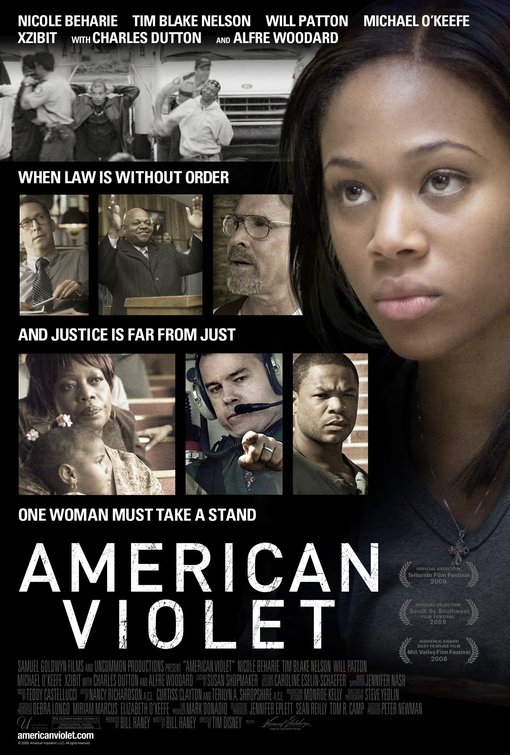
My Year of Hopefulness – American Violet

Tonight, I went to the New York screening of American Violet, a movie about an ACLU case in Texas against a District Attorney for racial profiling in drug cases. I was skeptical about the movie. I was worried about it being preachy and over-dramatic, though my friend, Richard, invited me, and I wanted to support him and his organization. And I couldn’t have been more wrong. The movie is stunning.

This movie showcases activism at its best. A young woman takes on the case as the lead plaintiff with the encouragement from the ACLU to stand up for her community, her neighbors, and her family. Wrongfully convicted of selling drugs in a school zone, she endures great pain and difficulty in the name of what’s right. She displays so much courage that had a I not known it was based on a true story, I would have believed it was invented in Hollywood.

A complete surprise, the woman whom the story is based on was there in the audience and spoke after the movie. Her eloquence and grace in the face of such trying circumstances is so inspiring that I left wondering how on Earth I could ever complain about anything in my life. While many people have given their lives to stand up for justice, the main character of American Violet didn’t have a choice. Injustice was her life, and the life of those all around her. If she wanted to live free, truly free, and move forward she had to stand up. She had no choice but to fight.

American Violet is a testament to the power of story-telling and narrative, the ability to connect people across miles and circumstances, despite age, race, culture or gender. Stories, and their telling and retelling, build empathy and strength. Films about social issues have the ability to entertain and inform; they build community. And to solves problems as large as the issues of racism and substance abuse and incarceration, we need community.

As I walked back to my apartment, I was reminded of Anne LaMott‘s book Bird by Bird, my favorite book about writing and story telling. At one point in the book, Anne talks about the writing classes she teaches in the Bay Area. And her one piece of advice to her students that I always think about revolves around courage in writing. If you have the courage to live through a tough situation and free yourself, then have the courage to write it down and share it with others because in telling your story, you just might help set someone else free. I can’t imagine a more beautiful example of that principle than American Violet. Opens in theatres everywhere April 17th.