art, culture, time

This just in: The truth about the truth

Speak the truth, even if your voice shakes.

“The truth is always dangerous because once you know it you have to do something about it.” ~Azar Nafisi

Yesterday I went to hear Azar Nafisi, one of my favorite authors, speak about the cultural landscape of Iran and how understanding that landscape can open the way to cross-cultural dialogue. The quote above is my favorite from her talk, and it resonates so deeply with me because of the past year I’ve had when so many truths within my own life and in the world itself have come to light in stark, and often frightening, reality.

Once we know the truth, we can’t unknow it. We can try to ignore it, even deceive ourselves into thinking it’s not there. Truth is relentless—it will grow louder, larger, and stronger until it finally gets its share of the limelight. It will not move on quietly. It demands to be noticed and addressed.

The truth will set you free, though free in this case has a very specific meaning. It will free us from old paradigms, habits, and routines, and this isn’t always easy. Actually, it’s almost never easy. Truth sets us free to see ourselves and those around us as we truly are, not as we imagine. Truth rips off the veil; it strips away the lens and the filters that alter our reality. And this is a very good, albeit difficult, thing.

With the truth, we can have a real and lasting impact. We can move forward with confidence and conviction, and we can help others do the same. The truth makes us lighter, makes it possible to imagine and then create new realities that are sustainable and richer than the half-truths that we had before.

Maybe you’re in the midst of confronting some prickly truths, realizing that things were not as they so long appeared to be. I certainly am, and so are many others. You’re not alone in your discoveries, and you’re certainly not alone in trying to make peace and purpose with them. This is a part of the human experience. It’s something that binds all of us together, across every culture, race, religion, gender, language, and even across time. We’re in this together.

business, creativity, culture, future, technology, writer, writing

Beautiful: We Are on the Brink of Something Amazing. It’s Called The Future.

A pic I snapped during one of the tech session at Advertising Week

Day 3 at Advertising Week blew my mind. Literally. Technology is taking us right to the brink, in a good way. The brink is where you want to be. The brink is where we push the boundaries of possible, where our wildest dreams become the realities that we seamlessly integrate into our daily lives. The brink is where it’s at. It’s where I want to spend all of my time.

In one particular session, I began to see my future come together, how all the pieces of experience I’ve collected throughout my life gel. I may have even heard a “schumpf” as the picture of my future as a writer in the fields of technology, culture, and business became so much clearer. The steps to the end game aren’t all laid out in a perfect sequence. There are holes that I don’t quite know how to navigate, but I do know where I’m going and why. And I do know the very next step I need to take. That’s enough to keep going.

I also know this: I needed every job I’ve had, every person I’ve ever met, and every place I’ve traveled to make sense of it all. Some were delightful and some were awful. They were all necessary. It is a satisfying thing to look back on our days and see the logic in the madness, the order in the chaos. It makes the day-to-day so much more manageable.

China, communication, culture

Step 47: Chicken Talks to Duck

I recently took a spin through Chinatown with my friend, Michael. He and his lovely wife, Min, have been schooling me on Chinese culture. My friend, Allan, is grateful for the help. Being from Beijing, Allan has been showing me the ways of the Chinese for almost 5 years now. With my endless questions, Allan can use all the reinforcements he can get!

Allan, Min, and Michael have shown me so many incredible aspects of Chinese culture, a culture we so sadly know precious little about in the U.S. P.F. Chang’s and electronics do not a culture make. Chinese manufacturing is largely responsible for our lifestyle in this country, and yet we have not taken to their literature or philosophy as readily as we should. It’s a shame, really. Their wisdom has so much to offer us as we make our way down the road to enlightenment.

One aspect of Chinese culture that I adore are the proverbs. In a handful of words, they encompass so much learning. Michael hit me with one the other day that’s been on my mind ever since. “Ji tong ya jiang” – in English it literally translates to “chicken talks to duck.” Both birds, found in the same geographies, and no matter what, they can’t understand each other. How many times a day do we have this same conundrum with others? You say something to me, I say something back, sometimes in the same language, and neither of us have a clue what the other said.

So how do we get beyond chicken talks to duck? In other words, can we learn empathy and understanding? Yes, I believe we can. It’s not easy, and if we aren’t born with an innate sense of empathy, I think it always remains a challenge. Not impossible, but indeed challenging.

Here are 6 ways to get some empathy and gain a better sense of understanding of others:
1.) Volunteer – spending time on a project with others, and particularly helping others who are struggling, instills us with a remarkable sense of understanding. It forces us to walk in another’s shoes.

2.) Travel and seek out the locals. I can’t stand resorts and fancy digs on vacation. They create such an unnatural barrier between tourists and locals. They impede understanding. So whenever I’m traveling, I get out, way out, of my comfort zone.

3.) Read literature, listen to music, eat food, and see art that’s entirely foreign to you. A peoples’ culture comes alive in their art. It tells their history, their trials and tribulations. Give it a whirl and you’ll discover things about others and about yourself that you never even imagined.

4.) Learn a new language. Inexpensive language classes and conversation groups exist in almost every major U.S. city. You really want to understand another culture? Literally try to speak with their words and you’ll learn and earn their hearts.

5.) Take up the sport, exercise, or meditation of another culture. Yoga, Tai Chi, Qigong, karate, cricket. A nation’s pastime is an enjoyable way to more deeply understand their culture.

6.) Stop in at the church, synagogue, temple, ashram, or mosque of another culture. I’m not saying you have to believe in what’s being preached. Just listen. Culture the world over is deeply rooted in religions. Learn how a culture prays, where they turn to when times are tough, and understanding their daily lives becomes easier.

The image above is not my own. It can be found here.

culture, history, museum, The Journal of Cultural Conversation

The Journal of Cultural Conversation: Titanic: The Exhibition

Happy Monday, all. My latest post is up at TJCC. On Saturday I visited Titanic: The Exhibition, now on view at the Discovery Times Center on 44th Street. The exhibit tells the story of the Titanic through items salvaged from the wreckage, eye-witness accounts, and scientific exploration. I found it to be equal parts fascinating and terrifying. Around every corner I was surprised by some new fact I never knew.

For the full article and to check out all of the other great conversations happening over at TJCC, please click here.

books, clarity, culture, hope, meditation

My Year of Hopefulness – Law of Attraction

I love getting daily quotes, thoughts, intentions, etc. into my inbox. I’m a loyal e-newsletter subscriber. My friend, Ken, turned me on to one put together every day by a duo that offers workshops based on ideas behind The Secret. I’m not into going to workshops, though I’m enjoying the daily quotes. 


Ken reads the daily quote first thing in the morning and then when he gets home at the end of the day. He meditates on the sentiments and meaning offered in each, and tries to be mindful of it throughout the day. I’m not saying that this is a magic potion, though it does make me feel better to read these ideas and consider them in my daily life. At this point, positive reflection on our current situation may be the best remedy. It’s a technique worth trying. You can sign up for the daily quote emails at http://www.abraham-hicks.com/lawofattractionsource/index.php

As a sample of what’s typically on offer, here is the daily quote from today:
“You are on the leading edge of thought, taking thought beyond that which it has been before. Who cares what thoughts have led up to this. You’re standing in the fresh now, and many of the thoughts that you vehemently oppose are the very thoughts that have given you the desire that has attracted the clarity of where you now stand. No matter how awful you think they might be, all were of value in the evolution forward. Every one of them.

Excerpted from a workshop in Philadelphia, PA on Tuesday, April 14th, 1998

Our Love, 
Jerry and Esther”

communication, culture, language, technology

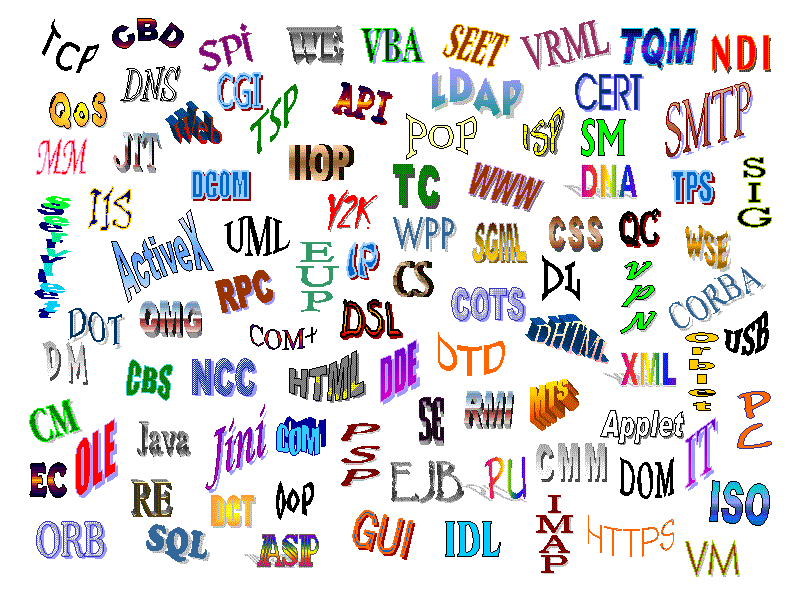
Acronym City

Ever have a conversation with someone, in English, and then all of a sudden feel like you’ve stepped into a foreign land without moving from where you are? My friend, Kelly, has the wonderful quality of being friendly to EVERYONE. On occasion this will get her into trouble, like one recent night at Joshua Tree. 


She was speaking to a guy at the bar (she dubbed him “Jersey Johnny” as his two favorite subjects of conversation were himself and New Jersey) who was there with his friends, though seemed much more interested in Kelly than in his friends. To be honest, she thought he was a bit of a jerk, but given her inability to be anything but friendly, she kept talking to him. He was going on and on about another party he was supposed to go to. “So then why are you staying?” Kelly asked. He leaned over to her and quietly said, “Well, I have some IOI here and I want to see what happens.” Huh? 

Kelly though that my constantly-connected life would leave me well-versed in this type of acronym speak. Nope – this is a new one for me. Jersey Johnny went on to say that he felt some of the other girls in the bar were checking him out so he wanted to see if any of them might make a move – he had Indications of Interest (IOI) from them. 

Now this story left me ROTFLOL (Rolling On The Floor, Laughing Out Loud – one of the favorite sayings of my friend, Lon) though prompted me to consider all of the ways we develop and re-develop language, and how confusion could arise by not saying exactly the words we intend. For example, Kelly could have thought Johnny meant “Internal Operating Income” or “Index of Irritation”. You see how easily this whole speaking-in-acronym thing could backfire?

So how wide spread is this possible acronym confusion, and how are we supposed to sort it all out if these handy little time-savers are creeping in to pick-up lines at bars? Fear not – there is an on-line acronym dictionary with thousands of common and not-so-common acronyms. (What we might really need is an iPhone app to whip out at a moment’s notice, as evidenced by Kelly’s situation with Jersey Johnny.) NFW, you say? LNKO, folks. This could be MC for your social life, particularly those of you who are into OLD. I am N/J – you really cannot take these suckers out of context, lest you could end up with a BFM on your hands. 

Here are a few common acronyms whose confusion could have dire consequences:
WTF – Welcome to Finland!, Wild Turkey Federation, What The Frick (polite version)
HOTD – Hottie of the Day, Hair Of The Dog, Head Of Train Device
BFF – Best Friends Forever, Black Footed Ferret, Buffered Flip-Flop 
STD – Sexually Transmitted Disease, Save The Date, Safely Tolerated Dose 
BFD – Big Frickin’ Deal (polite version), Big Fat Disclaimer, Burger Fries Drink
 
And if you’re wondering “AYS?” with all these acronyms, the answer is “YBBI”! 

communication, corporation, culture, job, leadership

Opinion as fact not accepted here

My friend, Kelly, always had a saying in graduate school that she’d repeat whenever someone in class decided to spout off their belief system to chew up class time and to hear themselves talk. She’d say something like, “why do people think it’s okay to state opinion as fact?” Today at work I was reminded of that saying during my team meeting.


We were discussing some of the alignment issues our department has, not on our specific team but elsewhere in the organization. I think we might have all been getting a little too down on the structure of the business as a whole. 

One of the many things I love about my boss is that she has a great way of recognizing a negative attribute and then in the next breathe providing a unique positive that we hadn’t considered. She’s been at the company for a number of years in several different roles and one thing that she loves about the company is hearing the CEO speak. To quote her directly, “there is no CEO better to get you inspired about your business. In the world of CEOs, he is as good as it gets.” Immediately I thought, “oh, he must be very good at keeping people’s spirits up and encouraging them.” My boss followed up her statement with, “it is fascinating to hear him speak because he speaks only about facts. He never gives a speech based on opinions. Ever.”  

Now, I’ve heard a lot of speeches from leaders but my boss really got me thinking back to all the speeches I’ve ever heard. Some people throw a bunch of positive quotes and pretty pictures onto powerpoint slides and call that a motivational speech. They put up lists of books and websites they follow and reference and call themselves a resource. A lot of leaders do that. Many of them pace back and forth on the stage and say how much better they are than the competition, akin to cheerleaders. Most leaders do not base every speech in fact. Heck, some never base their speeches on fact. Now I find my new CEO even more remarkable, especially because our company, being in financial services, is under the microscope of every industry analyst, reporter, and rival. A tough climate to state just the facts, making my CEO’s continued honesty all the more worthy of admiration.

For the last three weeks I’ve been standing tall when I tell people the company I work for. Now I know I can stand even taller, up on my tippy toes if necessary, because all of this pride I have in the company is not based on opinion or belief or a “feeling”. It’s based in fact, and that feels great.
business, career, culture

Why a corporate culture matters and needs tending

No matter how much the culture of a company is discussed during recruiting events or in media, mainstream or otherwise, I am always amazed by how few companies actually actively measure it. I consider the quality of a company’s culture to be as critical, if not more so, that any other business metric. They track sales, margin, expense rate, and investment. I’ve even heard some executives say that those are the only four numbers that a CEO can actively manage. 


But what about culture? It increases retention time, which certainly lowers expense rate. Dollar for dollar,  investing in retaining top talent is the best investment a company can make. And I am a firm believer in the idea that if a company cares for its talent, its talent will care for its customers, increasing sales and margin. If looked at that way, a CEO could possibly focus a sizable chunk of attention on culture and do very well. If he or she takes care of the culture, the culture will take care of the talent, and the other numbers will fall into line.     


The Financial Post ran an interesting article on culture this past week, and it’s worth the short read. It discusses two companies, Maple Leaf and Starbucks Canada, who actively measure culture and adjust accordingly to preserve its integrity. Managing culture is no easy undertaking, though from the perspective of these two companies, the effort pays off handsomely. 


The picture above can be found at: http://grivina.ru/i/ill/049.jpg

career, creativity, culture, innovation, invention, job

Soil and seeds

I met with a group today who is interested in doing some consulting work with my company. We can’t afford them, though I enjoyed the way they spoke about their projects. They think of them as soil or seed. 

Soil projects are those embedded in culture, building competencies and new skill sets. Seed projects are those that explore new opportunities or new systems. Though the metaphor is simple, it has a tremendous amount of power. A ground of fertile soil won’t grow anything if seed isn’t sewn, and the seed won’t flourish if it’s planted in concrete.
Companies are the same as soil and seed. No matter how many fantastic ideas we have, if we don’t have a culture of innovation and comfortability with change. And if we have a strong culture without the creativity to create new ideas and concepts, the culture won’t do us any good. 
There’s just one snag in the soil seed metaphor. I am left wondering if one can generate the other. Can a creative culture inspire creative project ideas or can a collection of ideas inspire us to build a culture that brings those ideas to life?    Â