health, time

Step 168: Doing Less

“It’s okay to do less.” ~ Jason Fried, Co-founder of 37 Signals

“Your energy levels could be low today, which could make you feel lethargic. Perhaps your body is sending you signals that you need to rest and take it easy in order to recharge. When we feel listless, it is often because we have over-taxed our bodies–we spend so much time running and so little time resting that our bodies simply crash. In order to heal, our bodies then create barriers that ultimately prevent us from recharging ourselves. Resting in relaxation pose, however, helps us to unwind enough so that we can release the blocks we have and let in the healing energy of the universe. By giving the gift of relaxation to yourself today, your body will soon recover, and you will be filled with the loving and bountiful energy of the universe.” ~ My horoscope on 6/16/10

I hate summer colds. I can’t remember the last time I had one. All week I’ve been fighting one, and to no avail. The cold beat my will. I had so many fun things planned this week, so many events with friends, and all of them have fallen through. I finally got to work on Wednesday and by the end of a long day felt wiped out. By 4:00, my fever had returned and I broke a sweat in my cube sitting at my computer.

While I know that biologically I have some type of virus that is causing me to sleep for 12 hours at a stretch, I also think the universe has a lesson in mind. I hate colds because they cause me to be wildly unproductive. You can find me this week on my couch, a jug of orange juice in one hand and a super-sized box of tissues in the other hand. A pathetic sight.

I read this quote by Jason Fried last week in an interview he did with Brian Clark, Founder of Lateral Action and author of Copyblogger. Upon reading it, I thought, “Yeah, right. Do less? In this economy? I don’t know anyone doing less.” And this type of reaction gets me into trouble with the universe. It tempers my strong-willed “give me a break” attitude quickly, this week with a cold. Just take a look at my horoscope.

So here I am on my couch, thinking, pen in hand. Maybe doing less isn’t such a bad thing, and maybe it’s even possible for me to accomplish. I’ll consider the possibility, that’s all I’m promising. I guess I can’t run myself down filling up every single moment of free time. That won’t benefit anyone. But universe, could you at least let me have my fun times out on the town with my friends? I promise to give up some other things in return. Really.

The image above depicts the mucus monster from the popular Mucinex ads.

change, luck

Step 167: More on Luck and Chances

“I’ve found that luck is quite predictable. If you want more luck, take more chances. Be more active. Show up more often.” ~ Brian Tracy

“Playing it safe isn’t really safe at all,” Brian is fond of telling me as we work on charting a course for my life going forward. “The safe road just gives us the illusion of safety.” My yoga teacher tell me this, too. Safety is a little trick our minds use to help us get from day-to-day. If we actually came to grips without how much uncertainty we have in our daily lives, we’d have one long and major meltdown. The safe road is actually the one paved with the chances we took in our lives.

When I younger, I used to throw caution to the wind on a daily basis. I didn’t have a lot to lose back then. My chosen profession as a theatre manager was wildly unstable, I had hardly any savings, and I was used to living a life where I scraped by every month. Truth be told, I was kind of proud of my ability to scrape by. I thought it made me resilient and tough. I thought it was at the root of the definition of self-sufficiency, something I always wanted.

And then somewhere along the way, the elusive safety seduced me and made me more practical. Rather than getting an MFA, I got an MBA. Rather than following my heart after I finished graduate school, I followed the scent of a stable paycheck, a regular work schedule of 9-5 Monday to Friday, and a job title that many people respect. Now my career makes sense to others, but it doesn’t make sense to me.

A few weeks ago, Laurie Ruettimann, author of the blog PunkrockHR, wrote a post about making lists: q to describe what you would love to do for work, what you might do for work, and what you absolutely will not do for work. I think her post was addressing me personally. She hit some sore points that I’ve been turning over in my mind but have been a little frightened to articulate. I think it’s time to stop being so frightened. These lists are lens to evaluate new opportunities, and a tool to see differently should be celebrated, not feared. So here are my lists:

What I would love to do:
Writing and editing
Create products and services that are meaningful to people and the world
Research
Do some traveling
Teach
Support charitable causes
Yoga

What I might do:
Work outside
Work with kids
Fundraise for a nonprofit
Make coffee

What I won’t do:
Have a rigid schedule
Work in a gray cubicle
Collect a check without much meaningful work to do
Wait tables

These lists aren’t complete, but they’re a good start. Time to take more chances, be more active, and show up more often, even if I don’t know where it’s all leading.

home

Step 166: Becoming an American

“The things that the flag stands for were created by the experiences of a great people. Everything that it stands for was written by their lives. The flag is the embodiment not of sentiment, but of history.” ~ Woodrow Wilson, 28th U.S. president, quoted for U.S. Flag Day, June 14, 2010

Real Simple magazine ran a beautiful feature this month. It features 6 women who became U.S. citizens last year, and each describes why they chose to become American. This article had an intense effect on me because last week I went on a date with a guy who pronounced how not proud he is to be an American. I replied, “The why don’t you leave?” In case you were wondering, we’re not going on a second date. I can’t date someone who profusely explains that he is not proud to be an American and yet happily uses every government service at his disposal.

As I went home from the date I thought about some concrete reasons of why I am proud to be an American. If I had to choose just one reason it would be because here in this country we can dream as big and bold as we want to. Here are the lead in lines to the article in Real Simple that explain why these women became Americans:

“To live free of fear” ~ Lorraine Lamm, 31, from Kingston, Jamaica

“To be in a place where greatness is encouraged” ~ Monika Kochhar, 28, from Lucknow, India

“To escape oppression” ~ Than Than Aye, 51, from Yangon, Myanmar (formerly Rangoon, Burma)

“To be with my soul mate” ~ Avishag Mofaz, 44, from Tel Aviv, Israel

“To break with my past” ~ Michele Mitrovich, 28, from Volgograd, Russia

“To give my parents – and myself – a better life” ~ Maria Yoplac, 35, from Lima, Peru

The image above depicts a study pamphlet from 1907 that helped people to study for the exam taken by all perspective American Citizens.

creative process, creativity, decision-making

Step 165: 37 Tips from Hugh McLeod

I’ve heard Hugh McLeod’s name mentioned several times in the last week. My pal, Amanda, just let me know that the image I posted on my blog earlier this week was his work and I love it. Hugh has a daily cartoon and a newsletter that he sends out. Hop over there and sign up for some inspiration. You can also join him on Twitter and Facebook. In the mean time, here are 37 tips he lists on his website that have worked for his creative spirit.

1. Ignore everybody.

2. The idea doesn’t have to be big. It just has to be yours.

3. Put the hours in.

4. If your biz plan depends on you suddenly being “discovered” by some big shot, your plan will probably fail.

5. You are responsible for your own experience.

6. Everyone is born creative; everyone is given a box of crayons in kindergarten.

7. Keep your day job.

8. Companies that squelch creativity can no longer compete with companies that champion creativity.

9. Everybody has their own private Mount Everest they were put on this earth to climb.

10. The more talented somebody is, the less they need the props.

11. Don’t try to stand out from the crowd; avoid crowds altogether.

12. If you accept the pain, it cannot hurt you.

13. Never compare your inside with somebody else’s outside.

14. Dying young is overrated.

15. The most important thing a creative person can learn professionally is where to draw the red line that separates what you are willing to do, and what you are not.

16. The world is changing.

17. Merit can be bought. Passion can’t.

18. Avoid the Watercooler Gang.

19. Sing in your own voice.

20. The choice of media is irrelevant.

21. Selling out is harder than it looks.

22. Nobody cares. Do it for yourself.

23. Worrying about “Commercial vs. Artistic” is a complete waste of time.

24. Don’t worry about finding inspiration. It comes eventually.

25. You have to find your own schtick.

26. Write from the heart.

27. The best way to get approval is not to need it.

28. Power is never given. Power is taken.

29. Whatever choice you make, The Devil gets his due eventually.

30. The hardest part of being creative is getting used to it.

31. Remain frugal.

32. Allow your work to age with you.

33. Being Poor Sucks.

34. Beware of turning hobbies into jobs.

35. Savor obscurity while it lasts.

36. Start blogging.

37. Meaning Scales, People Don’t.

37. When your dreams become reality, they are no longer your dreams.

courage, home

Step 164: Hanging Art

Art makes a home. For several months, I’ve had my art framed tucked away against one wall of my apartment, wrapped meticulously in brown paper. I made every excuse not to hang it: I need a hammer; I need a picture hanging kit; I don’t have time; I don’t know where I want the pieces to go. This is the same art that I had in my apartment building that caught fire. Thankfully the pieces I really cared about survived; the frames did not. I tried to hang up these re-framed pieces several times back in January. I would get out the ladder, climb up to the top, and tear up. I just couldn’t get myself to make this apartment a home.

And then today, something shifted. Last night I went out with friends of mine to Apotheke, a bar I used to love that I went to with a guy I used to date. It was a truly horrible experience. It’s become yet another stuck-on-itself nightspot in NYC with a jerk working the door, donning a too-big ego, a fake British accent, and a cheap Blackberry that he checks incessantly. I was so disgusted and upset about the evening that it made me reconsider New York altogether. Was this a sign that nothing is the same here anymore? That I just don’t belong anymore? Maybe I’ve outgrown NYC, or maybe its outgrown me. Maybe I just don’t fit here anymore. Maybe 3 years has been enough time, and now I better get on to the next place.

I woke up this morning, looked at that art in brown paper, and realized why I’ve felt a little out-of-place in my life for the past few weeks. I’ve got this great shell of a life and I fill it up and empty it out, fill it up and empty it out. What if rather than running, I just painted the walls? What if I finally got out the art, hung it up (all excuses aside), and just began to really only take into my life the people, activities, and experiences I truly want. No sense of “I must do”, and only a sense of “this is right for me, today”.

Maybe the path to real liberation begins by climbing the ladder, tear and fears and regrets, and just putting the hammer to the nail. The walls may not be perfect, and they may never be like they were before, but at least they can show us how far we’ve come.

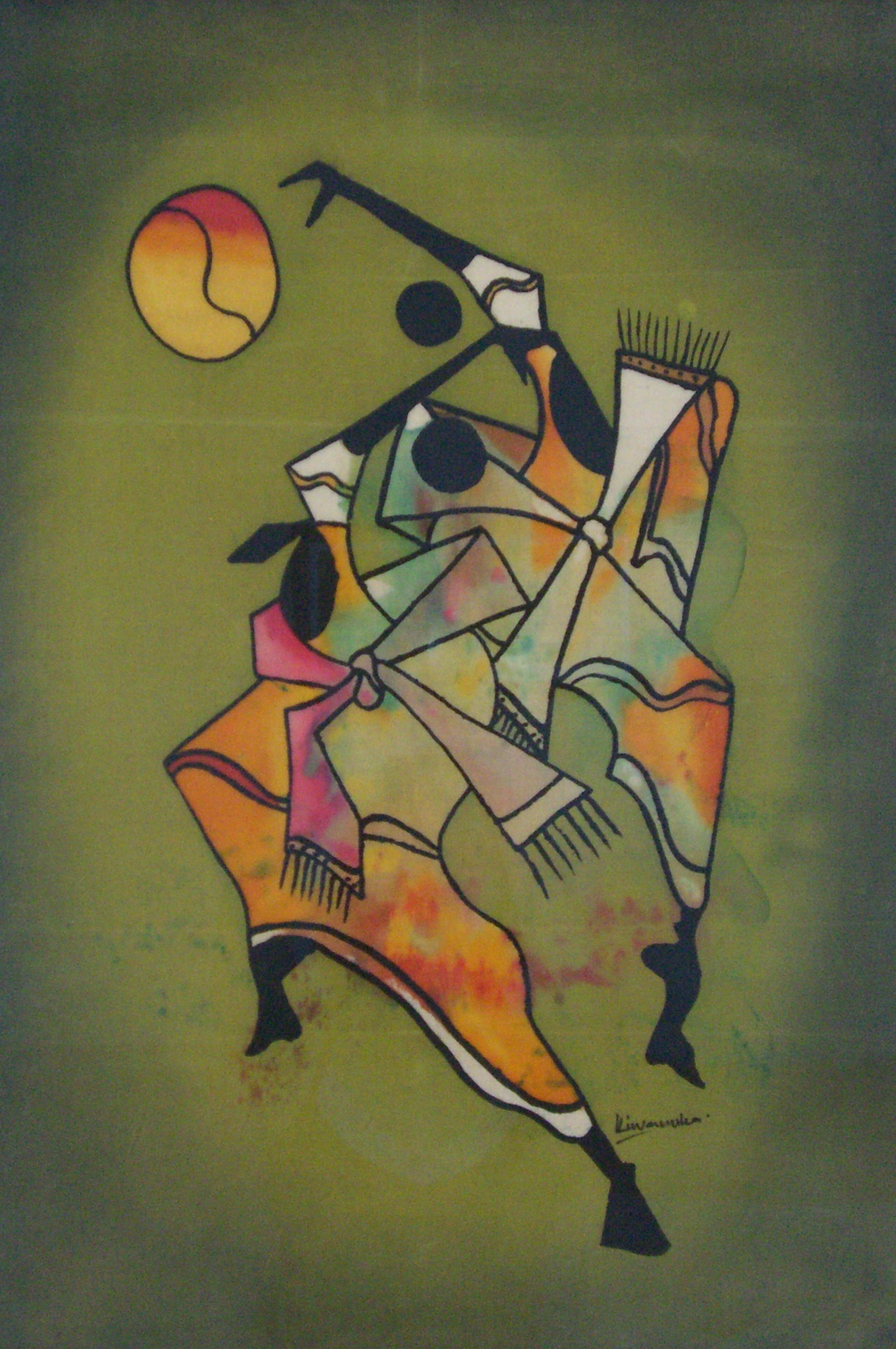
The image above is my favorite piece of art that I own. It’s a hand-painted canvas that I bought from a street artist in Soweto, South Africa in 2007. I am glad it’s back on my walls.

choices, decision-making, priorities

Step 163: Stones, Gravel, and a Jar

This week O’Reilly Media sent me a book entitled Your Money: The Missing Manual by JD Roth, the author of Getrichslowly.org. The book is chock-full of helpful money tips and resources. No matter what your level of financial management, the book has something useful for everyone. I’ll review the book in a later post, though wanted to share an anecdote in the book that applies to goal setting and how we spend our time.

Let’s say we have a mason jar, a few big stones, and a lot of gravel. We need to get all of the gravel and all of the stones into the jar. What should we do first? We could pour in all of the gravel to create a nice level surface and then try to stack the big stones on top of the gravel. If we take this approach, we find that the big stones don’t fit in the jar neatly. Now, let’s put the big stones in first and then pour the gravel on top of the big stones. This second approach allows the gravel to do what it does best – fill in the small little spaces around the big stones. Everything fits.

This analogy sheds light so many areas of our lives: how we set up our to-do lists, pack for vacation, design our living space or office, decide on a career or a job, and build relationships. We need big, clear priorities (the big stones) and then we have lower priorities (the gravel) that can fit in and around the bigger stones. Getting the big stones, our biggest priorities, placed first helps us meet with success, and ultimately drives our happiness.

On Friday afternoon, I started to feel overwhelmed with my weekend. I have friends in town, a birthday party tonight, and lots of personal things to get done on my to-do list. The jar analogy helped me organize my time:

Big stones
See my friends who are visiting
Finish the rough draft of a syllabus for a class I will teach in the Fall
Work on my e-book on entrepreneurship

Gravel
Friend’s birthday party – it’s an all-day / well-into-the-evening party so I have lots of options of how to attend
Clean my apartment for a friend who will be in town on Monday
Grocery shopping
Some blog writing
Planning for a SWSX presentation I plan to submit in the next few weeks
Get in some yoga
Doing some prep work for my Greece trip in a few weeks
and the list goes on…

Now I have a much clearer path to a successful happy weekend. Make progress on the big stones first, and then fill in with gravel when and where I can. I hope this analogy helps you, too!

environment, nature

Step 162: How to Help in the Gulf Coast

“I suppose if you had to choose just one quality to have that would be it: vitality.” ~ John F. Kennedy, as quoted in One Thousand Days: John F. Kennedy in the White House by Arthur M. Schlesinger, Jr.

Today Manhattan Users Guide ran their daily MUG to list ways that we can all help with the efforts to clean up the disastrous oil spill in the Gulf Coast. Everyone can contribute with funds or time of every capacity, large and small, short-term and long-term. The spill destroys more life everyday – our collective efforts can help turn the tide.

From MUG:
Volunteer to the LA Gulf Coast Response, a coordinated effort among several organizations.

Seed grant money to the Gulf Coast Fund, which is distributing emergency grants.

Supply life vests needed by the Barataria-Terrebonne National Estuary Volunteer Program.

Go to the beach on June 26th and participate in Hands Across the Sand.

Eat out as part of the Dineout for the Gulf Coast, today and tomorrow.

Fill in for Sarasota-based Save our Seabirds staff members who have been reassigned into the field during the crisis.

Give heating pads to Wildlife Sanctuary of Northwest Florida (birds covered in oil often suffer from hypothermia). Click on Volunteer Document [PDF]

Wash your dishes with Special Edition Dawn, which will donate $1 per bottle to help save wildlife. You need to activate the donation here.

Text WILDLIFE to 20222, a $10 donation to the National Wildlife Federation. NWF says 97% of the donation will go to Gulf region recovery efforts.

Follow 1,000,000 Strong Against Offshore Drilling on Facebook.

Download Not One Drop: Betrayal and Courage in the Wake of the Exxon Valdez Oil Spill by Riki Ott (free) and donate to Global Green.

Volunteer for Audubon’s response efforts.

Urge Senators to pass a comprehensive climate and energy bill.

Buy a book today through Monday at Borders with this coupon and the company will donate 10% of sales to the Coalition to Restore Coastal Louisiana.

Travel to New Orleans and spread those tourist dollars around generously.

Donate to the Greater New Orleans Foundation.

Get a haircut or get your dog, sheep, or llama groomed and save the hair (or fur or fleece); then send it to Matter of Trust which will stuff booms it.

Use less plastic and take the pledge at Save My Oceans.

Support the Suncoast Seabird Sanctuary in Florida, the largest wild bird hospital in the country.

Host a Clean It Up event under the Sierra Club umbrella.

Form a branch of the Krewe of Dead Pelicans.

Rely on science over big business when it comes to the planet by supporting Manomet, the Center for Conservation Sciences.

Let the President know that we shouldn’t be doing more offshore drilling until and unless we have remediation technology commensurate with drilling technology and—better yet—we should fully commit to clean technologies. Petitions here, here, and here.

The image above appeared on the EPA website and depicts a pelican overlooking the tragedy in the Gulf. Gulf Coast wildlife has been a silent victim in the disaster.

adventure, education, entrepreneurship

Step 161: Lateral Action

I went to college right out of high school at a prestigious university, finished in 4 years, completing classes in very practical subjects (economics and history, minor in psychology). I got an MBA in general management at another very prestigious university, worked my a** off, and then got a well-paying job right after graduation. By all accounts I architected my career to foster financial independence and my creative spirit, even if some of my decisions in real-time made some people scratch their heads. In the end, I did make the best choices. I was right to make the moves I made. Go me.

And then about a year and a half ago, the bottom fell out of the economy and I started to question what I was doing with my time post-MBA. All the old paradigms about education, career, and making a living crumbled. Then 9 months ago, my apartment building caught fire, I almost lost my life, I did lose almost all of my precious belongings I had worked so hard for, and I began to question everything. This staged questioning lead me to a door I never thought I’d choose again: entrepreneurship. Working for myself. And not just as a freelancer, but building my own company from the ground up – Compass Yoga.

I talked to entrepreneurs, interviewed them, wrote about them, read books, magazines, and blogs, and attended conferences. I built up enough knowledge that I knew I wanted to do this, that I’d be really disappointed with my life if I didn’t at least give it a whirl. And the further I’ve delved into the process, the more I realized that it would be very easy for me to make a bunch of really lousy mistakes because I don’t know what I don’t know. This is all new and I need some guidance, or at least some people around me who are in the same start-up boat.

Kismet set in and a post from Problogger showed up in my inbox on Tuesday about a guy named Brian Clark who pens Copyblogger. I hopped over to Copyblogger and liked what I saw. He was honest, straight-forward, and a very talented writer. He also seemed very genuine in his desire to help brand new or would-be entrepreneurs (i.e., me). He just co-launched an initiative called Lateral Action that will offer a 6-week online entrepreneurship course that offers “everything we would have wanted to know 10 years ago starting out.” His co-founders are a cartoonist and a poet. My kind of folks. Hmmm….I kept reading, skeptically.

Sounded like too much of a line, too much a clichĂ©. And then he said something that opened my mind a bit more. “What is that type of information worth? Well, I personally made squat for about three years getting started. Making even a fraction of my current income back then would be worth a fairly substantial investment given that kind of return. Let me be clear. We’re not looking for just anyone with a credit card. Rather, we’re interested in working with motivated people who will take action with these methods.”

Okay, now I’m really listening. What sold me was that I sent an email to one of the co-founders and he responded within a few minutes. I told him about Compass Yoga and a bit about my professional background as a product developer. He told me why the class would be completely worthwhile for me and that one of his inspirations (and friend) is Jonathan Fields, the person who founded Sonic Yoga (where I just completed my yoga teacher training.)

All these pieces bundled together – the fact that I need some more guidance in starting MY business (not just any business), Brian’s authentic voice, Mark’s responsiveness, and the Jonathan Fields connection – made me realize that I stumbled upon something that is far more valuable than the small class fee. I just downloaded the first few modules, and I’m going to comb through them this weekend. I’ll let you know how it goes. This just may change my tune about online education.

Have you ever had an experience that caused you to change a long-held belief? If so, I’d love to hear about it!

I don’t know who created the cartoon above, though if I had to place a bet, I’d say it was Tony Clark, the cartoonist who is a co-founder of Lateral Action. The cartoon is from their site and I think it’s hilarious (and true-to-life).

business, cooking, creativity, innovation

Step 160: Share Like a Chef

Yesterday I read the transcript of an interview between Brian Clark of Copyblogger and Jason Fried, Co-founder of 37Signals. The interview is part of a series that Brian is using to kick-off his initiative Lateral Action, a program to support would-entrepreneurs as they take the leap into their own businesses. Now that I’ve started Compass Yoga, I find that I read about entrepreneurship with an even greater interest than I did when I was just writing about entrepreneurship for Examiner. These stories take on a whole new meaning when my first goal is to figure out how to apply them directly to my own venture.

One piece of advice that Jason offers up is the idea of every entrepreneur emulating a chef. “They tell you everything they know.” There’s a tendency to keep our strategic advantages, our ways of doing things, close to our chests in business. The conventional business wisdom dictates that if we give away how we work, everyone will copy us, and we will never be able to stay afloat. Chefs don’t think that way. They let it all hang out – where they shop, what’s in their pantries, and the mechanics and exact ingredients that they use to create a dish. They even write books divulging all of their secrets with glee! Walk into any restaurant and a chef’s philosophy and skill is on display for everyone to see.

What gives? How do chefs give away everything they know and stay in business? In practical terms, chefs have a few things going for them:

1.) Everyone’s got to eat and not everyone wants to cook all the time. Chefs fill that gap with their services.

2.) Going out to eat is an event, usually a social one, so it’s just as much about the experience as it is about the food and drink.

3.) Chefs have the idea of feeder businesses down pat. Their cookbooks, TV shows, restaurants, and retail merchandise all feed into their individual brand, creating a loyal audience who craves their wisdom.

4.) Chefs constantly re-invent themselves, giving us all a reason to go back to see what’s new. That’s the nature of cooking. Every fresh pan is a clean slate for something new that will not be exactly as it was before and will never be again.

Beyond the practical nature of their work, chefs have put their finger on the best way to thrive in business: their strategic advantage is their individuality. No one can exactly copy what they do because every dish, every time, is unique. I could have every ingredient and miniscule detail of the process that any chef uses, and when I make the dish it will taste different than their creation.

So here’s what we really need to do beyond sharing like chefs: we need to identify what really makes us our gorgeous, talented, creative-beyond measure selves and then work the heck out of that. Being part of the pack isn’t going to serve us going forward. Break-out, share, and celebrate your individuality. It’s the only truly strategic advantage we can keep. What makes you, you?

The image above depicts Mario Batali, one of the most generous, talented, and unique chefs around. I love him.

failure, innovation

Step 159: Labs – a Place for Pros

Today, Chris Brogan wrote about the value of having an on-line lab. Chris just launched his new travel blog (seperate from his main site) to experiment, try out some new ideas, play, and build another business. Chris also makes the points that labs transform failures into learning opportunities and invite us to continue rolling up our sleeves and getting into the nuts of bolts of making things work.

I have thought about this subject in relation to Compass Yoga, the site I set up 10 days ago to begin my yoga training business. I wondered if I should have fully-baked Compass Yoga into my personal site rather than building out a separate site with its own URL. Was I just shying away from really putting Compass out into the open on my personal site because I was afraid of how it might go? Then I read Matthew Russo’s excellent comment on Chris’s post: “The difference between a pro and an amateur in any field is that pros take the time to “practice off the court” while amateurs practice on the job. Labs are a perfect business example of this analogy.” I do want to be a pro with my yoga business, so I better give it its own court.

Here’s what the separation of my personal site from Compass Yoga does for me:
1.) Gives me a place to solely discuss all things yoga, wellness, and health, which while important to me, is only one of my passions.

2.) Compass is the very first business I’ve ever started. I’ve spent over a year intensely studying entrepreneurs and they have inspired me so much that I could no longer keep from jumping off the cliff. I’m sure I will make lots of mistakes and missteps, and all of them will be valuable to me in the long-term. Having a separate site for Compass lets me take risks and try some new, wild ideas, without worrying what impact it will have on my own personal brand.

3.) Giving Compass its own space keeps both my personal site and the Compass site clutter free. I can’t stand sites that have 800 things to look at. I’m always impressed by a clean design, easy navigation, and the ability of a content provider to edit out the unnecessary so the necessay can speak. I wanted Compass to have its own space, clutter-free, to stretch its wings.

Do you have an online lab where you play and experiment, separate from your main online presence? I’d love to hear about it!